Limo to New York City: A Practical Booking Guide
Updated October 16, 2026

You're standing by the foyer with suitcases open, a flight update on the phone, and three choices in front of you. An app looks easy, a taxi sounds familiar, and a pre-arranged black car feels safer, but the right choice depends on where you're going, when you're leaving, and how much curb chaos you're willing to manage.
A limo to New York City or out to the Hamptons is not just a long ride. It's a corridor problem with a city exit, a Long Island run, and a final East End stretch that can change fast when traffic, airport timing, or curb access gets messy. A good chauffeur coordinator handles those moving parts so you don't have to build the route in your head.
Table of Contents
- What a Limousine Trip Between NYC and the Hamptons Involves
- Matching the Right Vehicle to Your Trip
- Timing the Drive Across the Corridor
- Navigating NYC Curb Rules and Congestion Pricing
- Airport Transfers and Flight-Aware Pickups
- Booking, Quoting, and Day-Of Coordination
What a Limousine Trip Between NYC and the Hamptons Involves
Booking sites list this as a point-to-point ride, but that label hides how the corridor works. The trip begins in the city, runs onto Long Island roads, and then slows into a different pattern once you reach the East End. The last stretch matters most because hotel entrances, private homes, golf clubs, and venues often replace a simple curbside drop-off.
The route is really three separate decisions
First, the city exit. Loading zones, building frontage, congestion pricing, and Midtown traffic shape the first part of the ride, and the pickup point often matters as much as the destination. Second, the Long Island express segment, where the car can settle into a quicker rhythm on an ordinary day, or slow hard when weekend traffic stacks up. Third, the arrival zone, where the chauffeur has to place you at the exact door, not just near it.
Practical rule: if a quote only talks about mileage, it's missing the part that most affects the ride.
That is why this booking calls for a corridor model, not a generic car search. You are choosing how the trip will be managed from the first curb to the last. For one client that means an executive couple with luggage. For another, it means a family, a wedding party, or a larger group on a fixed schedule.
The trip profiles that usually come up
The right fit changes with the job. An airport transfer with two bags is not the same as a rehearsal dinner run with guests, and neither one looks like a corporate shuttle between venues. A knowledgeable operator should sort that out before the vehicle is ever sent.
The corridor also changes by day and direction. Friday eastbound traffic can turn a clean run into a slow one, and city pickups inside congestion-pricing zones add another layer of timing and curb planning. Airport work brings its own rules, including staging and waiting, so the chauffeur has to know where to hold, where to load, and when to move.
If you want the trip handled without guesswork, text (631) 294-0747 for a fixed quote.
Matching the Right Vehicle to Your Trip
The best vehicle is the one that matches people, luggage, and the day's real logistics, not just the headcount on paper. A couple with two suitcases can fit very comfortably in a sedan, while a family with gear, strollers, or extra bags may need an SUV even if the passenger count looks small. That's the mistake people make most often, they choose by seats alone and forget the luggage, the child seat, or the pet carrier.
Vehicle classes and the trips they fit
| Vehicle | Passenger Capacity | Best For |
|---|---|---|
| Mercedes-Benz S-Class | Up to 3 | Executive couples, solo airport transfers, refined city-to-Hamptons point-to-point service |
| Premium SUV, such as Cadillac Escalade or Chevrolet Suburban | Up to 6 | Families, small groups, wedding rehearsals, airport luggage runs |
| Mercedes-Benz Sprinter | Up to 14 | Off-site teams, golf groups with clubs, bridal parties, group transfers |
| Mini-bus or motor coach | 25, 36, or 55 passengers | Weddings, corporate shuttles, school events, multi-stop coordination |
The sedan works when the trip is light and quiet. The SUV is the flexible choice when bags or people start to multiply. The Sprinter is the practical move when a group wants to stay together without splitting into several cars.
For larger events, a single coach often makes more sense than trying to piece together multiple smaller vehicles. If you're comparing how groups are handled in other markets, the same logic shows up in guides on limo bus hire Sydney costs, where the key issue is matching the vehicle to the event, not just quoting the ride by the hour.
The decision criteria that actually matter
Start with the passenger count, then add luggage, then think about the shape of the day. A child seat can change a sedan booking into an SUV booking. A dog can do the same. A golf bag doesn't sound like much until there are four of them and everyone wants to sit comfortably.
A vehicle that looks oversized on paper is often the one that saves the day once the luggage is loaded.
If you're looking at a limo to New York City trip and you're unsure which class fits, don't guess by instinct. Use the actual luggage count, the pickup style, and whether anyone needs a child seat or pet-friendly arrangement. For a deeper look at the van option, see our internal guide on luxury Sprinter van seats.
The safest move is to ask for a fixed quote and let the operator size the vehicle properly. That's how you avoid booking too small and turning one smooth ride into a squeeze.
Timing the Drive Across the Corridor
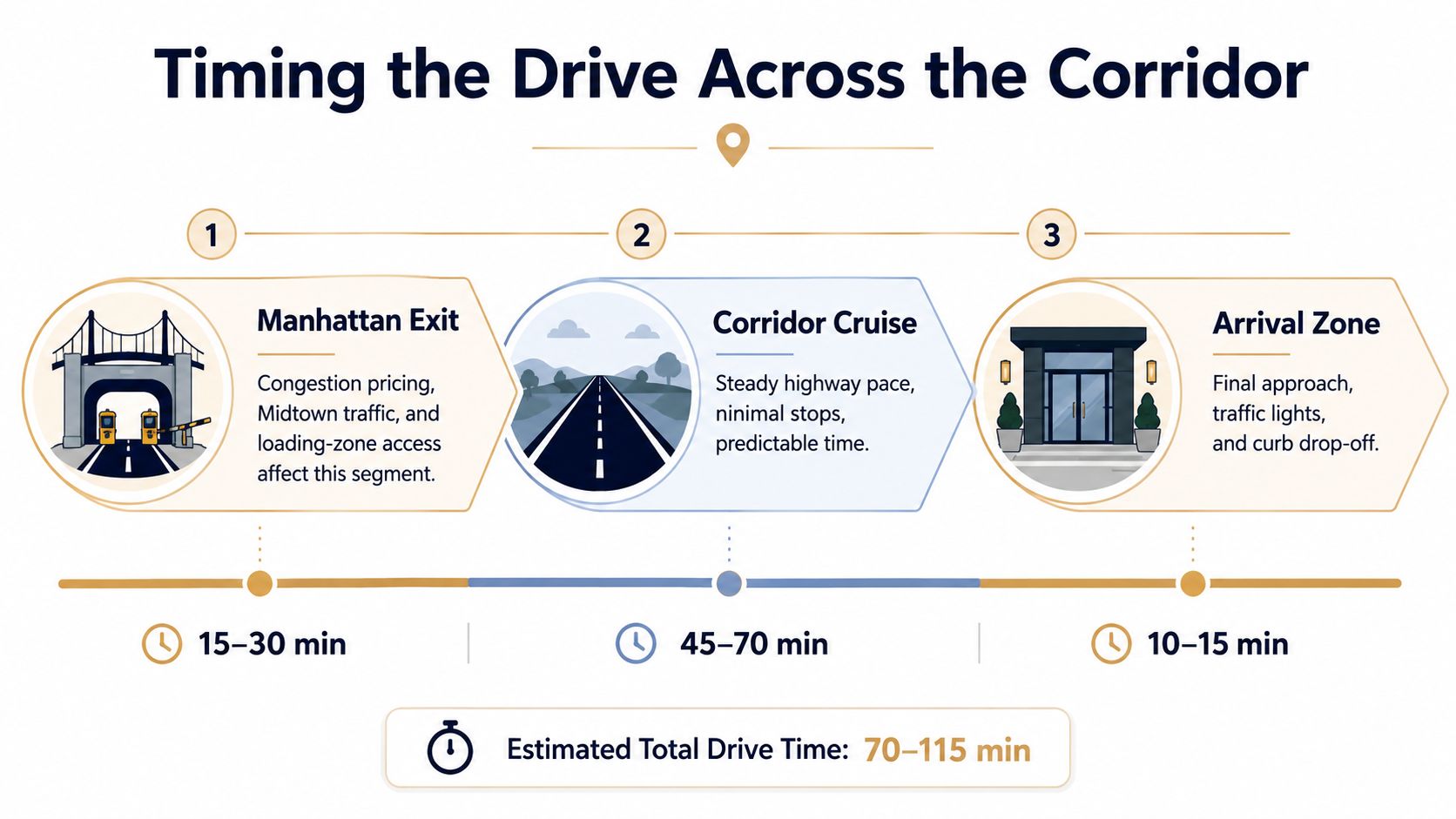
A Hamptons run doesn't behave like one continuous drive. It behaves like three separate time risks, and if you don't account for each one, you'll end up underestimating the total time. The first risk is leaving the city, the second is the highway run, and the third is the East End approach.
Think in three segments, not one estimate
The Manhattan exit is where everything can slip early. Loading takes time, curb access can be awkward, and a legal pickup point matters more than you might expect. Once the car clears the city, the corridor tends to normalize, but that doesn't mean it stays predictable.
The Long Island stretch is the segment people over-trust. On a normal weekday, it can feel straightforward. On a summer Friday, it can slow abruptly because everybody else is trying to leave at the same time.
The mistake isn't leaving too early, it's assuming the same road behaves the same way every day.
The East End final stretch is the one that catches people who only look at mileage. That's where the route narrows into the same corridor everyone else is using, and that's where timing can stretch fast if you've chosen a peak window.
What the corridor data means in practice
Published route comparisons show that a Southampton trip can go from about 2 hours to 3.5 hours on a summer Friday afternoon, while Montauk can move from about 2 hours 45 minutes to 4.5 hours under the same conditions. The point isn't that every ride will do that. The point is that a fixed baseline is only useful if you add a realistic buffer around it. For route context and the Friday and Sunday congestion windows, see the corridor breakdown at HamptonsVerified transport guidance.
If you're planning a wedding arrival or a corporate check-in, schedule backward from the required arrival time. Don't schedule forward from the departure time and hope the road cooperates. Fixed pricing protects you from surge, but timing still needs a buffer.
Navigating NYC Curb Rules and Congestion Pricing
The NYC end of a Hamptons trip is often decided at the curb. A correct vehicle and route still fail if the building entrance is wrong, the street is blocked, or the chauffeur cannot legally stop where the passenger expects. That risk is easy to miss on a Friday eastbound run, when time spent circling for a legal pickup can add to an already difficult departure window.
What a proper curb plan includes
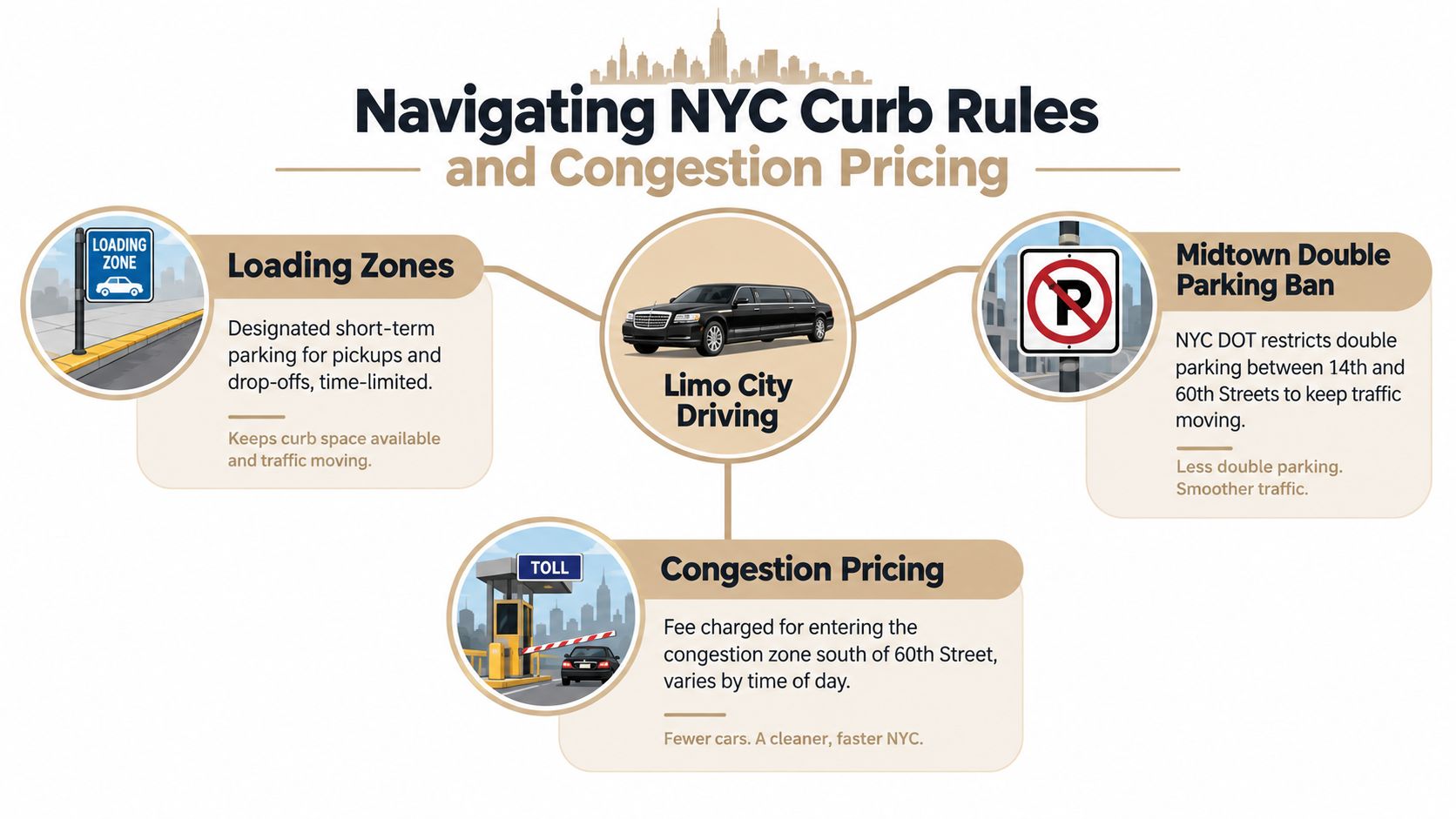
A loading zone provides designated curb space for pickups and drop-offs. NYC DOT identifies commercial metered parking, hotel loading areas, neighborhood loading zones, and certain no-parking locations as possible curb-access categories. In Midtown, double parking is prohibited between 14th and 60th Streets, from First through Twelfth Avenues, so a chauffeur cannot stop wherever traffic appears to allow it.
Good coordination starts before dispatch. Confirm the exact building entrance, passenger mobile number, and any access instructions. The chauffeur should have a legal loading location before arriving, rather than searching for one while sitting in traffic.
The same rule applies to hotels and airport-related trips. A legal curb is more dependable than an assumed one. If the front door is blocked or restricted, a commercial loading area or hotel-designated pickup point usually gives the driver a safer place to meet the passenger.
How congestion pricing changes the quote and the route
Since January 5, 2025, most passenger vehicles entering Manhattan south of 60th Street during peak periods pay a separate congestion charge. Taxis and black-car services are charged per trip under a different structure. For a NYC to Hamptons journey, the destination and the planned departure window affect both the charge and the route discussion.
A Midtown hotel drop-off, an Upper West Side residence, and a Brooklyn event space create different curb and routing requirements. The destination zone can change the quote, the pickup strategy, and whether the chauffeur approaches through a different part of Manhattan.
Friday timing makes this corridor decision more practical than theoretical. A car collecting passengers near the congestion-pricing zone may need extra curb time before heading east, while an airport staging point follows separate commercial pickup rules. Confirming the precise entrance helps the dispatcher price the city portion and the Hamptons route together.
State the exact destination when you request a limo to New York City quote so the congestion charge and route are priced together.
Airport Transfers and Flight-Aware Pickups
Airport pickup looks simple from the passenger side. The plane lands, the bag comes off the belt, and the car should be waiting. In real operations, it only works that way when the dispatcher and chauffeur are watching the flight, the terminal, and the curb access all at once.
The pickup sequence that actually works
The first step is to collect the airline, flight number, terminal, passenger mobile number, and any child seat or accessibility needs. Then the flight gets monitored instead of the original schedule being treated like gospel. When the plane is on the ground and the bags are moving through claim, that's when the car gets staged.
The staging point matters. Airport pickups need legal commercial loading space, not a random curbside guess. If the terminal changes or baggage takes longer, the pickup should adjust with it.
The FAA says the New York-New Jersey airports are among the most delayed in the country, and that tracks with what airport coordinators see on the ground. Weather and heavy traffic can stack delays quickly, so a fixed pickup time that ignores the live flight status is usually the wrong plan. For a detailed service note on this workflow, see tracking flights in real time.
Operational rule: a correct flight number beats a guessed landing time every time.
Why this matters for JFK, LaGuardia, and Newark
The region's airport environment is busy enough that a small change can ripple through the rest of the day. A winter disruption can affect more than one airport at once, which is why a chauffeur should be ready to wait, shift, and communicate rather than disappear after the first schedule change.
That's where around-the-clock coordination earns its keep. For a limo to New York City transfer, the value isn't just the ride, it's the handoff from air to car without making the passenger manage the delay alone. A good operator stays in contact, stages legally, and adjusts the pickup when the flight lands.
Booking, Quoting, and Day-Of Coordination
A bad booking starts with a vague request. A good one gives the dispatcher enough detail to price the trip and stage the right car without back-and-forth.
Send the pickup address with the exact entrance, the drop-off address, passenger count, luggage count, flight number if there is one, and any child seat, pet, or timing needs. If the ride is tied to a wedding, include the venue names and the order of stops so the vehicle assignment matches the day.
What to include in the first text
- Pickup details: exact address and entrance, not just the street name.
- Trip details: destination, appointment time, and whether the ride is one-way, round trip, or hourly.
- Load details: passengers, luggage, child seats, and pets.
- Flight details: airline, flight number, and terminal when the trip involves an airport.
- Event details: rehearsal, ceremony, corporate meeting, theater run, or school transport.
Fixed pricing keeps the quote from changing after the conversation starts. There is no need to guess about surge pricing or worry about a surprise cancellation fee after the car is already committed. The number should be clear before the vehicle rolls.
For a clean request format, keep our airport transfer quote guide handy.
Day-of coordination that keeps the trip calm
Confirm by text the morning of the ride. Expect the chauffeur to call on approach. If the pickup is at a hotel, office, or airport, keep the phone on and make sure someone can answer when the car is close.
For the corridor work between NYC and the Hamptons, the handoff matters as much as the drive. Peak Friday eastbound traffic can turn a short delay into a late arrival, and congestion-pricing zones in New York City change where it makes sense to stage, wait, or collect a passenger. Airport staging rules matter too, because a commercial car needs legal loading space, not a hopeful curbside guess.
Hamptons Leisure Limo's workflow is built around fixed pricing, 24/7 coordination, uniformed chauffeurs, and daily deep-cleaned vehicles, which is the kind of consistency that matters for late-night theater runs, early-morning airport departures, and wedding weekends with multiple moving parts. For a broader perspective on luxury ground transport choices, Haute Black's transportation insights are useful background.
Ready to Ride with Hamptons Leisure Limo?
Fixed pricing. No surge fees. 30 years of experience serving the Hamptons. Text us what you need and we will send a quote.