How to Get an Accurate Airport Transfer Quote
Updated September 15, 2026
You've just landed at JFK after a red-eye. Your phone is in one hand, your luggage is in the other, and the ride-hail fare that looked reasonable before boarding has climbed while you were in the air. You still need to reach the Hamptons, Manhattan, or a connecting hotel, but you don't know whether the amount on the screen includes airport access, tolls, waiting time, or the awkward trip to a remote pickup area.
That's why an accurate airport transfer quote matters. It should tell you what you'll pay, what vehicle is assigned, where your chauffeur will meet you, and what happens if your flight changes. A quote that leaves those points vague isn't a fixed plan. It's an estimate with room for surprises.
Table of Contents
- Why Accurate Airport Transfer Quotes Matter
- Information to Provide When Requesting a Quote
- How Quotes Are Built Behind the Scenes
- Flight Tracking and Curbside Pickup Explained
- Example Quote Scenarios by Airport
- Hidden Fees to Watch For and Final Checklist
- Getting Your Quote and Booking with Confidence
Why Accurate Airport Transfer Quotes Matter
At JFK, LGA, and ISP, the cheapest-looking option can become difficult to compare once the details are exposed. Airport access charges, fixed-fare rules, vehicle class, route conditions, and service level all influence the final amount. The airport taxi fare index illustrates why airport pricing differs by location, with airport-specific charges and regulated fare structures shaping quotes in different cities.
A prearranged quote protects you from three common problems:
- Unpredictable demand: On-demand services can change their displayed fare when demand rises, weather disrupts travel, or fewer vehicles are available.
- Unclear inclusions: A quote may exclude tolls, airport access, luggage handling, meet-and-greet service, parking, or waiting time unless someone confirms them.
- Poor vehicle matching: A single-car estimate can fail when three passengers arrive with four bags, a child seat, golf equipment, or oversized luggage.
Practical rule: Compare the guaranteed total for the complete itinerary, not the lowest number shown for one vehicle.
For a JFK to Southampton trip, curbside pickup may suit a traveler who can walk directly to the arrivals zone. A client with young children, heavy luggage, or an unfamiliar terminal may prefer an inside terminal meeting arrangement. At LGA, pickup lanes and terminal traffic affect the meeting plan. ISP is more compact, but the correct terminal and luggage details still matter.
A quality black-car service should confirm the route, vehicle, pickup method, flight policy, and exclusions before accepting the booking. This is the practical difference between fixed airport transfer pricing and a fare that changes after you've landed.
Information to Provide When Requesting a Quote
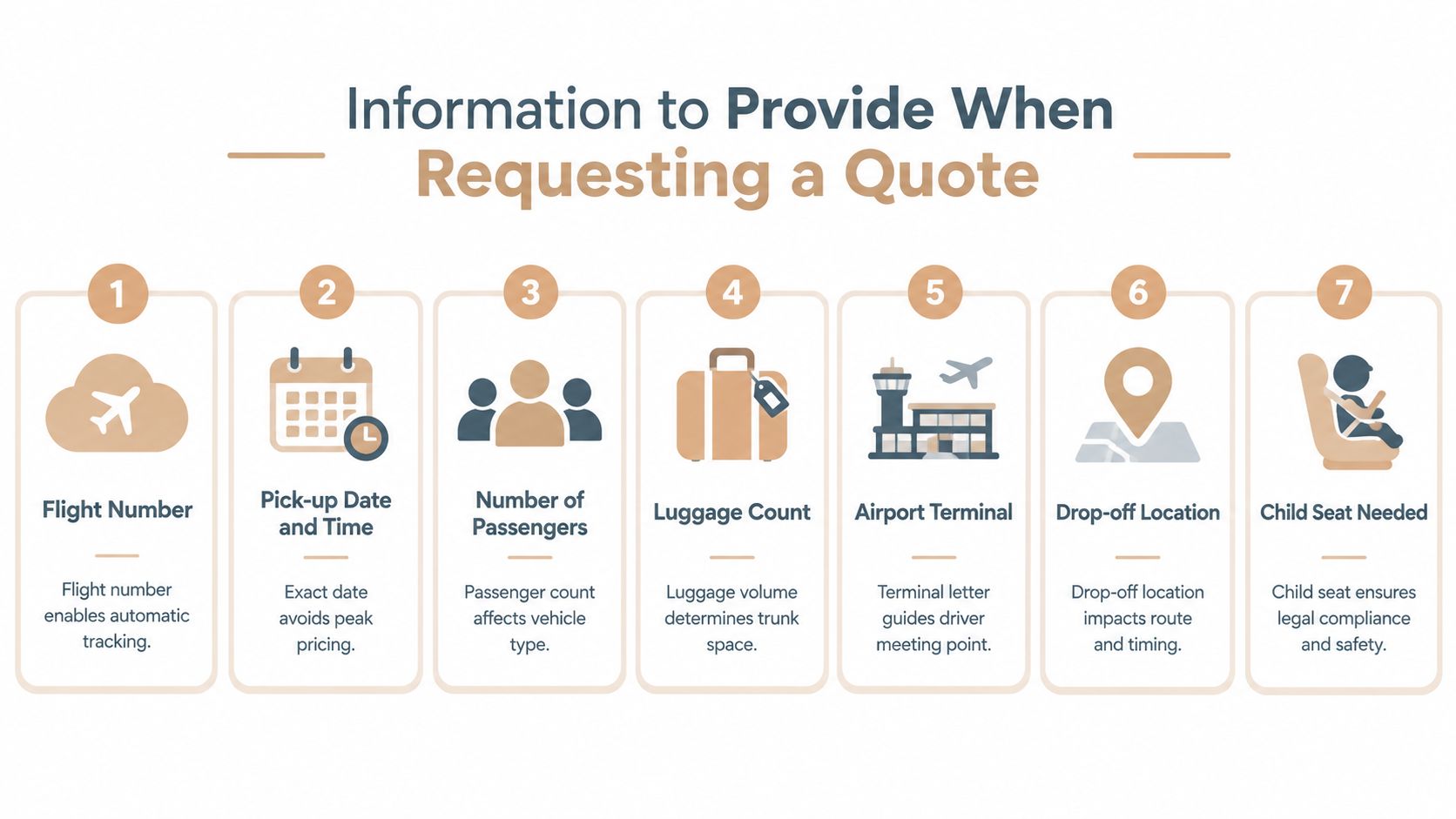
A dispatcher can only build an accurate airport transfer quote from accurate trip details. Send the information below in one message instead of starting with only “JFK to the Hamptons.”
Start with the flight and pickup details
Include the flight number, arrival date, airline, and airport. Flight information lets a professional dispatch team monitor schedule changes and adjust the pickup around the actual landing rather than relying only on the scheduled time.
Name the airport terminal whenever you know it. JFK, LGA, and ISP each have different terminal layouts and pickup procedures, so the terminal helps the chauffeur receive the right meeting instructions. If you're leaving from the Hamptons, include the complete destination address, building name, hotel, resort, estate, or venue. A town name alone isn't enough for a precise route.
Describe the people and the luggage separately
Passenger count and bag count serve different purposes. Two passengers with several large cases may need more cargo space than a larger party traveling with small carry-ons. List checked bags, carry-ons, golf bags, skis, surfboards, musical instruments, or other bulky items.
Mention child seats, boosters, pets in carriers, mobility equipment, and low-step entry needs before the vehicle is assigned. These details affect both capacity and the boarding experience. Don't assume a sedan can accommodate every combination because the passenger count appears to fit.
State the pickup preference and itinerary complications
Tell the dispatcher whether curbside pickup is acceptable or whether you need a meet-and-greet inside the terminal. Also disclose connecting flights, cruise transfers, separate arrivals, extra stops, or a group arriving on different flights. Those details can change the vehicle plan and may make a coordinated multi-vehicle booking more sensible than separate individual reservations.
How Quotes Are Built Behind the Scenes
The final amount on a quote rests on a cost stack. A professional operator normally considers route distance, realistic travel time, vehicle class, airport access, tolls, waiting arrangements, and the service work required to coordinate the booking. Independent airport-transfer guidance recommends confirming whether tolls, congestion charges, flight tracking, luggage surcharges, and meet-and-greet service are included before accepting an offer. You can review that planning guidance in this airport chauffeur pricing overview.
The route calculation should use the actual terminal and destination, with the expected departure or arrival period in mind. A Friday evening JFK pickup to Southampton is not operationally identical to a midweek LGA trip into Manhattan. The vehicle also matters. An SUV or larger van carries more people and luggage, but it also involves different operating costs and space considerations than a sedan.
Airport access charges deserve particular attention. A public-record compilation cited by airport transfer pricing guidance reported that curb fees and related access charges at the 50 largest U.S. airports cost travelers more than $183 million in one year, with some airports charging up to $5 per ride. Those fees can be legitimate, but the quote should say whether they're included or passed through.
| Cost Component | Fixed-Price Quote | Ride-Hail App |
|---|---|---|
| Route and travel time | Confirmed around the requested route and service | May change with demand and routing |
| Vehicle class | Selected from passenger and luggage details | Depends on available category |
| Airport access | Should be confirmed in the written total | May appear as a separate fee |
| Tolls and congestion charges | Included or clearly identified before booking | Can be added during the trip |
| Flight delays | Governed by a stated tracking and waiting policy | May require a new request |
| Meet-and-greet | Chosen in advance | Usually depends on the pickup format |
| Group coordination | Can be planned across vehicles | Often handled as separate rides |
A quote doesn't need to expose every internal business cost, but it should identify the items that can change what you're charged. If the provider can't explain those items plainly, don't treat the quote as fixed.
Flight Tracking and Curbside Pickup Explained
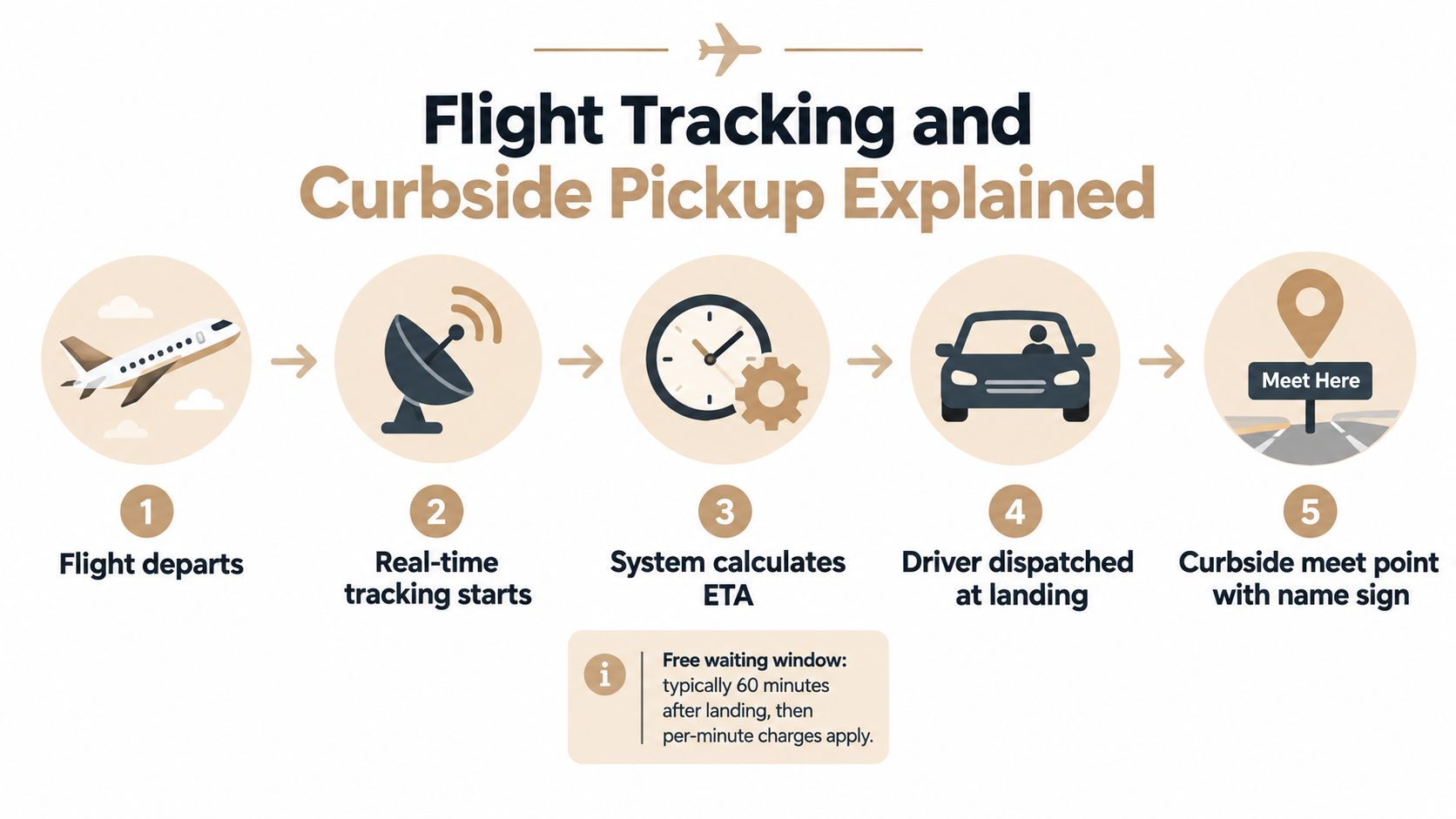
Flight tracking starts with the flight number you provide. A professional transfer service watches the live schedule, adjusts the expected landing time, and coordinates the chauffeur around the actual arrival. One published transfer policy states that airport waiting begins at touchdown, not at the scheduled arrival time, and includes a 45-minute free waiting period for airport pickups. This guide to real-time flight tracking explains why that distinction matters.
The waiting allowance varies by company and airport policy, so ask for the exact terms in writing. Another published policy uses 60 minutes from actual landing, followed by additional waiting billed in 15-minute blocks. The important question isn't whether a provider uses one particular allowance. It's whether the clock starts from landing and whether the quote explains what happens afterward.
JFK, LGA, and ISP require different meeting habits
At JFK, the chauffeur needs the terminal and a clear communication plan because terminal curbs are active and vehicles may not wait indefinitely at the arrivals lane. At LGA, the Central Terminal Area pickup lanes can become crowded, so the dispatcher may direct you to a specific door or lane after you collect your luggage.
At ISP, the airport is more compact, which usually makes the meeting point easier to understand. It still helps to confirm the terminal, pickup side, vehicle description, and contact method before landing.
Many airports prohibit vehicles from sitting at terminal curbs. San Francisco International Airport says vehicles can't wait at terminal curbside or on airport roadways, while Rochester Airport directs travelers to use its cell phone lot because curbside waiting isn't allowed. Rochester also notes that deplaning and baggage retrieval typically take 15 to 40 minutes. These policies explain why “the chauffeur will wait at the curb” is not a complete pickup plan.
For a delay, the dispatch team should update the pickup based on the new landing time. For an early arrival, the service should explain whether the chauffeur can meet you sooner or whether the original window remains in place. If a flight diverts, contact dispatch immediately. A text message containing the chauffeur's name, vehicle details, license plate, and meeting instructions gives you a usable plan before you leave the aircraft.
Example Quote Scenarios by Airport
The quote process changes with the route, timing, vehicle, and luggage. The figures below are planning examples without dollar amounts, because a proper quote must be made for the exact destination and service requirements.
JFK to Southampton
Three passengers, four bags, a black SUV, and a Friday evening arrival create a larger planning job than a simple passenger count suggests. The dispatcher needs the JFK terminal, flight number, Southampton address, bag dimensions if anything is oversized, and the preferred curbside or meet-and-greet arrangement.
Traffic timing affects the expected journey, but a fixed quote should not become a meter that keeps running because the road is slow. The vehicle should also leave enough room for luggage rather than forcing the group into a smaller category.
LGA to Midtown Manhattan
Two passengers with two carry-ons may fit comfortably in a sedan. The shorter urban route still needs a specific building address, because hotel entrances, office loading areas, and one-way streets can change the practical drop-off point.
A midweek late-morning pickup may have a different operating profile from an evening airport run. That difference should be reflected in the quote before booking, not discovered through a changing app fare after arrival.
ISP to a Hamptons estate
Four passengers with six bags and a request for a larger SUV calls for careful capacity matching. Estate addresses can include long driveways, gates, separate entrances, or a property name that doesn't map cleanly to the destination pin.
A dispatcher should confirm the exact address, gate or arrival instructions, luggage volume, and whether there are additional stops. The quote should cover the full itinerary that was described, rather than assuming the group will add details at pickup.
| Route | Vehicle | Passengers | Luggage | Fixed Price Range |
|---|---|---|---|---|
| JFK to Southampton | Black SUV | 3 | 4 bags | Request a route-specific fixed quote |
| LGA to Midtown Manhattan | Sedan | 2 | 2 carry-ons | Request a route-specific fixed quote |
| ISP to Hamptons estate | Larger SUV | 4 | 6 bags | Request a route-specific fixed quote |
For context, one 2026 industry pricing guide places standard major-market airport transfers at approximately $95 to $195 for a sedan and $125 to $250 for an SUV. Those figures are broad market guidance, not a quote for a Hamptons route, and they reinforce why vehicle class, city demand, and service level must be identified before comparing offers. See the 2026 corporate ground transportation pricing guide for that market context.
Hidden Fees to Watch For and Final Checklist
A quote can be technically accurate and still be hard to understand if the exclusions are buried. Ask about meet-and-greet charges, airport access fees, extra stops, oversized luggage, parking, tolls, after-hours service, cancellation rules, and waiting time. Legitimate tolls and airport charges aren't automatically a problem. The problem is discovering them only after the ride begins.
A broker may also present a low base fare and add coordination fees later. Dynamic pricing can create another issue for on-demand bookings, especially when airport demand changes. The guide to limo service fees can help you identify which line items deserve clarification.
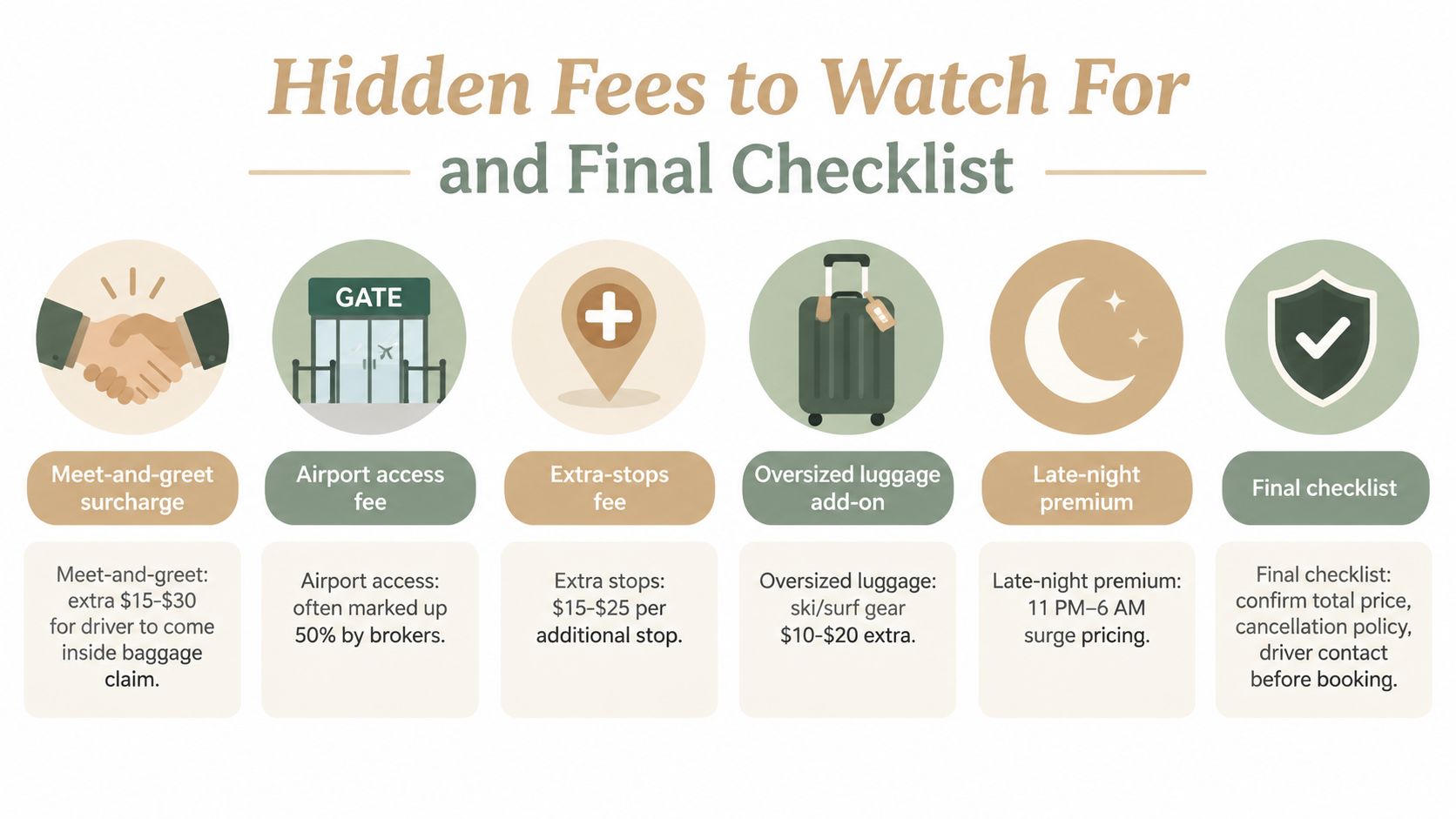
Use this checklist before you accept an airport transfer quote:
- Confirm the total: Ask whether the quoted amount is fixed and whether surge adjustments are excluded.
- Verify flight tracking: Make sure the chauffeur and dispatch team will monitor the flight you provide.
- Define the meeting point: Confirm curbside pickup, inside-terminal meet-and-greet, terminal door, and contact procedure.
- Clarify waiting time: Ask when the clock starts, how much waiting is included, and how additional time is billed.
- Match the vehicle: Confirm passenger capacity, luggage room, child seats, boosters, pets, and oversized equipment.
- List every stop: Include hotels, offices, estates, venues, cruise terminals, and separate group pickups.
- Request written confirmation: Have the provider text the total, vehicle type, inclusions, cancellation terms, and chauffeur contact timeline.
If the answer is “we'll figure it out when you land,” keep looking. Airport logistics work better when the important decisions are settled before takeoff.
Getting Your Quote and Booking with Confidence
A reliable booking process is straightforward:
- Gather the trip details: Flight number, date, airport, terminal, pickup preference, and full destination address.
- Send the group details: Passenger count, luggage count, child-seat needs, pets, mobility requirements, and special equipment.
- Request a fixed quote: Text or email the information and ask for the complete trip total with inclusions and exclusions stated.
- Confirm the vehicle: Make sure the assigned sedan, SUV, Sprinter, or other vehicle matches the actual group and luggage.
Text-based coordination gives you a written record. It should show the route, vehicle, pickup method, flight-tracking policy, included waiting time, toll treatment, gratuity terms, and any extra stops. You should also know what information comes back, such as the total trip price, vehicle description, and chauffeur contact details.
For major-market context, published airport transfer pricing places New York City sedan airport transfers at approximately $95 to $195, while New York City SUV hourly service is listed at approximately $110 to $165 in one 2026 guide. Those are reference ranges, not Hamptons Leisure Limo prices, and they shouldn't replace a route-specific quote. The market's wider variation is another reason to provide the full itinerary instead of requesting a generic airport fare.
Send your flight number, airport, terminal, destination, passenger count, luggage count, and pickup preference in one message. Hamptons Leisure Limo provides prearranged airport transfers for JFK, LGA, ISP, Newark, and regional airports with fixed pricing, flight tracking, curbside pickup, and vehicle coordination for groups.
Text (631) 294-0747 with your flight details, pickup airport, destination, passenger count, and luggage information to request a fixed-price quote from Hamptons Leisure Limo. Visit Hamptons Leisure Limo to review airport transfer options for the Hamptons, Long Island, and New York City.
Ready to Ride with Hamptons Leisure Limo?
Fixed pricing. No surge fees. 30 years of experience serving the Hamptons. Text us what you need and we will send a quote.