Luxury Sprinter Van Seats and Configurations
Updated October 10, 2026
Leather, ambient lighting, and reclining backrests are the popular answers when people ask what makes luxury Sprinter van seats premium. Those details matter, but they don't decide whether a group feels comfortable after a long transfer between New York City and the Hamptons. Seat spacing, restraint design, aisle access, luggage capacity, and real-world ride behavior matter more than the number of polished cushions installed in the cabin.
A Sprinter can be configured for different missions, from executive travel and airport transfers to weddings, golf outings, and larger group movements. The right question isn't just how many people fit. It's whether each passenger has a suitable seat, a working restraint, enough room to move, and practical access to luggage.
Table of Contents
- Redefining Luxury Sprinter Van Seats
- Understanding Passenger Capacity and Spatial Limits
- Safety and Restraint Systems in Premium Configurations
- Evaluating Ride Comfort and Ergonomic Design
- Matching Seating Layouts to Specific Group Needs
- Navigating Fleet Options and Booking Logistics
- Final Checklist for Group Transportation
Redefining Luxury Sprinter Van Seats
The most common mistake is treating maximum seating as the definition of luxury. A published capacity is a ceiling, not a promise that every occupant will receive equal legroom, recline, ventilation, luggage access, or personal space. Mercedes-Benz lists U.S. passenger-van configurations reaching 15 occupants, while a 15-seat arrangement generally means 14 passengers plus the chauffeur. The manufacturer has also offered configurations such as 12 seats, and earlier passenger-wagon specifications included up to 11 passengers plus the chauffeur, with removable three-seat and four-seat benches. These options show how adaptable the platform is, not that every layout delivers the same premium experience. Mercedes-Benz explains the Sprinter's passenger configurations and global platform history.
Luxury is usable space
For an executive group, a lower-density cabin can work better than a fully populated passenger layout. Wider captain's chairs, a clear aisle, accessible luggage, and enough room to enter without climbing over another passenger can make a greater difference than decorative trim. Wedding guests also need room for formal clothing and garment bags, while families may need space for child restraints and easy boarding.
A luxury conversion should be judged from the passenger's position, not from the showroom doorway. Can an older traveler reach the seat without awkward steps? Can a passenger leave the row without asking several people to stand? Does the seat maintain support through a long ride, or does it only look impressive while stationary?
Practical rule: The most premium layout is usually the one that preserves comfortable spacing and straightforward movement, not the one with the highest cushion count.
Interior detailing can support the experience, especially when leather, trim, flooring, and high-touch areas need regular care. For practical ideas on maintaining a polished cabin, review these worthwhile interior add ons, then evaluate whether the underlying seating plan works for the itinerary.
Hamptons Leisure Limo offers a Mercedes-Benz Sprinter with leather passenger seats and dedicated luggage space, which is useful for groups that want a refined cabin without ignoring baggage logistics. The same principle applies to any provider: confirm the actual seat map, not just the vehicle name.
Understanding Passenger Capacity and Spatial Limits
A Sprinter's height and width help explain its popularity for group travel, but the interior envelope doesn't remain empty after a conversion. Mercedes-Benz Canada lists interior standing height of up to 191.8 centimeters, or 6 feet 3 inches, and maximum interior floor width of 177.4 centimeters, or 69.8 inches. Those dimensions can make entry and movement easier than in a conventional car, yet luxury seats, trim, tables, partitions, and luggage reduce the space available to passengers. Mercedes-Benz publishes the Sprinter's interior dimensions in its passenger-van brochure.
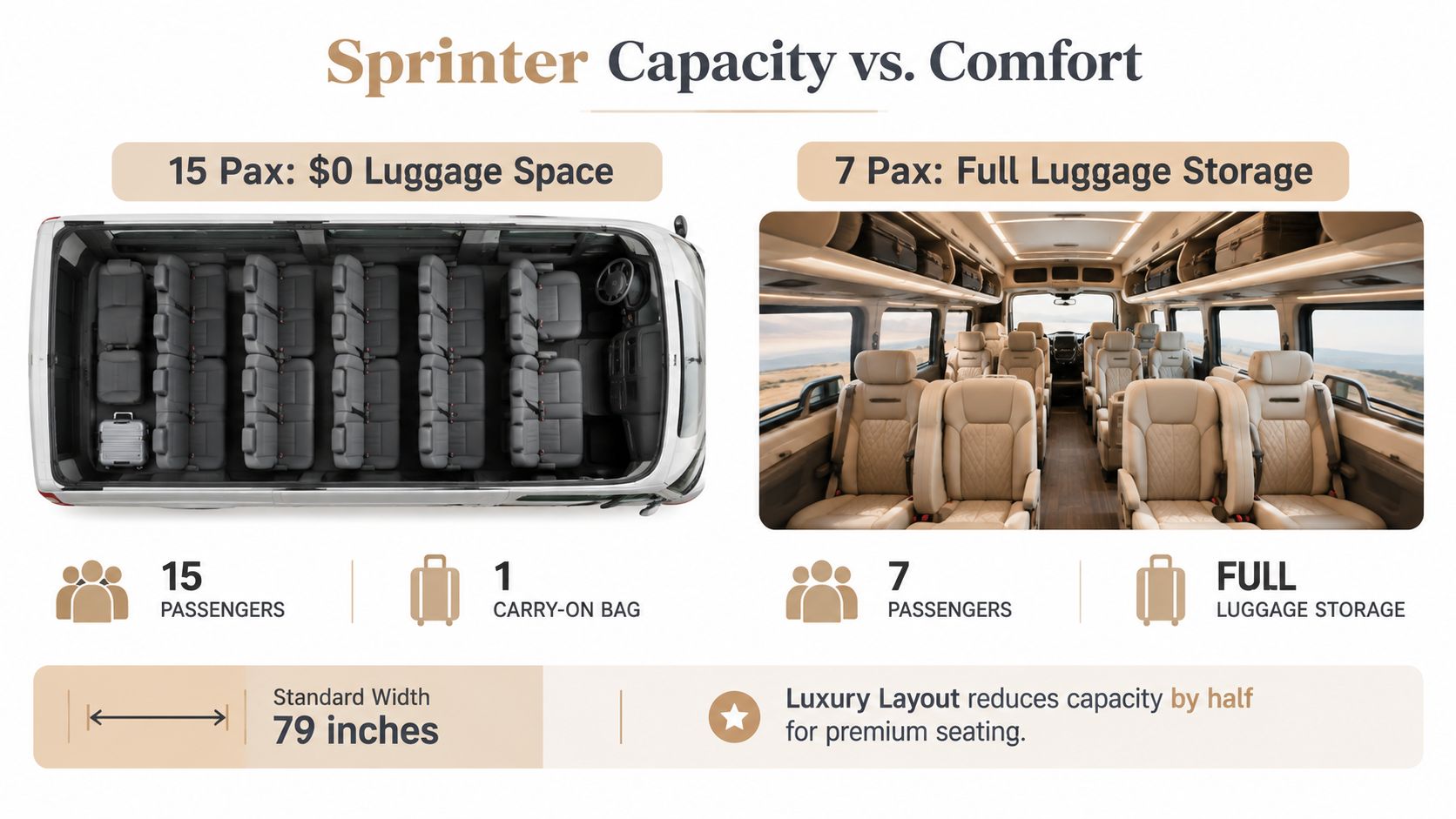
Capacity depends on the mission
Mercedes-Benz lists the Sprinter Passenger Van with seating for up to 15 adults, making that figure a useful benchmark for group transportation. The U.S. Sprinter Passenger Van brochure identifies the vehicle and its published passenger capacity. A particular conversion may offer fewer usable luxury seats because wider chairs, an aisle, tables, partitions, and luggage storage consume floor area.
Wheelbase also affects the planning equation. Car and Driver notes that the 144-inch passenger version seats 12, while the 170-inch version can fit 15, and describes the factory interior as relatively spartan, with comfort equipment varying by package. Car and Driver compares Sprinter passenger configurations and available comfort features. The longer body can provide more room, but it doesn't automatically solve every luggage or spacing problem.
A practical capacity review should account for:
- Passenger size and duration: A dense layout may be acceptable for a short local movement but less suitable for a multi-hour airport transfer.
- Baggage type: Golf bags, wedding garments, hard-sided cases, and event equipment require more planning than small personal bags.
- Aisle design: A clear path improves boarding and reduces the need for passengers to climb or reach across seats.
- Seat width and recline: A wider chair can improve comfort while reducing the number of positions available.
- Conversion details: The model year, wheelbase, seat mounting, and removable-row design all affect practical capacity.
The best booking conversation starts with the group's complete inventory. List passengers, luggage categories, mobility needs, child restraints, and whether anyone needs direct aisle access. A van that technically accepts the group may not provide the experience the group expects once the baggage is loaded.
Safety and Restraint Systems in Premium Configurations
Premium trim changes the look of a Sprinter cabin. It does not change the rules that make a seat travel-ready. What matters in service is whether each occupied position remains a designated seating position with the correct belt type, proper anchorage, safe orientation, and enough surrounding clearance. Under U.S. FMVSS No. 208, designated seating positions require either a Type 1 lap belt or a Type 2 lap-and-shoulder belt, and rear seating positions are part of that framework. For multipurpose passenger vehicles with a gross vehicle weight rating of 10,000 pounds or less, forward-facing rear outboard positions generally require integral Type 2 restraints. NHTSA explains the federal restraint requirements for designated seating positions
This becomes more important in premium conversions because luxury layouts often add the very features that need closer scrutiny. Swivel bases, removable rows, opposing lounge seats, and aisle-side captain's chairs can improve access or social seating, but each change affects restraint geometry and how the position is evaluated in motion.
I advise clients to ask for the actual seat map, not just cabin photos.
Rear outboard placement is one of the details that can get missed in a sales conversation. NHTSA describes rear outboard positions as those within 12 inches of the vehicle side, which affects how certain converted positions are treated. NHTSA defines rear outboard seating positions and describes applicable belt requirements If a provider cannot identify which seats are outboard, forward-facing, or approved for occupied travel, the conversation is not finished.
Vehicle classification matters too. Federal belt requirements for some buses with a gross vehicle weight rating of 10,000 pounds or less differ from the treatment of larger buses under the cited rule, and operators may also be working under state requirements, contract terms, insurer conditions, and internal safety standards. FMCSA summarizes seat-belt requirements and occupant-protection standards for buses For planners who want operating context, these bus operator compliance tips explain why appearance and compliance are separate questions.
The practical questions are simple. Which seats have lap-and-shoulder belts. Which seats are removable or reconfigurable. Which positions accept a child restraint, and by what approved method. Can an older passenger reach the seat without climbing past another row.
Mercedes-Benz notes that reclinable seats are available, reinforced seat bases use three-point belts, and entrances should allow safe, comfortable boarding and exit. Mercedes-Benz provides passenger-van information on seating, restraints, and access For airport runs with children, confirm the exact restraint setup before dispatch and review this guide to airport car service with car seats.
Evaluating Ride Comfort and Ergonomic Design
Luxury is decided after an hour on the road, not in the first minute after the door opens. For long-distance group travel, the question is whether each row stays supportive, settled, and usable once pavement changes, luggage is loaded, and passengers start shifting in their seats.
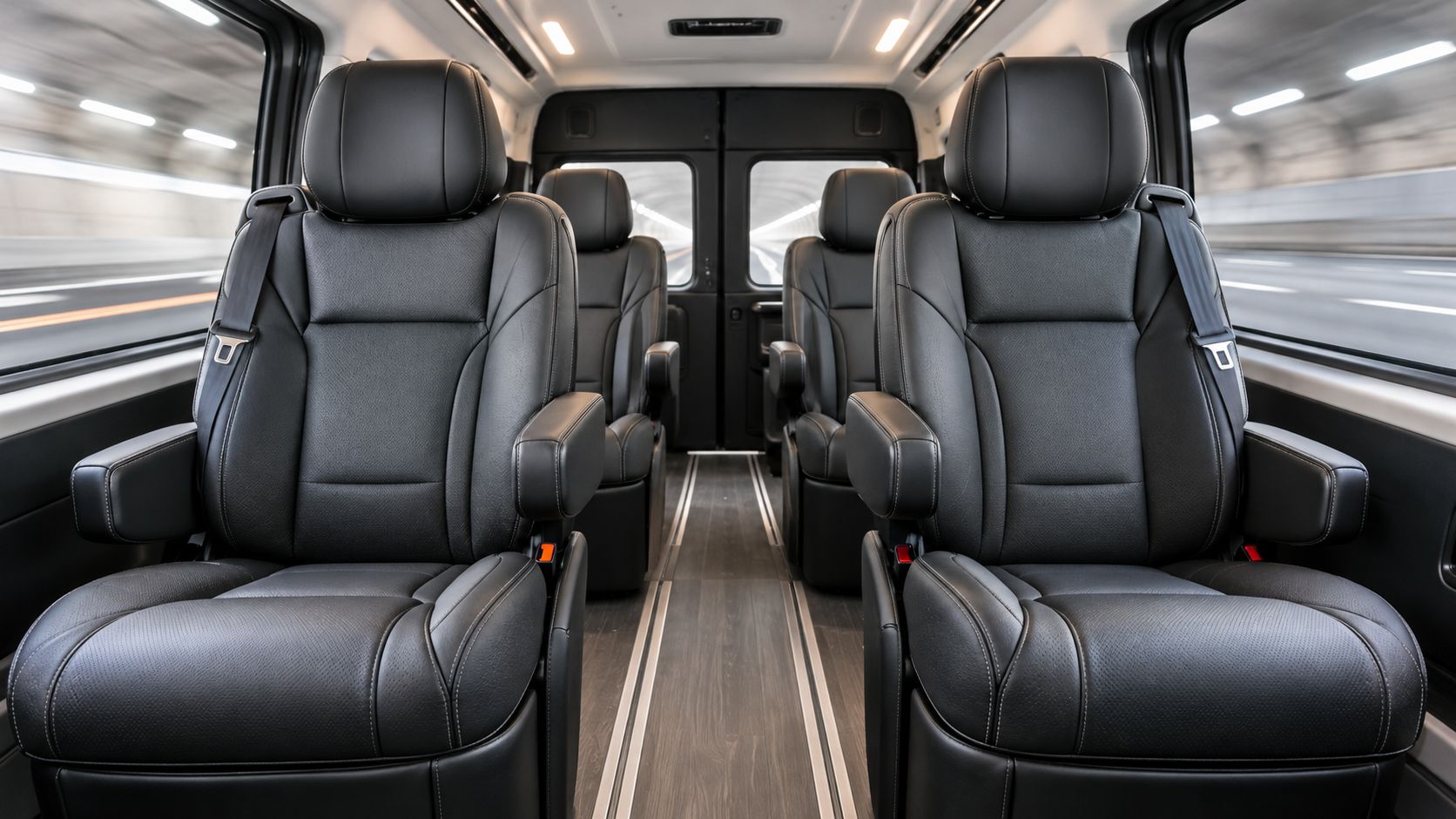
Ride comfort starts with the full chain of motion through the vehicle. Vibration moves from the tires and suspension into the floor, the seat base, the cushion, and finally the passenger. That is why thick padding alone can disappoint on a longer trip. Seat stiffness, damping, mounting, and posture all affect whether the cabin feels composed or tiring.
Research published by SAE found that the least-stiff tested seat had the lowest resonance frequency and the lowest whole-body-vibration magnitudes across six road types, and participants preferred it. The SAE technical paper examines seat stiffness, vibration response, and perceived comfort The practical takeaway is narrower than many buyers assume. Softness can help, but only when the cushion, structure, isolation, and passenger posture work together.
I would never judge a premium van seat while parked. A proper evaluation happens in motion, with typical passenger weight and real baggage on board, because load changes how the rear rows react. That test should include city streets, highway speed, braking, and turns. A seat that looks impressive in a showroom can start transmitting harshness, rocking under recline, or crowding the passenger behind it once the van is fully occupied.
During a test ride, check cushion pressure first. Hot spots under the thighs or hips usually show up quickly. Then check lumbar shape and back angle, because lower-back support that feels acceptable for ten minutes can become irritating on a longer airport transfer. Lateral support matters too. Passengers should stay stable in turns without feeling pinched by the bolsters.
Then look row by row. Test recline with someone seated behind. Confirm that rear passengers get heating and cooling instead of whatever drifts back from the front. Listen for trim noise, and pay attention to how much extra movement the last row gets over rough sections.
Ventilation can improve thermal comfort, but it cannot fix poor damping, weak lumbar support, or an unstable seat base.
Comfort also depends on what shares the cabin. If a carry-on, garment bag, or stroller ends up in foot space, legroom disappears and the advertised luxury stops mattering. Check how luggage is secured and whether the last row still works once the storage area is full.
A quick visual pass can separate premium materials from functional design. This interior walk-through helps illustrate that difference.
Matching Seating Layouts to Specific Group Needs
The right seat map changes with the group. An executive transfer often benefits from fewer, roomier positions and a clear path to luggage. A wedding party may need more seats, but garment bags, makeup cases, and guests wearing formal clothing can make a dense arrangement uncomfortable. A family airport run adds another concern, child-restraint compatibility, and easy boarding for adults carrying children or bags.
Mercedes-Benz's 2025 passenger-van guide confirms that reclinable seats are available and that reinforced seat bases use three-point belts. It also says entrances must allow people to board and exit safely and comfortably. Mercedes-Benz's passenger-van guide addresses reclinable seating, three-point restraints, and entry access.
Configuration Guide by Travel Scenario
| Travel Scenario | Recommended Density | Layout Focus |
|---|---|---|
| Corporate airport transfer | Lower density | Individual executive chairs, aisle access, charging access, and quiet working space |
| Wedding party | Moderate density | Comfortable forward-facing seats, garment storage, simple boarding, and room for event bags |
| Family airport run | Moderate density | Approved child-restraint positions, reachable rear seats, and space for strollers and luggage |
| Golf outing | Moderate density | Secure equipment storage, clear movement through the cabin, and seats that remain comfortable after loading |
| Larger event movement | Higher density when appropriate | Certified seating positions, belt access, coordinated boarding, and realistic baggage limits |
Families shouldn't assume that a lounge-style opposing arrangement is automatically better. A forward-facing seat may provide more useful head support, clearer belt geometry, and easier child-seat installation. The manual includes separate child-restraint suitability information, reinforcing that compatibility depends on the actual configuration rather than the word “Sprinter.”
Older travelers deserve the same practical attention. A chair near the entrance may be more valuable than a wider chair in the back if reaching it requires climbing past other passengers. Ask whether the chosen position has direct access, adequate clearance, and a stable step path.
Wedding planners and executive assistants should send the provider a passenger list with special requirements before selecting the vehicle. The Sprinter van rental with driver guide can help frame that conversation around itinerary, group size, and service expectations rather than a generic seat count.
Navigating Fleet Options and Booking Logistics
The glossy cabin photo matters less than the trip details. The right booking starts with the movement itself: where the group is going, when everyone needs to arrive, how much luggage is coming, and whether any passenger needs easier entry or a specific seat. That information determines whether a luxury Sprinter is the right tool or just the most attractive one on the quote sheet.
I usually sort the decision by how the group will function once the doors open.
A small executive party may be better served by a premium SUV such as a Chevrolet Suburban or Cadillac Escalade, especially if the priority is quick curb access and a tighter cabin. A Mercedes-Benz S-Class fits a very small movement where privacy matters more than shared travel. A Sprinter makes more sense when the group needs to stay together, separate people from baggage, or arrive on one schedule. For larger wedding blocks and corporate moves, a minibus or motor coach can be the cleaner solution if splitting people across multiple vehicles would create boarding delays, missed counts, or inconsistent arrival times.
The quote request should reflect those realities, not just a seat total. Send one clear message with the passenger count, including children and anyone who needs a specific row or easier access. Add baggage details such as golf bags, garment bags, strollers, hard cases, or event equipment. Then list the route in plain terms: airport terminal, private airfield, hotel, venue, planned stops, and return timing. If you already have a vehicle preference, state it, but also explain your actual priority, whether that is lower seat density, luggage room, child-seat compatibility, or easier aisle movement.
Hamptons Leisure Limo handles airport service from JFK, LaGuardia, Newark, Long Island MacArthur, and private airports including FOK, Westhampton, East Hampton, and Montauk. Its coverage also includes Southampton, East Hampton, Sag Harbor, Montauk, Bridgehampton, Amagansett, Water Mill, Wainscott, and Quogue, along with longer-distance service across Long Island and neighboring states. Before asking for a quote, Review the available vehicle categories and fleet options so the request matches the trip.
Pricing can be fixed and free of surge, which helps with peak-season planning, but the final number still depends on the actual vehicle, timing, and service pattern. Ask who will handle flight tracking, staging, and communication if pickups split across locations. That answer tells you a lot about whether the operator can run the movement well, not just sell a luxury seat.
Final Checklist for Group Transportation
A comfortable group transfer depends on decisions made before the vehicle arrives. Use this checklist to keep the conversation specific:
- Confirm practical capacity: Ask how many passengers the selected luxury layout accommodates with your actual luggage.
- Request the seat map: Identify front, middle, and rear positions, aisle access, recline limits, and removable rows.
- Verify restraints: Confirm the belt type and approved seating position for every passenger who will travel.
- Discuss children and mobility: State child-seat needs, boarding concerns, and whether anyone requires a more accessible seat.
- Review storage: List golf bags, garment bags, strollers, equipment cases, and other items that could reduce cabin space.
- Ask about comfort: Confirm rear climate distribution, seat support, charging access, and whether the vehicle has been evaluated on real roads.
- Clarify the itinerary: Include airports, terminals, venues, stops, waiting periods, and return movements.
- Get the quote in writing: Confirm the vehicle class, service hours, pricing structure, and any requested amenities.
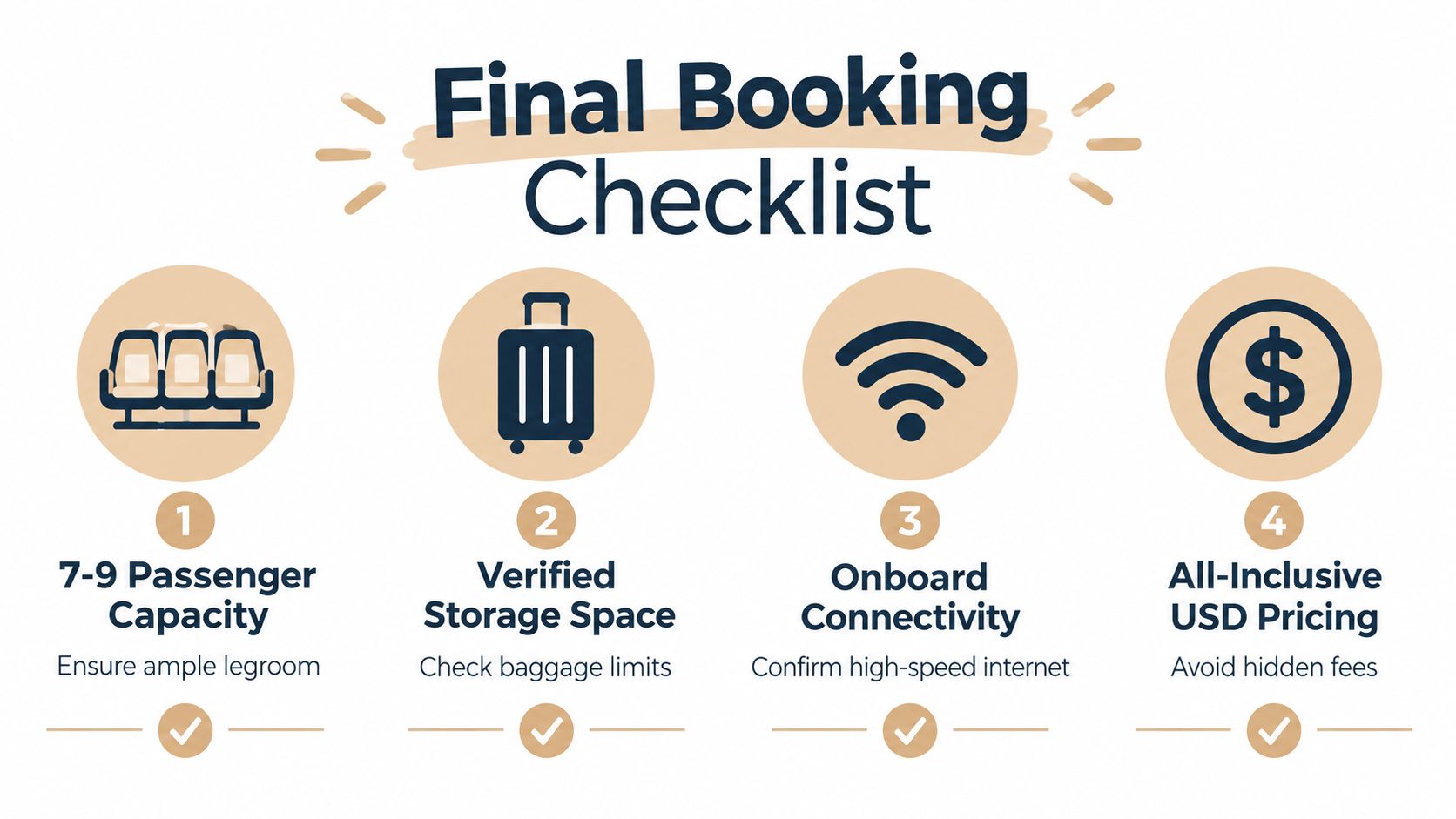
The key test is simple. Every passenger should have a suitable restraint, enough personal space for the journey, and a reasonable way to enter, exit, and access belongings. If maximizing the installed seat count forces luggage into the aisle or makes the rear row difficult to use, the configuration isn't serving a premium trip.
Share the complete passenger and baggage picture with dispatch rather than booking from capacity alone. Text (631) 294-0747 for a quote, and ask for a fixed-price, no-surge option matched to your Hamptons itinerary.
Hamptons Leisure Limo provides SUVs, Mercedes-Benz Sprinter vans, sedans, minibuses, and motor coaches for airport transfers, weddings, corporate travel, and East End events. Visit Hamptons Leisure Limo and text (631) 294-0747 to discuss passenger spacing, luggage requirements, and the right seating configuration for your trip.
Ready to Ride with Hamptons Leisure Limo?
Fixed pricing. No surge fees. 30 years of experience serving the Hamptons. Text us what you need and we will send a quote.