How Much Does Car Transportation Cost in the Hamptons?
Updated October 29, 2026
How much car transportation costs turns on the vehicle, the billing basis, and the route, so a written, route-specific quote is the only reliable number. Text (631) 294-0747 for one before you lock a plan.
It's Thursday night. Your flight lands Friday, the house in East Hampton is ready, and six people plus luggage still need a ride from the airport. One person is checking an app. Another is adding tolls and weekend parking in their head. A third is asking whether one vehicle can take the whole group. Those three habits produce three different totals for the same evening, because a fare on a screen, the cost of driving your own car, and a reserved booking are not the same kind of bill.
The useful question is the door-to-door total. That means who is traveling, whether the vehicle waits, which airport or village is the pickup, and whether tolls, parking, and standby time sit inside the price. A general average is a weak stand-in for a Southampton wedding, a Montauk house, or a late arrival at JFK.
Table of Contents
- Which Service and Vehicle Set Your Cost Range
- Why the Same Trip Can Be Quoted Differently
- Hourly Booking or Point-to-Point for Your Itinerary
- Airport Transfers and How Each Airport Changes the Quote
- Fixed Pricing Compared With Rideshare Surge Pricing
- Car Transportation Compared With Driving Yourself
- Estimate, Reduce and Confirm Your Quote
Which Service and Vehicle Set Your Cost Range
No single rate covers every car transportation trip. The total follows the vehicle, the billing basis, and the route, so the first job is matching seats and bags to the right booking, not hunting a universal per-mile figure.
Hamptons Leisure Limo quotes each option below with fixed pricing and no surge. Text (631) 294-0747 and you'll get a written quote for the vehicle and route you name.
| Service | Vehicle | Passenger capacity | Pricing basis |
|---|---|---|---|
| Airport transfer | Premium SUV (Chevrolet Suburban or Cadillac Escalade) | Up to 6 | Point-to-point fixed quote |
| Hourly city service | Premium SUV (Chevrolet Suburban or Cadillac Escalade) | Up to 6 | Hourly, reserved vehicle |
| Executive trip | Mercedes-Benz S-Class | Up to 3 | Point-to-point or hourly |
| Group transfer | Mercedes-Benz Sprinter | Up to 14 | Point-to-point or hourly |
| Mini-bus event | 25-passenger or 36-passenger mini-bus | 25 or 36 | Hourly or event quote |
| Motor coach | 55-passenger motor coach | Up to 55 | Hourly or event quote |
How the lineup scales
A premium SUV, such as a Chevrolet Suburban or Cadillac Escalade, seats up to six. It fits airport transfers and hourly city service across Southampton, East Hampton, Sag Harbor, and Montauk when the group is small and the bags are ordinary.
A Mercedes-Benz S-Class seats up to three. That is the executive trip: one or two clients, a meeting in the village, or a quiet ride where a large cabin would be wasted space.
A Mercedes-Benz Sprinter seats up to 14. Families and wedding parties use it when several cars would otherwise leave at different times. Mini-buses in 25- and 36-passenger sizes, and a 55-passenger motor coach, cover larger events where one departure matters more than a low base quote.
A larger vehicle raises the base quote because it takes more planning, fuel, and chauffeur time. The cost per person falls as the seats fill. Six people in one Sprinter is a different bill from six separate rides, even when the miles match.
Practical rule: Count passengers and luggage first, then choose the smallest vehicle that fits both.
Child seats, golf bags, and garment bags count as space. If they don't fit the smallest cabin, step up one size before you book, not at the curb.
Why the Same Trip Can Be Quoted Differently
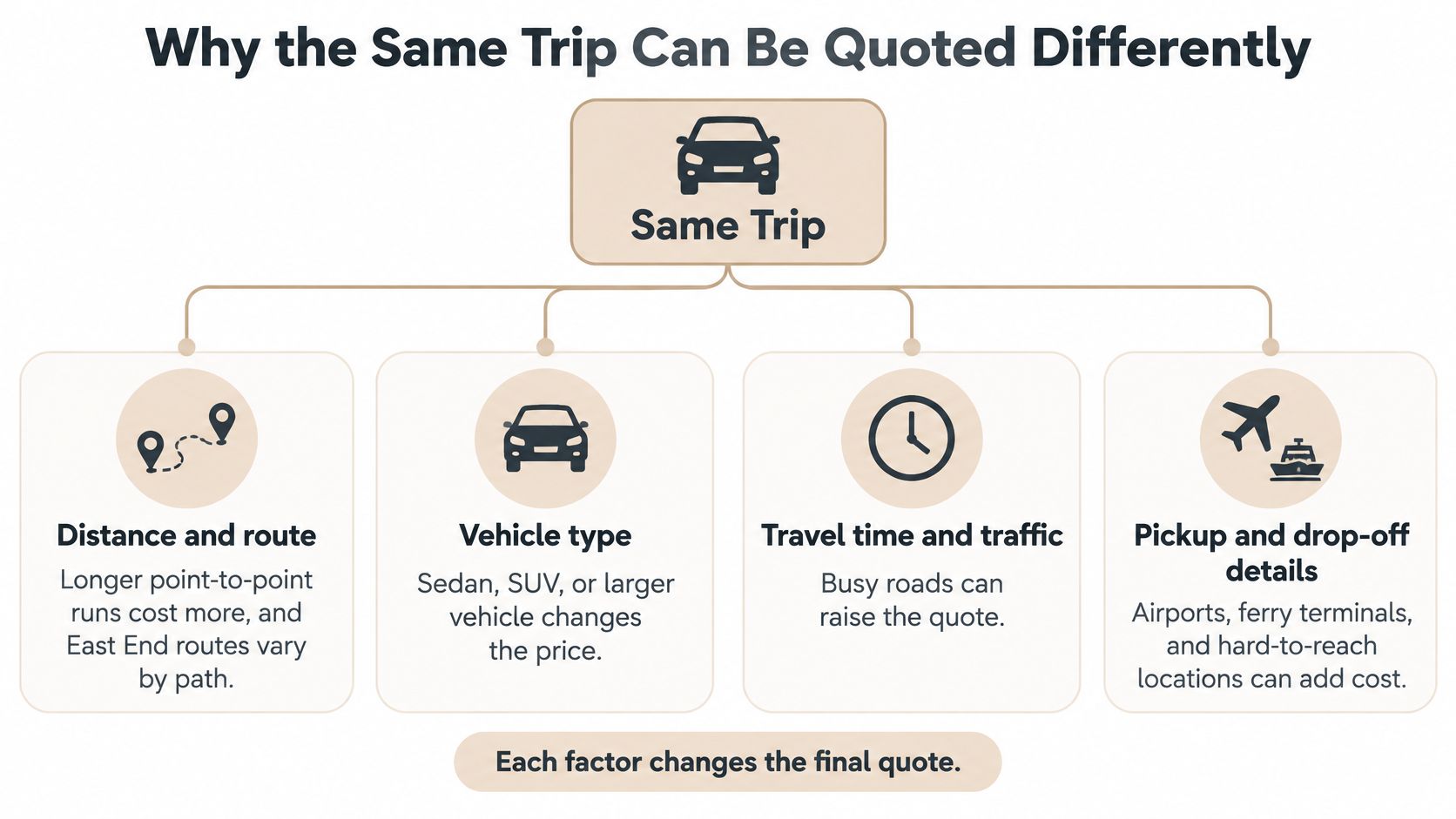
Two travelers can request a car from the same Southampton driveway to the same JFK terminal and receive different totals. A quote works like a restaurant check: the main plate matters, but the sides, the service, and the table you held all appear on the bill. Vehicle, route, and billing basis each add a line, and changing any one of them moves the final number.
Broader transportation prices offer context for why a ride quote is built from several inputs rather than one. The Bureau of Transportation Statistics reported that transportation-related prices reached a record level in 2025 on an annual increase of only 0.5%, while motor-vehicle insurance and maintenance and repair each rose 5.9% and motor fuel fell 5.6%. Those figures describe consumer transportation prices across the national economy. For a chauffeured booking they serve as a reminder that running a vehicle has several cost inputs, and they rarely move in the same direction.
The same release notes a geographic split. When transportation is combined with housing, only 26% of U.S. neighborhoods meet a commonly used affordability benchmark, compared with 55% when housing is considered alone. Access, not just miles, changes what a trip costs.
Route and vehicle
Distance and route come first. A longer point-to-point run costs more, and East End traffic can stretch the same map at peak hours: Friday afternoons toward Montauk, Sunday evenings back toward the city.
Vehicle type follows. A sedan, an SUV, a Sprinter, or a coach carries a different base quote and a different amount of planning. A coach needs a staging plan that a three-seat sedan never does.
Timing and extras
Billing basis splits one completed leg from a reserved window. Point-to-point covers one trip between set addresses. Hourly service holds the vehicle and chauffeur for a set block, which is what waiting, extra stops, and return positioning consume.
Airport access changes the route: a terminal pickup, a curbside wait, or a private-field arrival is not the same path. Waiting time, while a flight lands or a group gathers, is often its own line. Tolls and parking should be marked included or passed through before you compare two quotes.
Pickup accessibility matters on narrow village streets and at venues that cannot take a large vehicle at the front door. A different arrival point can add a short walk or a secondary transfer. Passengers and luggage, plus child seats, can force the next vehicle size. Timing shifts the number too: late-night, early-morning, and peak-weekend bookings reserve the vehicle for a window that is harder to fill.
Before you compare totals, ask two plain questions. Is gratuity inside the quote? Are stops added mid-trip included, or do they change the booking? A fixed quote that already covers tolls, waiting, and gratuity can beat a lower headline number that adds each item later.
A general average is a weak guide. The written quote, built from these inputs, is the number worth comparing.
Hourly Booking or Point-to-Point for Your Itinerary
Point-to-point works like a single fare for a single journey. Hourly works like reserving a private table for the evening: the vehicle and the chauffeur stay with you until the window ends.
Point-to-point is one trip between set addresses, one-way or round trip, priced as a fixed quote. You name the start and the end, and the booking covers that leg. Waiting, extra stops, and return positioning sit outside it.
Hourly reserves the vehicle and chauffeur for a set number of hours. Stops that fall inside the window are part of the reservation, so a day that bends is billed by the clock rather than by the door. The difference between hourly and point-to-point black car service is easiest to see once the stops are written down.
That distinction decides the total. A multi-stop afternoon quoted as point-to-point means a new fare or a booking change at every added stop, while the same afternoon on an hourly basis is one agreed figure.
Three East End plans
A single airport arrival to a Southampton house is point-to-point. One pickup, one drop-off, no reason to hold the vehicle after the bags are inside.
A North Fork wine day with three tasting rooms is hourly. The chauffeur waits at each stop, and the clock, not a new fare at every door, is the billing unit.
A wedding weekend shuttling between a ceremony, a cocktail lawn, and a reception is usually hourly, or a sequence of bookings if the gaps run long. One reserved vehicle through a four-hour dinner also keeps a full group on a single fixed price instead of splitting into separate rides.
Run this self-test on your own plan. List the stops in order and note the time at each one. Ask whether any stop needs the vehicle to wait. If the answer is yes at more than the final address, you are pricing an hourly window. If the route is one clean leg, a point-to-point quote is the simpler and usually cheaper shape.
Airport Transfers and How Each Airport Changes the Quote
Drive time is the baseline, and the spread is wide. Long Island MacArthur (ISP) is the short hop, about 45 minutes to an hour to most East End destinations. Newark Liberty (EWR) is the long one, roughly 2.5 to 3 hours. JFK and LaGuardia sit in between, roughly two to 2.5 hours. On a point-to-point quote, that gap often matters more than which airline you booked.
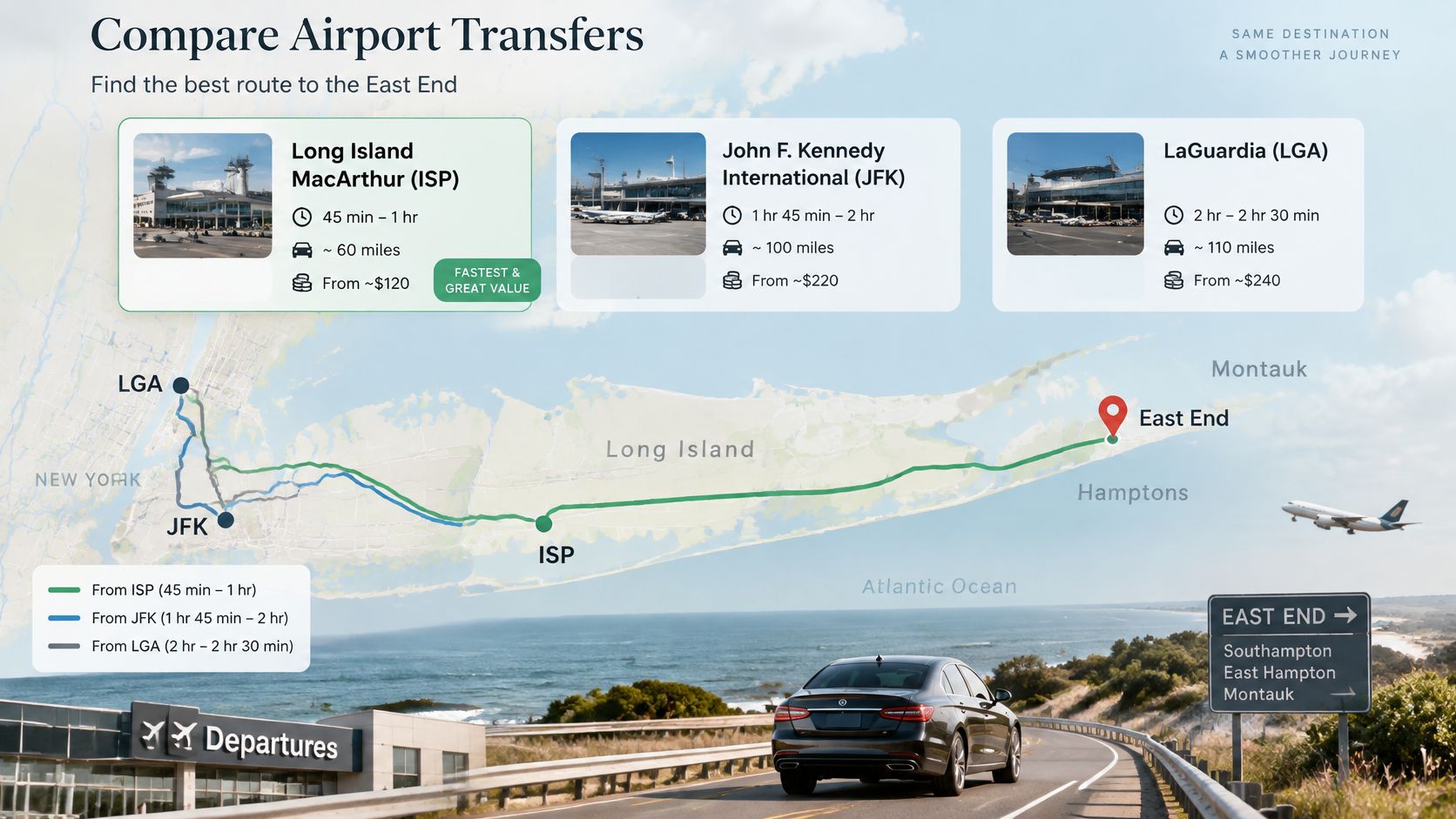
| Airport | Approximate drive to Hamptons | Best for | Quote factor |
|---|---|---|---|
| Long Island MacArthur (ISP) | About 45 minutes to 1 hour | Shortest drive, limited flights | Short distance keeps the route component low |
| John F. Kennedy (JFK) | About 2 to 2.5 hours | International travel, most flight options | Longer route; confirm terminal and access |
| LaGuardia (LGA) | About 2 to 2.5 hours | Domestic flights | Similar route to JFK; confirm terminal |
| Newark Liberty (EWR) | About 2.5 to 3 hours | United hub and New Jersey departures | Longest route of the four airports |
| Private airports (Westhampton FOK, East Hampton, Montauk) | Set by the field and the house | Private aviation | Quoted as a separate route; confirm landing details |
What the quote should name
ISP keeps the route component low, with fewer flight choices. JFK adds time and terminal complexity, which is why international arrivals need the terminal named, not just the airport code. LGA is a similar road time to JFK for many East End houses, but the pickup curb is not the same building. EWR is the longest of the four public airports, so it should not be priced as if it were JFK.
Private fields at Westhampton (FOK), East Hampton, and Montauk are separate routes. A landing at East Hampton and a house in Montauk is not the ISP pattern, and it is not the JFK pattern either.
Confirm three items in writing. Is pickup curbside or meet-in-terminal? Which terminal? Are airport access charges included? A quote that says only "JFK to Southampton" still has those blanks.
Flight monitoring is the other half. The chauffeur tracks the inbound flight, the pickup time adjusts when the arrival moves, and the team waits if the flight is late, so you can check the quote against the arrival instead of a timetable that slipped. For a closer look at how an airport transfer quote is built, send the flight number and terminal at booking so the price reflects the actual arrival point.
Fixed Pricing Compared With Rideshare Surge Pricing
Rideshare surge pricing is a supply-and-demand mechanism, not a distance calculation. Platforms raise fares when many ride requests hit the same area at the same time, using the higher rate to pull more vehicles into that area. The University of Minnesota's Center for Transportation Studies describes this as a two-sided market: prices respond to rider demand and to available vehicles. One study found that a short-lived sharp surge can cause some riders to delay their trip, while the higher price attracts more supply and may reduce the later fare. The route can be identical and the price still moves.
A fixed quote is set before the trip, with no surge, and the writing states what is included. That is a different decision from accepting whatever the app shows in the moment. The fixed-price approach is built for trips you can describe in advance.
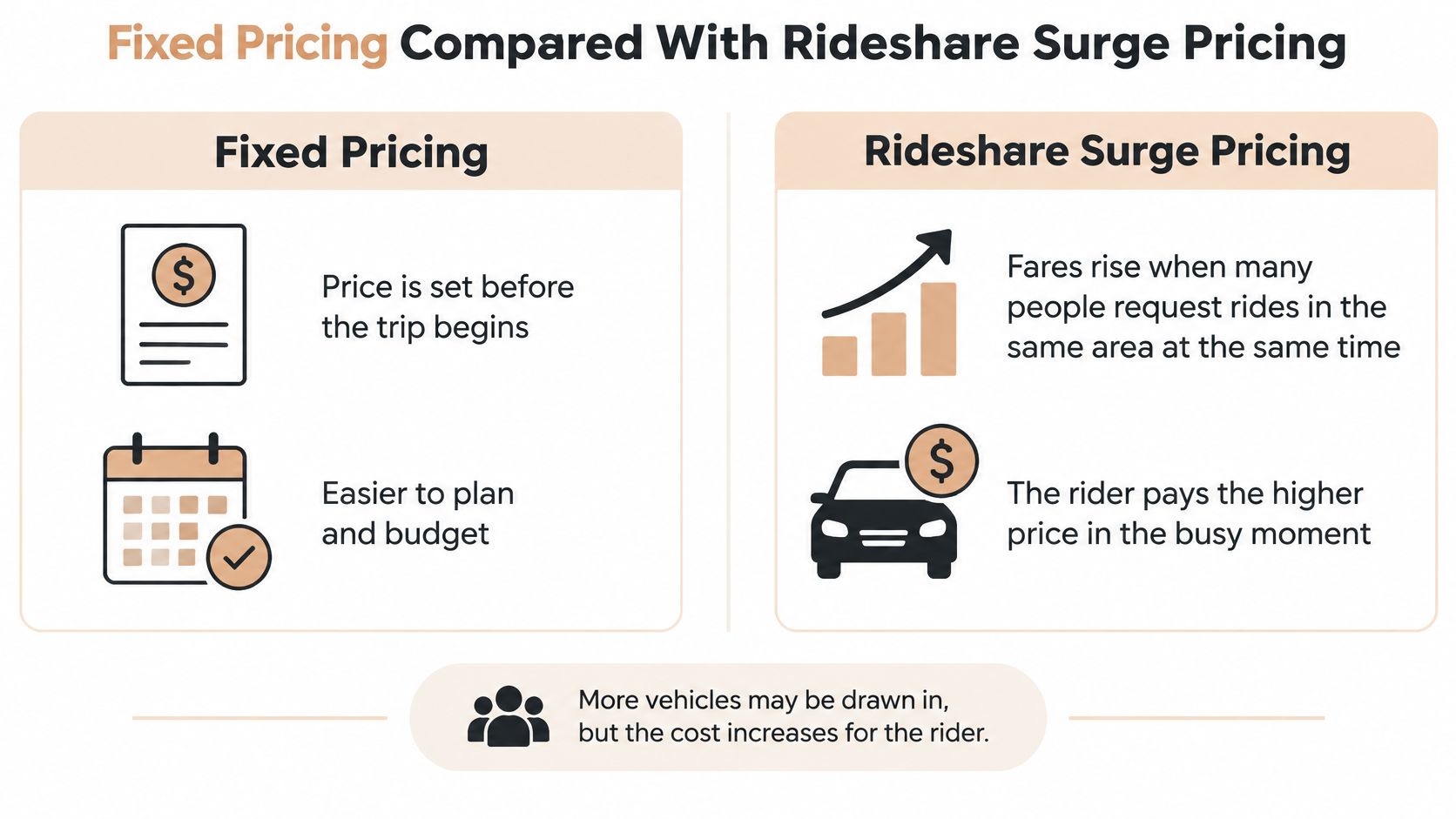
| Factor | Fixed-price service | Rideshare surge pricing |
|---|---|---|
| How the price is set | Quoted before the trip | Set by the app at booking |
| Peak demand | Fixed quote, no surge | Fare rises when requests spike |
| Waiting and cancellation | Stated in the written quote | Set by the app and the clock |
| Multi-vehicle groups | Coordinated under one booking | Separate rides for each car |
| Availability at booking | Reserved for the confirmed time | Only if a car is nearby |
| Best fit | Airport transfers, weddings, and corporate groups | Single short trips booked on the spot |
A Friday in July
Say a family of five lands on a Friday evening in July, with luggage for a week. An app can mean two or three cars, each priced at that moment, and a second search if one car cancels. One Sprinter under one booking is a single quote and one pickup, with the bags in the same vehicle as the people.
There is a fair counterpoint. A single short trip booked on the spot, two people and no wait, can still be quicker through an app. Compare that live fare with a written quote at the same time, on the same route, before you decide the app is cheaper.
Car Transportation Compared With Driving Yourself
A booked car is worth comparing with your own vehicle only on an all-in view, not on fuel alone. The lines people skip are fuel, tolls, parking, insurance, maintenance, tire wear, and depreciation.
AAA's 2025 national analysis of new-vehicle ownership put depreciation as the largest annual component, which is why the purchase price understates what those miles cost. The AAA Your Driving Costs fact sheet separates that ownership stack from the fuel you see at the pump. Driving to the East End and back still burns that stack, even when the weekend feels like "just gas."
A side-by-side check
- Count total miles and hours, including the return leg and any repositioning.
- Add tolls, parking, and fuel for your own car on that exact route.
- Add the time you spend driving, plus the time passengers spend lining up cars.
- Add wear and insurance for the miles you will drive in practice.
- Set that total next to the written quote for the same route and the same seat count.
A chauffeured trip can be simpler for reasons that are not on a gas receipt. The chauffeur handles the route and the parking. Passengers can work or rest. Luggage and child seats are arranged in one booking instead of split across cars.
Be honest about the other result. For a single short trip with two people, driving yourself may still cost less. The comparison should be allowed to show that. Use the quote when the hours, the group, or the airport wait are the expensive part, not when the drive is a quick local errand.
Estimate, Reduce and Confirm Your Quote
An estimate built from seven inputs gets close to the actual number, because each input is something a dispatcher can price instead of guess.
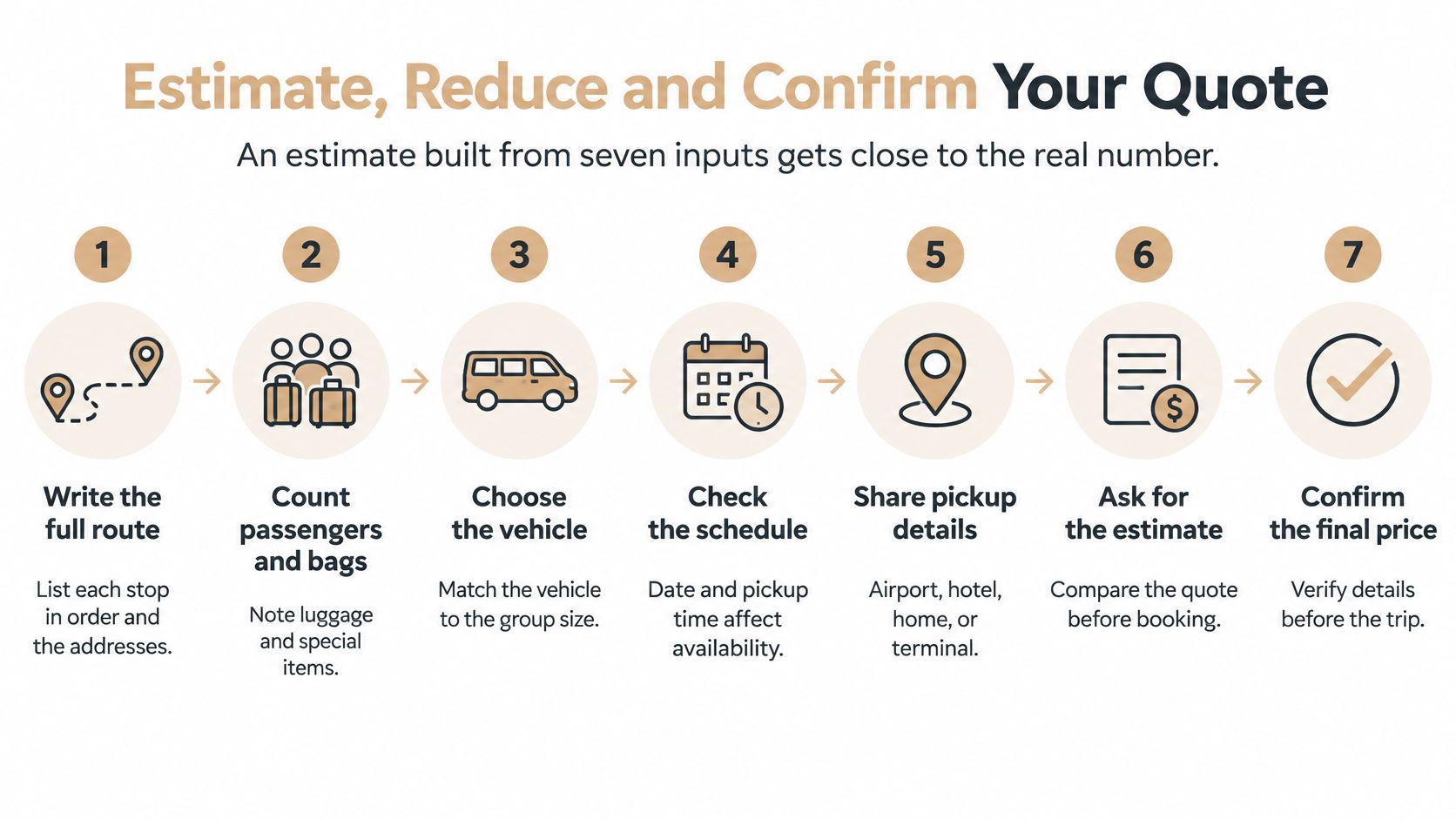
- Write the full route. List each stop in order with the street address. "The Hamptons" is not a destination a quote can use. A house on Further Lane and a hotel in Sag Harbor are different jobs.
- Count people and cargo. Passengers, luggage, and child seats decide the cabin. Pick the smallest vehicle that fits all three so you are not paying for empty rows or, worse, splitting the group at the curb.
- Choose the billing basis. Point-to-point for one leg. Hourly when there are several stops or the vehicle must wait. Picking the wrong basis is how a simple transfer gets priced like a full-day hold, or a wedding shuttle gets priced like a one-way drop.
- Add the airport facts. Airline, terminal, flight number, and whether pickup is curbside or inside the terminal. Those details set the meet point. Leave them out and the quote is for a generic curb that may not be yours.
- Name the clock. Late-night, early-morning, and peak-weekend windows can change the quote because the vehicle is held for that time. Book early when the date is a holiday Friday or a wedding Saturday.
- Mark the extras. Ask whether waiting, tolls, parking, and gratuity sit inside the fixed price. If they are passed through, they belong in your comparison, not as a surprise after the ride.
- Get it in writing. Request a written, route-specific quote and compare two options on the same terms: same stops, same vehicle size, same inclusion list.
Ways to bring the total down
Combine guests into one vehicle instead of several bookings. Use a larger vehicle when the group fills it, because the per-person figure drops as seats fill. Keep several stops inside one hourly window rather than starting a new trip at every door. Book outside peak dates when the calendar allows.
The common mistake is estimating from distance alone and skipping waiting time. A map mile does not include a 40-minute hold at the terminal or a chauffeur staged between ceremony and reception.
Passenger trips and vehicle shipping are different products. If you are moving a car rather than people, the questions change to condition, open or enclosed transport, and schedule. A walkthrough of shipping costs with National Car Transport shows that separate checklist. It will not price a Hamptons airport transfer, and a passenger quote will not price a shipped car.
Text (631) 294-0747 with the route, the date, the passenger count, and the flight details. Ask for a fixed-price quote with no surge, and compare that page with the all-in cost of doing the trip yourself.
Hamptons Leisure Limo provides pre-arranged black car and limousine service across the Hamptons, Long Island, and New York City, with fixed pricing and no surge on airport transfers, events, and hourly bookings. If you are pricing a specific route, a group, or a flight arrival, a written quote is the figure to compare with driving or an app. Visit Hamptons Leisure Limo and text (631) 294-0747 with your date, stops, and passenger count.
Ready to Ride with Hamptons Leisure Limo?
Fixed pricing. No surge fees. 30 years of experience serving the Hamptons. Text us what you need and we will send a quote.