Hourly Black Car Service: What It Is and When to Book
Updated October 13, 2026
An hourly black-car reservation makes sense when your day includes multiple stops, airport waiting, event standby, or uncertain timing. The Federal Highway Administration's Planning Time Index shows why: a PTI of 1.60 means planning 60% more time than free-flow travel time for a 95%-reliable arrival.
You're at JFK with three meetings in Manhattan, dinner in Southampton, and an early flight home the next morning. Booking a separate ride for every leg may look simple until a meeting runs late, baggage takes longer than expected, or traffic turns the trip across Long Island into a moving target.
Hourly black-car service is a prearranged reservation where you pay for a vehicle and chauffeur by the hour, often with fixed pricing and no surge. The reservation usually covers vehicle availability, standby time, intermediate stops, and the return to your final destination. Instead of searching for a new ride after each appointment, you keep one assigned resource working from a defined itinerary.
The practical rule is straightforward: hourly service earns its keep when uncertainty is part of the schedule. A single predictable airport transfer usually belongs in the point-to-point category. A day with meetings, errands, dinner, event standby, or a delayed flight often belongs in the hourly category.
Table of Contents
- What Hourly Black Car Service Actually Means
- Where the Black Car Model Came From
- Point-to-Point vs Hourly Booking
- Common Hourly Use Cases in the Hamptons and NYC
- Vehicle Options and Right-Sizing for Your Group
- Pricing Benefits and Honest Trade-Offs
- Booking Tips, Checklist, and How to Request a Quote
What Hourly Black Car Service Actually Means
The simplest way to understand hourly booking is to think of the vehicle as a reserved workspace that moves with you. The chauffeur arrives at the agreed pickup point, remains available during the booking window, and follows the planned route as your day unfolds.
For the JFK itinerary, that could mean airport pickup, a meeting in Midtown, a second appointment downtown, a third meeting near the airport, and an evening transfer to Southampton. You aren't buying four disconnected rides. You're reserving continuity, which matters when the next pickup depends on how long the previous stop takes.
A point-to-point reservation has a defined origin and destination. An hourly reservation has a defined coverage window and operating area. The clock commonly begins when the vehicle arrives for the reservation, although the exact start, end, waiting policy, and service boundary should appear in the quote.
Practical rule: Ask what the hourly quote covers before you compare it with a point-to-point fare. Confirm pickup, standby, intermediate stops, final drop-off, tolls, parking, and any route or service-area limits.
What stays covered during the booking
Standby is the feature many first-time clients misunderstand. If the chauffeur is holding the vehicle while you're in a meeting, shopping, attending dinner, or waiting for luggage, that reserved availability is part of the hourly arrangement. You're paying for the vehicle not to leave and for the chauffeur not to become unavailable when you need to move again.
That doesn't mean every change is automatically included. A new destination outside the agreed area, a substantially larger group, a different vehicle requirement, or a schedule extending beyond the reservation may change the quote. Discuss those conditions before the itinerary begins.
For a broader explanation of the service category, see what a black-car service is. The important distinction is that hourly service sells time, continuity, and readiness, not merely distance between two addresses.
The dispatcher's way to frame it
I tell clients to separate two questions:
- Do you need a ride? Point-to-point may be enough.
- Do you need a vehicle to remain available? Hourly booking is usually the better fit.
That distinction prevents overbooking a short, predictable transfer and prevents underbooking a day where every delay creates another transportation decision.
Where the Black Car Model Came From
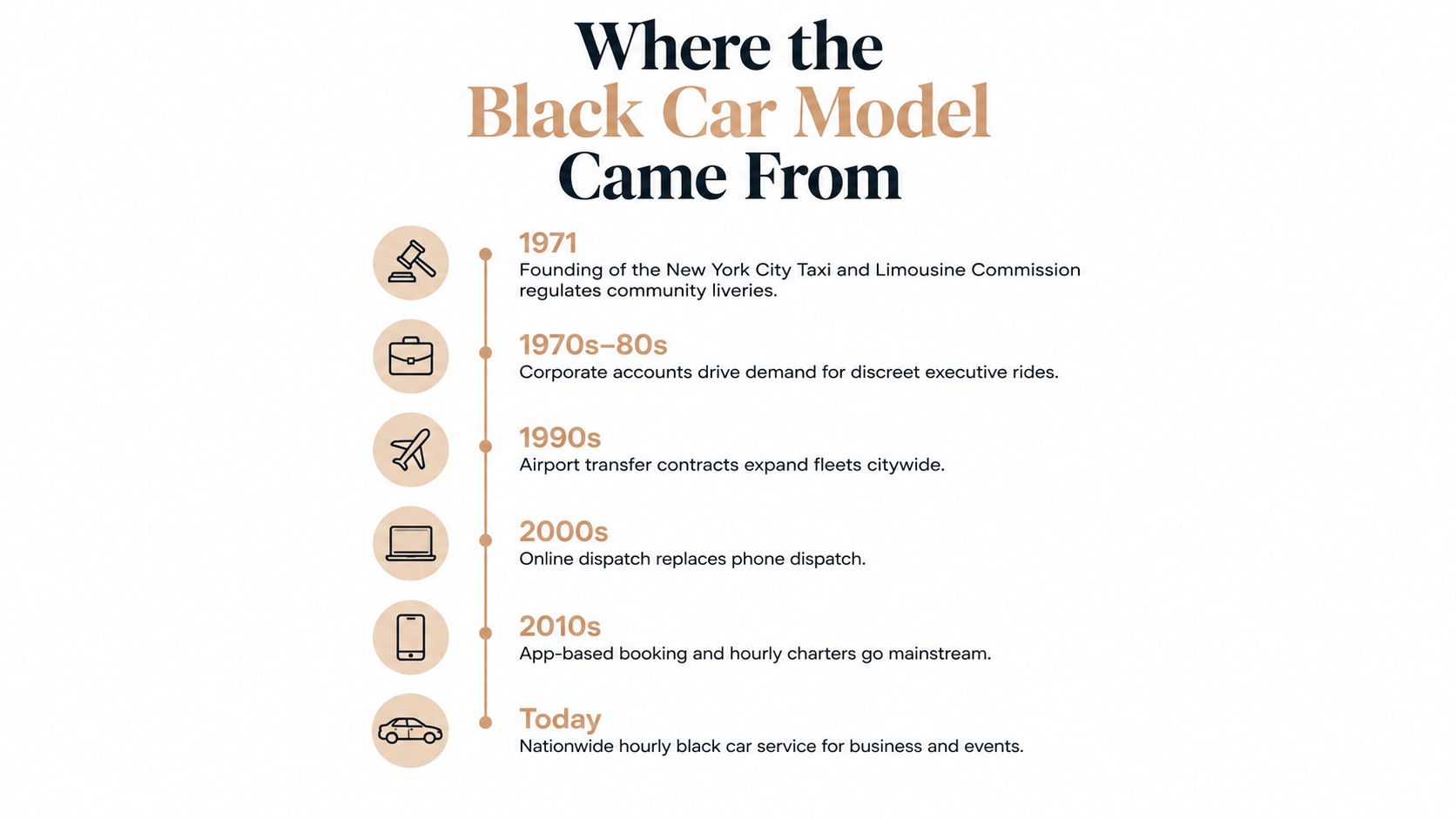
Black-car service grew from a regulated, prearranged transportation model rather than from the street-hail taxi system. New York City created the Taxi and Limousine Commission in 1971, and the TLC regulates several for-hire categories, including community-based liveries, black cars, luxury limousines, commuter vans, and paratransit vehicles. The New York City Taxi and Limousine Commission overview provides that regulatory background.
A yellow taxi typically waits for a street hail and uses a taximeter. A black car generally receives a reservation or dispatch before the trip begins. Black-car businesses commonly serve corporate and contracted clients, with fares established through quoted or contractual arrangements. That structure explains why hourly service relies on advance reservations, dedicated vehicle availability, and agreed pricing instead of a meter that starts and stops with each block.
Why geography matters
Black-car travel isn't limited to Manhattan office towers. A TLC Black Car and Livery Task Force report found that, beginning in June 2017, 64.5% of black-car trips originated outside Manhattan (TLC Black Car and Livery Task Force report). That finding fits the actual shape of regional travel, where airports, outer boroughs, Long Island, corporate campuses, residences, and event venues connect rather than sit within one central business district.
The same report recorded a 72.4% loss in black-car base trip volume between February and April 2020, during the COVID-19 shutdown. Driver participation fell from 16,520 in April 2019 to 6,010 in April 2020, a decline of approximately 63.6%, then recovered to 10,258 by April 2021, still about 37.9% below the April 2019 level. Those figures show how sharply transportation supply can change when travel conditions shift.
For clients in the Hamptons, Long Island, and New York City, the lesson is practical. Hourly black-car service belongs to a professional, regulated for-hire ecosystem built around dispatch, planning, and vehicle continuity. New York City's for-hire service rules include a dedicated Chapter 59, which reinforces that this is a formal transportation arrangement, not an informal upgrade to a taxi ride.
Point-to-Point vs Hourly Booking
The best choice depends on whether your itinerary has one fixed movement or several decisions still waiting to happen. A single transfer from JFK to a Manhattan hotel is easy to define. JFK to a meeting, then another meeting, then Southampton, with the possibility of a late departure, is a different operating problem.
Use this comparison before requesting a quote:
| Trip type | Point-to-point fit | Hourly fit |
|---|---|---|
| One predictable airport transfer | Strong fit. The route and destination are clear. | Usually unnecessary unless waiting or additional stops are expected. |
| Airport pickup with uncertain baggage or meeting timing | Less suitable if the vehicle must remain available. | Strong fit when protected coverage matters. |
| Several meetings in Manhattan | Requires separate reservations or new requests. | Strong fit because one vehicle can remain assigned. |
| Shopping, galleries, restaurants, and beach-club stops | Awkward when each stop creates another pickup. | Strong fit when the itinerary changes during the day. |
| Wedding, gala, prom, or nightlife standby | Limited if the group needs a vehicle nearby. | Strong fit for a defined standby window. |
| One fixed ride between the Hamptons and New York City | Strong fit when departure and arrival are predictable. | Useful only if stops, waiting, or return coverage are part of the plan. |
The cost question isn't just, "Which rate is lower?" Compare the entire operating day. Point-to-point can be economical when the trip has one destination and little delay risk. Hourly can protect against the cost and stress of arranging another vehicle every time a meeting runs over, a flight is delayed, or a group changes its plan.
Why traffic uncertainty changes the decision
The Federal Highway Administration defines the Planning Time Index as the 95th-percentile travel time divided by free-flow travel time. A PTI of 1.60 means a traveler should budget 60% more time to arrive on schedule in 95% of comparable trips (FHWA travel-time reliability report). For a 60-minute free-flow journey, that equals 96 minutes.
The same FHWA source reports 2015 average PTI values of 2.52 for Interstate highways and 2.98 for other freeways and expressways. These figures aren't a quote for your specific Hamptons route, but they explain the planning problem: average travel time doesn't tell you how much room a schedule needs on a difficult day.
An hourly reservation turns some of that uncertainty into a managed resource. The vehicle waits while you handle the meeting, dinner, baggage, or venue access issue. For a single, predictable ride, that coverage may be wasteful. For a multi-stop itinerary, it can be the difference between managing one reservation and repeatedly rebuilding the day.
For a focused explanation of fixed routes and direct transfers, review point-to-point transportation.
Common Hourly Use Cases in the Hamptons and NYC
Hourly service becomes easier to evaluate when you see the timing problem in a real itinerary. Each example below uses the same basic service, but the uncertainty comes from a different source.
Airport arrival and curbside readiness
A client lands at JFK, but the schedule doesn't end at baggage claim. The client may need to collect luggage, meet a colleague, change clothes, or take a call before continuing toward Southampton.
A flight number gives dispatch a specific arrival to monitor, while a broad airport-status page does not. The FAA's public airport-status tool states that its information describes general airport conditions and isn't flight-specific (FAA airport status information). A professional reservation should therefore include the airline, flight number, terminal information when available, and a reliable way to reach the client.
Hourly coverage is useful when the vehicle must remain available after curbside pickup. The client doesn't need to request another ride because baggage took longer or the first meeting moved.
A corporate day across the region
An executive arrives at JFK, attends meetings in Midtown, travels to a client office, and finishes at a Bridgehampton residence. With point-to-point reservations, every delay creates another coordination task. With one hourly reservation, the chauffeur receives the route, waits through defined stops, and keeps the vehicle positioned for the next movement.
Corporate travel managers should also ask how the reservation is documented. Can the company receive a consolidated invoice? Is the vehicle and chauffeur identifiable? Can an executive assistant update the itinerary? Is there an escalation contact if a meeting changes?
These questions turn hourly service from a convenience purchase into a basic duty-of-care process.
Shopping and errands in the Hamptons
A Southampton shopping day rarely follows a straight line. The group may move to East Hampton, continue to Sag Harbor, stop in Water Mill, and finish with dinner. Point-to-point bookings make each stop a separate decision, especially during a busy period.
Hourly booking keeps the vehicle with the group while they visit shops, galleries, restaurants, or a beach club. The reservation should still list the likely stops and the expected end time, so dispatch can assign the right vehicle and preserve a sensible service boundary.
Weddings, galas, proms, and nightlife
Event transportation has a different risk. The group may need a vehicle nearby even when nobody is moving. A wedding party may finish photographs late. A gala may release guests in waves. A prom group may need a coordinated return rather than an immediate pickup request.
A defined standby window lets dispatch plan where the vehicle should wait and how the chauffeur should communicate with the event contact. For larger events, a centralized manifest and synchronized arrival windows reduce confusion when several vehicles are involved.
Vehicle Options and Right-Sizing for Your Group
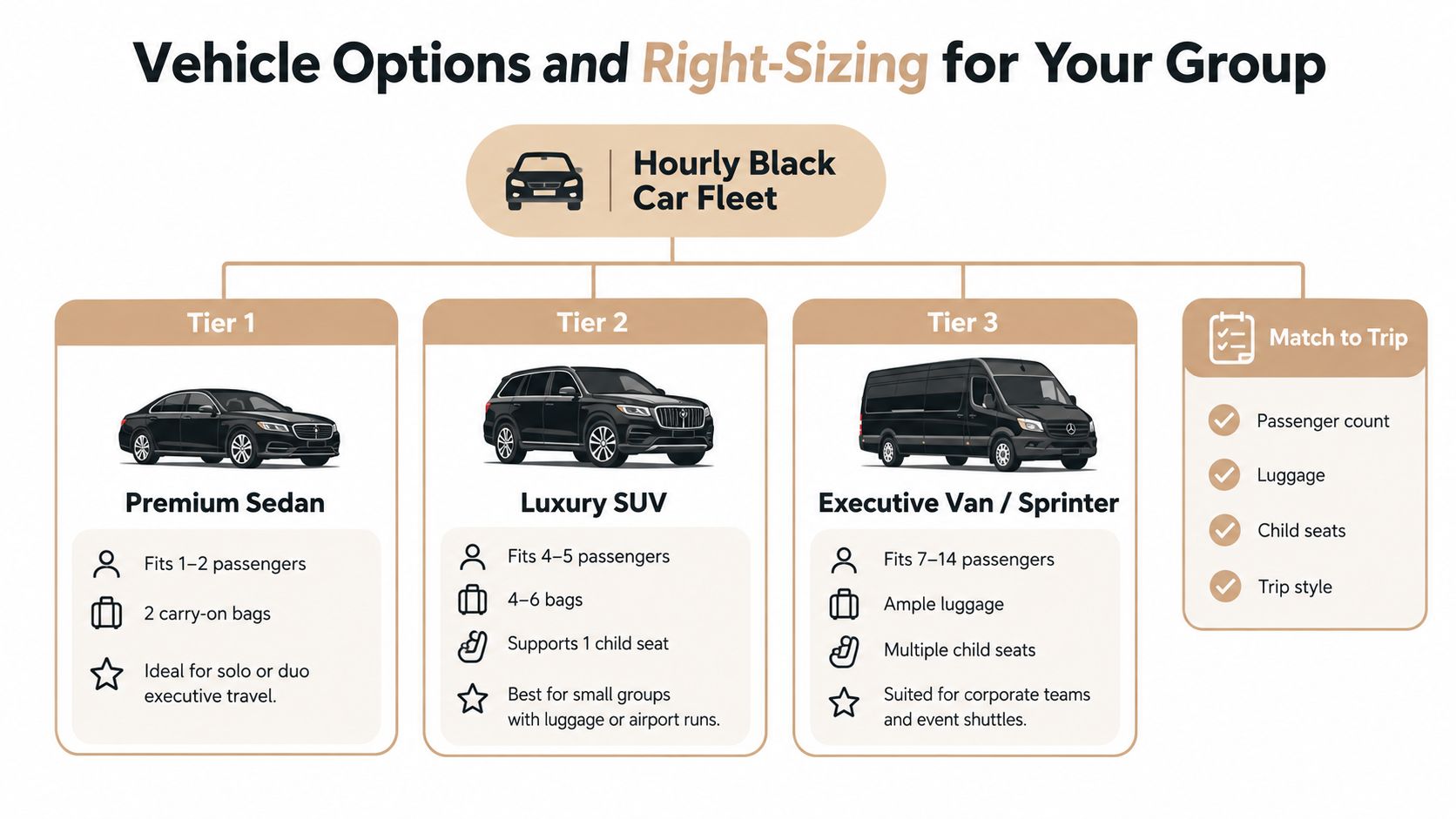
The right vehicle is not just the one with enough seats. Dispatch must account for luggage, child seats, mobility equipment, curb access, comfort, and how long passengers will remain inside. A vehicle that technically fits everyone can still create a poor experience if bags block the cabin or loading takes too long.
Start with the passenger count, then add the conditions that consume usable space:
- Passenger count: Include children and the chauffeur when checking rated capacity.
- Luggage: Count large cases separately from carry-ons.
- Child seats: Request them in advance and identify how many are needed.
- Trip style: An executive transfer, wedding shuttle, and all-day shopping itinerary need different layouts.
- Loading conditions: Narrow streets, hotel zones, airport curbs, and event venues may favor a more maneuverable vehicle.
A premium sedan, such as a Mercedes-Benz S-Class, suits solo or duo executive travel when luggage is light. A Chevrolet Suburban or Cadillac Escalade provides more room for a small party with airport bags. A Mercedes-Benz Sprinter works for larger families, corporate teams, and coordinated event movement. Minibuses and a 55-passenger coach suit weddings, corporate offsites, and school-related transportation.
Interstate insurance and capacity
The vehicle's rated capacity matters beyond comfort when an hourly itinerary crosses state lines. For-hire passenger carriers operating in interstate commerce must maintain at least $1.5 million in public liability coverage for vehicles designed to carry 15 or fewer passengers, including the chauffeur, and at least $5 million for vehicles designed to carry 16 or more passengers, including the chauffeur (FMCSA financial responsibility requirements).
That threshold is based on the vehicle's design capacity, not merely the number of people booked for one ride. If your route connects New York with Boston, Philadelphia, Washington DC, or the Carolinas, ask whether the carrier has the applicable interstate registration and financial-responsibility documentation.
The Federal Motor Carrier Safety Administration describes registration and evidence-of-responsibility requirements for qualifying interstate passenger carriers (FMCSA passenger carrier information). A polished vehicle matters, but documented authorization and suitable commercial coverage matter more.
Pricing Benefits and Honest Trade-Offs
Hourly service is often described as a way to save money, but that claim needs a boundary. Hourly booking isn't automatically economical. If you're traveling from one fixed address to one fixed destination with no waiting, a point-to-point quote may be the more efficient choice.
Hourly service becomes financially useful when it prevents repeated reservations, missed coverage, and last-minute decisions. Fixed pricing and no surge make the quote easier to plan during busy periods, but the value still depends on how much of the reservation you need.
A good comparison asks:
- Will the chauffeur wait through meetings or appointments?
- Are intermediate stops included in the defined service area?
- Does the quote remain fixed if the day becomes busy?
- Is the vehicle held for the full activity window?
- Will an itinerary change require a new reservation?
- Are parking, tolls, and venue access conditions explained?
The cheapest quote can also carry hidden administrative costs. If a corporate assistant has to coordinate several separate rides, track multiple receipts, identify changing vehicles, and solve a late pickup without a clear escalation path, the lower initial quote may not represent the lower total burden.
Duty of care belongs in the comparison
Corporate travel teams often have risk policies, but ground transportation can receive less attention than flights and hotels. A 2025 summary of GBTA research reported that 85% of corporate travel programs include risk-management policies, while 55% always or often address ground transportation. The same summary reported that 24% track ground-transport data, even though 89% have traveler-tracking systems (GBTA-related corporate travel safety summary).
Those figures support a useful corporate checklist: identify the provider, confirm the chauffeur and vehicle, maintain passenger contact details, document itinerary changes, and establish emergency escalation. Hourly booking can support that workflow because one reservation record may cover a full operating window.
For a clearer explanation of predictable quotes, see fixed-price transportation. Treat fixed pricing as a planning tool, not as proof that hourly service is right for every trip.
Booking Tips, Checklist, and How to Request a Quote
A clean reservation begins with useful information. Send the details dispatch needs to match the vehicle, route, and coverage window:
- Passengers: Include adults, children, and anyone needing special assistance.
- Luggage: Describe large cases, golf bags, samples, or equipment.
- Child seats: State the number and type requested.
- Pickup: Provide the full address, building entrance, terminal, or venue.
- Stops: List meetings, residences, restaurants, clubs, and likely additions.
- Timing: Include the event start time and the time the vehicle must remain available.
- Flight data: Send the airline and flight number for airport pickups.
A specific flight number matters because general airport conditions aren't the same as flight-specific arrival information. Dispatch can coordinate the pickup against the individual arrival, terminal, and client communication plan rather than relying on a broad airport notice.
Questions to settle before booking
How is a delayed meeting or flight handled? Confirm whether the chauffeur remains assigned during the reserved window and what happens if coverage needs to extend.
Are stops and route changes included? Ask the dispatcher to define the service boundary, stop sequence, waiting arrangement, and any conditions that could change the quote.
How should a multi-car event be organized? Provide one manifest, one event contact, synchronized arrival windows, passenger assignments, and a single billing contact when available.
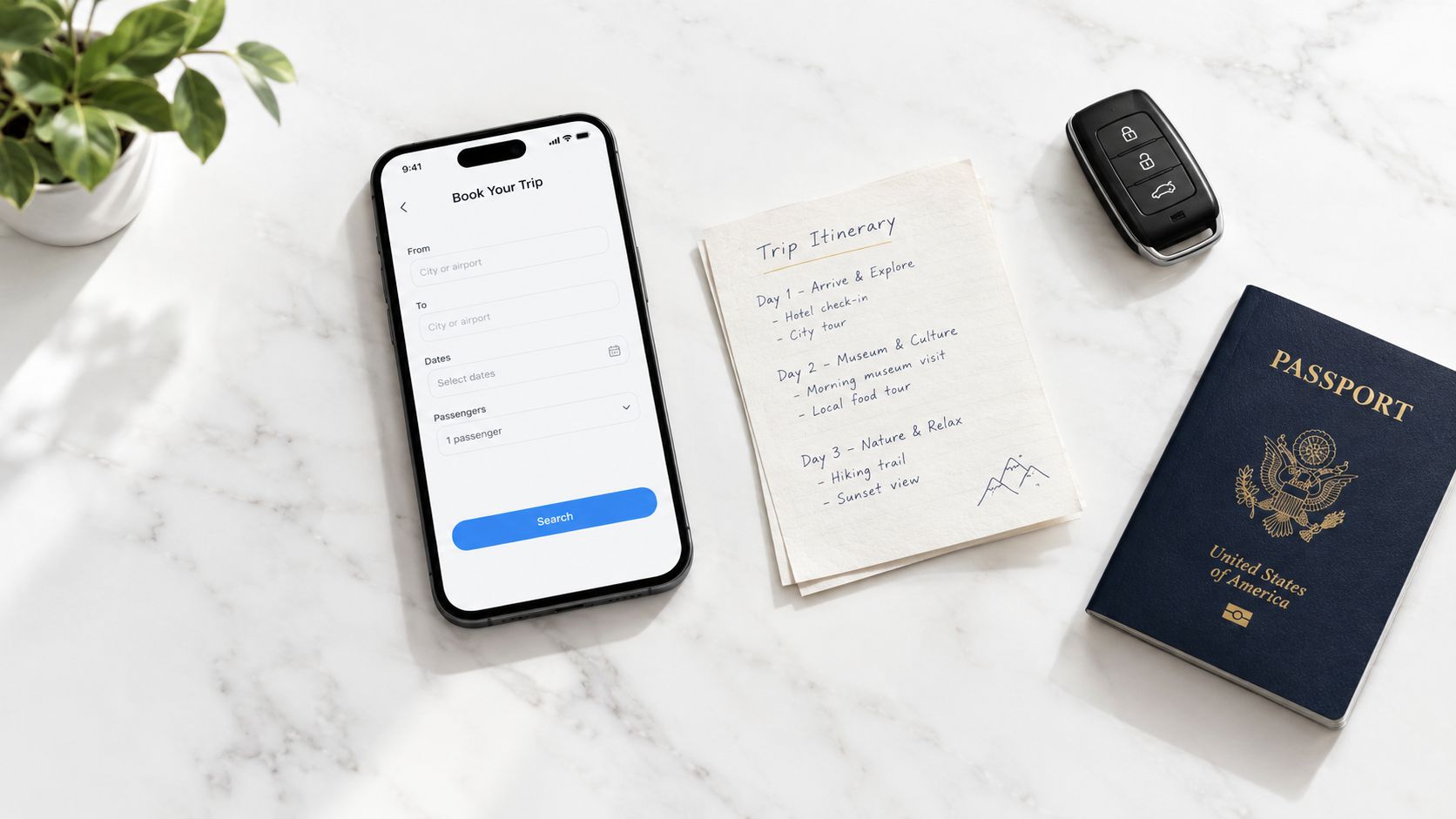
For a visual reminder of the planning process, use this travel-planning reference:
Text (631) 294-0747 for a quote and describe the entire activity window, not only the first pickup. That gives the dispatcher enough context to compare point-to-point and hourly coverage fairly.
Hamptons Leisure Limo provides prearranged hourly transportation across the Hamptons, Long Island, and New York City, with vehicle options for executive travel, airport waits, events, and coordinated group itineraries. Text (631) 294-0747 for a fixed quote, then visit Hamptons Leisure Limo to plan a reservation built around your actual stops, timing, and passenger needs.
Ready to Ride with Hamptons Leisure Limo?
Fixed pricing. No surge fees. 30 years of experience serving the Hamptons. Text us what you need and we will send a quote.