Business Transportation Services in the Hamptons and NYC
Updated November 15, 2026

You already know the shape of the week. A 7:40 a.m. departure out of JFK on Tuesday, a board meeting in Midtown that afternoon, six colleagues landing on three different airlines between Thursday night and Friday morning, and a client dinner in Sag Harbor on Saturday that has to end with everyone back at their hotel before midnight.
None of that schedule is fully in your control. The ground transportation is. What follows is how to match vehicles, airports and group logistics to the trip you're taking, and where each choice starts costing you time or money the moment a plan changes.
Table of Contents
- Business Transportation Options at a Glance
- Which Business Trips Need Ground Transportation
- Executive Airport Transfers From JFK, LGA, EWR and ISP
- How Flight Delays and Changed Itineraries Are Handled
- Corporate Events, Retreats and Large Group Moves
- Verifying Credentials, Fixed Pricing and Booking Terms
- Request a Business Transportation Quote Today
Business Transportation Options at a Glance
Start with the service list, because most quote requests arrive half-specified. Someone asks for an SUV when the trip really needs an hourly booking plus a second vehicle at 11 p.m. Hamptons Leisure Limo offers nine service types: airport transfers, chauffeur service, hourly, point-to-point, long-distance, wedding, corporate, prom and special events. Three of those carry most of the business travel load: the airport transfer, the hourly booking and the point-to-point ride.
The distinction matters more than it sounds. Chauffeur service assigns a dedicated chauffeur for the day, so the vehicle stays with the client through back-to-back meetings, a lunch that runs long and a stop nobody put in the calendar. Point-to-point is a single one-way trip, fixed-price and quoted before the client steps into the vehicle, which suits a straight airport run or a Manhattan to Southampton transfer where traffic is the only real variable. Booking hourly when you needed point-to-point wastes money. Booking point-to-point for a day with four stops strands the traveler at stop three.
Vehicle capacity and the right use for each
Count people and bags first, then read down this table.
| Vehicle | Passenger capacity | Best for |
|---|---|---|
| Mercedes-Benz S-Class | Up to 3 | Executive transfers and one-on-one chauffeur days |
| Chevrolet Suburban or Cadillac Escalade | Up to 6 | Small teams and airport pickups with luggage |
| Mercedes-Benz Sprinter van | Up to 14 | Small offsites and team airport transfers |
| 25-passenger minibus | 25 | Mid-size corporate outings |
| 55-passenger motor coach | 55 | Large groups, detailed in the events section |
Two details get missed. The 36-passenger minibus sits between the 25-passenger coach and the full motor coach and is usually the right answer for a 30-person offsite that can't justify a coach. And a Sprinter carrying 14 people with 14 roll-aboards is a different booking than the same Sprinter with 14 people and no luggage, so state the bag count when you reserve.
The rule that survives contact with reality: count passengers and luggage first, then choose the smallest vehicle that fits both. A group of nine in a 25-passenger minibus pays for space it never uses; the same nine split across two SUVs needs two chauffeurs, two pickup windows and a coordinator keeping them together.
Practical rule: when the headcount is soft, book one size up from the current count and confirm the final number two days out. Resizing downward is easy. Finding a second coach in August is not.
Which Business Trips Need Ground Transportation
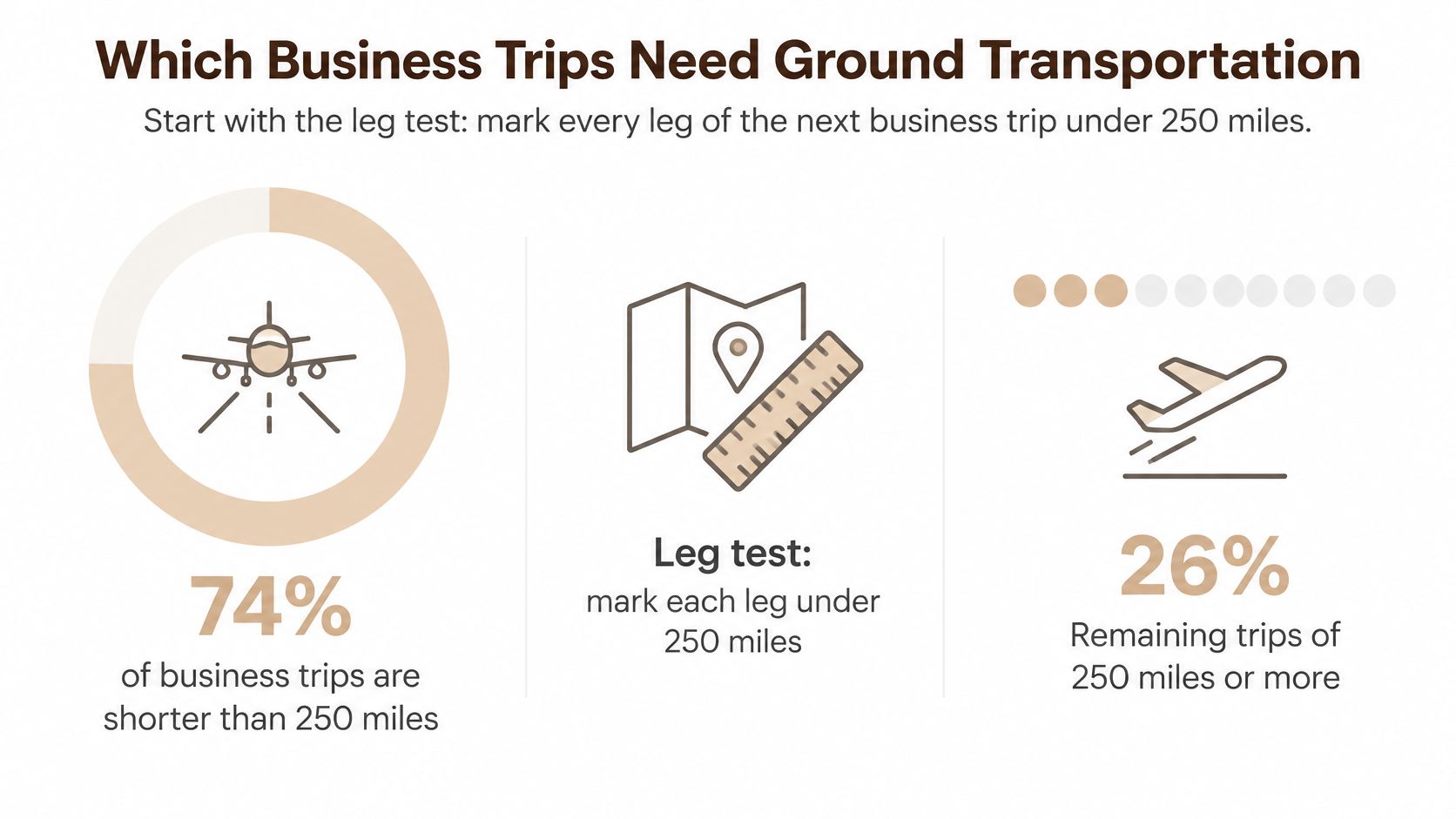
Run the leg test before you look at a single vehicle. List every leg of the next business trip: home to airport, airport to hotel, hotel to office, office to dinner, dinner back to hotel. Mark each leg under 250 miles. That's the zone where chauffeured transportation competes on something other than price.
The Bureau of Transportation Statistics reports that Americans make more than 405 million long-distance business trips annually, representing 16% of all long-distance travel, and that nearly three-quarters, or 74% of business trips are shorter than 250 miles, with most of those under 100 miles. Personal vehicles account for approximately 81% of business trips and air travel about 16%, but the split shifts with distance: for trips between 500 and 749 miles, air captures 64% of trips against 33% for personal vehicles.
That 74% is the whole argument for scheduled car service in a regional market. The trip isn't long enough to fly and shouldn't be driven by someone who needs to arrive sharp.
What each short leg should book as
- Under 100 miles with a fixed start and end: point-to-point. One vehicle, one price, no meter running while your client answers email in the back.
- Three or more stops in a day: hourly. The chauffeur holds the vehicle, and nobody renegotiates a pickup every time a meeting overruns.
- The airport leg: a transfer booked with the flight number attached, because that's the leg most likely to move without warning.
For the Hamptons and New York City, this means airport transfers are only part of the demand. Corporate itineraries need dependable links between a Manhattan office, an East End venue and a second destination in the same day, and the value of the booking is that the client never has to solve the middle of the trip themselves.
The flight is the highway. Ground transportation is the last mile that decides whether the executive walks into the room composed or arrives explaining a rideshare cancellation.
Executive Airport Transfers From JFK, LGA, EWR and ISP
There's no commercial airport in the Hamptons. Every executive transfer begins somewhere else, and the airport you pick changes the day more than the airline does.
| Airport | Drive time to the Hamptons | Best for |
|---|---|---|
| JFK | 2 to 2.5 hours | International flights and the most options |
| LaGuardia (LGA) | 2 to 2.5 hours | Domestic flights, often less crowded |
| Newark (EWR) | 2.5 to 3 hours | United Airlines hub |
| MacArthur (ISP) | 45 minutes to 1 hour | Shortest drive, limited flights |
| East Hampton (JPX) or Montauk (MTP) | About 10 minutes from the villages | Private flights |
| Gabreski (FOK) | About 25 minutes to Southampton | Private flights |
Drive time, not distance, is the decision point. A landing at JFK clears the terminal and puts a traveler in Southampton roughly two to two and a half hours later, which still leaves an evening. Newark adds another 30 to 60 minutes on top of that, enough to kill a same-evening dinner on the East End. MacArthur is the only field where someone can land and be at a morning meeting with time to spare, at the cost of a thinner flight schedule.
Volume keeps those three big airports central to the calendar. The FAA's historical passenger totals show U.S. air carriers transported approximately 1.1 billion passengers in fiscal year 2024, 6.5% above the pre-pandemic average of 1 billion passengers recorded across fiscal years 2017 through 2019. More flights means more delays, terminal changes and 20-minute schedule slips that land squarely on the pickup.
Private aviation removes most of that friction. East Hampton and Montauk sit about 10 minutes from their villages, and Gabreski is about 25 minutes from Southampton, so a client on a private jet is effectively already at the destination.
What arrival looks like
For business travel, a regular chauffeur is assigned and learns the traveler's route, coffee order and quiet hours, which matters more on the fourth trip than the first. Flights are tracked in real time and the pickup is adjusted at the curb, and transfers run around the clock so a 5 a.m. departure gets the same treatment as a 9 p.m. landing. The full arrival sequence, including how pickup times are recalculated, is covered in this guide to airport transfers between the city and the East End.
Match the airport to the flight schedule and the destination village, then book with the airline and flight number attached so the assignment follows the aircraft rather than the original plan.
How Flight Delays and Changed Itineraries Are Handled
The question worth asking a provider isn't whether they track flights. It's what happens when the itinerary collapses at 11 p.m. on a Friday. In a survey of travel managers, 64% identified flight delays or cancellations as their top airport frustration, ahead of long security or customs lines at 29%, according to the Air Travel Problems poll results. Newark shows the exposure plainly, with about 29.1% of passengers experiencing disruptions there in 2025 in the AirHelp ranking cited in that survey.
Those numbers describe a system where the ground leg absorbs the failure. A provider with a documented playbook is worth more than one promising punctuality.
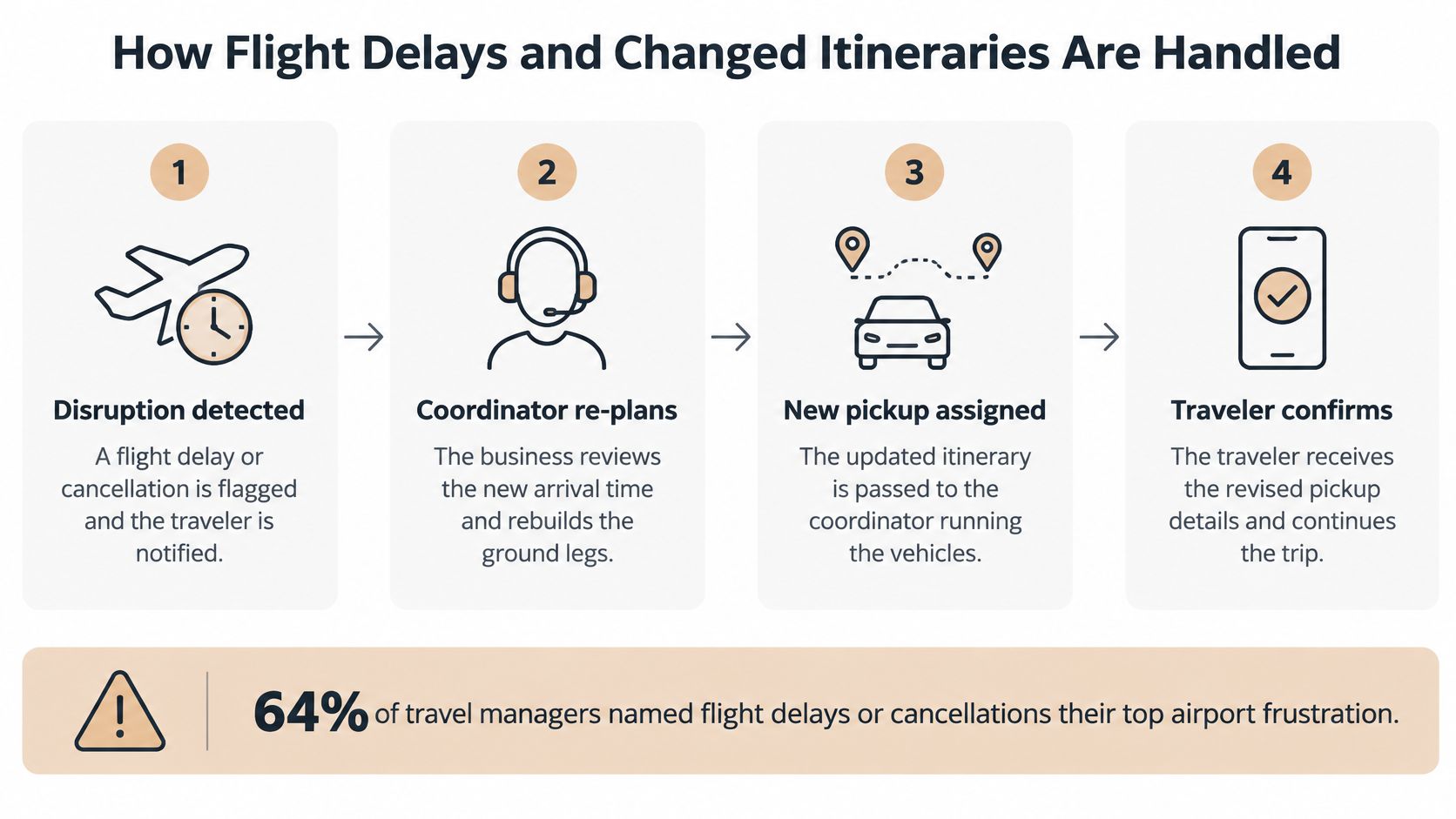
The disruption playbook, in order
- Monitor from booking to landing. Tracking that begins at the gate is already too late. It should start when the reservation is created, so a two-hour delay is visible while the vehicle can still be reassigned.
- Recalculate, then confirm by text. A new pickup time is worthless if the traveler is still working from the original number. Confirming it in writing gives them something to hold onto.
- Write the wait rule into the trip. Agree before departure how long the chauffeur waits for a late arrival and when that wait ends, so nobody negotiates it at the curb at midnight.
- Reroute diversions on the existing booking. If weather pushes a flight to a different airport, confirm the new terminal and rebuild the leg on the original reservation rather than starting a fresh request.
- Keep a human contact list. Assistants, hosts, the coordinator and a second number for the traveler. Phones die, and a group lead stranded in a terminal without a fallback is the failure that gets remembered.
- Reassemble groups at one point. Multi-vehicle movements break apart under delay. One coordinator, one meeting point, one revised departure.
- Hold backup capacity, not just backup vehicles. Federal hours-of-service limits mean a chauffeur must take at least 8 consecutive hours off duty before a shift, may drive no more than 10 hours afterward, and may not remain on duty beyond 15 hours, per FMCSA duty limits. A chauffeur who ran a New York to Hamptons transfer in the morning may be legally unavailable for a late-night recovery, so the fix is a relief chauffeur or a staggered movement, planned before peak season.
- Consolidate the invoice. A trip that changed three times shouldn't arrive as three disjointed charges. Fixed pricing means a rebooked transfer doesn't pick up a surge fee along the way.
Tracking alone isn't resilience. Decision rules are. The mechanics of live monitoring sit in this explanation of tracking flights in real time, but the operational part is knowing who decides when the aircraft lands somewhere unexpected.
Three questions separate a real plan from a promise. Who waits with the vehicle? Who makes the call to change the route? Who gets phoned when the traveler's line goes dead?
Corporate Events, Retreats and Large Group Moves
A single-vehicle transfer is a ride. A group move is a schedule, and it fails in different places. Twelve people arriving on four flights for a Friday retreat need one coordination table, not four separate bookings that nobody reconciles until the last guest is standing outside baggage claim.
| Event | Vehicle plan | Coordination |
|---|---|---|
| Wedding shuttle | 55-passenger motor coach | One coordinator sets arrival windows |
| Corporate retreat | 25-passenger minibus or multiple vehicles | One coordinator and a shared itinerary |
| Executive offsite | Sprinter van or S-Class | Pickup windows set around meeting times |
| Prom or school trip | 25-passenger minibus or 55-passenger motor coach | Guardian contact list and escort-to-gate option |
| Golf outing | Chevrolet Suburban or Sprinter | Tee times and return times scheduled in advance |
Above 14 passengers, the work shifts from vehicle choice to traffic management. Multiple vehicles run under one coordinator so the group arrives together, the itinerary has a single point of contact, and any change reaches every vehicle at the same moment.

Credentials belong in the same conversation as capacity. The New York DMV commercial driver license guidance states that chauffeurs operating stretch limousines carrying nine or more people, including the chauffeur, must hold at least a Class C commercial driver license with a Passenger endorsement, and the minimum CDL itself requires written testing, practice driving and a road test. For event work, ask what the chauffeurs hold, not just what the vehicle looks like in the photo.
Accessibility is a planning task, not a vehicle feature
Wheelchair capacity on a spec sheet doesn't answer the key question: how a traveler requests assistance, confirms mobility-device dimensions and avoids repeating their medical details to four different people. Only 18% of travel managers say their companies extensively accommodate travelers with accessibility needs, while 50% cite limited employee awareness and 30% cite insufficient supplier information and booking complexity, according to Corporate Traveler's accessibility findings. A retreat coordinator should confirm door-to-door versus curbside assistance, service-animal handling and the contingency if the assigned vehicle changes.
The planning routine that holds up: confirm total headcount and bag count, set pickup windows with buffer rather than a single departure time, and name one coordinator who owns the schedule and can be reached by everyone on it. Multi-vehicle shuttle work for corporate groups runs on that structure, which is what corporate shuttle service on the East End covers in practice.
Verifying Credentials, Fixed Pricing and Booking Terms
Four things are worth checking before any deposit moves: a USDOT number you can verify, commercial insurance on the specific vehicles assigned, licensed and insured status in the states served, and chauffeurs holding the credentials their vehicles require. None of it takes more than a few messages, and all of it is invisible until something goes wrong.
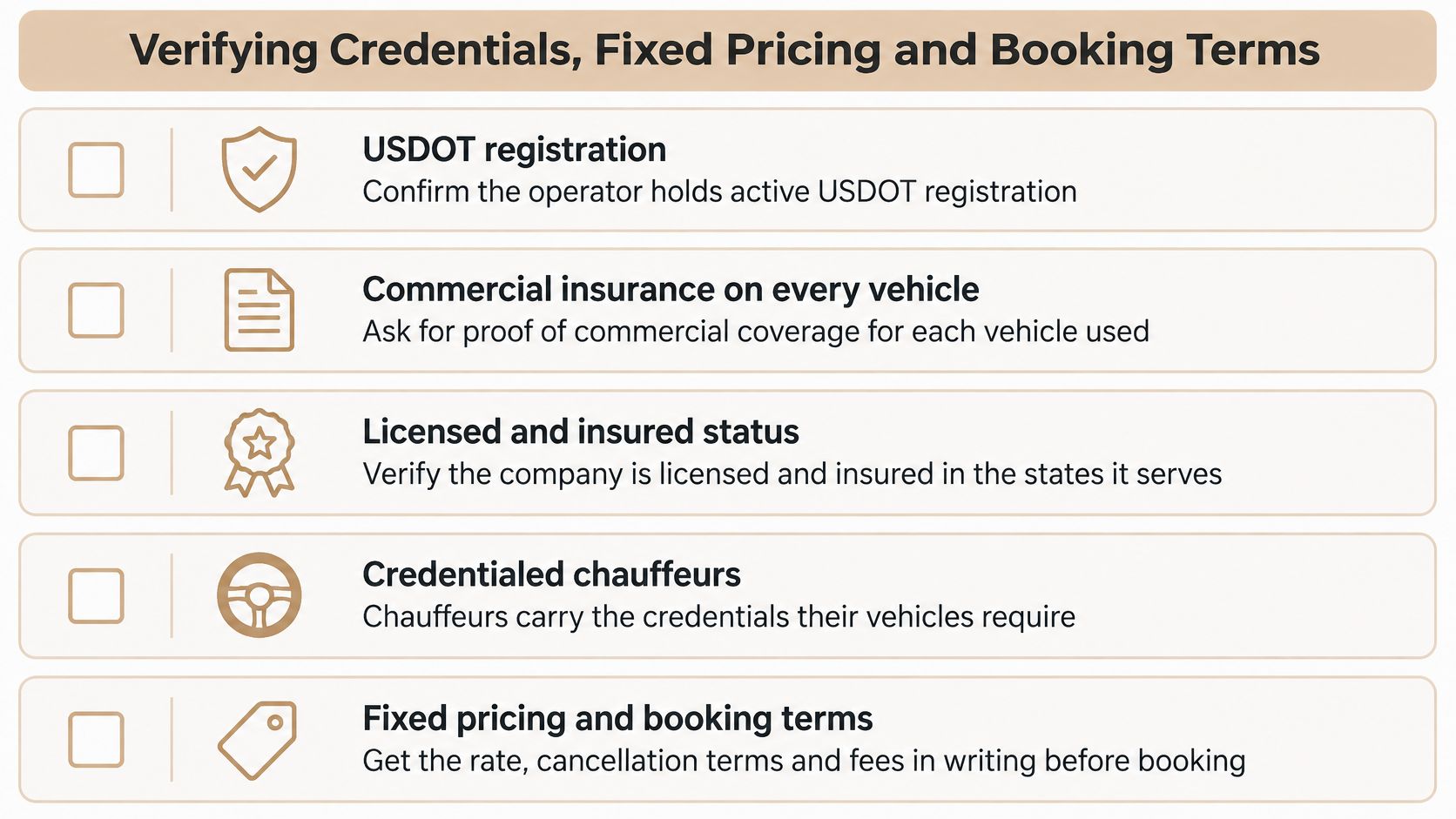
- A USDOT number that resolves to the operator. Verify it against the carrier providing the trip, not a broker's brand name.
- Proof of commercial insurance, per vehicle. A certificate naming the company and the vehicle class you've booked.
- A vehicle matched to the passenger count. A Sprinter booked for 16 people is a compliance problem before it's a comfort problem.
- A written fixed-price quote. Fixed pricing for one-way trips, no surge fees, no hidden charges, with the terms in the same message as the number.
- One named contact for the day of travel. Someone who answers at 6 a.m. and knows the reservation.
The federal thresholds behind the paperwork
Why the vehicle matters legally, not just logistically: FMCSA passenger carrier guidance treats a vehicle as a commercial motor vehicle when it's designed or used to transport at least 9 passengers including the chauffeur for compensation, or 16 or more passengers including the chauffeur regardless of compensation, and also when the gross vehicle weight rating reaches at least 10,001 pounds. Passenger vans, minibuses and motor coaches therefore carry formal obligations that a private car never touches.
Insurance scales with the same logic. Under FMCSA financial responsibility requirements, the minimum liability level a for-hire passenger carrier must hold is set by the largest seating capacity in its fleet, with a higher tier for vehicles designed for 16 or more passengers including the chauffeur. Choosing a larger vehicle can move the trip into a different federal insurance category, which is one reason to ask what a carrier is covered to operate.
Authority is a state question on top of the federal one. The New York DMV guidance for transporting passengers states that carriers generally need operating authority from NYSDOT when transporting passengers for compensation within New York State, alongside inspections and 19-A enrollment for certain categories. Ask for the operating authority and the inspection record next to the insurance certificate. FMCSA inspection guidance requires each commercial vehicle to pass a periodic inspection at least once every 12 months, with roadside inspection reports delivered to the carrier within 24 hours and retained for 12 months, so the record should exist on request.
Before you sign: ask how the quote handles tolls, gratuities and waiting time. Those three line items are where a fixed price quietly stops being fixed.
Pricing that holds still is a credential in its own right. Fixed-price quotes, no surge fees and no hidden charges mean a rebooked transfer, a rescheduled dinner or a two-hour delay doesn't rewrite the invoice, and point-to-point one-way trips are quoted before the client steps into the vehicle. Thirty years of running these routes is the reference behind that. The same discipline applies to any event where costs sit outside the headline rate, including budgeting beyond the base charter rate on a client sailing, where fuel, crew and gratuity determine the final cost.
Request a Business Transportation Quote Today
One action turns this plan into a booking. Hamptons Leisure Limo takes quote requests by text at (631) 294-0747, and the team is available 24/7, so an 11 p.m. message about a 6 a.m. flight gets the same attention as a Tuesday afternoon request.
Send these details in the first text:
- Pickup and drop-off addresses, including the terminal if you know it.
- Airline and flight number for any airport transfer, in both directions.
- Date and time, with a note if the outbound is flexible.
- Passenger count and luggage count, separate numbers.
- Event type for corporate or group work, so multi-vehicle coordination gets priced in from the start.
- Any needs, such as child seats or a pet traveling along.
Child seats are complimentary and pets are welcome in the vehicle, so say so up front rather than at the curb. What comes back is a fixed-price quote with no surge, which you can hold against the vehicle table and the airport drive times above. Text the trip details to (631) 294-0747 today, while the itinerary is still open and the options are still yours.
Hamptons Leisure Limo runs executive airport transfers, hourly chauffeur service, point-to-point transfers and multi-vehicle group coordination across the Hamptons, Long Island and New York City, with fixed pricing, no surge fees and flight tracking on every airport trip. Send the itinerary, passenger count and flight details by text and the team will match the right vehicle to the schedule before anything is confirmed. Visit Hamptons Leisure Limo to plan the next business trip with a quote in hand.
Ready to Ride with Hamptons Leisure Limo?
Fixed pricing. No surge fees. 30 years of experience serving the Hamptons. Text us what you need and we will send a quote.