Airport Transfers NYC: The Hamptons Guide
Updated September 28, 2026
Your flight has landed, your bags are on the carousel, and your next destination is still a long way east. At JFK, LaGuardia, or Newark, the difficult part may not be getting out of the terminal. It may be finding the correct pickup zone, estimating traffic across the city, and securing a vehicle with enough room for your luggage, golf clubs, children, or colleagues. For anyone heading to Southampton, East Hampton, Sag Harbor, or Montauk, airport transfers in NYC are part of the journey, not an afterthought.
A pre-arranged black car transfer gives executive assistants, families, and high-net-worth travelers a clearer handoff. Your chauffeur can monitor the flight, meet you at the agreed location, assist with luggage, and take responsibility for the long road to the East End. App-based transportation can work in simple conditions, but it becomes less predictable when terminals are crowded, traffic thickens, or demand rises.
Table of Contents
- Navigating the New York Airport Chaos
- Choosing the Right Airport for East End Travel
- The True Cost of Surge Pricing and Congestion
- Terminal Pickup Rules and Grace Periods
- Matching the Fleet to Your Itinerary
- Avoiding Common Booking and Routing Mistakes
- Securing Your Fixed-Price Hamptons Transfer
Navigating the New York Airport Chaos
A traveler arrives at JFK after an international flight and opens a rideshare app. The estimated fare has changed, the pickup instructions point to a separate area, and the vehicle location moves while the traveler is still collecting luggage. Meanwhile, the person waiting in Southampton is asking whether the transfer has started.
That situation is common because airport pickup involves more than requesting a car. You need to know the terminal, baggage status, meeting point, vehicle description, and route strategy. At a major airport, small communication gaps create long delays. A chauffeur assigned in advance works from the same information as the dispatch team, rather than beginning the process only after you reach the curb.
The airport itself can add confusion. If you're unfamiliar with a terminal layout, an indoor airport maps guide can help you understand why meeting-point instructions need to be precise. “Meet outside arrivals” isn't enough at a complex airport. A reliable booking identifies the terminal, level, door, zone, and fallback contact method.
Why the East End changes the equation
A trip to Manhattan is often treated as the default airport journey. The Hamptons require a different mindset. Once your vehicle leaves the airport, the transfer becomes a substantial regional trip with limited tolerance for a missed handoff, a poorly sized vehicle, or an unclear price.
The right chauffeur turns that transition into useful private time. You can take a call, review documents, settle children into their seats, or rest after a long flight. The vehicle should be ready for the actual itinerary, not merely available somewhere in the airport queue.
Practical rule: For a Hamptons arrival, book the ground leg with the same care you give the flight. The airport handoff determines whether the rest of the journey feels controlled or improvised.
Choosing the Right Airport for East End Travel
The best airport for a Hamptons trip depends on where you're flying from and how much you value route selection versus road time. JFK, LaGuardia, Newark, and Long Island MacArthur serve different purposes. Treating them as interchangeable is a planning mistake.
JFK is usually the practical choice for international travelers and many long-haul itineraries. It handled 62.63 million passengers in 2025, compared with 47.00 million at Newark and 32.79 million at LaGuardia, for roughly 142.7 million passengers across the Port Authority's three major airports, according to the Port Authority's 2025 facility volume report. That volume supports broad flight availability, but it also means heavier terminal activity and more complicated ground coordination.
LaGuardia is primarily domestic and can be a sensible choice for travelers arriving from major U.S. cities. It sits closer to many parts of Long Island than Newark, but the final Hamptons journey still depends heavily on city traffic and the exact East End destination. Newark works well when the flight schedule is materially better or when a traveler is already positioned in New Jersey, though crossing the city and Long Island adds route complexity.
Long Island MacArthur, also known as ISP, is the most strategically convenient airport for many East End trips when the route is available. Its limitation is flight selection. A slightly shorter drive isn't useful if choosing it requires an awkward connection, inconvenient arrival, or a schedule that doesn't fit the itinerary.
NYC airport to Hamptons transit profile
| Airport | Est. Drive Time to Southampton | Primary Flight Profile |
|---|---|---|
| JFK | Variable, based on traffic and destination | International and broad domestic service |
| LaGuardia | Variable, based on traffic and destination | Primarily domestic service |
| Newark | Variable, with cross-city and Long Island routing considerations | Domestic and international service |
| Long Island MacArthur | Generally the shortest road approach to the East End | More limited commercial flight selection |
Airport history helps explain why the New York system feels fragmented. LaGuardia opened in 1939, while JFK opened in 1948 as New York International Airport, later known as Idlewild, and was renamed in 1963 after President John F. Kennedy. JFK became New York's busiest airline airport by 1964, as documented in the FAA history of New York airports.
For executive assistants, the decision is simple: choose the flight first, then select the transfer around the airport profile. Don't force an inferior flight merely to avoid a longer drive. Instead, tell the transportation provider the airport, arrival details, destination town, luggage profile, and desired level of flexibility before confirming the booking.
The True Cost of Surge Pricing and Congestion
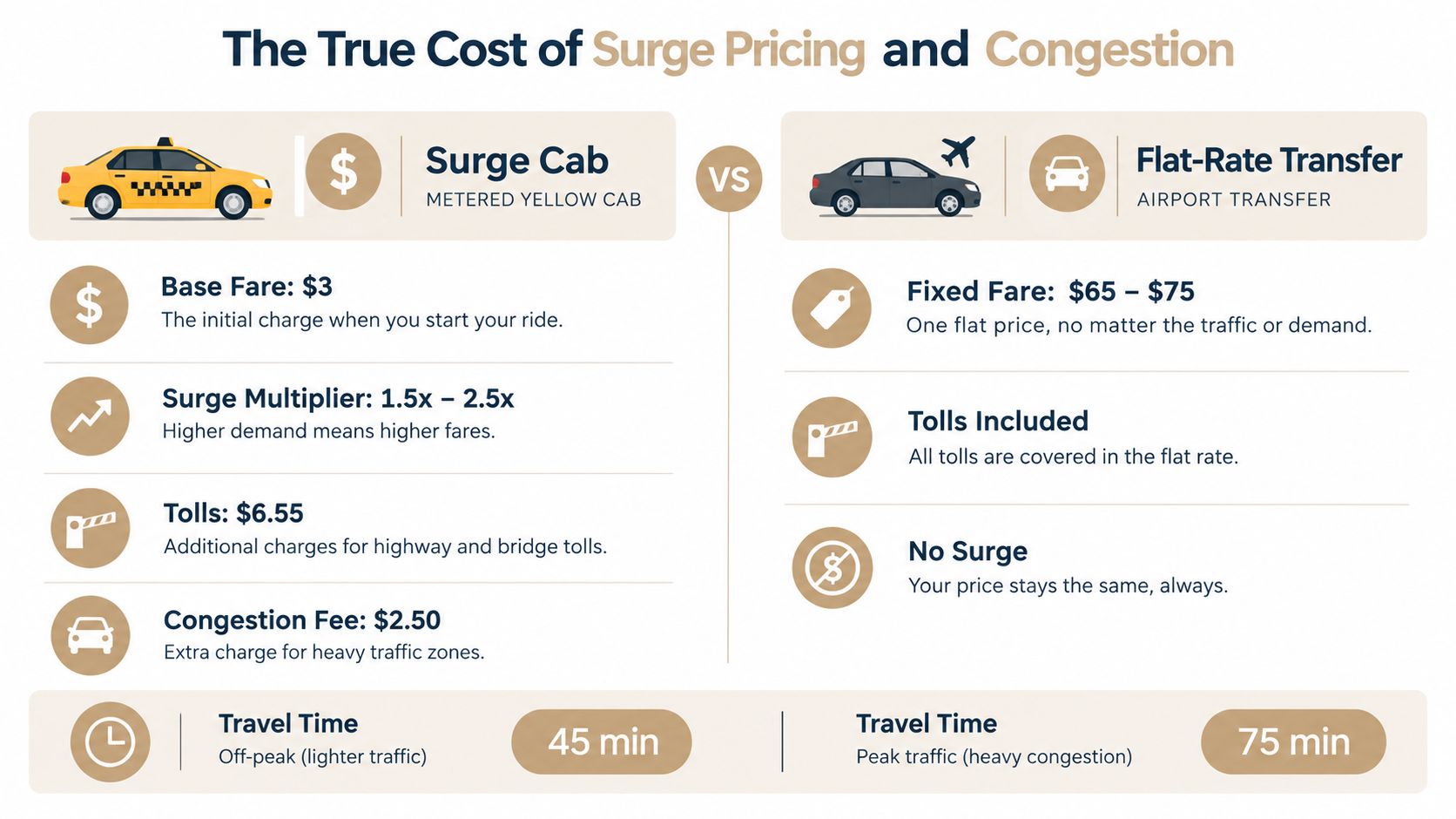
The cheapest displayed fare isn't always the lowest-cost transfer. A rideshare estimate can change before pickup, while a taxi meter, tolls, waiting time, and congestion-related charges can make the final total difficult to predict. That uncertainty matters more on a long airport journey to the Hamptons than it does on a short local trip.
Recent coverage reports that New York's Congestion Relief Zone began on January 5, 2025 and adds $9 for passenger vehicles entering Manhattan south of 60th Street during peak hours, as described by Business Travel Today's NYC airport car-service coverage. The same source reports Q1 2026 rideshare dispatch logs showing surge multipliers of 1.8x to 2.4x at JFK and Newark during weekday morning peaks. Those figures don't apply to every trip, but they show why a headline app estimate isn't a dependable budget.
What predictable pricing actually solves
Fixed pricing changes the decision from “What will this cost when I land?” to “What did I approve before departure?” That distinction is valuable for corporate travel, family logistics, and anyone coordinating a pickup for another person. You can compare the quote against the itinerary without watching demand conditions rewrite the fare.
JFK's official taxi guidance provides a useful example of why advertised prices require context. The airport states that Manhattan taxi trips use a flat fare of $70, plus tolls, tip, and an additional $2.75 to $8.50 in fees depending on time and destination, as explained on the official JFK taxi service page. The page also says that the flat fare applies only to the first Manhattan stop when a passenger requests multiple stops, after which the meter begins a new trip.
For a Hamptons transfer, the important question is broader than the base fare. Ask whether tolls, waiting, luggage assistance, gratuity, and airport access are included. Hamptons Leisure Limo offers a fixed-price model with no surge, and you can review the practical distinction in this guide to what surge pricing means for airport transportation.
The right comparison is not app estimate versus limousine quote. It's uncertain total cost versus a confirmed transfer plan.
Terminal Pickup Rules and Grace Periods
A smooth airport pickup starts with a clear walking route. Don't assume your chauffeur can wait at any curb, especially at LaGuardia, where terminal frontages are designed for active pickups and drop-offs rather than vehicle storage.
LaGuardia's official guidance says passengers must be ready with all bags before approaching the curb. Parking isn't allowed on airport roadways or terminal frontages, and unattended vehicles can be towed at the owner's expense. The airport's on-airport lot is open 7 days a week from 7:00 a.m. to 11:59 p.m. ET, according to the LaGuardia pickup and drop-off rules.
Follow the meeting point, not the habit
Terminal-specific instructions matter. At LaGuardia Terminal B, black cars, rideshare vehicles, and car services don't collect passengers at the arrivals curb. The designated meeting area is the parking garage on Level 2, rows E through F, following signs for Ground Transportation or For-Hire Vehicles, as detailed in this Terminal B pickup guide.
A professional booking should give you more than a company name. Confirm:
- Terminal and level: Verify where you'll walk after baggage claim.
- Meeting zone: Ask whether the chauffeur meets curbside, in a garage, or at another designated area.
- Contact method: Keep the dispatch number available if the terminal changes.
- Luggage status: Tell the team whether you'll have checked bags, oversized items, or mobility equipment.
Flight tracking makes the scheduled pickup time less rigid. For Newark, independent airport-service guidance describes grace periods tied to actual landing rather than the scheduled arrival. The published structures range from 45 minutes for domestic flights and 75 minutes for international flights to 60 minutes for domestic arrivals and 90 minutes for international arrivals, as outlined by Newark airport car-service guidance.
That variation is exactly why you should confirm the provider's policy before booking. A dispatch team that watches the flight can adjust for delays and coordinate the curbside handoff around the actual arrival, not an outdated timetable. You can also review how real-time flight tracking supports airport pickups.
Matching the Fleet to Your Itinerary
Vehicle selection should follow the luggage and the passengers, not the other way around. A premium sedan may suit one executive with a carry-on, but it can become uncomfortable when the same traveler adds presentation cases, winter coats, or equipment for a weekend on the East End.
Choose around the real load
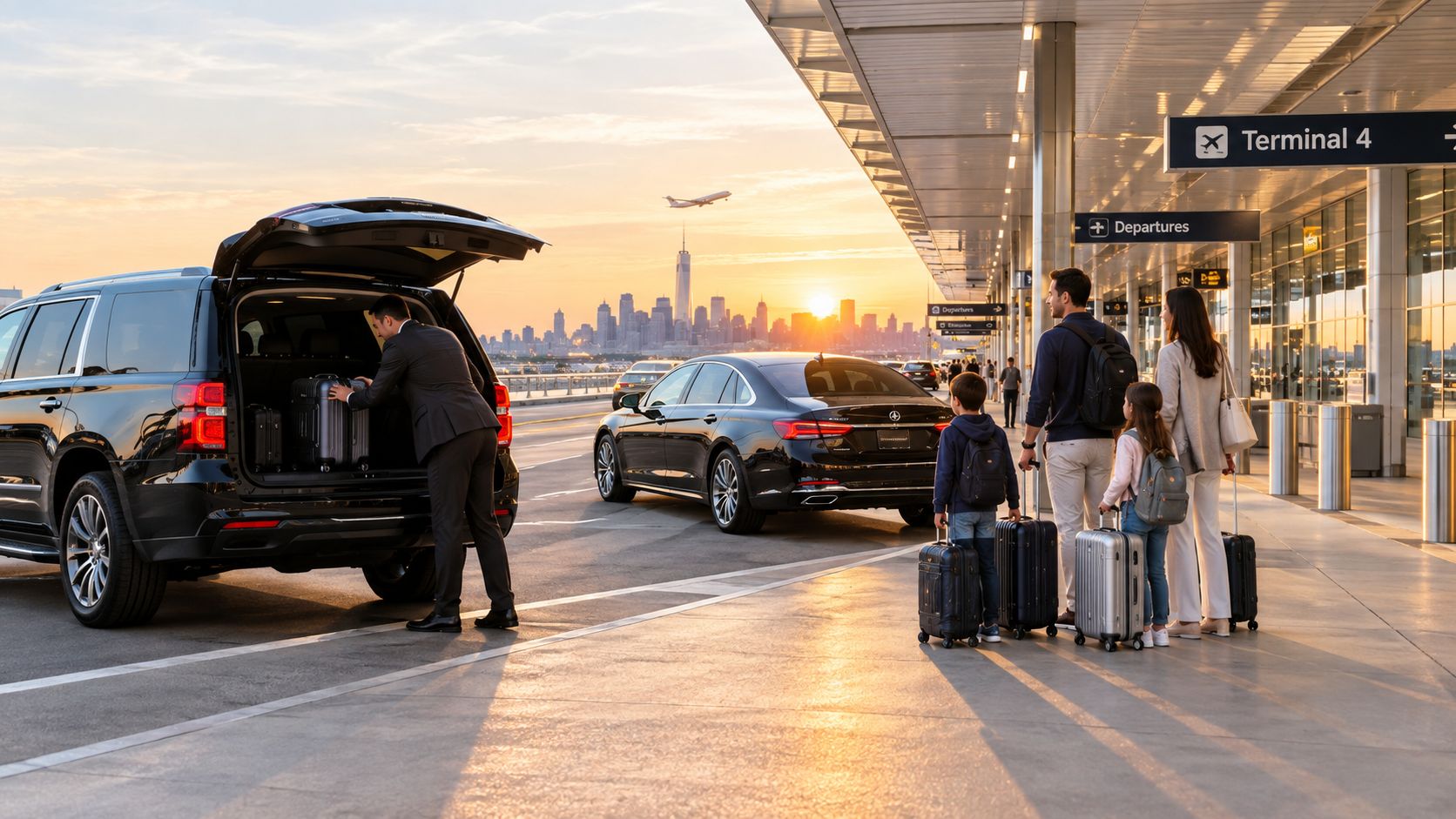
A Mercedes-Benz S-Class suits a solo executive or a small party that travels light. A premium SUV, such as a Chevrolet Suburban or Cadillac Escalade, accommodates up to 6 passengers and gives families more usable luggage space. That extra room matters when everyone has a suitcase, personal bags, and items that can't be compressed.
Golf travel creates another clear example. A trip from JFK to a Shinnecock Hills itinerary may require club storage in addition to standard luggage. Tell the coordinator about the clubs before the vehicle is assigned. The same principle applies to strollers, folding wheelchairs, musical instruments, or retail purchases.
For families, request child seats in advance and confirm how many are needed. For corporate retreats, wedding parties, or multi-family travel, a Mercedes-Benz Sprinter van can carry up to 14 passengers, while larger groups may need a 25-passenger, 36-passenger, or 55-passenger coach.
The vehicle also affects the quality of the arrival. A spacious SUV reduces the need to stack bags around passengers, while a properly coordinated van keeps a group together instead of splitting people across several app-based vehicles.
A short video can help travelers understand the practical difference between vehicle classes and luggage planning before they reserve a transfer.
Give the transportation coordinator the complete passenger count, luggage description, child-seat needs, destination town, and any intermediate stops. For the East End, comfort is not a decorative upgrade. It protects the itinerary from an avoidable capacity problem.
Avoiding Common Booking and Routing Mistakes
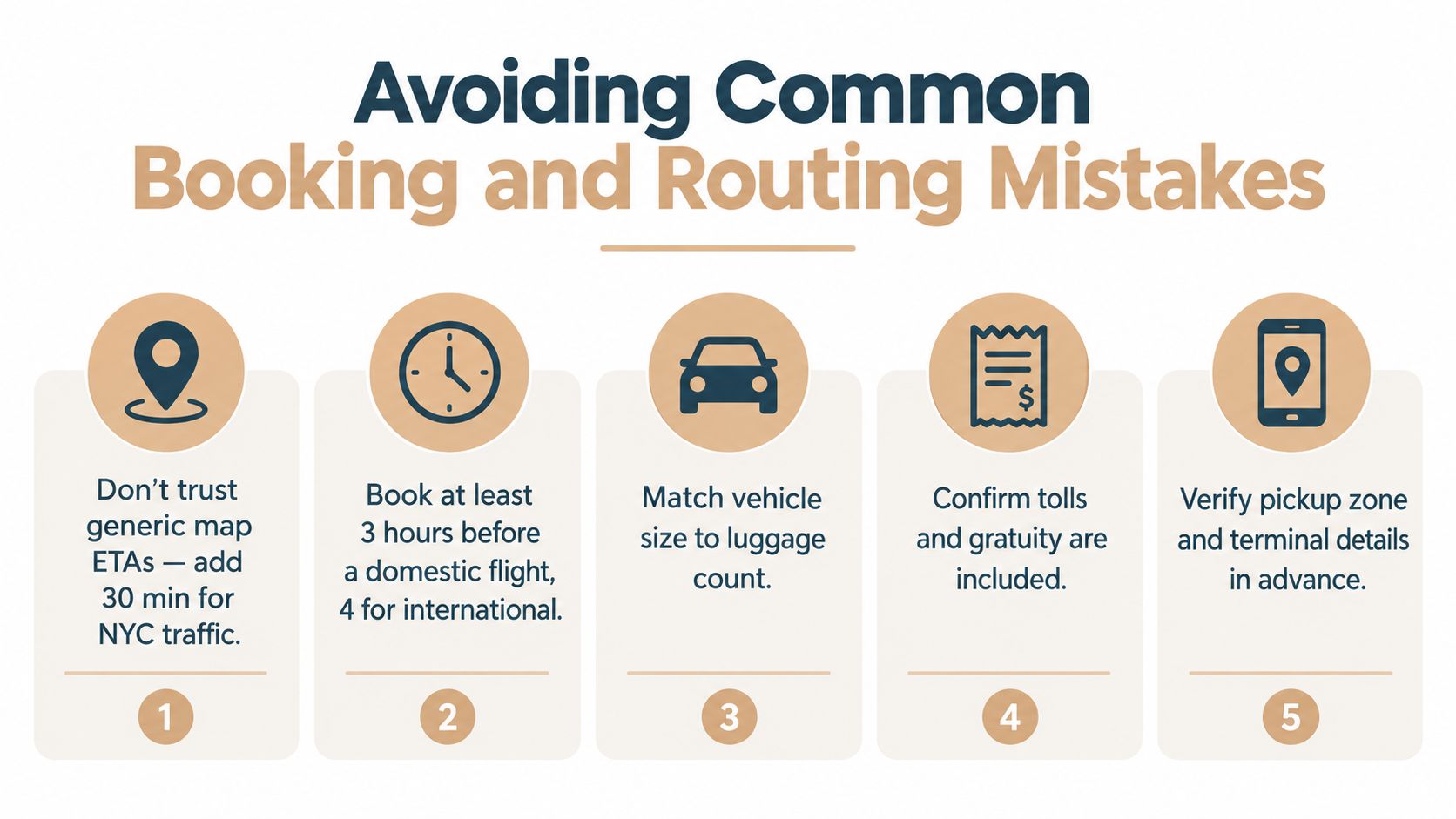
Generic map apps are useful for orientation, but they aren't a complete dispatch plan. JFK guidance estimates 30 to 60 minutes from JFK to LaGuardia and 60 to 100 minutes from JFK to Newark, reflecting the variability of crossing borough and state boundaries, according to the airport's connections travel guidance. A route to Southampton adds another layer of uncertainty, so a fixed ETA without traffic-aware planning is a weak basis for a high-value itinerary.
The most damaging mistakes are usually preventable. They happen when a traveler supplies incomplete flight information, books a vehicle that can't carry the luggage, or treats a cross-airport transfer like a short local ride.
Give dispatch enough information
An executive assistant should provide the exact flight number, arrival airport, terminal if known, passenger name, mobile number, destination address, and luggage profile. If the itinerary includes a dinner, meeting, or connecting flight, state the hard deadline instead of leaving the chauffeur to infer it.
Use these checks before confirming:
- Confirm the flight number: Dispatch can track the actual arrival and respond to delays.
- Describe luggage accurately: Count suitcases, carry-ons, golf bags, strollers, and equipment.
- Separate airport transfers: JFK to LaGuardia and JFK to Newark require different routing assumptions.
- Clarify the destination: Southampton, Montauk, and the North Fork aren't interchangeable drop-offs.
- Ask about the complete quote: Confirm the treatment of tolls, gratuity, waiting, and additional stops.
The Port Authority Airport Traffic Dashboard tracks ground-transport activity across JFK, Newark, LaGuardia, and Stewart, including taxi-dispatched data for JFK, Newark, and LaGuardia. Its airport traffic dashboard user guide shows why airport demand data can be more operationally useful than airline arrivals alone when teams plan staffing, vehicle staging, and curb management.
Don't build a critical itinerary around the cheapest theoretical route. Build it around a verified pickup location, an appropriate vehicle, active flight monitoring, and enough time for the actual road conditions.
Securing Your Fixed-Price Hamptons Transfer
A dedicated local service is the sensible choice when the destination is the Hamptons and the arrival needs to feel orderly. A Southampton-based team understands the East End route network, the difference between a Southampton and Montauk drop-off, and the coordination required for airport pickups, corporate travel, golf outings, weddings, and family arrivals.
The booking conversation should be direct. Provide the airport, flight number, destination, passenger count, luggage, child-seat needs, and preferred vehicle. Then request a fixed-price quote that clearly states what the transfer includes. A fixed-price airport transfer gives you a better basis for planning than a fare that changes with demand after landing.
Hamptons Leisure Limo provides pre-arranged airport transfers from JFK, LaGuardia, Newark, Long Island MacArthur, and private airports, with flight tracking and curbside coordination. Its fleet includes premium SUVs, Mercedes-Benz sedans, Sprinter vans, and larger coaches for group transportation.
Booking standard: Your transportation provider should know where you're meeting, what you're carrying, who is traveling, and what price you approved before the aircraft lands.
Text (631) 294-0747 for a quote. A short message can secure a fixed-price transfer, an experienced chauffeur, and a vehicle matched to your route and luggage.
Text (631) 294-0747 to arrange a fixed-price airport transfer from JFK, LaGuardia, Newark, or Long Island MacArthur to Southampton, East Hampton, Montauk, or another Long Island destination. Visit Hamptons Leisure Limo to coordinate a spacious vehicle, flight tracking, and a clear curbside handoff for your next East End journey.
Ready to Ride with Hamptons Leisure Limo?
Fixed pricing. No surge fees. 30 years of experience serving the Hamptons. Text us what you need and we will send a quote.