Corporate Shuttle Service: Fleet, Costs and Routing Guide
Updated October 28, 2026
Your leadership team lands at JFK on Friday afternoon, and you need to get everyone to a Southampton offsite before the opening session. There are 16 travelers, luggage, and arrival times that don't quite match. Booking a large vehicle sounds simple until you realize the key decisions are who travels together, when they can leave, and what happens if a flight is delayed.
A corporate shuttle service starts with those decisions, not a vehicle brochure. The right program matches transportation to the schedule, then puts clear responsibilities and pricing around it.
Table of Contents
- What a Corporate Shuttle Service Covers
- Fleet Options From Sedans to 55-Seat Coaches
- Why Companies and Event Planners Use Shuttles
- How Scheduling and Routing Keep Groups on Time
- Corporate Shuttle Use Cases in the Hamptons and NYC
- Fixed Rates Compared With Surge Pricing
- Vet Your Provider and Request a Quote
What a Corporate Shuttle Service Covers
A corporate shuttle service is a pre-arranged group transportation program with professional chauffeurs, organized for a company. It can cover employee transfers, executive movements, offsites, retreats, and event logistics. It doesn't have to mean a bus repeating the same route all day.
For the hypothetical leadership team arriving at JFK, the coordinator first checks whether everyone can reasonably leave together. If some executives arrive much later, holding the entire group may make less sense than arranging a separate transfer.
The difference from booking several unrelated cars is coordination: one request, one transportation plan, one invoice, and vehicles matched to the group. Travelers receive consistent instructions, while the company has a named contact responsible for the overall movement.
Choose the service pattern first
A scheduled shuttle works like a commuter rail line: passengers organize themselves around its timetable. A point-to-point transfer works more like a dedicated taxi, taking an assigned group directly where it needs to go.
Corporate shuttle service models compared
| Service model | How it runs | Best for |
|---|---|---|
| Scheduled route shuttle | Fixed stops on a set timetable | Daily employee travel between hubs, rail stations and offices |
| Point-to-point group transfer | One pickup and one drop-off at a set time | Airport arrivals, hotel to venue and offsite moves |
| Hourly charter | Vehicle and chauffeur held for a block of hours | Multi-stop days, site visits and executive itineraries |
| Event shuttle | Timed trips between a meeting point and one venue | Conferences, galas, retreats and wedding weekends |
An hourly charter is useful when the vehicle needs to remain available between appointments. An event shuttle instead prioritizes moving attendees around a venue's opening, program, and departure times.
Before requesting vehicles, answer these questions:
- Repetition: Does the travel repeat on a timetable?
- Trip structure: Is it a direct movement or a day with several stops?
- Venue connection: Is the transportation tied to a single event location?
Those answers establish the operating model. Only then should you decide which vehicles to reserve.
Fleet Options From Sedans to 55-Seat Coaches
Corporate shuttle fleet capacity and best use
| Vehicle | Passenger capacity | Best for |
|---|---|---|
| Mercedes-Benz S-Class | Up to 3 passengers | One executive or a small leadership pair |
| Chevrolet Suburban or Cadillac Escalade | Up to 6 passengers | Small team with luggage |
| Premium SUV | Up to 6 passengers, with the assigned model confirmed | Executives on a separate arrival or a smaller side run |
| Mercedes-Benz Sprinter van | Up to 14 passengers | Team of 6 to 14, airport arrivals with bags |
| 25-passenger minibus | Up to 25 passengers | Mid-size offsites and hotel transfers |
| 36-passenger minibus | Up to 36 passengers | Larger departmental groups and event movements |
| 55-passenger motor coach | 55 passengers | Full-company moves and large events |
Vehicle selection is the first equipment decision, but seat count is a starting point, not the answer. Confirm the actual vehicle configuration and baggage space before treating its passenger capacity as a practical airport load.
The Mercedes-Benz S-Class suits an executive who needs a separate itinerary. A Chevrolet Suburban or Cadillac Escalade gives a small team shared transportation without requiring everyone to follow the larger group's schedule.
The Mercedes-Benz Sprinter is a useful option for airport arrivals with bags. Still, a team carrying presentation equipment, golf clubs, or oversized cases needs a specific storage check rather than an assumption that every seat can be occupied.
Match the vehicle to the busiest run
Minibuses fill the gap between vans and full-size coaches. For a large company movement, a luxury coach bus can keep the group together, provided the pickup location and destination can accommodate it.
Practical rule: Match capacity to the riders on each run plus their luggage. Don't send a coach simply because it was needed for an earlier departure.
Child seats are available by request. Include them in the initial booking so the provider can confirm the appropriate arrangement before assigning the vehicle.
Environmental comparisons also require more than a seating chart: the EPA transportation inventory reports that light-duty trucks, including SUVs, pickup trucks, and minivans, accounted for 37% of transportation greenhouse-gas emissions in 2022. That category-wide figure doesn't establish the footprint of an individual trip, which requires occupancy, fuel type, mileage, and operating conditions.
Use this selection checklist:
- Group size: Count confirmed riders on each departure.
- Luggage per rider: Include equipment and oversized items.
- Route length: Consider comfort over the full journey.
- Stops: Check access, loading space, and turning room.
- Accessibility: Confirm boarding and securement needs.
- Trip direction: Specify one-way travel, a return transfer, or vehicle standby.
Why Companies and Event Planners Use Shuttles
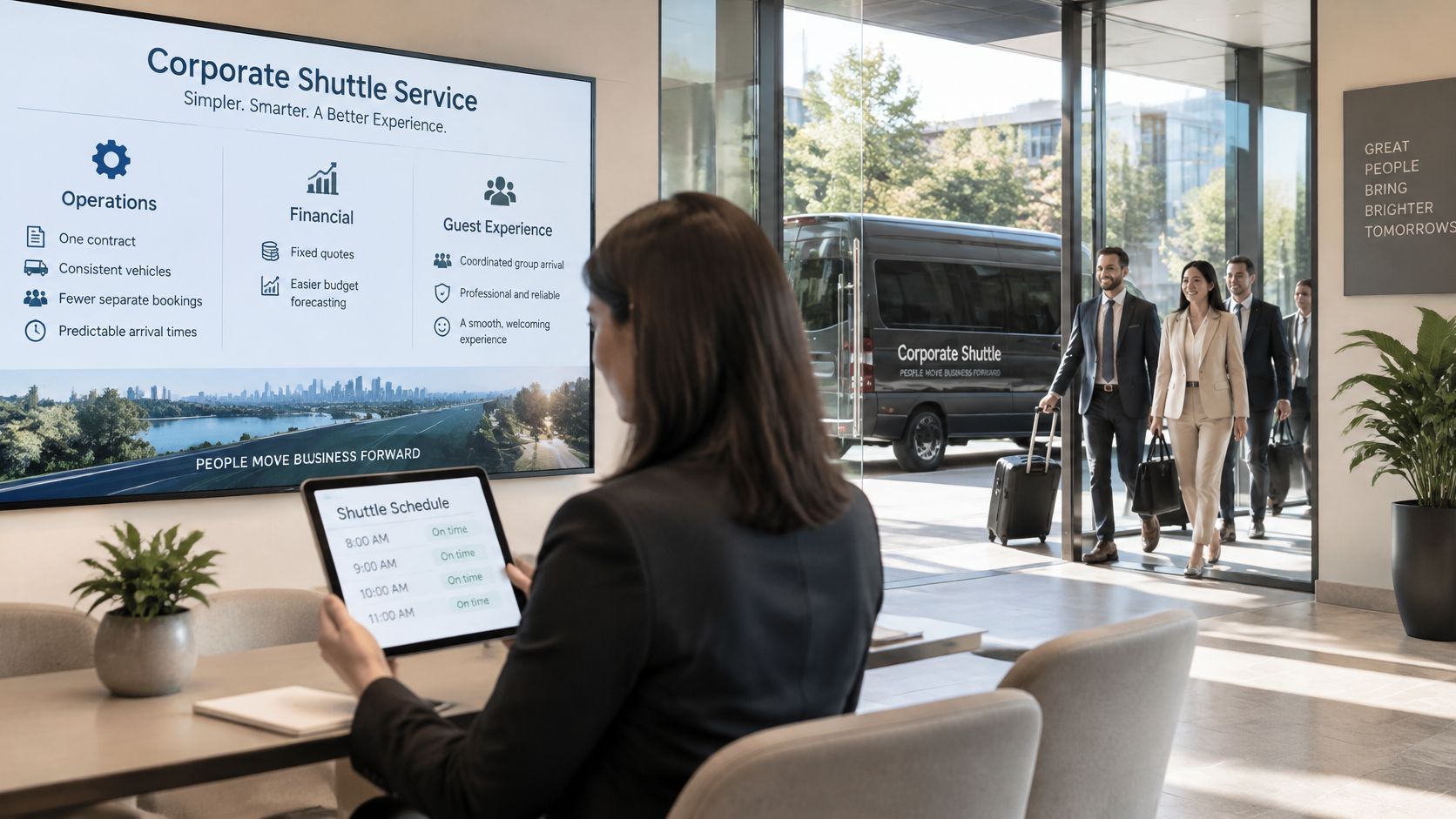
Companies usually organize shuttles for operational control, budget clarity, and a better traveler experience. Those benefits come from managing the journey as a program rather than leaving each attendee to arrange transportation independently.
Operationally, a shared contract reduces separate bookings and gives the coordinator consistent vehicle standards. Travelers get a common arrival plan, and the venue knows which groups are expected together.
Financially, a written quote makes transportation easier to include in the event budget, while consolidated billing replaces scattered receipts. Freeform House's guide to budgeting for your next company event is useful context for placing transportation alongside venue, catering, and other program costs.
Protect the arrival experience
Executives may want time to prepare privately rather than deal with an unfamiliar route. Event guests benefit from clear instructions and an organized arrival instead of uncertainty about where to park or which entrance to use.
The goal is a coordinated handoff between the travel manager, transportation coordinator, and venue team.
There's also a reason to evaluate trip consolidation: the U.S. Environmental Protection Agency reports that transportation produced 28% of total U.S. greenhouse-gas emissions in 2022, the largest share of any sector.
That doesn't mean every shuttle is an environmental or financial improvement. Results depend on occupancy, distance, and whether travelers would otherwise use separate cars; a half-empty coach can cost more than it saves.
Measure what the program replaces
Track these measures after each program:
- Passenger trips: Count completed journeys, not just reservations.
- Vehicle miles avoided: Compare the shuttle operation with a documented estimate of the separate travel it replaced.
- Otherwise-solo riders: Ask which passengers would have driven alone without the service.
Keep the comparison honest. A traveler who would have taken a train shouldn't automatically count as a car trip removed, and a booked seat shouldn't count as a completed ride.
How Scheduling and Routing Keep Groups on Time
Use a shared trip manifest and a dispatch sheet as the working documents. The manifest identifies who travels; the dispatch sheet tells the transportation team how to execute the plan.
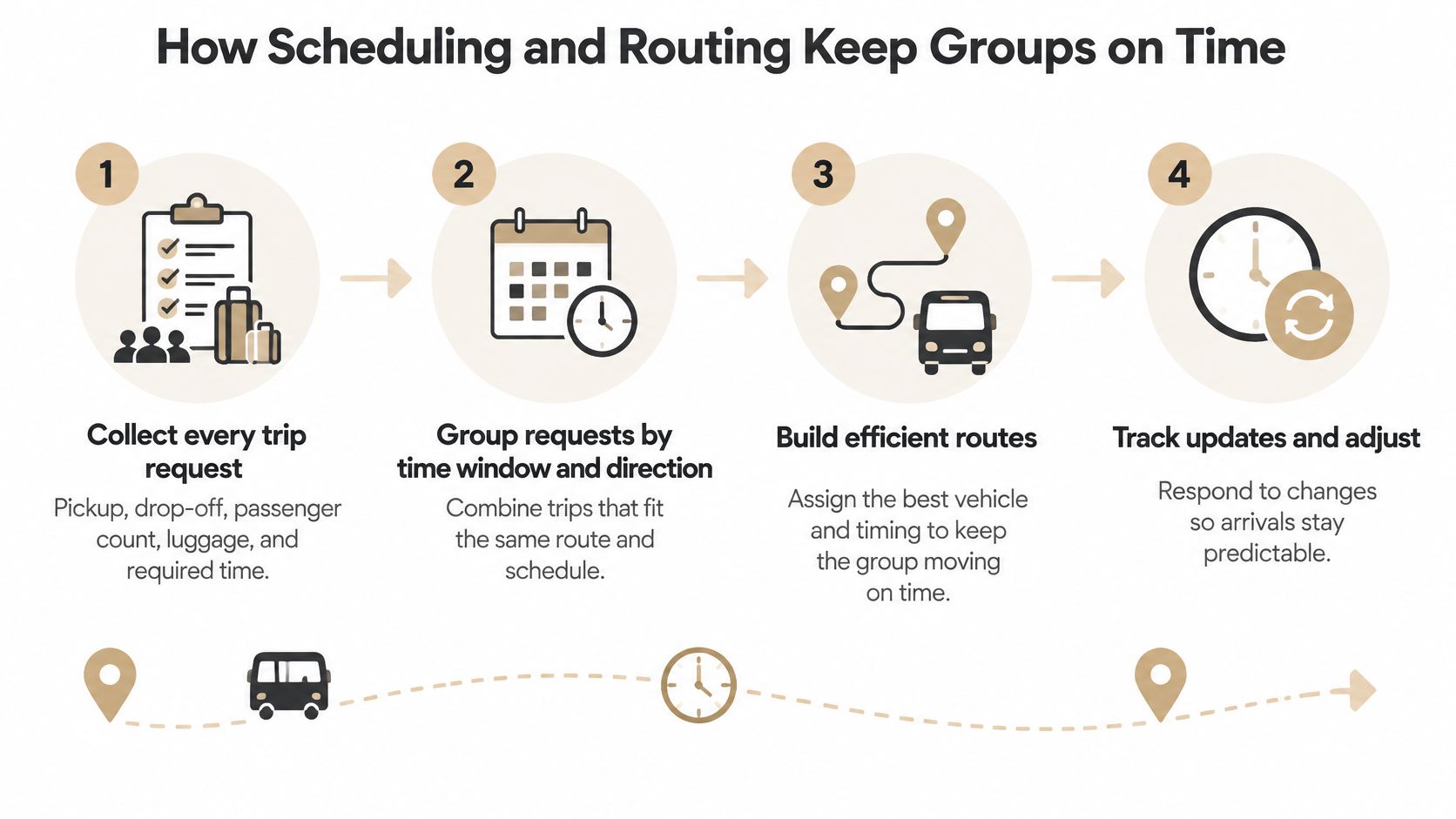
Collect every trip request. Record pickup, drop-off, passenger count, luggage, and required arrival time. Distinguish a flight's landing time from the time passengers are likely to be ready at the curb.
Group compatible requests. Sort by time window and direction before assigning vehicles. Don't combine travelers merely because they share an airport if doing so creates an unreasonable wait.
Build routes around corridors and hubs. Choose the vehicle from the actual load on each run. Check hotel entrances, venue loading areas, and whether intermediate stops introduce unnecessary detours.
Allow for airport uncertainty. Build arrival buffers around baggage collection and terminal movement, then use real-time flight tracking to adjust curbside pickup. Give passengers a clear instruction for contacting the coordinator once they're ready.
Confirm the manifest 24 hours ahead. Ask each rider or group coordinator to verify travel details and headcount. Mark the revised version clearly so an old passenger list doesn't reach dispatch.
Dispatch through one coordinator. For multi-vehicle moves, route changes through a single operational contact and send concise text updates to affected travelers. Avoid separate venue, executive assistant, and passenger instructions reaching chauffeurs simultaneously.
Review completed service. Examine load factor, on-time performance, and cost per passenger after each event or operating month. Record the reason for exceptions so a flight delay isn't mistaken for poor route design.
The process needs both advance planning and live adjustment.
Adjust for uneven attendance
Hybrid schedules can leave Monday and Friday service underused. During the first month, measure passenger loads by trip and time period, then set a minimum viable occupancy for each of those runs using the operating quote and the employer's service commitment.
Move departures below that threshold to reservation-based windows or point-to-point transfers. Tell employees how the alternative works before changing the timetable.
A smaller confirmed departure is more useful than a large scheduled vehicle that doesn't match when employees travel.
For events, align dispatch with the venue's run sheet. Creventa's guidance on keeping venue teams aligned on event day helps clarify who communicates program changes, while a broader corporate event transportation plan should connect arrivals, sessions, dinner, and return travel.
Corporate Shuttle Use Cases in the Hamptons and NYC
Consider a hypothetical 14-person offsite in Sag Harbor, with arrivals split between JFK and MacArthur. A Sprinter handles the main group, while a Premium SUV collects two executives on a later flight. The vehicles follow separate airport schedules rather than making the early arrivals wait for everyone.
That arrangement works because the coordinator plans around arrival waves, not just the total headcount. The same team may travel together to dinner later, when the schedule supports a shared departure.
A coastal venue arrival also needs a defined unloading point and a contact ready to receive the group.

Organize requests by trip type
- City-to-East End movements: Fixed-route trips between NYC and the Hamptons in either direction suit teams with an agreed departure point and time.
- Airport transfers: Coordinate JFK, LaGuardia, Newark, and MacArthur (ISP), plus private airports such as Westhampton and East Hampton, with flight tracking.
- Local business itineraries: Use point-to-point or hourly service between Southampton, East Hampton, Sag Harbor, Montauk, Bridgehampton, Amagansett, Water Mill, Wainscott, and Quogue.
- Executive retreats and offsites: Separate arrival transportation from the vehicles needed for meetings, dinners, and return departures.
- Golf outings: Plan travel to Shinnecock Hills, Maidstone, and National Golf Links around tee times and equipment storage.
- Wine tours and galas: Arrange North Fork itineraries or corporate evening transportation with a clear final pickup plan.
Treat drive times as planning references
Approximate starting ranges are 45 minutes to 1 hour from MacArthur to most Hamptons destinations, 2 to 2.5 hours from JFK or LaGuardia, and 2.5 to 3 hours from Newark. Traffic, season, the exact destination, and pickup conditions can change those times substantially.
Don't use an airport-to-region estimate as a guaranteed venue arrival time. Ask the coordinator to work backward from the session start and identify whether the itinerary remains workable if baggage collection or road travel takes longer.
For a multi-stop day, decide whether the group needs the vehicle to remain available or can commit to separate pickups. That distinction matters when a site visit runs late or executives split from the main itinerary.
This video provides additional context for planning private group transportation.
Fixed Rates Compared With Surge Pricing
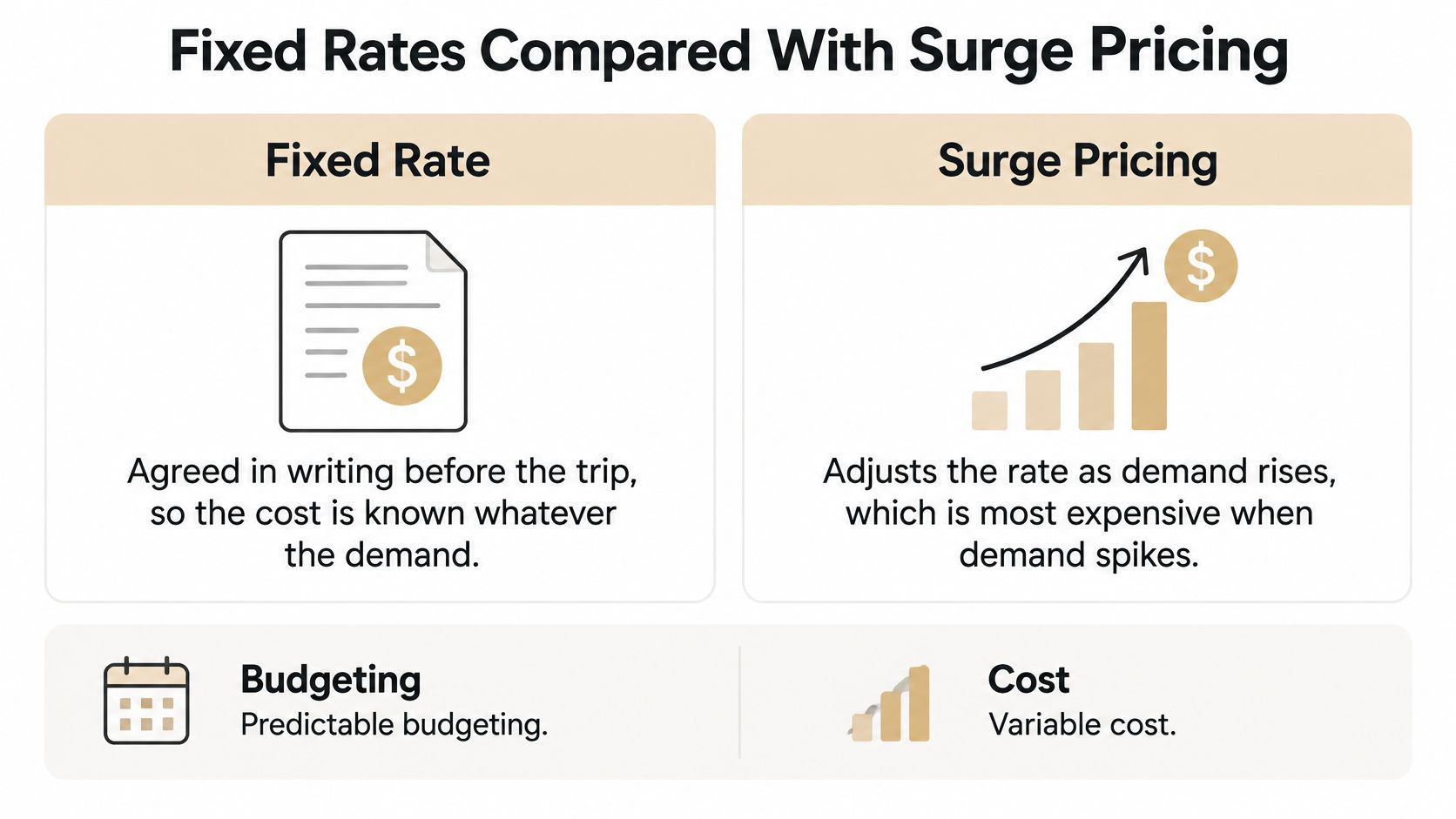
A fixed rate is agreed in writing before the trip, while surge pricing adjusts the rate as demand rises. The practical question is whether your confirmed booking remains protected during busy travel periods and what happens when the itinerary changes.
Fixed rate versus surge pricing for corporate shuttles
| Criteria | Fixed rate | Surge pricing |
|---|---|---|
| Quote | Agreed in writing before the trip | Estimate that can change with demand |
| Peak weekends and holidays | Quoted rate applies for the full booking | Rate can rise when demand and chauffeur availability tighten |
| Budget forecasting | Cost per trip is known in advance | Harder to forecast across a season |
| Cancellations and changes | Terms written into the contract | Terms vary by booking, so confirm in writing |
| Multi-vehicle moves | One consolidated invoice | Billing varies by booking and vehicle |
| Flight delays | Pickup adjusted to the new arrival time under agreed terms | Adjustment depends on provider and demand |
Peak Hamptons weekends, holiday windows, and major events are situations where demand and vehicle availability deserve particular attention. A fixed quote should make clear which vehicles and service windows the provider has committed to supplying.
The distinction is straightforward, but the written scope still matters.
Test the quote against disruption
Vehicle size, route length, and hourly versus point-to-point service shape either pricing model. Fixed pricing doesn't mean an added destination or extended charter automatically falls within the original scope.
Contract check: No surge protects against demand-based increases. It doesn't, by itself, explain waiting time, overtime, or itinerary changes.
Ask these questions before approval:
- Booking window: Is the rate fixed for the full reserved service period?
- Demand protection: Is the no-surge commitment written into the confirmation?
- Changes and cancellation: What happens if headcount, dates, stops, or departure times change?
- Flight disruption: How are delays handled, will the chauffeur wait, and what waiting terms apply?
For airport service, distinguish adjusting pickup to a delayed arrival from holding a vehicle after travelers are ready. Those are different operating situations and should have clear treatment.
A fixed-price transportation arrangement with no surge and consolidated invoicing supports predictable budgeting when the service scope is explicit. Text (631) 294-0747 for a written quote, and include the full itinerary so the confirmation addresses peak demand and flight delays rather than leaving them unresolved.
Vet Your Provider and Request a Quote
Use the same checklist for every provider you're considering. A polished vehicle photograph doesn't establish operating authority, insurance coverage, accessibility, or the ability to recover from a breakdown.
Ask for written answers that can be attached to the booking confirmation. That gives your travel team a usable reference when the person who arranged the trip isn't available on travel day.
Verify operating readiness
- Registration and insurance: Verify USDOT registration and commercial insurance covering the assigned fleet. Ask who operates any subcontracted vehicle and how its documentation is checked.
- Chauffeur standards: Confirm professional, uniformed, experienced chauffeurs and the process for communicating itinerary changes. Ask whether vehicles are cleaned daily.
- Commercial terms: Obtain a written fixed rate, a no-surge statement, cancellation and change terms, and consolidated billing for multi-vehicle moves.
- Operational contact: Confirm a single point of contact, 24/7 availability, and text communication for schedule changes. Establish who can authorize additional service.
- Backup arrangements: Ask what happens if the assigned vehicle becomes unavailable. A replacement must meet the group's actual needs, not merely offer a similar number of seats.
Don't accept a general assurance that someone will handle a disruption. Request the escalation contact and the procedure the coordinator should follow.
Check access and traveler safeguards
Accessibility needs should be discussed before the vehicle is assigned. Ask about documented accessible-vehicle capacity, boarding procedures, wheelchair securement where needed, chauffeur training, and a backup vehicle plan.
Keep sensitive information limited to what the transportation team needs to deliver the trip. Share boarding requirements through a designated coordinator rather than placing medical details on a widely distributed manifest.
- Family groups: Confirm requested child seats and their suitability before departure.
- Minors: Establish escort or guardian communication, authorized handoffs, and the response to a missed pickup.
- Nonstandard schedules: Check that early, late, or separate departures receive the same operational support as the main group.
Separate commuter benefits from event travel
A recurring commuter program may qualify for different treatment from an occasional offsite transfer. Federal transit-benefit guidance identifies thresholds of at least six passenger seats excluding the chauffeur, use of at least 50% of adult seating capacity excluding the chauffeur to transport employees to and from work, and employee commuting representing 80% of overall vehicle use.
Conferences, airport transfers, executive meetings, and retreats aren't the same commuter-focused use. Confirm eligibility and administration with your benefits or tax adviser before describing a program as a qualified benefit.
Text (631) 294-0747 with dates, passenger count, pickup and destination details, and luggage requirements. Compare the written quote against this checklist before approving the booking.
For corporate travel, Hamptons Leisure Limo offers pre-arranged airport transfers, executive transportation, and coordinated group movements across NYC, Long Island, and the Hamptons with fixed pricing and no surge. Visit Hamptons Leisure Limo to review the service options, then Text (631) 294-0747 with your itinerary to request a written quote.
Ready to Ride with Hamptons Leisure Limo?
Fixed pricing. No surge fees. 30 years of experience serving the Hamptons. Text us what you need and we will send a quote.