20 Person Party Bus Options for a Group of 20
Updated November 21, 2026
A marketed 20 person party bus isn't the same as 20 comfortable seats. A larger coach or coordinated smaller vehicles may fit the group better, especially when guests bring luggage, formalwear, or mobility equipment.
You've gathered the guest list, chosen the venue, and started sorting out who's staying where. Before you reserve transportation, turn that list into a boarding plan: who needs a seat, what they're bringing, and where the vehicle can collect them.
Table of Contents
- Seats That Actually Fit 20 Guests
- Comfort That Shrinks a Full Bus
- Why a 20 Person Vehicle Is a Bus
- One Vehicle or a Split Pickup
- A Hamptons Evening Run of Show
- Minors Luggage and Formalwear
- Text for a Group Quote
Seats That Actually Fit 20 Guests
A Southampton hotel pickup can start with 20 guests in one lobby, then become several stops once bags, hotel locations, and venue access are considered. Treat a vehicle's advertised capacity as the starting point: the trip also needs usable seats, room for belongings, and a route the vehicle can manage.
Vehicle options for a group of 20
| Vehicle | Seated capacity | Luggage | Best use | If the 20-seat bus is gone |
|---|---|---|---|---|
| Mercedes-Benz S-Class | 3 passengers and 2 bags | 2 bags | Executive add-on | Pair with the group vehicles |
| Premium SUV such as Suburban or Escalade | Up to 6 | Limited cabin and rear space | Airport splits and tight driveways | Use several SUVs for 20 |
| Mercedes-Benz Sprinter | 14 | Cargo space depends on the assigned layout; divide bags across vehicles | Weddings, wine stops, narrower roads | Add a second vehicle for the remaining guests |
| 25-passenger mini-bus | About 25 seats | Storage may be beneath the floor or at the rear; keep bags clear of the aisle | One vehicle when truly available | Size up if gowns or bags fill the aisle |
| 55-passenger coach | 55 plus luggage bays | Large bays | Wedding shuttles, corporate outings, school trips | One coach and one bill when the route fits |
| Coordinated smaller vehicles | 20 seated across vehicles | Luggage split by car | Dispersed homes and staggered times | Often the practical substitute |
Match the interior to the trip
The S-Class is an executive add-on, not the main group ride. Its capacity is 3 passengers and 2 bags, so it can handle a separate airport transfer or early departure while the rest of the party follows its own schedule.
A Chevrolet Suburban or Cadillac Escalade can suit smaller boarding areas and separate departure times. The trade-off is shared space: passengers and suitcases compete for room in the cabin and rear. A full passenger load may leave little space for airport bags, so assign luggage across vehicles rather than assuming every item will fit.
A Mercedes-Benz Sprinter carries 14 passengers, leaving six of a 20-person group to travel in another vehicle. Decide who rides where before pickup, particularly if a child seat or a guest's luggage needs to stay with that person. For groups bigger than 14, Hamptons Leisure Limo uses multiple vehicles with one coordinator, which helps keep separate pickups organized.
More seats don't settle every question
A 25-passenger or 36-passenger mini-bus may keep a group together when that vehicle is available. Seat count alone doesn't settle whether it suits the trip. The bags still need a place that does not block the aisle, and guests need suitable seating positions.
A full-size coach offers substantial passenger capacity and luggage bays, but its size affects turning and staging. On a narrow East End lane, a smaller-vehicle plan may work better even when the coach has many empty seats. Route access can matter as much as spare seats.
Practical rule: If the group has bags, gowns, or a mobility device, plan storage and vehicle access alongside the headcount. Extra seats help only when belongings can travel without occupying passenger space or blocking the aisle.
Comfort That Shrinks a Full Bus
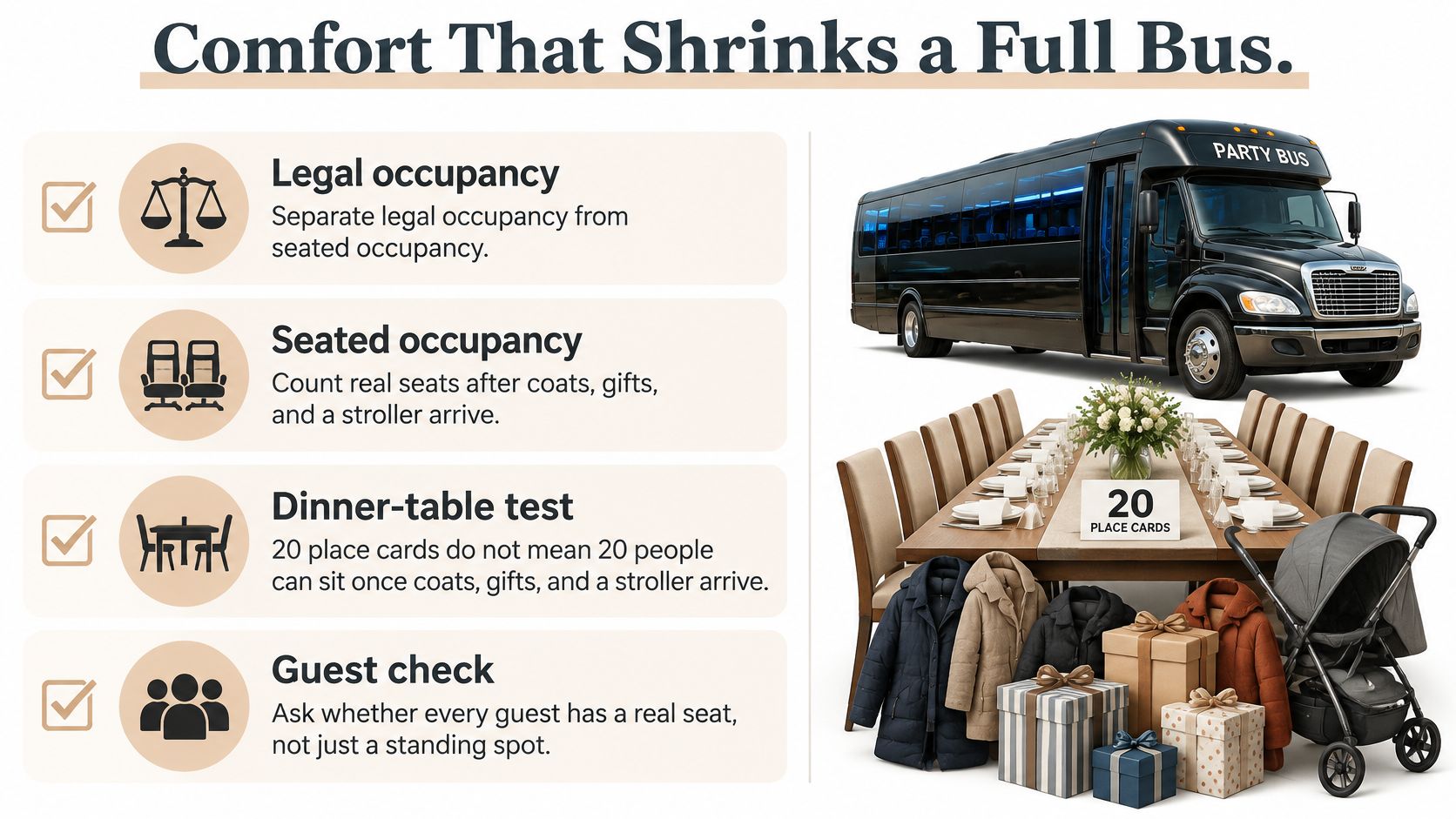
A party bus is like a dinner table: 20 place cards don't mean 20 people can sit comfortably once coats, gifts, and a stroller arrive. Legal occupancy describes an approved limit. Comfortable seated occupancy also requires a usable seat, suitable restraint equipment, and somewhere else to put belongings.
Use that distinction before judging an interior by its lighting or open floor area.
Belts belong to seating positions
A 2025 Federal Register notice discusses restraint requirements by seating position and documents a temporary exemption involving lap-only belts at some side-facing positions on entertainer-type motorcoaches. That doesn't describe every party bus. It does show why matching advertised capacities don't establish matching restraint protection.
The New York State DMV guidance states that, effective February 3, 2022, Vehicle and Traffic Law Section 383 requires safety belts at every passenger seating position in altered motor vehicles, regardless of manufacture or alteration date. The accompanying state transportation guidance also addresses vehicles converted into stretch limousines on or after January 1, 2021, requiring passenger-position belts along with required front-seat belts.
Those are altered-vehicle requirements, not permission to assume every entertainment vehicle has the same layout.
Federal rules have a specific scope
In its motorcoach rule announcement, NHTSA reported an average of 21 motorcoach and large-bus occupants killed and 7,934 injured annually, and estimated that lap-and-shoulder belts could reduce fatalities by up to 44 percent and moderate-to-severe injuries by up to 45 percent. Its rule covers new over-the-road buses and certain other new buses above 26,000 pounds gross vehicle weight rating, subject to exceptions, with belts for the chauffeur and passenger seats.
These figures concern the motorcoach and large-bus populations described by NHTSA. Weight and design determine coverage, so the rule doesn't automatically describe every smaller party vehicle.
Before booking, put these questions in writing:
- Exact vehicle: Request the actual model and interior configuration, not a representative photograph.
- Assigned seats: Confirm a designated seat and functioning belt for every guest.
- Movement policy: Establish whether standing or dancing is permitted, and plan for guests to remain seated and restrained during travel.
- Usable clearance: Check boarding steps, headroom in formal shoes, and space around seating.
- Storage and extra room: Identify where luggage and mobility equipment go, and size up for children, older guests, or bulky clothing.
Why a 20 Person Vehicle Is a Bus
A listing that says “20 passengers” gives you a starting point, not a complete vehicle description. Before choosing one large vehicle for an East End outing, check what its capacity counts and how the vehicle is classified. A full group may need more seats than the advertised number suggests, or coordinated smaller vehicles instead.
The exterior offers clues, but it does not establish legal capacity.
Federal and state definitions count differently
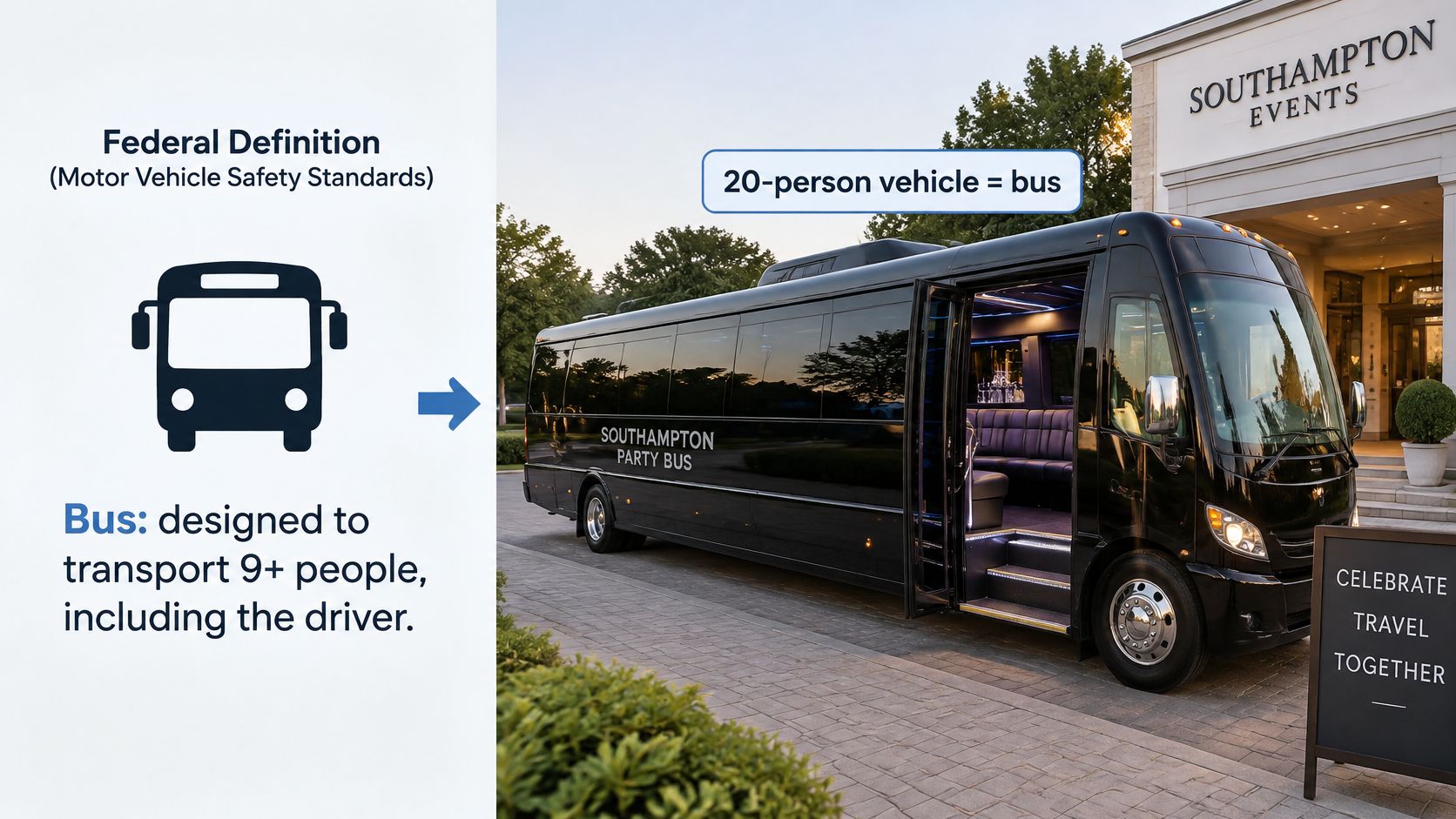
For crash reporting, the Federal Motor Carrier Safety Administration defines a bus as a motor vehicle designed primarily to transport at least 9 people, including the chauffeur. That broad definition places many vehicles advertised for large groups within the bus category, rather than the ordinary passenger-car category.
New York uses a different threshold. A New York State inspector general report describes a bus as a vehicle used to transport people with seating for at least 15 passengers in addition to the chauffeur. The report also states that limousine operators carrying nine or more people, including the chauffeur, need a passenger-endorsed commercial driver license.
These definitions count seats differently. One includes the chauffeur in its threshold; the other counts passenger seating separately. Ask whether a listing's number refers to passengers alone or includes the chauffeur. That distinction can change whether the vehicle suits a group of 20.
Ask about the operating arrangement
Ask for the vehicle's legal passenger capacity and the operating authority under which it will make the trip. Inspection, maintenance, licensing, and passenger-carrier compliance are part of understanding what has been booked. For 20 guests, also confirm that the available seating fits the group, rather than assuming the advertised capacity means 20 guest seats.
Hamptons Leisure Limo is fully USDOT registered and commercially insured. Those are concrete details to consider alongside the vehicle's seating and operating documentation.
For terminology, the comparison of limo buses and party buses explains the names clients may encounter when comparing interiors. A label describes a style, not the legal seating capacity.
This video provides another visual reference while comparing vehicle descriptions.
For a different kind of group outing, an all-ages bay cruise for families shows how the activity and operator shape the transport plan. It is separate from New York road-vehicle definitions.
National large-truck and bus crash totals provide broad safety context, not a party-bus fatality rate. They do not rank a particular vehicle. For a Hamptons trip, the useful comparison is between the actual passenger capacity, the group's needs, and the documented operating arrangement.
One Vehicle or a Split Pickup
Begin with where guests will be waiting, not where the bus will be parked. A host who writes only the venue address hasn't yet planned the journey.
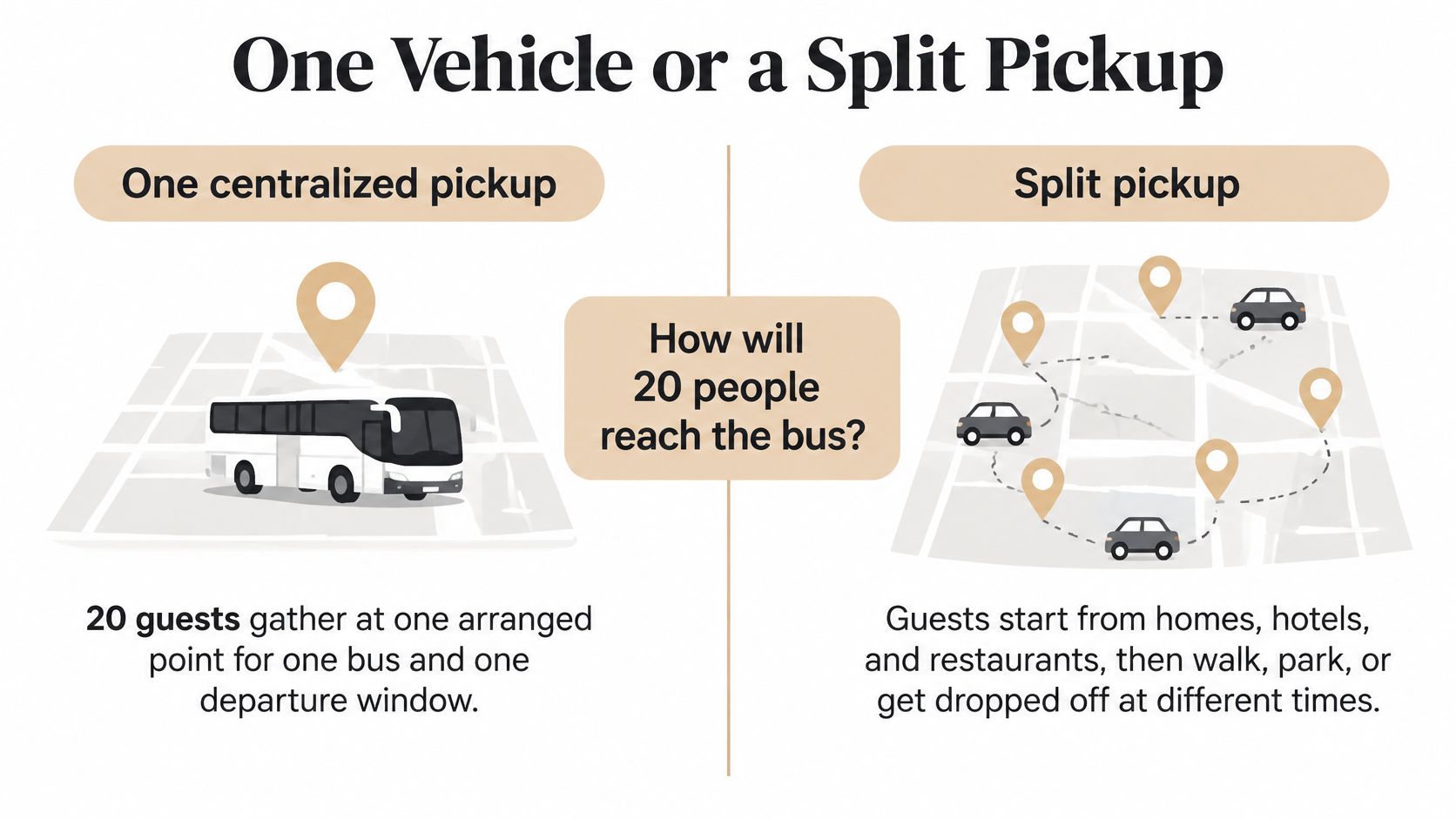
The 2025 SEMCOG special-event transportation questionnaire distinguishes starting points such as homes, hotels, restaurants, transit stops, and arranged meeting points, and asks whether attendees walked, parked, or were dropped off before boarding. That's a useful planning distinction: reaching the transportation is part of the transportation plan.
One vehicle or split vehicles for 20 guests
| Situation | Better setup | Why | Watch for |
|---|---|---|---|
| Everyone at one hotel | One mini-bus or coach | One boarding and one departure | Legal waiting space at the curb |
| Guests above 14 at several homes | Multiple vehicles, one coordinator | No one waits across town | Matched arrival time at the venue |
| Narrow lanes or estate driveways | Sprinter plus SUV | Smaller vehicles can turn and stage | Luggage split across vehicles |
| Staggered flights or late arrivals | A backup vehicle | The main group is not held | Named contact for the late party |
| Airport plus a celebration | Right-sized vehicles with bag room | Formal clothes and suitcases together | Terminal, flight, and return plan |
| Out-and-back with a venue curfew | One timetable and a buffer | Return is planned before departure | Meet 15 to 20 minutes before wheels-up |
Choose the gathering pattern first
A centralized pickup reduces the number of boarding events. It works best when guests can reach the meeting point without creating another awkward transfer.
Split boarding makes more sense when the homes are dispersed or departure times differ. For groups bigger than 14 passengers, we use multiple vehicles with one coordinator, so staying organized doesn't require everyone to occupy the same cabin.
Our mini-bus planning guide can help when evaluating a larger-vehicle alternative. Confirm the actual vehicle arrangement rather than assuming a vehicle category shown online is available for the date.
The main choice is whether guests should gather before boarding or board near where they're staying.
Give the host a usable departure plan
As a planning example, set the guest meeting time 15 to 20 minutes before departure, then confirm the actual allowance with the coordinator. That interval is for finding guests, checking belongings, and boarding, not an estimate of East End traffic.
Name the curb or entrance where boarding is permitted. Confirm turning access, waiting arrangements, and the venue's return pickup location before sending guests a map pin.
- Traffic allowance: Build a route-specific buffer for Montauk travel, venue access, and reception departures.
- Late arrival plan: Assign a backup car and contact rather than automatically holding the entire group.
- Airport details: Put the terminal, flight, bag count, and party destination in the same itinerary.
The host's final text should contain meeting point, departure, intended arrival, return pickup, and the person confirming headcount. A street address alone won't tell guests which entrance to use or whom to call when they're missing.
A Hamptons Evening Run of Show
Consider a hypothetical wedding party of 20, staying at a Southampton inn and two East Hampton houses. The coordinator assigns guests by pickup address and checks the proposed routes before confirming the schedule. These times illustrate the sequence, not a promised travel time between towns.
At 4:40 p.m., the host confirms the names, bags, and two requested child seats. This is also the moment to resolve whether any gifts need to travel to the venue or can stay at the inn.
Separate pickups with a shared arrival
In this example, a Sprinter boards 14 guests at 5:10 p.m. at the inn. An SUV collects the remaining 6 at 5:20 p.m., provided the confirmed child-seat arrangement, passenger mix, and belongings fit that exact vehicle.
The SUV handles the tighter residential approaches. Both itineraries target a 6:10 p.m. arrival, with a 20-minute planning buffer incorporated into routes the coordinator has checked. If the addresses or traffic conditions don't support those times, the pickups move earlier.
The event schedule should show the full journey, including the trip home.
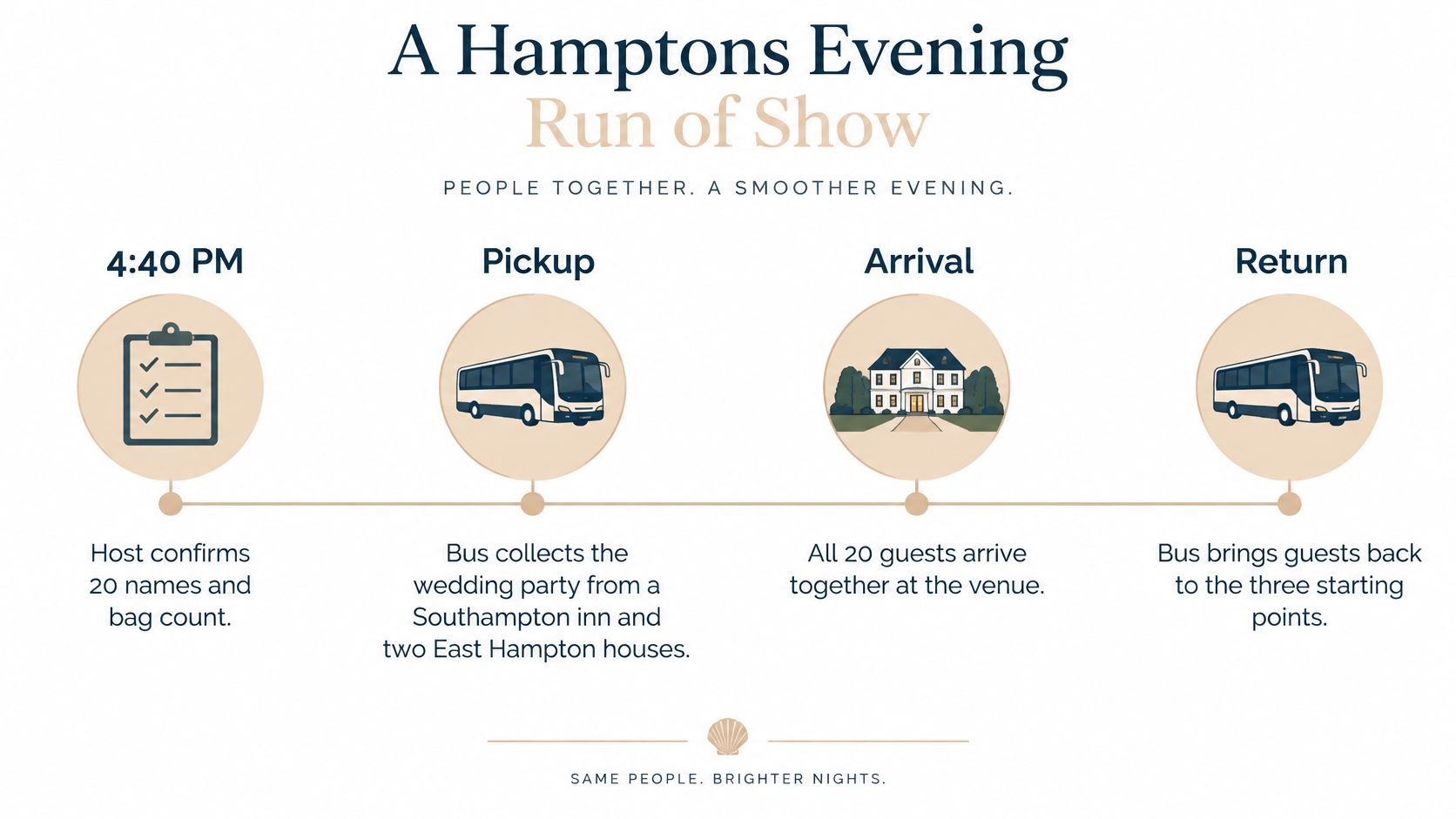
During the reception, the vehicles aren't assumed to be circling outside. Their waiting or release arrangements are settled in advance, and the hypothetical return pickup is 10:40 p.m., subject to the venue's actual curfew and boarding requirements.
Gift planning belongs on the packing list too. California Cowboy's groomsmen gift ideas that last can help with selecting gifts, but any boxes being transported still need an assigned storage location.
Change the vehicle when the purpose changes
For a hypothetical corporate group arriving at MacArthur with 20 travelers and golf bags, investigate a mini-bus or coach with confirmed luggage storage before dividing everyone among SUVs. The onward destination might be Shinnecock Hills or a Southampton hotel, but the airport load determines the first vehicle requirement.
A North Fork wine afternoon has a different rhythm. An hourly arrangement keeps the vehicle and chauffeur with the group between tastings, rather than leaving the host to organize a fresh departure after every stop.
Keep the event schedule and transportation schedule together. A photo session, tasting reservation, or reception finish matters only if guests can board in time to reach it.
Across these examples, the host controls the same essentials: named passengers, boarding locations, departure windows, venue access, and a planned return. Music and refreshments come after those decisions.
Minors Luggage and Formalwear
Youth supervision can change the required seating before any luggage is counted. A New York State Assembly memorandum proposed at least one adult chaperone for every 20 individuals under 21, plus a chaperone on each deck of a double-decker bus; the proposal also addressed prohibiting possession or consumption of alcohol, controlled substances, and marijuana by those under 21 aboard the bus.
That memorandum is proposal material, not proof that every provision is current law. Before a prom or school trip, verify current requirements with the operator and relevant New York authorities.
Count the supervising adults too
Use the proposed ratio as a concrete starting point for discussing supervision, not as a legal conclusion. In a hypothetical group of 20 minors plus an adult chaperone, the adult needs an additional assigned passenger seat.
Decide who checks attendance, who communicates with parents, and who handles a guest who cannot continue the trip. The chauffeur operates the vehicle and shouldn't be treated as the group's event chaperone.
- Child restraints: Request child seats before travel day and confirm their installation and compatibility with the assigned vehicle.
- Supervision position: Seat the responsible adult where they can monitor the group without obstructing the aisle.
- Trip rules: Give parents and passengers the agreed conduct and return arrangements before boarding.
Treat belongings as part of the booking
Airport rollers, garment bags, and gift boxes need designated storage. Don't plan to solve a storage shortage by placing loose bags in an aisle or using a guest's assigned seat after the vehicle arrives.
Formalwear creates a different space requirement. Gowns need room around hems, tuxedo jackets shouldn't be compressed under luggage, and boarding should happen on a clean, stable surface.
Older guests and people using mobility equipment need a specific access discussion:
- Boarding method: Confirm the steps, assistance, or lift arrangement needed for that guest.
- Equipment storage: Establish whether a device folds and where it can be secured.
- Pickup surface: Choose a firm boarding location rather than a grassy shoulder.
- Seated comfort: Identify the actual seat and the space available around it.
A seat count isn't an accessibility plan. Describe the guest's boarding and seating needs before choosing the vehicle.
If the seating assignment works only when someone holds luggage or stands, change the booking before invitations lock in the arrangements.
Text for a Group Quote
Send a complete trip message rather than a screenshot of a vehicle listing. The coordinator needs enough information to match the route, passengers, and belongings to a workable arrangement.
Use this order:
- Date and operating window: Give the event date, first pickup, required arrival, and final return.
- Addresses and towns: Name each boarding location and the venue, including the correct entrance when known.
- People and belongings: State the headcount, bags, child-seat requests, formalwear, mobility needs, and whether minors are traveling.
- Boarding preference: Say whether everyone can meet at a legal curb or needs collection from separate addresses.
- Vehicle confirmation: Request the exact vehicle or vehicles, seating layout, restraint availability, and storage arrangement.
Confirm the whole itinerary
Our group transportation service guide provides context for coordinating the move. Keep one host responsible for approving changes, and give the coordinator a backup contact who will be reachable during the event.
A useful hypothetical message reads:
We're arranging transportation for 20 wedding guests from a Southampton inn and two East Hampton houses. We need coordinated arrival before photos and a confirmed return after the reception. Please review the attached addresses, passenger assignments, bags, and child-seat requests, then confirm the vehicle arrangement and boarding times.
Hamptons Leisure Limo offers fixed pricing with no surge. Our 55-passenger coach is used for wedding shuttles, corporate outings, and school trips, while the exact arrangement for a dispersed group should be confirmed through coordination rather than inferred from a listing.
We're available 24 hours a day, 7 days a week, 365 days a year. Clients can save up to 40% compared with rideshare services during peak Hamptons season, but the useful comparison is the quote for your actual itinerary, not an assumed saving on every trip.
Finish with an approved boarding list
Before travel, confirm each guest's assigned pickup and vehicle. Add the meeting time, late-arrival contact, and return entrance to the same message thread so nobody relies on an outdated screenshot.
An experienced chauffeur leads each vehicle. The host's job is to make the passenger list accurate and communicate changes before they disrupt departure.
Hamptons Leisure Limo offers pre-arranged group transportation with coordinated pickups, experienced chauffeurs, and fixed pricing for Hamptons events. Text (631) 294-0747 with your date, pickup addresses, headcount, and luggage needs to plan a practical alternative to a marketed 20 person party bus, or visit Hamptons Leisure Limo to explore your transportation options.
Ready to Ride with Hamptons Leisure Limo?
Fixed pricing. No surge fees. 30 years of experience serving the Hamptons. Text us what you need and we will send a quote.