25 Passenger Minibus Rental: Capacity, Rules and Planning
Updated November 18, 2026
Your wedding guest list is settled, the hotel rooms are booked, and now you're trying to move everyone without a string of separate arrivals. Or you're organizing an airport transfer and wondering whether the group's suitcases will fit alongside the people. A 25 passenger minibus rental looks like the obvious middle option, but the advertised seat count is only the starting point.
The right booking depends on the actual seating layout, luggage storage, boarding access, and route. Before committing, separate what the vehicle is rated to carry from what your particular trip needs.
Table of Contents
- How Many People a 25 Passenger Minibus Carries
- Which Group Trips Suit a 25 Passenger Minibus
- Usable Seats, Luggage and Capacity Limits
- Accessibility and Route Planning for Mixed Groups
- Legal and Carrier Checks Before an Interstate Trip
- Timing, Stops and Booking Request
How Many People a 25 Passenger Minibus Carries
Passenger capacity by vehicle size
| Vehicle | Rated seats | Best for |
|---|---|---|
| Premium SUV | About 6 passengers | Small family or golf group |
| Sprinter-style van | 14 passengers | Medium group or airport transfer |
| 25-passenger minibus | 25 passengers | Wedding party, corporate offsite or prom |
| Motor coach | 55 passengers | Large event or multi-group move |
These are vehicle-shopping categories, not confirmation of a particular vehicle's legal seating configuration. Ask whether the advertised passenger capacity excludes the chauffeur, then compare the complete occupant count with the manufacturer's rating.
A minibus occupies the useful space between a passenger van and a full-size coach. It can keep a midsize group together without requiring the same loading area or maneuvering room as a larger bus. That matters at hotel entrances, wedding venues, airport pickup areas, and private properties where the approach road is manageable but the turnaround is tight.
Choose for the trip, not just the headcount
The distinction between smaller passenger vehicles and buses is operational, not merely cosmetic. The Federal Transit Administration's national transit summary tracks buses separately from vans and cutaways, reflecting the different vehicle formats used for shared transportation.
For a wedding party, keeping everyone together means a shared departure rather than separate parking searches. For a corporate offsite, the organizer can communicate a schedule change to the entire group at once. Fewer separate vehicles can also mean fewer chauffeurs to coordinate and fewer arrivals for the venue to manage.
A larger coach makes sense when the group or equipment requires it. A smaller vehicle can be a better choice when guests have different destinations or departure times. Don't pay for togetherness if the itinerary immediately splits everyone apart.
Sizing rule: Match the complete occupant count, including the chauffeur, to the actual rated seating layout. Then check cargo and access requirements before treating every passenger seat as usable.
The best fit isn't necessarily the smallest vehicle that passes a headcount test. It's the vehicle arrangement that can carry the entire load and reach every planned stop.
Which Group Trips Suit a 25 Passenger Minibus
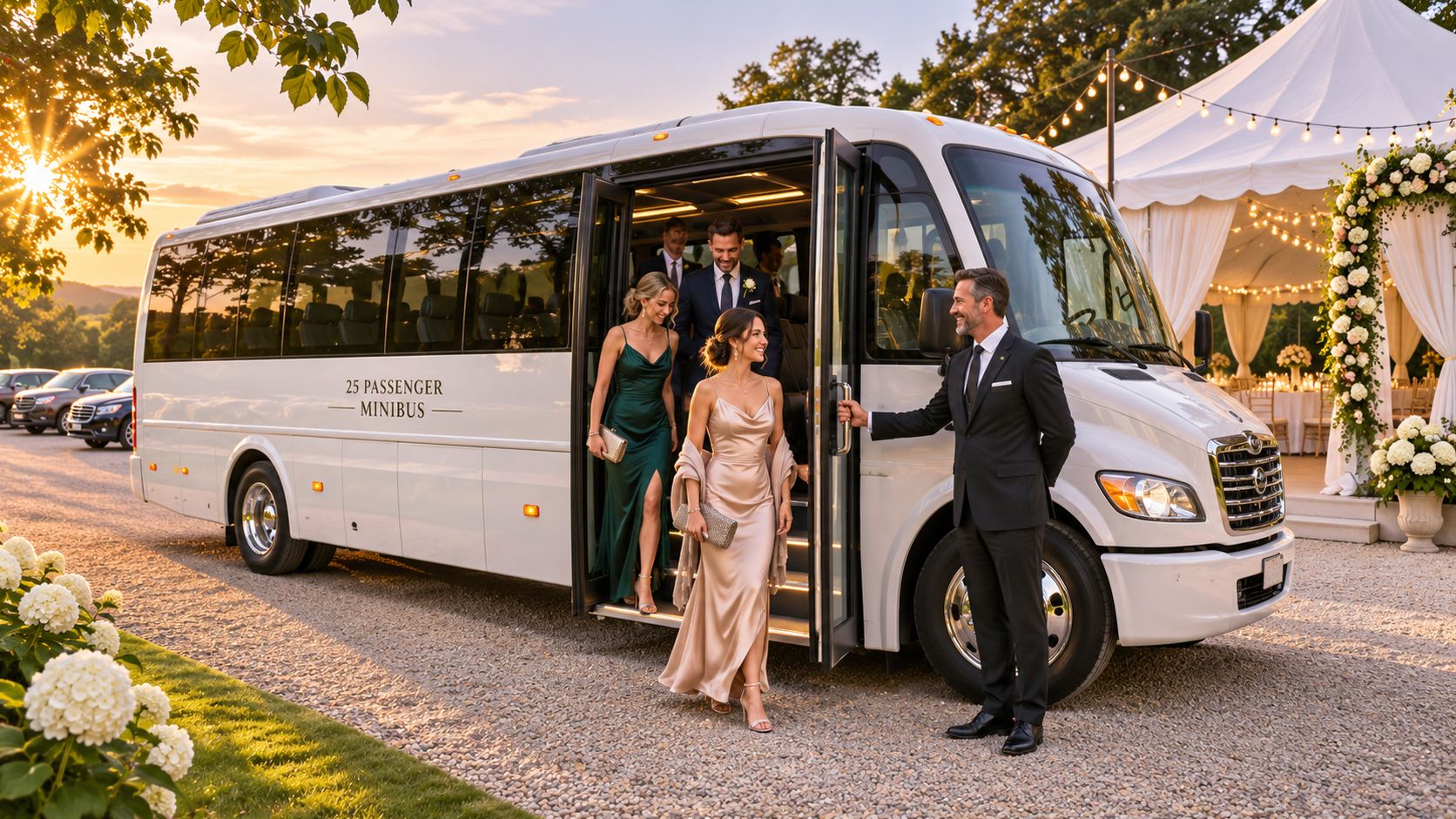
Wedding transportation needs a departure window tied to the ceremony, not a loose instruction to meet outside. Assign someone to gather guests inside the hotel while the chauffeur manages loading at the agreed pickup point.
A shared arrival works best when guests are ready before the vehicle reaches the venue.
Match the event to its main constraint
Rather than assign a supposedly typical group size to every event, use each event's confirmed guest list and the load it creates.
- Corporate offsites and executive teams: Choose a shared schedule and name an organizer who can approve changes. Separate executive departures should be identified before booking, not negotiated at the curb.
- Airport transfers: A group arriving together is easier to collect than travelers spread across different terminals. Supply every flight number and identify who will confirm that everyone has collected their bags.
- Prom and school-related trips: Establish adult contacts, approved stops, and the return arrangement. For younger children, the NHTSA child-restraint training manual calls for restraints appropriate to age and weight, secured according to manufacturer instructions. Confirm vehicle compatibility before travel.
- Golf and North Fork wine outings: Clubs, purchases, coolers, and overnight bags can determine the vehicle choice before seats do. Submit the equipment list with the itinerary.
For a pre-wedding getaway, accommodation searches can also help establish where the group will assemble. Hen Hideaways' hen party houses resource is useful for that planning stage, but confirm the actual property address and vehicle access before building transportation around it.
Use the following video alongside your written itinerary discussion, not instead of confirming the assigned vehicle.
Keep coordination separate from vehicle selection
At Hamptons Leisure Limo, groups bigger than 14 passengers are served with multiple vehicles and one coordinator. Our group transportation planning guide helps organizers approach those coordinated movements.
A minibus may suit the general vehicle category you're researching, but don't assume a particular fleet arrangement from that label. Count travelers, add equipment, and choose a confirmed arrangement that accommodates both.
Usable Seats, Luggage and Capacity Limits
Rated capacity is a safety specification, not a marketing number. NHTSA's bus-regulation guidance explains that manufacturers establish seating capacity and use it when determining gross vehicle weight rating and required emergency exits. Adding seats, blocking aisles, or treating standing room as extra capacity isn't a legitimate way to accommodate a larger group.
Passenger count and luggage volume need separate checks. Suitcases, garment bags, golf clubs, and event supplies can make an otherwise suitable seating layout impractical.
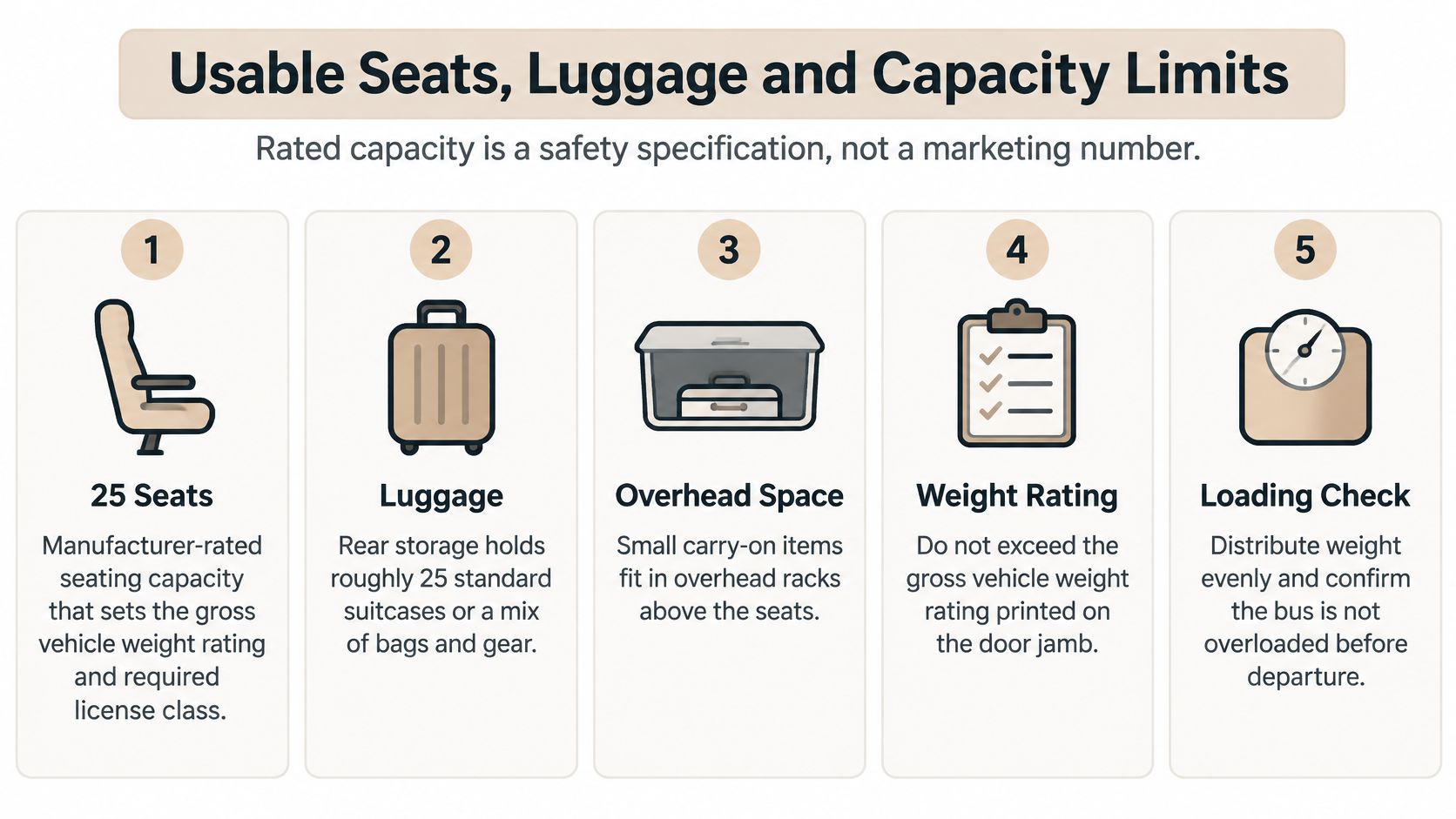
Treat illustrated storage quantities as examples, not a guarantee for the assigned vehicle. Rear compartments and overhead racks must be confirmed against the actual vehicle specification.
Build a load plan before pickup
Count everyone traveling, including the chauffeur. Keep the passenger manifest separate from the total occupant count so there's no ambiguity about what the advertised capacity includes.
List bags by count and size. Distinguish checked suitcases from small overnight bags. Flag rigid golf cases, strollers, garment carriers, and unusually heavy equipment rather than describing everything as luggage.
Confirm the seating layout and cargo limit. Request the actual configuration, not a representative photograph. Ask where oversized items will be secured and whether the proposed load remains within the manufacturer's limits.
Keep emergency exits clear. Bags shouldn't obstruct doors, aisles, or exit access. A suitcase that fits physically may still be in an unsafe position.
Allow for mobility equipment and child restraints. Confirm designated positions and compatible installation points. Don't assume an empty seat automatically provides suitable restraint anchorage or securement.
Share the manifest before pickup. Give the chauffeur the passenger names, loading notes, and designated group contact. Last-minute additions need another capacity check.
Our large-group transportation guide provides additional context for organizing a coordinated departure.
A seat left empty because the cargo plan requires it isn't wasted capacity. It's part of selecting a workable vehicle.
Bus occupant protection also depends on the vehicle's design. Closely spaced, energy-absorbing seat backs provide a protective envelope in certain large-bus configurations, but that principle shouldn't be treated as a promise about every minibus. Passengers should remain in designated seats, use the installed restraints, and never ride in an aisle.
Accessibility and Route Planning for Mixed Groups
Advertised seats don't necessarily equal usable passenger positions. A wheelchair position can require a different seating layout, and safe boarding may need more curb space and loading time than a standard pickup.
Start with the rider's requirements rather than a generic request for an accessible vehicle. A person who remains in a wheelchair during travel needs a different arrangement from someone who transfers to a passenger seat.
Check boarding before cabin amenities
- Lift or ramp: Confirm which system is fitted and whether it accommodates the mobility device. DME Superstore's guide can help you compare side door wheelchair ramps, but the assigned vehicle's equipment specifications must determine suitability.
- Doorway and steps: Obtain clear-opening dimensions and step height where relevant. Check handholds and the boarding approach as well.
- Securement: Confirm the wheelchair securement system, occupant restraint arrangement, and number of devices the configuration accommodates.
- Companion seating: Establish where a companion can sit and where a service animal can remain safely.
- Restroom access: Check both the travel stops and destination facilities, including the path from the unloading point.
Inspect every stop on the itinerary
A suitable vehicle doesn't make an unsuitable drop-off accessible. Historic properties, beach approaches, winery grounds, and private estates may have gravel, grass, slopes, or restricted entrances.
Say a wedding guest uses a wheelchair. The plan needs a compatible lift-equipped vehicle, sufficient boarding time at the ceremony, and a paved unloading point at the reception. A venue's main entrance may look convenient on a map while the usable accessible entrance is elsewhere.
Contingency check: Ask what happens if the assigned vehicle is substituted. A replacement must preserve the access features the rider actually needs.
Record these requirements in the booking notes, including the agreed boarding assistance and venue contact. Written details give dispatch, the chauffeur, and the event organizer the same practical instructions.
Legal and Carrier Checks Before an Interstate Trip
A vehicle designed or used to transport 16 or more people, including the chauffeur, falls within the federal commercial-motor-vehicle passenger threshold described by FMCSA's passenger transportation guidance. Booking fewer passengers doesn't turn a larger vehicle into an ordinary passenger van for regulatory purposes.
For compensated interstate transportation, FMCSA's operating-authority guidance requires carrier registration before service and explains that private invitations or nonprofit status don't, by themselves, remove for-hire obligations.
Requirements by trip type
| Trip type | What to confirm | Why it matters |
|---|---|---|
| Local trip within one state | Chauffeur qualification, vehicle inspection and insurance on the rental | State rules and the operator's safety program still apply |
| Interstate trip for hire | Operating authority, commercial insurance appropriate to the rated seating capacity and a qualified chauffeur | Passenger-carrier rules apply to the whole route |
| Compensated group trip not open to the public | Carrier authority and insurance | Private or invitation-only groups can still fall under carrier rules |
| Self-drive van rental | Who holds the appropriate commercial license and passenger qualification, and who carries liability | The vehicle's designed capacity can trigger commercial licensing obligations |
Understand who holds responsibility
In a chauffeured booking, the operating carrier manages chauffeur qualification, dispatch, vehicle inspection, and maintenance. A self-drive arrangement raises a different set of questions about licensing, insurance, and who is legally acting as the operator. A rental agreement alone doesn't settle those obligations.
FMCSA's passenger-carrier safety information identifies applicable controls including commercial licensing, drug and alcohol testing, hours-of-service limits, inspections, and maintenance.
Request written confirmation of:
- Operating authority: The legal carrier name and applicable registration.
- Commercial coverage: Insurance that covers the planned service and complete itinerary.
- Chauffeur qualification: Appropriate licensing and the applicable testing program.
- Vehicle oversight: Inspection status and maintenance practices for the assigned equipment.
Hamptons Leisure Limo is fully USDOT registered and commercially insured. Our explanation of commercial vehicle insurance helps distinguish commercial coverage from ordinary personal-auto protection.
Check the actual route
A direct Hamptons-to-New York City journey stays within New York. Traveling into Connecticut or New Jersey, or onward to Boston, requires an interstate review. Also flag an airport transfer connected to a wider interstate journey rather than assuming that an in-state road segment settles every regulatory question.
Confirm the applicable authority and insurance before signing, with coverage addressing every state and service involved.
Timing, Stops and Booking Request
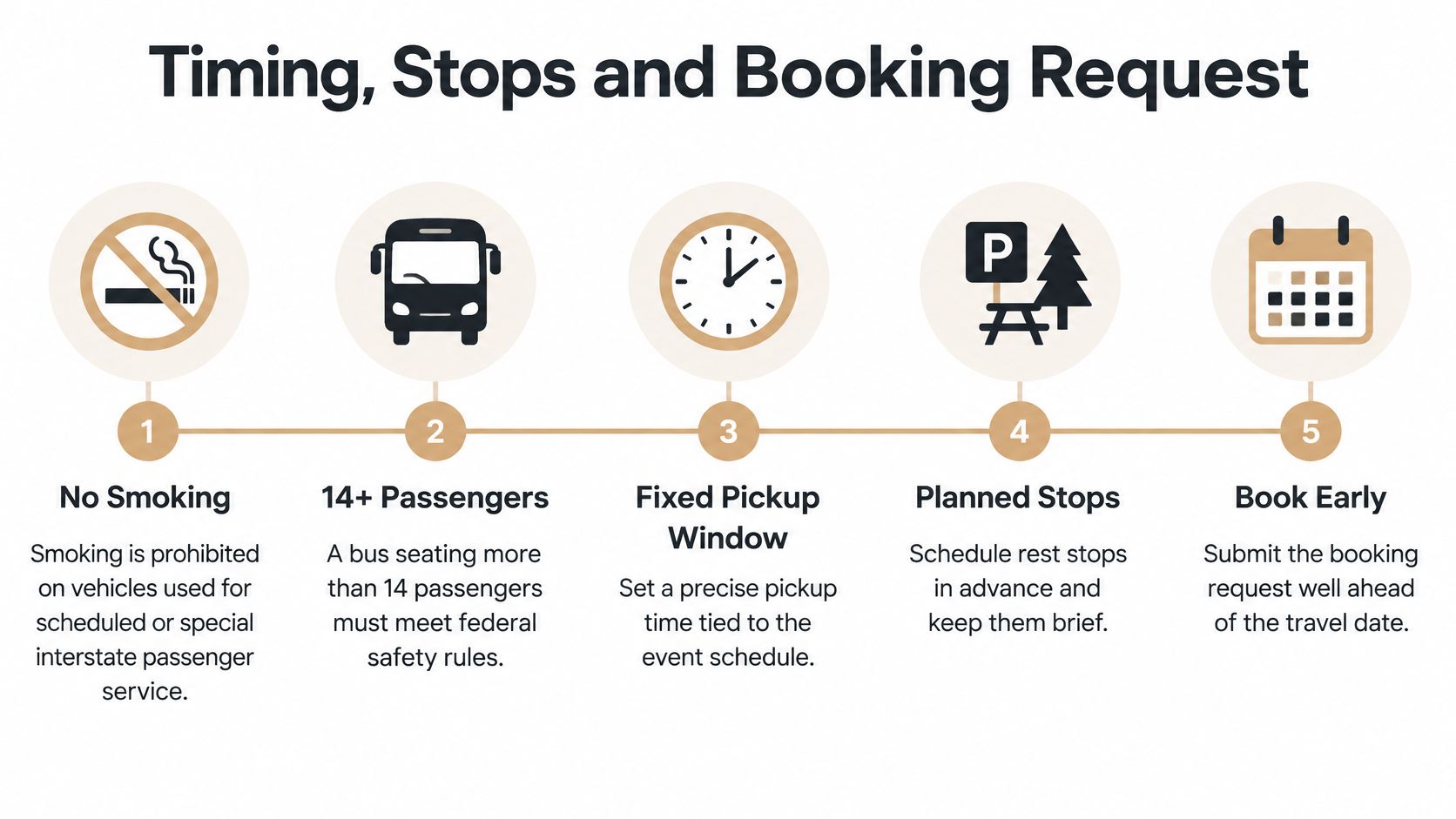
For federally regulated scheduled or special interstate passenger service, federal passenger-carrier regulations prohibit smoking and generally require a clean, maintained restroom on buses seating more than 14 passengers, excluding the chauffeur, unless reasonable rest stops are provided. Don't assume the minibus has an onboard restroom. Establish the stop plan before departure.
A workable schedule includes boarding, unloading, and access time, not just the navigation app's travel estimate. A private estate entrance, airport collection, or crowded reception exit can require a different pickup arrangement from a straightforward hotel departure.
Work backward from the first commitment
- Reconfirm headcount and luggage ahead of departure. A practical approach is to review the manifest during the preceding week, then communicate any changes immediately.
- Tie pickup to the first event. Use the required arrival time to establish when boarding must begin, rather than treating pickup as the moment guests start leaving their rooms.
- Send flight numbers. Our airport coordination uses real-time flight tracking. Identify every arrival and the person who will confirm the group is ready to collect.
- Choose rest stops in advance. Consider restroom access, safe parking, and whether everyone can board again without crossing busy traffic.
- Build an event buffer. If a delayed departure would cause guests to miss the ceremony, meeting, or reservation, the schedule needs more margin.
- Confirm the return in writing. Specify the collection address, meeting point, group contact, and procedure for communicating a change.
Every Hamptons Leisure Limo ride includes a 25-minute free grace period. Confirm how that policy applies to your pickup rather than using it as planned event time.
Send a complete booking request
Put the traveler count, bag inventory, seating requirements, mobility access, child-restraint needs, stop plan, addresses, and return time into the same request. Include the venue contact and ask for applicable carrier authority and insurance documentation covering the full itinerary.
Request the complete quote in writing. Clarify whether fuel, tolls, parking, waiting time, gratuity, and overtime are included, and establish how itinerary changes are handled. A headline hourly figure isn't a complete transportation plan.
Hamptons Leisure Limo is a Southampton-based black-car and limousine company with over 30 years in transportation. We serve the Hamptons, Long Island, and New York City, including Southampton, East Hampton, Sag Harbor, Montauk, Bridgehampton, Amagansett, Water Mill, Wainscott, and Quogue.
Keep the final itinerary in a shared document, but designate a single person to approve changes. That prevents different guests from giving the chauffeur conflicting departure instructions.
For your 25 passenger minibus rental planning, Hamptons Leisure Limo offers coordinated group transportation with fixed pricing and no surge. Text (631) 294-0747 for a quote, including your travel date, group size, pickup and drop-off points, luggage, and access needs so we can confirm a suitable vehicle arrangement.
Ready to Ride with Hamptons Leisure Limo?
Fixed pricing. No surge fees. 30 years of experience serving the Hamptons. Text us what you need and we will send a quote.