Limo Bus vs Party Bus: Which Fits Your Hamptons Event
Updated November 13, 2026
The most repeated advice about limo bus vs party bus choices is easy to summarize: book the party bus if your group wants fun, book the limo bus if the group is formal, and always put everyone in one vehicle so nobody gets left behind. Two of those three rules fall apart the moment the itinerary includes an airport run, a 78-year-old guest, a flight that lands late, or a 16th passenger.
The decision isn't luxury versus fun. It's whether the trip is transportation or an event, and whether the headcount matches the vehicle someone is about to pay for. Passenger count, luggage, boarding time and the federal line between a 15-passenger vehicle and a 16-passenger one settle more Hamptons bookings than any lighting package. Across three decades of routing vehicles on the East End, the failures trace back to capacity math and paperwork, almost never to whether the bus had a dance pole.
Table of Contents
- Limo Bus and Party Bus Side by Side
- Seating Capacity by Group Size
- Licensing and Insurance Rules by Passenger Count
- Interior Layout and Safety on Board
- Choosing the Vehicle by Event Type
- Cost Structure Beyond the Hourly Rate
- Confirm the Vehicle Before You Book
Limo Bus and Party Bus Side by Side
A party bus can make the ride part of the event. A limo bus is generally set up to transport a group comfortably between stops. The right choice depends on how passengers will use the vehicle, not just what it is called.
Limo bus and party bus compared on the criteria that matter
| Feature | Limo bus | Party bus |
|---|---|---|
| Primary purpose | Private point-to-point, airport and event transport | Group entertainment during the trip |
| Typical passenger range | Small to mid-size groups, roughly 10 to 15 | Often 10 to 50, depending on vehicle size |
| Interior layout | Seating suited to transfers and dinner trips | Often perimeter seating with open floor space |
| Luggage handling | Space and boarding arrangements vary by vehicle | Open floor space and party equipment may limit room for bags |
| Best fit | Weddings, airport transfers, corporate groups | Proms, nightlife tours, celebrations |
| Compliance threshold | Check the vehicle against the 15- and 16-passenger line | Check the vehicle's capacity, especially at 16 or more passengers |
| Pricing basis | Hourly or fixed point-to-point quote | Usually hourly, sized to the vehicle |
A limo bus suits a group traveling between destinations, such as an airport transfer from Sagaponack to JFK, a wedding party moving between a Water Mill rental and a Bridgehampton venue, or a corporate group coordinating one arrival. Its layout is geared toward seated travel.
A party bus shifts the emphasis to socializing during the ride. Inward-facing seats and open floor space can suit a prom, a nightlife outing in Sag Harbor, or a birthday celebration. That layout may leave less room for luggage, so check how much baggage the vehicle can accommodate before booking.
Where the two vehicles actually diverge
A full coach is a different size category from many limo and party buses. The National Academies describes motorcoaches as generally at least 35 feet long and capable of carrying 30 or more passengers (National Academies motorcoach research). Luggage capacity depends on the vehicle's design, so confirm the available space rather than assuming it from the vehicle label.
Group charter service is one part of motorcoach transportation. Both limo buses and party buses can be chartered for a specific group trip, but their layouts serve different priorities: seated transportation or socializing on board.
The question that settles most bookings: is the ride mainly transportation, or is it part of the event? Let that answer guide the choice, then confirm the passenger count, luggage space, boarding needs and trip purpose.
The name on the booking is only a starting point. The vehicle's layout and usable space need to fit the itinerary.
Seating Capacity by Group Size
Advertised capacity and usable capacity are different numbers. Add three figures before choosing anything: seats people will occupy, bags that travel with them, and any child seats or mobility devices. Then book the smallest vehicle that clears all three, because an oversized vehicle costs more and handles worse on two-lane East End roads.
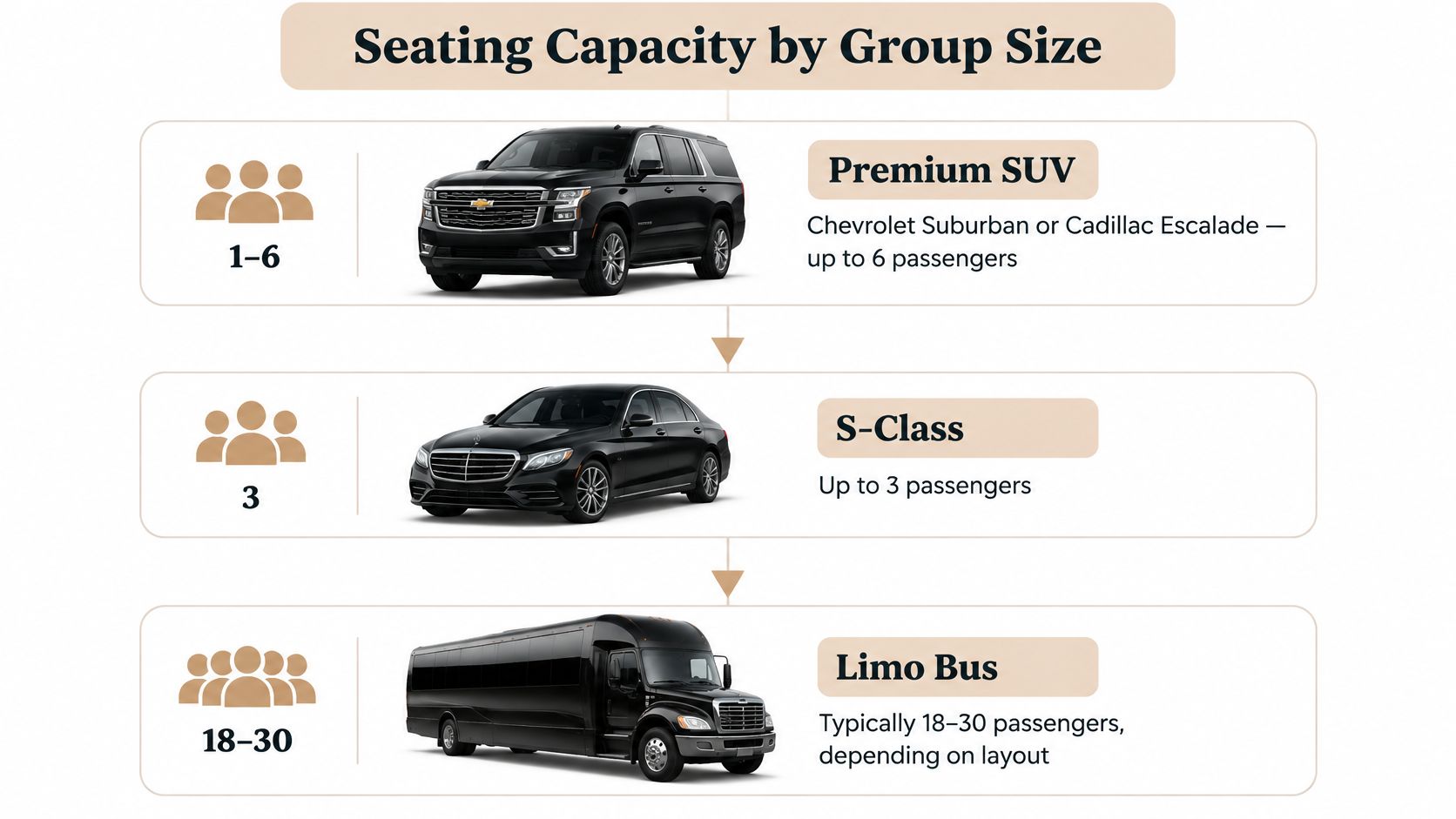
Passenger limits by vehicle type
| Vehicle | Passenger limit | Typical use |
|---|---|---|
| Premium SUV such as Chevrolet Suburban or Cadillac Escalade | Up to 6 | Small private transfers |
| Mercedes-Benz S-Class | Up to 3 | Executive pickups |
| Mercedes-Benz Sprinter van | Up to 14 | Small group transfers and airport runs |
| Minibus | 25 or 36 | Mid-size groups and party trips |
| Coach with luggage bays | 55 | Wedding shuttles and large groups |
Start at the small end. A Mercedes-Benz S-Class carries up to 3 passengers, which suits an executive pickup or a couple landing at Westhampton. A premium SUV such as a Chevrolet Suburban or Cadillac Escalade carries up to 6, which is the right call for a family plus luggage or a short airport transfer that doesn't justify a bus.
The Mercedes-Benz Sprinter van carries 14 passengers, and it's the vehicle most groups of 8 to 14 should be pricing: standing headroom, forward-facing seats and space for bags. A limo bus typically lands in the same neighborhood, where a small or mid-size group wants a premium finish instead of an open floor. Party buses spread much wider. Solvermatic reported that party buses typically accommodated 10 to 50 passengers depending on vehicle size (Solvermatic party bus cost guide), while Dataintelo put typical party-bus groups at 12 to 30 passengers in 2025 (Dataintelo limousine services market report).
Above 14, the tiers jump hard. Minibuses seat 25 or 36, and a 55-passenger coach with luggage bays sits at the top. Here's the arithmetic that catches people: a group of 15 flying out of JFK doesn't fit a 14-passenger Sprinter, and that same group of 15 in a 55-passenger coach is paying for 40 empty seats. A coach makes sense when the group is large; two vehicles under one coordinator makes sense when it isn't. Add the seats you need, the bags you're bringing and the child seats you're using, then choose the smallest vehicle that fits everyone.
Licensing and Insurance Rules by Passenger Count
Passenger count changes the rules before a vehicle leaves the lot. Federal requirements distinguish vehicles designed to carry 15 or fewer passengers from those designed for 16 or more. For-hire vehicles designed to carry 9 or more passengers are commercial motor vehicles, while the 16-passenger threshold brings additional passenger-carrier requirements (FMCSA passenger carrier guidance).
Federal requirements by passenger count
| Requirement | 15 or fewer passengers | 16 or more passengers |
|---|---|---|
| Vehicle classification | Commercial motor vehicle if carrying 9 or more for pay | Passenger-carrier threshold regardless of occupancy |
| Chauffeur license requirement | Standard license in most cases | CDL with passenger endorsement |
| Financial responsibility | Lower federal minimum | Higher federal minimum for for-hire service |
| Drug and alcohol testing | Not triggered at this size | Required for applicable CDL chauffeurs |
| Operating authority | Confirm carrier registration | USDOT registration and interstate operating authority for cross-state trips |
What changes once a vehicle seats 16
A 14-passenger vehicle falls below the 16-passenger threshold, but it still has commercial requirements when used for hire. For a vehicle designed to carry 16 or more passengers, check the carrier's insurance limits against that seating capacity. The federal financial-responsibility minimum is higher for these for-hire vehicles than for vehicles carrying 15 or fewer passengers.
For a larger coach, ask how the operator handles driver qualifications, maintenance records and passenger counts at each stop. Those details matter when a group boards and unloads together.
What to ask for before you compare amenities
Request the carrier's USDOT registration, commercial insurance certificate, chauffeur qualifications, maintenance status and the designated seating capacity of the vehicle assigned to your trip. If your event also includes a booked attraction, PSW Events simulator hire insurance outlines coverage questions to raise with that vendor.
Insurance documents can be difficult to interpret. Review how commercial vehicle insurance works for charter fleets so you know what to check on the certificate.
Interior Layout and Safety on Board
A party-bus interior can look spacious while making boarding harder and reducing usable seating. Check the steps, handrails, exits, seat belts and aisle before you compare lighting or sound.
Federal rules cover emergency exits and window release, retention and operation on buses. Buses rated at 10,000 pounds gross vehicle weight or less also fall under ejection-mitigation requirements (FMCSA occupant protection standards for buses).
A vehicle tour in four stops
Start at the boarding door. Count the steps and check for a handrail. A high-floor party layout may be difficult for a guest with limited mobility, even if the same steps pose no problem for other passengers.
Next, locate the marked window releases and roof hatch. Make sure they are unobstructed. Then compare the seating: forward-facing seats with belts provide a different ride from perimeter benches around an open floor. Ask whether passengers must remain seated while the vehicle is moving.
Passengers should stay seated while the bus is in motion and fasten seat belts whenever belts are available. Before departure, locate the boarding door, marked window exits and roof hatch, then follow the chauffeur's instructions (FMCSA bus passenger safety tips).
For mixed-age groups, ask whether the vehicle can accommodate mobility devices, how many steps are at the door and where children or older guests can sit. Open floor space suits a dancing group, but may leave less room for passengers who need stable seating or support while boarding.
Ask about the vehicle's cleaning routine, including the contact times for vehicle disinfectants, rather than assuming a quick wipe is enough.
Choosing the Vehicle by Event Type
Match the vehicle to the event before matching it to the budget. Six scenarios cover most Hamptons bookings, and the answer isn't the same for any two of them.
Best vehicle fit by event type
| Event | Better fit | Why it matters |
|---|---|---|
| Wedding with guests arriving and leaving at different times | Coach or multi-vehicle plan | One coordinator and separate pickups avoid early guests waiting |
| Airport transfer for a small group | Limo bus or Sprinter van | Luggage space and fixed pickup timing matter more than interior style |
| Prom or teen celebration | Party bus within capacity and supervision rules | Social interior matches the purpose if the operator documents compliance |
| Nightlife tour across several venues | Hourly party bus | The vehicle and chauffeur stay with the group between stops |
| Corporate retreat or executive group | Limo bus or mixed fleet | Professional presentation and one consolidated bill |
| Group larger than 14 people | Multiple vehicles with one coordinator | Splits boarding and return timing across vehicles |
Weddings expose the flaw first
Weddings break the single-vehicle assumption faster than any other event. Guests check into different hotels at different hours, the ceremony and reception run on separate clocks, and a handful of people always leave before the last dance. One large vehicle on one loop forces early arrivals to wait and early leavers to stay.
Our 55-passenger coach is the usual pick for wedding shuttle work, and it also covers corporate outings and school trips. A coach booking comes with one chauffeur and one bill, which simplifies a planner's evening more than most upgrades do.
Airport runs and school events reward different choices
An airport transfer for a small group is a luggage problem more than a social one, so a limo bus or a Sprinter van beats a party interior every time: fixed pickup timing, real bag space, and a chauffeur who can adjust when a flight lands two hours late. Prom is the opposite case. A party bus fits a prom when the group fits the vehicle and the operator documents capacity and supervision, and that second condition carries more weight than the lighting.
Nightlife and corporate itineraries
A nightlife tour across several venues is the party bus's strongest case, because the vehicle and chauffeur stay with the group between stops and nobody has to reassemble a dozen people on a Sag Harbor sidewalk at midnight. Hourly booking is what makes that work.
A corporate retreat or executive group usually wants a limo bus or a mixed fleet: forward-facing seating for calls and conversation, a composed arrival, and one consolidated invoice instead of six.
Groups above 14 need multiple vehicles and one coordinator, which is not a downgrade. It's the only way to keep boarding honest and return timing predictable, and it's how a well-built special event transportation plan usually looks once the headcount passes a single vehicle.
Cost Structure Beyond the Hourly Rate
The hourly rate is the least informative number on a transportation quote. A party bus is normally quoted by the hour; a limo bus is quoted either hourly or as a fixed point-to-point fare. Comparing those two rates tells you almost nothing, because the total depends on how many vehicle-hours the plan consumes.
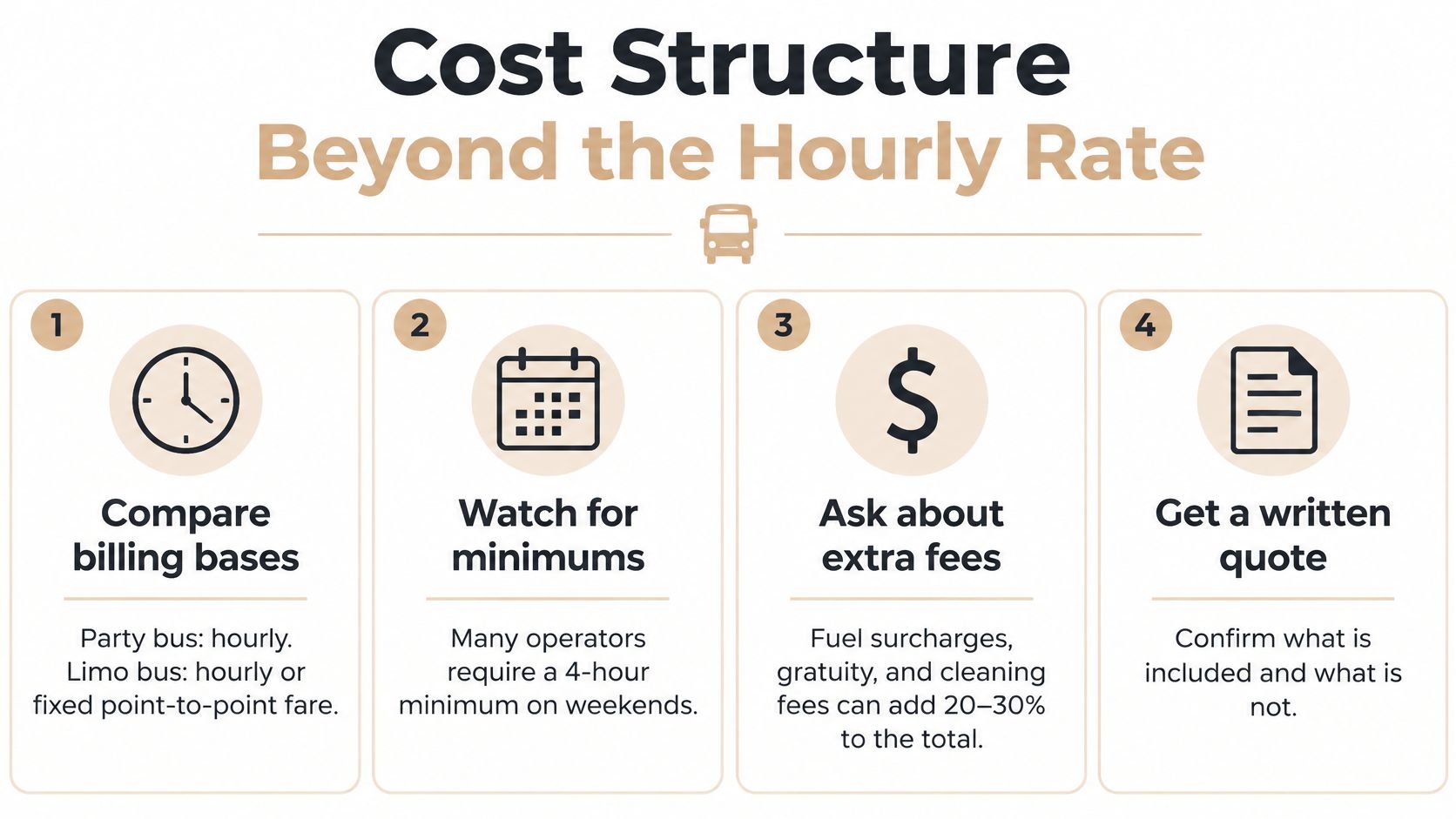
Five items build that total, and four of them never appear in the advertised rate:
- Staging time before pickup at the garage or the first stop, which you pay for even though nobody is aboard yet.
- Empty repositioning between a drop-off in Montauk and a pickup in Southampton.
- Parking and access in village centers and on private lanes, where a 55-passenger coach may not physically fit.
- Wait time at the venue, especially when a ceremony runs 40 minutes late.
- The return trip, which clients forget to price until the night of.
Build the total from vehicle-hours
Take a wedding where half the guests leave at 10 p.m. and the rest at midnight. One large vehicle runs the full evening because it can't leave and come back. Two smaller vehicles can run staggered shuttles, finish earlier and stop burning hours. Same guest count, shorter clock.
Group travel is moving in that direction. Operators report growing demand for larger group transfers and multi-vehicle deployments, with clients asking for flexible schedules, customized arrangements, accurate arrival information and digital confirmations (group airport transportation demand coverage). The vehicle choice is increasingly a transportation plan, not a binary pick.
If a party bus is still in the running, the line items behind party bus rental costs are worth reading before you set two quotes side by side.
We quote fixed pricing with no surge fees and no hidden charges, and a point-to-point ride is quoted before the client steps into the vehicle. That removes the guesswork, but it doesn't answer the planning questions.
Four questions before you sign
- What exactly is billed per hour, and does the meter start at the garage or at your door?
- How is staging counted on a multi-stop evening with two pickup zones?
- What happens if a flight is late, and who absorbs the wait?
- What is the cancellation policy if the guest count drops by eight a week out?
Text (631) 294-0747 for a quote on either vehicle type in your size, and ask what the plan looks like on a Saturday in August rather than a Tuesday in March.
Confirm the Vehicle Before You Book
A vehicle can look right in a listing and still be wrong for the job. Match the confirmed seat count to the passenger list, luggage, event schedule and operator's credentials before paying a deposit.
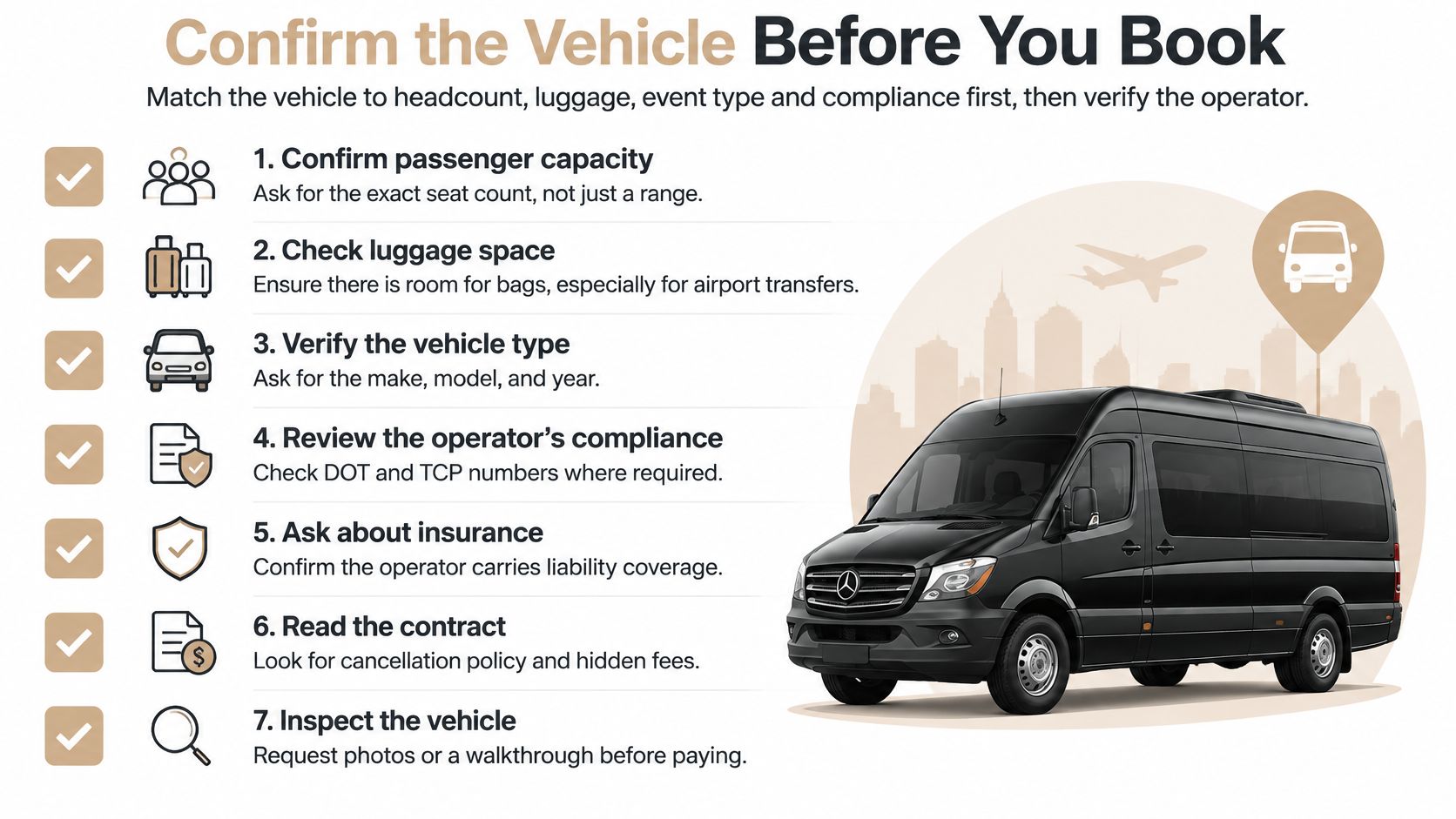
Use these seven checks to pin down what you are booking:
- Confirm the designated seat count. Ask how many passengers the specific vehicle carries. A vehicle described as “for 20” should have 20 actual seats; standing room does not increase seated capacity.
- Check registration and insurance. Ask the operator to confirm USDOT registration and commercial insurance. Hamptons Leisure Limo is fully USDOT registered and commercially insured.
- Clarify the driver and vehicle requirements. Ask what qualifications apply to the assigned driver and vehicle for your trip, and have the operator confirm that the setup meets applicable rules.
- Check requirements for trips across state lines. If your route crosses a state border, confirm with the operator that the vehicle and service are authorized for that trip.
- Get onboard rules before departure. Ask whether passengers must remain seated, when seat belts are required, and whether moving around is allowed. Share the rules with the group before boarding.
- Confirm the boarding door and exits on the assigned vehicle. Check the actual vehicle, rather than relying on a brochure photo or a different model.
- Request a fixed total. Ask for the quote to specify staging time and the return trip, so you can compare the full cost rather than only an hourly rate.
The vehicle's layout matters for guests who use mobility devices, need help with steps or may find boarding difficult. Ask about access and boarding arrangements before choosing a party-style interior.
For groups bigger than 14 passengers, Hamptons Leisure Limo uses multiple vehicles with one coordinator. Confirm how the group will be divided and who will coordinate the vehicles.
Availability also affects the plan. Hamptons Leisure Limo is available 24 hours a day, 7 days a week, 365 days a year. Request a fixed quote before booking, and ask for the total covering staging time and the return trip.
The right choice depends on the actual passenger count, luggage and trip details. Hamptons Leisure Limo offers airport transfers, wedding shuttles, corporate transportation and special-event service across the Hamptons, with fixed pricing and no surge fees. Visit Hamptons Leisure Limo to review the fleet and request a quote.
Ready to Ride with Hamptons Leisure Limo?
Fixed pricing. No surge fees. 30 years of experience serving the Hamptons. Text us what you need and we will send a quote.