Wine Tours Transportation: Vehicles, Routes and Tips
Updated November 7, 2026
Your group has picked a few wineries, someone wants lunch, and another guest has just asked whether there's room for the bottles they plan to bring home. You're ready to book transportation, but you still don't know whether the vehicle can enter every property or wait near the tasting room.
That's where wine tours transportation planning should start. On the East End, the best vehicle isn't the one with enough seats. It's the one each winery can accommodate, with a schedule that leaves your group time to enjoy the visit and a dependable way home.
Table of Contents
- Transportation Options for a Winery Day
- Choosing a Vehicle for Your Group Size
- Mapping Your Route Across the East End
- Sample Itineraries for Half and Full Days
- Safe Returns and the Legal Limits
- Pricing Factors and How to Book a Fixed Quote
Transportation Options for a Winery Day
Will your group follow a fixed route, or change stops as tastings run long? Make that decision before comparing vehicles.
Winery transportation options compared
| Option | Best for | Flexibility | Typical use |
|---|---|---|---|
| Private chauffeur for the day | Multi-stop tours with changing timing | High | Full-day North Fork or South Fork tours |
| Hourly car service | Groups who decide stops as they go | High | Flexible afternoons with long tastings |
| Point-to-point transfer | One-way legs such as airport or hotel to first winery | Low | Arrival or departure leg only |
| Shared group tour | Solo travelers who accept fixed stops | Low | Set-route tours with fixed departure times |
| Self-drive with one sober driver | Small groups where one person stays sober all day | Medium | Only where every winery allows it |
Match the service to how your group travels
A private chauffeur for the day suits a multi-stop itinerary across either the North Fork or South Fork. The advantage is continuity: your belongings stay together, and the same chauffeur handles each movement. Changes still need to fit winery reservations and the booked service period. A dedicated vehicle doesn't make an unavailable tasting slot available.
Hourly car service works for groups who want to decide the next stop over lunch. It leaves room for a longer meal or shopping break, but you're booking time, including time when the vehicle isn't moving. Confirm how extensions work before choosing this model.
A point-to-point transfer covers a defined journey, not an afternoon of availability. It's useful from an airport, hotel, or train station to the first estate. Pair it with confirmed onward transportation rather than assuming the arriving vehicle will remain.
Booking rule: A ride to the first tasting is not a transportation plan for the whole day.
Know what flexibility you're giving up
A shared group tour suits solo travelers and couples who are comfortable following someone else's route. Set stops and departure times simplify decisions. The trade-off is that your group can't expect a private detour or a longer lunch without affecting everyone else.
Self-drive with one sober driver can work when that person remains sober throughout the day and every winery accepts the arrangement. It also means someone takes responsibility for navigation, parking, and getting everyone home instead of participating in the tastings.
Count your stops, then decide how much timing flexibility you need. A common booking mistake is choosing a shared tour and later wanting a private stop. If that extra estate matters, choose a service model that can accommodate it from the outset.
Choosing a Vehicle for Your Group Size
Vehicle classes by seated passenger count
| Vehicle | Seated passengers | Best group | Check before booking |
|---|---|---|---|
| Sedan | 1 to 3 | Couples and small parties | Parking at small estates |
| Premium SUV | Up to 6 | Small groups with luggage | Direct routing and narrow driveways |
| Passenger van | Up to 14 | Medium groups under one chauffeur | Loading zone and turnaround space |
| Minibus | Up to 25 | Large groups, events, school trips | Coach access and parking at each stop |
| Motor coach | Up to 55 | Weddings and corporate outings | Belt positions, turnaround and parking |
These are planning categories, not a guarantee that every vehicle in a class has the same usable configuration. Confirm the actual vehicle and seating layout before booking.
Count people and belongings separately
Seat count isn't the same as carrying capacity. Luggage, coolers, mobility equipment, and gift bottles need their own space without occupying designated seats or blocking an aisle.
For example, a group of six bringing luggage and expecting to buy cases may need more space than an SUV provides comfortably. Send a luggage count, not just a passenger count. Choose around the guest with the largest space requirement, whether that's a child seat, a walking aid, or bulky bags.
A sedan suits a couple or small party looking for straightforward access at smaller estates. A premium SUV gives a small group more room while remaining easier to position than a coach. Neither should be promised access to a narrow driveway without checking the entrance.
For a medium group, a passenger van keeps everyone under one chauffeur and avoids coordinating a convoy. Our guide to luxury Sprinter van seating helps organizers think through passenger space before settling on a layout.
Check access and restraints before committing
Minibuses and motor coaches suit event groups, including weddings, corporate outings, and school trips, but their suitability depends on the property. An estate may welcome the group while lacking a safe place for a coach to turn or wait. These broader vehicle categories aren't a statement of what's available for a particular booking.
For groups bigger than 14 passengers, we use multiple vehicles with one coordinator, so arrival slots can be managed together.
The Federal Motor Carrier Safety Administration's occupant-protection guidance distinguishes federal motorcoach passenger belt-use requirements from installation standards and identifies lap-and-shoulder belts for designated positions in specified bus categories. Don't infer restraint availability from the word coach.
Before confirming, provide or verify:
- Seating needs: Total passengers and designated seating positions.
- Restraints: Available belts and any child-seat requirements.
- Accessibility: Boarding needs, wheelchair accommodation, and storage.
- Cargo: Cooler dimensions, luggage, and expected purchases.
Mapping Your Route Across the East End
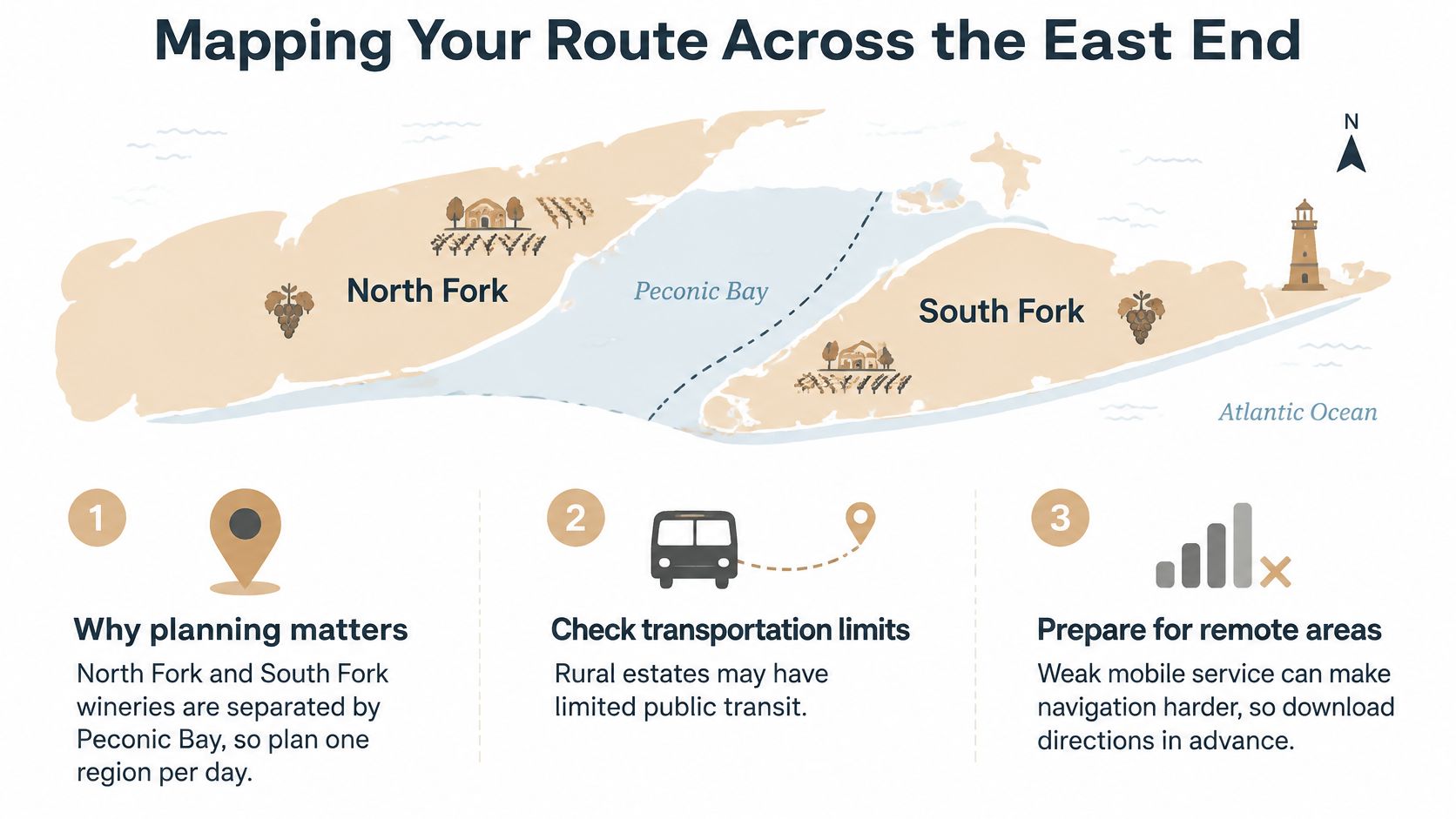
North Fork and South Fork wineries are separated by Peconic Bay. Plan one region per day unless the cross-region journey is itself part of the outing. Trying to combine both can turn a tasting day into a transfer day.
Rural estates may have limited public transit, weak mobile coverage, and narrow access roads. The global wine-tourism mobility report hosted by IVES identifies continuing car dependence in wine regions. For your itinerary, the useful question is whether each property has a workable arrival and departure arrangement.
Use this map as a starting point for choosing your region.
Build the route from confirmed appointments
List every stop with its appointment slot. Record the planned tasting length, check-in instructions, and lunch reservation if needed. Include the actual entrance address, which may differ from the property's mailing address.
Verify each property's loading zone, turnaround space, and van or coach access before the day. Ask where passengers should board and whether the vehicle may wait on-site, because permission to drop off doesn't necessarily include parking.
Group stops geographically. Avoid sending the vehicle back along the same road to recover a poorly placed appointment. Secure the least flexible reservation, then arrange nearby stops around it.
For a conservative worked schedule, allow a 30 to 45 minute recovery buffer after each tasting, separate from the expected journey. Treat this as planning slack, not a travel-time estimate, and adjust it after checking the actual route and reservations.
Set a final departure window and name a backup pickup point. The alternative needs to be safe, identifiable, and acceptable to the property, not just a convenient-looking roadside shoulder.
Assign one dispatch contact and send the full plan, including stop addresses, to every guest. Download directions in advance so a weak signal doesn't prevent anyone from finding the agreed meeting point.
Solve the last mile before departure
Where a winery has no usable transit stop, arrange a point-to-point transfer from the hotel or train station to the estate and connect it with a chauffeur for the rest of the day. Confirm the handoff, including who is responsible if the arriving service runs late. Don't leave a gap that requires guests to improvise transportation after tasting.
Travelers planning other tasting-region trips may also find the Kentucky travel tips from Blind Barrels useful for thinking about destination mapping. Use local access information for the East End rather than assuming another region's touring pattern transfers directly.
The decisive check isn't whether the route looks short on a map. It's whether each winery can accept the chosen vehicle at the chosen hour.
A reservation confirmation and an access confirmation answer different questions. Get both before treating the route as finished.
Sample Itineraries for Half and Full Days
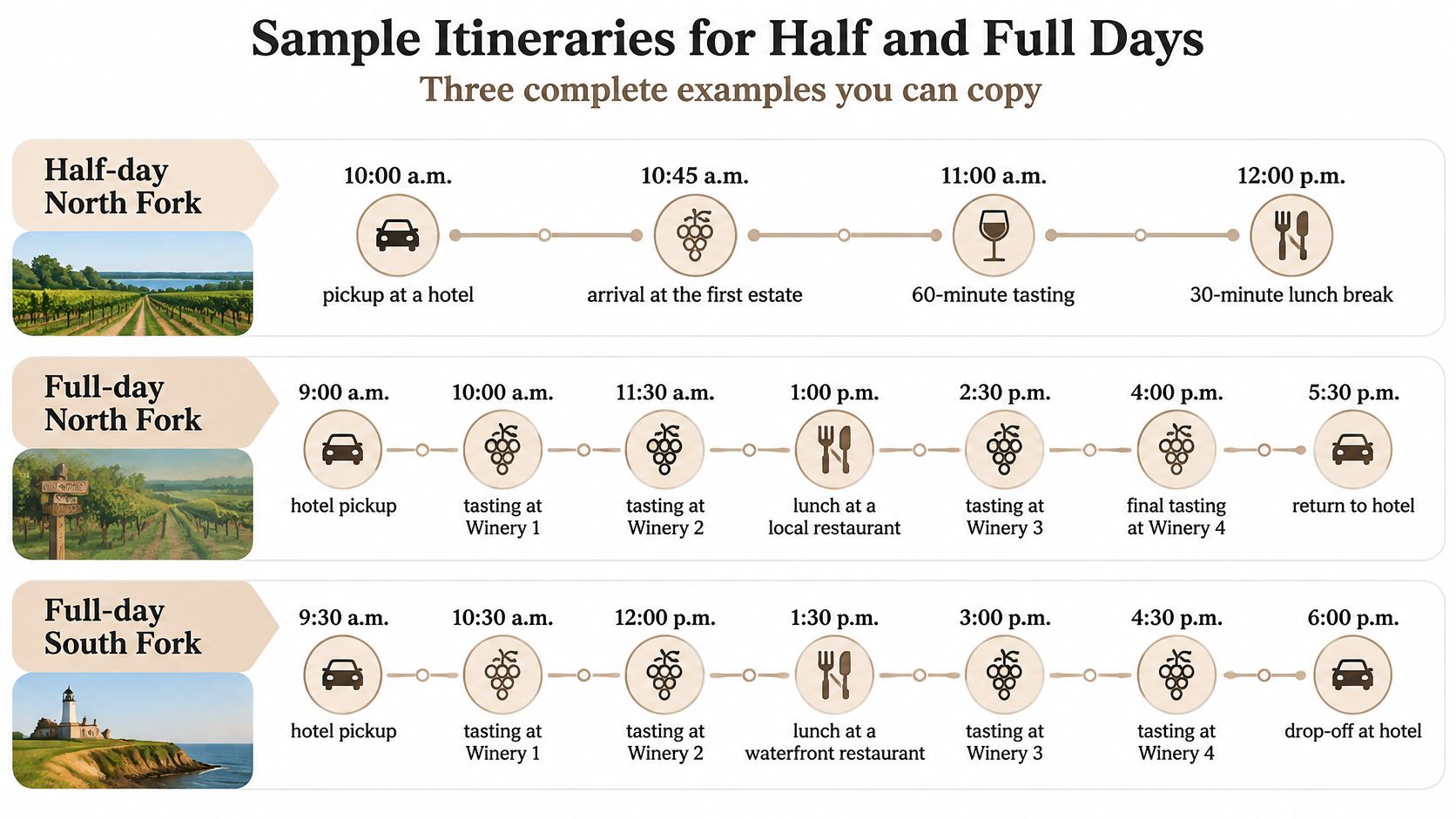
The following are hypothetical planning templates, not confirmed winery schedules or promised journey times. Replace the unnamed estates with properties that approve the group, appointment times, and vehicle.
The visual provides a quick comparison of the different day lengths.
Half-day North Fork with room to linger
For example, arrange 10:00 a.m. hotel pickup and 10:45 a.m. arrival at the first estate. Allow a 60-minute tasting, followed by a 30-minute recovery buffer before continuing toward a 12:30 p.m. second appointment.
Set the second estate's departure window at 1:45 p.m., with a planned 3:00 p.m. hotel return. The remaining allowance covers the actual journey and a possible short break, subject to the pickup location.
This lighter plan gives the group breathing room. Don't automatically convert unused time into another tasting, especially if the next property hasn't confirmed availability.
Full-day North Fork for a group of eight
A hypothetical five-stop itinerary could begin with 9:00 a.m. pickup, followed by estate arrivals at 10:00 a.m. and 11:30 a.m. Book a 90-minute lunch seating for 1:00 p.m., then plan estate arrivals at 3:00 p.m., 4:15 p.m., and 5:30 p.m., with final departure at 6:30 p.m.
This is the demanding option. It works only if the properties are close enough and each tasting fits its reserved window. If a hosted experience needs longer, remove a stop rather than compress lunch or assume the last estate will hold the appointment.
For a longer seated day, the driving comfort advice from Seat Belt Extenders offers additional preparation ideas. Keep any comfort adjustment compatible with the vehicle's seat and restraint instructions.
South Fork from Sag Harbor
For a hypothetical local outing, leave Sag Harbor at 10:00 a.m. for a 10:30 a.m. first estate. Finish at 11:30 a.m., keep 11:45 a.m. to 12:45 p.m. free for shopping, and book lunch from 1:00 p.m. to 2:00 p.m.
Continue to a 2:30 p.m. second estate and 4:00 p.m. third estate, then plan 5:15 p.m. departure for home. Check actual travel times before adopting those appointments.
This video offers another view of the wine-tour outing.
Visit the appointment-only winery first, then place confirmed walk-in options later where possible. Swap the stop names, keep the buffers, and recheck loading zones for any coach stop. The buffer is what protects the final visit when an earlier tasting stretches.
Safe Returns and the Legal Limits
Being below the standard intoxication threshold doesn't establish that someone is safe to drive. The New York State DMV alcohol and other drugs guide identifies BAC above 0.05% as legal evidence of impairment, 0.08% or higher as evidence of intoxication, 0.18% or higher as aggravated intoxication, and a zero-tolerance violation beginning at 0.02% for people under 21 who drive.
Commercial rules add another distinction: the New York DMV's alcohol-related penalties guidance identifies a 0.04% BAC threshold for commercial motor-vehicle operators. That's not permission for a working chauffeur to participate in tastings. Put all driving responsibility with a sober transportation professional throughout the itinerary.
Make the return nonnegotiable
Set a fixed end-of-day pickup window, identify a backup pickup point, and make the group rule clear: no guest drives after the final tasting. That includes collecting a personal car left at the first estate.
Quiet roads aren't a reason to relax the plan. According to NHTSA's 2024 alcohol-impaired-driving report, 58% of alcohol-impaired-driving fatalities occurred in urban areas and 41% in rural areas. On an East End itinerary, account for longer rural journeys and the practical difficulty of replacing a missed pickup.
A successful return plan gets guests to their final destination, not just back to wherever they parked.
Handle changes without splitting the group
- A guest becomes unwell: Stop the tasting schedule, tell the dispatch contact, and arrange an appropriate break or earlier return. If symptoms suggest an emergency, seek emergency assistance rather than treating transportation as medical care.
- The group buys extra bottles: Confirm purchase storage in the vehicle before buying cases. Keep bottles secured away from footwells and exits, and don't assume an unattended vehicle provides temperature-controlled storage.
- A stop runs long: Have the designated contact communicate the change. Drop an optional visit or revise the departure arrangement rather than sending guests off in informal carpools.
Transportation doesn't replace responsible consumption. Eat, drink water, use tasting spit receptacles when appropriate, and stop tasting when needed.
If you're weighing the value of a planned outing, our discussion of whether wine tours are worth it can help frame that decision. Before booking any provider, request its USDOT registration and proof of commercial insurance. We're fully USDOT registered and commercially insured, so those credentials can be part of your booking verification.
Pricing Factors and How to Book a Fixed Quote
The main quote factors are hours booked, vehicle class, group size, number of legs, and distance from pickup to the first winery. The event date and season, extra stops, waiting time, luggage, and child-seat requirements also shape the scope of the booking.
Two itineraries with the same tasting stops can require different transportation arrangements. A local hotel pickup is different from collecting guests across several towns, and a direct return is different from separate residential drop-offs. Send the whole day's movements rather than just the winery list.
Compare the scope, not just the total
Fixed pricing establishes the total for an agreed itinerary in advance. Some on-demand services raise rates when demand spikes; our fixed-pricing policy has no surge, so a busy weekend doesn't itself change the agreed quote. A changed itinerary or extended service still needs clear agreement.
Our explanation of fixed-price transportation provides more context for comparing booking models. Before accepting either quote, check the service boundaries:
- Included hours: When does booked time start, and when does it end?
- Trip expenses: Are tolls and parking included or handled separately?
- Waiting time: Does the quote cover time spent at tastings and lunch?
- Overruns: What happens if the group stays beyond the agreed finish?
- Route changes: Does adding or replacing a stop alter the total?
A cheaper-looking quote may cover less time or fewer movements. Get exclusions in writing, particularly when the day includes airport arrivals, luggage, or several return addresses.
Send a booking-ready plan
- Send the full itinerary, including the stop list, group size, and luggage count. Flag child-seat or accessibility requirements at the same time.
- Confirm pickup time and the final departure window. Identify which appointments can't move.
- Name the return point and backup pickup point, with an address or precise entrance description.
- Request USDOT registration and proof of commercial insurance, and retain the confirmation with your booking details.
Our North Fork vineyard tours include a designated chauffeur. The fleet consists of four vehicles: a Chevrolet Suburban, Mercedes S-Class, Mercedes Sprinter, and a 55-seat Coach, with the actual assignment matched to the booking and property access.
Mark K. oversees operations and still serves as a chauffeur for wine tours, corporate clients, and airport transfers across the South Fork. That operational contact matters when a proposed stop needs a different arrival arrangement rather than a simple addition to the list.
Once your stops and timing are ready, text (631) 294-0747 for a fixed quote. Include the pickup town and final destination so the return journey is part of the plan from the beginning.
Hamptons Leisure Limo offers custom North Fork wine-tour transportation with a designated chauffeur and fixed pricing with no surge. Visit Hamptons Leisure Limo to explore the service, then Text (631) 294-0747 with your date, group size, pickup address, and proposed wineries so we can help match the transportation to the day.
Ready to Ride with Hamptons Leisure Limo?
Fixed pricing. No surge fees. 30 years of experience serving the Hamptons. Text us what you need and we will send a quote.