What Is Surge Pricing: A Complete Guide for 2026
Updated September 26, 2026
You've just finished dinner in Sag Harbor on a July 4th weekend. It's around 10 p.m., the restaurants are emptying, concertgoers are heading home, and day-trippers are trying to get back west. You open a ride-hailing app and see the estimate move from $48 to $112, then to $164, even though the car shown on the map is only three minutes away.
That's surge pricing, a temporary increase driven by local demand and limited nearby supply. The app isn't adding a random fee. It's applying a multiplier to the normal fare because more people are requesting rides than available drivers can cover at that moment.
The mechanics matter, especially in the Hamptons, where holiday weekends, event endings, weather changes, and traffic can create sharp demand peaks. By the end of this guide, you'll understand how the number is calculated, why it can move so quickly, and how a pre-booked fixed-price reservation avoids the uncertainty altogether.
Table of Contents
- The Friday Night Fare That Would Not Stop Climbing
- What Surge Pricing Actually Means in Plain English
- Why Prices Spike in the First Place
- How the Multiplier Shows Up on Your Phone
- Real World Examples of Extreme Surge
- The Fairness Question Most Explainers Skip
- Why Fixed Price Black Car Service Avoids Surge Entirely
- Choosing Predictable Pricing for Your Next Hamptons Trip
The Friday Night Fare That Would Not Stop Climbing
Outside a Sag Harbor restaurant on a crowded Friday night, a traveler watches the ride estimate change while the vehicle icon remains nearby. More diners leave the restaurant, more phones request pickups, and the app recalculates the price for that small area.
The reason is straightforward: nearby requests have outrun available drivers. Ride-hailing platforms raise fares to encourage drivers to enter the area, stay online, or accept trips they might otherwise decline. The system is trying to pull supply toward the busiest pickup points. For the passenger at the curb, that balancing mechanism can produce a quote far above the earlier estimate.
A nearby car helps, but it does not set the entire fare. Local demand, available vehicles, time, pickup location, and ride type can all affect the amount shown on the screen.
Practical rule: A car's distance from you doesn't determine the whole fare. Local demand, available vehicles, time, location, and ride type can matter just as much.
Uber brought the modern version of surge pricing into public view in early 2012, using a real-time fare multiplier. A major academic study of Uber data found that surge appeared in a meaningful minority of UberX sessions, while much higher multipliers were uncommon. The same research found different surge patterns in New York City and Chicago, which indicates that these increases cluster around particular markets and time windows rather than remaining constant. The Verge's overview of surge pricing and its evolution discusses that history and the continuing debate around the model.

For travelers, the useful question is whether the live quote still fits the trip. A pre-booked car service sets the vehicle, pickup, and rate before the evening's demand peak, replacing a moving marketplace price with a known transportation cost.
What Surge Pricing Actually Means in Plain English
Surge pricing is a temporary fare multiplier applied when rider demand exceeds nearby driver supply. The normal fare usually reflects the trip's estimated time, distance, and selected vehicle category. During a demand spike, the platform applies a higher factor to that underlying fare.
The basic calculation looks like this:
- The app estimates the normal trip fare.
- The system measures requests and available vehicles in the pickup area.
- A multiplier or added amount is applied if supply is too limited.
- The updated price appears before you confirm the ride.
A quiet period might show 1.0x, which means no surge above the low-demand baseline. A multiplier above 1 means the estimate is higher than that baseline. For example, independent research describes 3.2x as an estimated price 3.2 times the price during a period of lower demand in this published analysis of ride-hailing pricing.
For a simple illustration, suppose a normal ride estimate is $40 and the app applies a 2.5x multiplier. The fare calculation would be $40 × 2.5, producing a $100 estimate before any separate applicable charges. This is an educational example of the math, not a quoted fare for any route.
The multiplier isn't a permanent change to the route. It can vary by neighborhood, pickup point, vehicle option, and time. A request from one side of a busy block may receive a different quote from a request several blocks away because the system sees different local conditions.
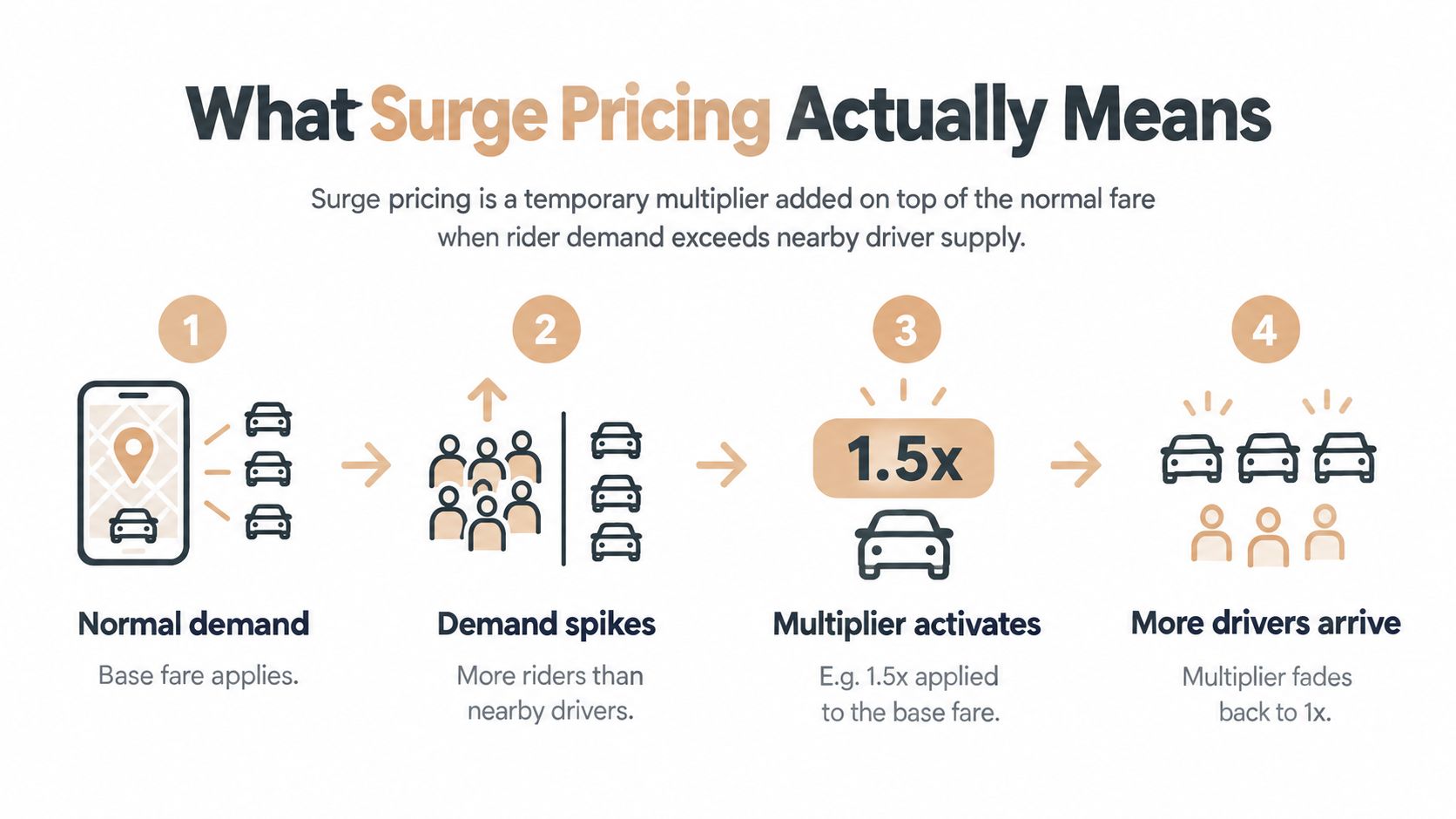
The rider normally sees the updated estimate before tapping the confirmation button. Uber explains that surge can appear as a multiplier, an added surge amount, or an upfront fare that already incorporates the increase, depending on the city. Its explanation of the rider-facing process is available in Uber's guide to surge pricing.
The purpose is market coordination. A higher potential payout can attract more drivers toward the busy area, while some riders may wait, walk to another pickup point, choose another travel option, or decide not to request the ride. When enough vehicles become available, the multiplier can fall back toward the regular fare.
Why Prices Spike in the First Place
A Friday evening in the Hamptons can bring several demands together. July 4th and Labor Day attract arrivals, dinners, parties, beach trips, and late-night returns. After a concert, a large crowd may request rides within the same short window. Rain can shift people from walking, biking, or boating into cars, while Friday departures from New York and Sunday returns add regular travel to the rush.
The supply side is less flexible than an app map suggests. Vehicles shown across a region may be far from the pickup point, already carrying passengers, heading offline, avoiding congested roads, or serving another ride category. A car that looks nearby may still be unable to accept a request soon.
Surge therefore concentrates in specific zones rather than applying citywide. A pickup in Montauk can receive a different quote from one in Southampton on the same evening because each area has its own balance of requests, available vehicles, and road conditions. The system responds to local scarcity, not just to the total number of cars visible across the region.
Consider the flow after July 4th fireworks at Main Beach. Many riders may request transportation at nearly the same time, while vehicles already on the road move slowly through crowded streets. On Labor Day Sunday, travelers leaving Montauk can compete for limited vehicles as traffic delays the trips those vehicles are already completing.
The route may be familiar, but its operating conditions change minute by minute. A vehicle delayed in traffic cannot serve the next passenger, and even a short journey can occupy the driver for much longer than usual. Demand rises while effective supply falls, creating the pressure that produces a higher quote.
Pre-booked transportation approaches the problem differently. A scheduled Hamptons Leisure Limo reservation uses an agreed price rather than recalculating the trip around a temporary rush. For a broader explanation of how trip costs can differ across transportation choices, see this guide to car service cost in the Hamptons. That fixed-price structure can suit airport transfers, corporate travel, and event transportation when knowing the cost in advance matters.
How the Multiplier Shows Up on Your Phone
The process begins when you open the app and enter a pickup location. The platform identifies where you are, what vehicle category you selected, and the current conditions in the surrounding service area. It then compares active requests with available vehicles and updates the quote as those conditions change.
Uber says its pricing system considers demand and driver availability across the city, along with forecasts about market conditions. Its explanation of the algorithm is provided in Uber's description of surge pricing.
A simplified sequence looks like this:
- You open the app. Your location, destination, ride type, and current time enter the fare estimate.
- The system checks the local zone. It compares ride requests with available vehicles near the pickup.
- The quote changes. If demand is unusually high, the system applies a multiplier or includes a surge amount.
- You review the fare. The app presents the updated estimate before confirmation.
- The market moves again. New vehicles may arrive, other riders may cancel, or more requests may appear.
The system doesn't use one citywide number for every person. Uber states that surge can vary by vehicle option and by rider and driver locations. If multiple surge areas affect a request, the higher surge amount may apply, as explained in Uber's rider help guidance on surge determination.
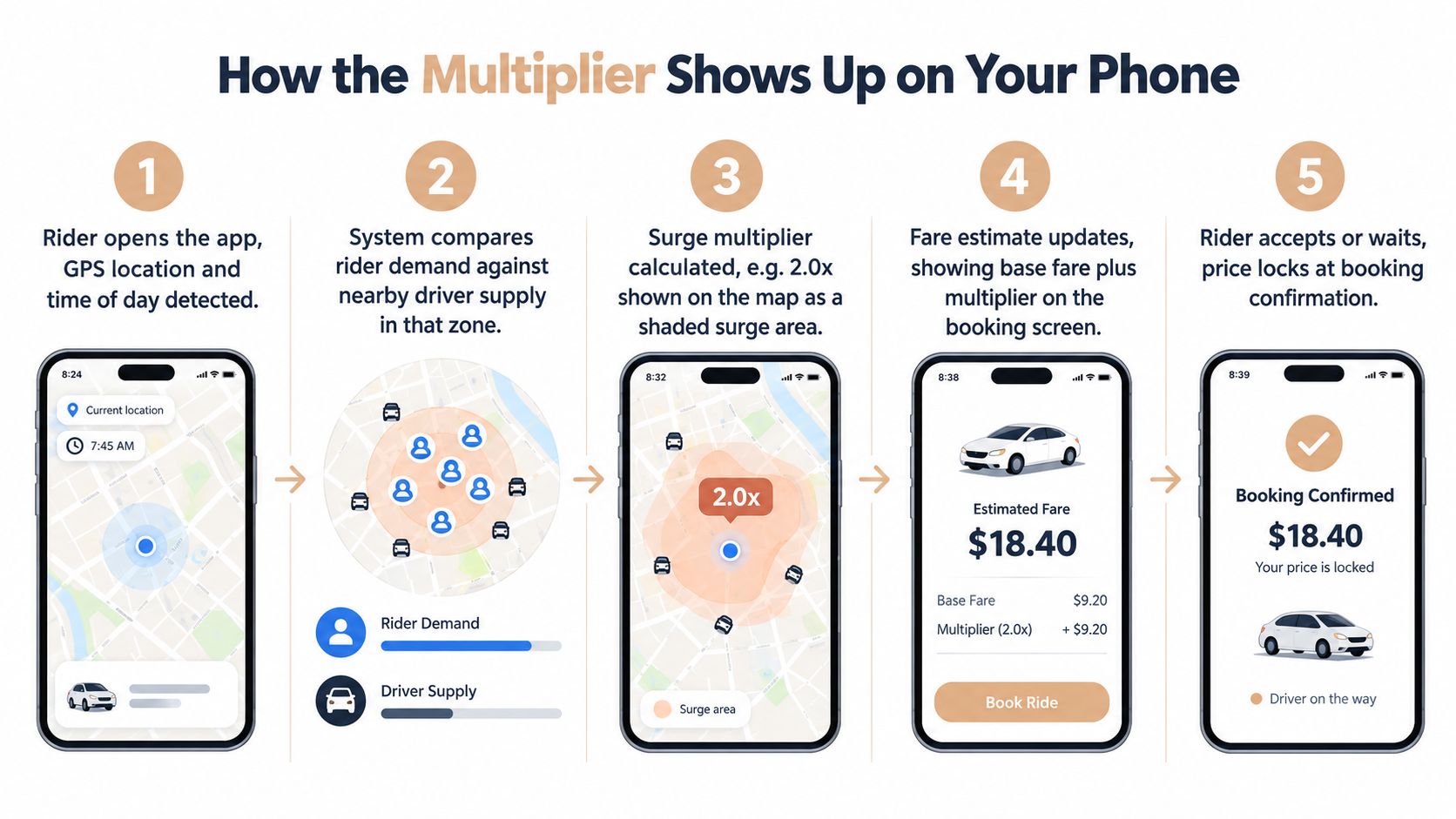
The rider may see a colored surge area on the map, a banner, or an upfront fare that already includes the higher amount. Some services use a multiplier display, while others show the total without revealing the arithmetic. Uber also says its service fee percentage doesn't change during surge pricing, although the total ride price can rise.
A quote can change while you're deciding. If a concert crowd requests rides faster than vehicles can reach the pickup zone, the app may update the estimate within moments. When supply improves, the higher pricing can recede just as quickly.
The same lesson applies across app-based ride categories and competing platforms. Whether you're comparing an economy option, a premium ride, or a black-car category, the quote reflects the live marketplace at the time of booking.
The following video offers another visual introduction to the way surge pricing appears in a ride-hailing experience.
Real World Examples of Extreme Surge
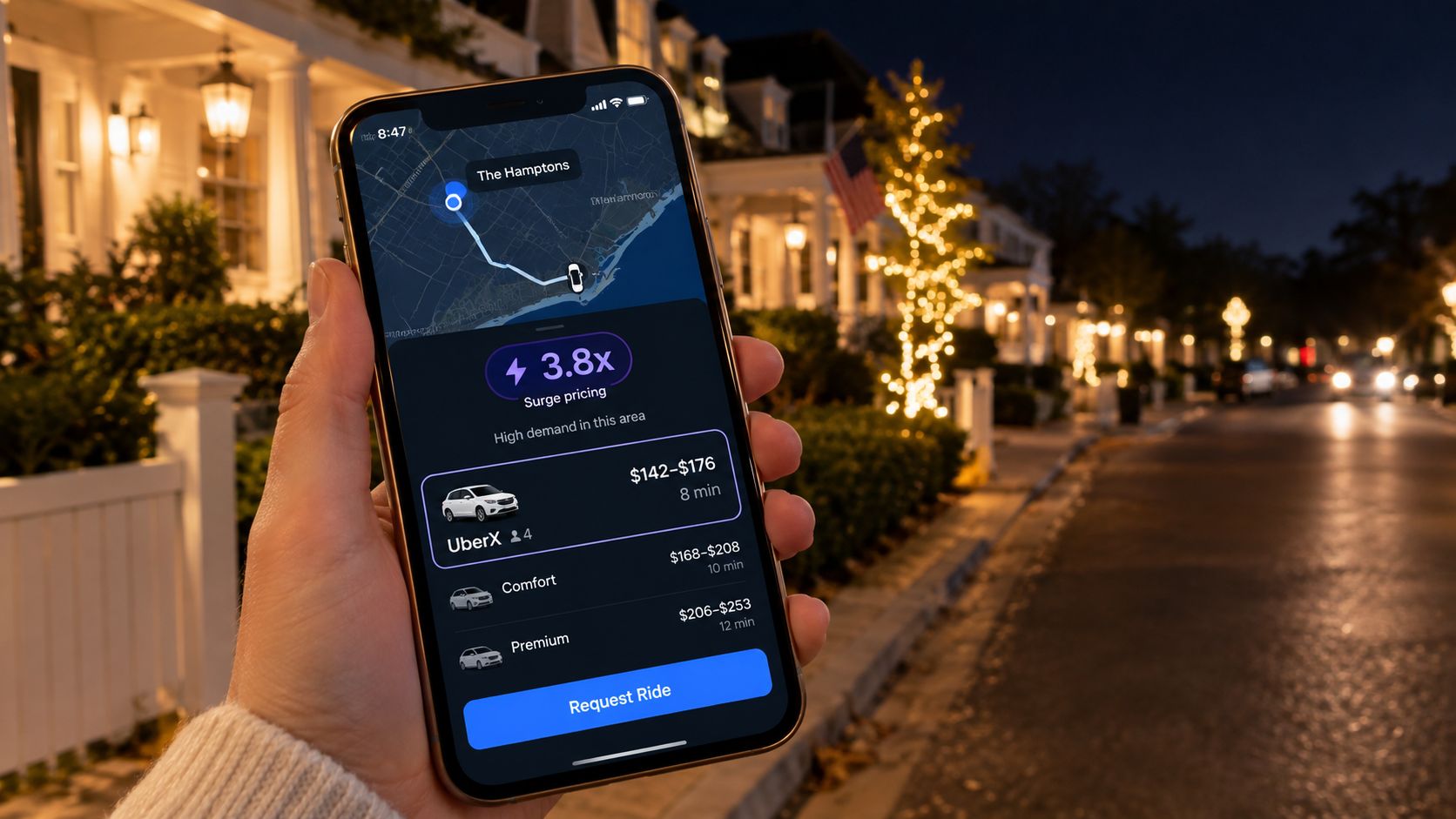
A July 4th evening in the Hamptons can turn a routine ride decision into a calculation. At 11 p.m., after a long dinner, a traveler opens an app and sees a 3.8x multiplier for an airport trip. The distance already makes the base estimate substantial. Once the multiplier applies, the quote may exceed the traveler's budget, while waiting creates another uncertainty: the price might fall as cars arrive, or rise if requests keep building.
Concert exits produce the same pressure in a tighter window. After a Madison Square Garden event, a large crowd can request short rides almost simultaneously. Four passengers may split the fare and still find the trip expensive under a high multiplier. Others walk several blocks, wait for demand to thin, or check another app.
The most extreme cases go beyond a busy evening. Reporting on Uber's early surge period described emergency multipliers of 6x to 8x. In Stockholm, a system glitch reportedly generated a 50x surge, equal to $57 per minute in that case, according to Time's report on Uber surge pricing.
July 4 travel data also shows why a single average can hide the rider's experience. The median and mode surge multiplier were both 1.0, yet the maximum reached 6.1. Mean prices were 26.06% higher than July 3 and 29.39% higher than July 5. Those figures describe a spread of conditions, not a uniform charge for every trip.
Most rides may stay near ordinary pricing while a smaller set faces sharp increases. A traveler who books during quiet periods might rarely see surge. Someone leaving an event at the exact peak can encounter the highest version of the system, which helps explain why pre-booked limousine service appeals to airport and event travelers seeking a fixed fare.
The Fairness Question Most Explainers Skip
The standard defense of surge pricing is that it allocates scarce rides to people who value them most and encourages more chauffeurs to enter the area. That logic explains the market mechanism, but it doesn't settle the fairness question for the person who needs to get home.
Recent ride-hailing research found that aggressive dynamic pricing reduced customer satisfaction, and that satisfaction fully mediated purchase intention. In plain language, riders don't respond only to the amount they pay. They also judge whether the price feels fair and whether the ride seems worth that amount. The findings are reported in this 2025 ride-hailing pricing study.
Driver-side effects can also complicate the supposed benefit. The same research found that surge-induced complaints made a driver 1.13 times more likely to receive a complaint, and those complaints offset about 23% of the driver's immediate gain from the surged fare. A higher fare can attract supply, but it can also create frustration that affects ratings, interactions, and future participation.
A pricing system can improve allocation and still feel unfair to the people using it.
The personalization concern adds another layer. Recent reporting describes cases in which riders see dramatically different prices for similar Uber and Lyft trips at the same time, raising the question of whether systems are measuring only local supply and demand or also estimating willingness to pay. That distinction matters. A market-wide scarcity adjustment feels different from an individualized offer based on what the platform believes a particular rider will tolerate.
Independent polling reported by Ipsos in 2025 found that only about one in three people supported paying more across common surge-pricing situations, with younger adults more accepting than older adults. These concerns are discussed in BGR's reporting on consumer attitudes and algorithmic ride pricing.
For travelers booking premium airport or event transportation, the appeal of a fixed quote is straightforward. It removes the need to decide whether a live price reflects ordinary scarcity, an event peak, or a personalized calculation.
Why Fixed Price Black Car Service Avoids Surge Entirely
A pre-booked black-car service works on a different timetable. Instead of asking an app to find an available vehicle at the moment demand peaks, the client reserves the trip in advance and receives a fixed-price quote. The transportation company plans the vehicle and chauffeur around the scheduled pickup.
That difference matters most in four situations:
- Airport transfers: Flight monitoring can help the operator adjust pickup timing when a flight is delayed, rather than asking the traveler to request a new ride at whatever rate the app shows.
- Group travel: A family, wedding party, or executive team can use an appropriately sized SUV, Sprinter, or coach instead of placing several separate app requests.
- Peak dates: A holiday Saturday in Montauk or a wedding weekend creates predictable demand. A reservation addresses that demand before the pickup window.
- Corporate billing: A company can arrange centralized transportation and one consolidated invoice instead of collecting separate rider-by-rider app charges.
The trade-off is real. On-demand apps are convenient when plans are flexible and a vehicle is needed immediately. Fixed reservations require more planning, but they exchange that immediacy for cost certainty and an arranged vehicle during high-demand periods.
| Factor | Ride-Hail Surge | Fixed Black Car |
|---|---|---|
| Price | Changes with live demand and nearby supply | Fixed pricing agreed at reservation |
| Availability | Depends on vehicles online at request time | Vehicle and chauffeur arranged in advance |
| Flight delays | Client may need to update or rebook | Operator can monitor the flight and adjust pickup |
| Groups | May require multiple ride requests | Vehicle can be matched to the group |
| Peak events | Fare may rise when crowds leave | Reservation avoids live surge pricing |
| Billing | Individual app charges | Centralized coordination may support consolidated billing |
Hamptons Leisure Limo is one local option that provides pre-arranged airport, event, corporate, and point-to-point transportation with fixed pricing and no surge charges. Its approach is outlined in this explanation of fixed-price car service.
For an airport transfer from JFK, LGA, EWR, ISP, or a private East End airport, the key question is not whether an app might eventually show a lower quote. It's whether you want to leave the price and vehicle availability to the conditions outside the restaurant, venue, or terminal at that moment.
Choosing Predictable Pricing for Your Next Hamptons Trip
Three ideas answer the question what is surge pricing:
- It's a real-time multiplier or added amount triggered by local demand and limited nearby supply.
- It concentrates around predictable pressure points, including holiday weekends, event exits, weather changes, and busy travel windows.
- It can turn an ordinary airport, dinner, or late-night trip into a budget surprise.
A pre-booked fixed-price service sidesteps those conditions by arranging the vehicle before the demand spike. That can be especially useful for airport transfers, wedding transportation, corporate travel, and late-night returns when arriving on schedule matters more than requesting a car at the last moment.
Before booking, ask four practical questions:
- Quote details: Is the rate fixed, and does it include the expected fees?
- Flight monitoring: Will the operator track delays and adjust the pickup?
- Vehicle class: Is the vehicle suitable for your group, luggage, and occasion?
- Cancellation terms: What happens if your plans change?
For a Hamptons airport transfer, review the details of an airport transfer quote, then text (631) 294-0747 to request a quote for your dates.
Hamptons Leisure Limo provides pre-arranged airport transfers, event transportation, corporate travel, and spacious vehicles across the Hamptons with fixed pricing and no surge charges. Text (631) 294-0747 for a quote, or visit Hamptons Leisure Limo to plan transportation before your next airport arrival, wedding, or East End event.
Ready to Ride with Hamptons Leisure Limo?
Fixed pricing. No surge fees. 30 years of experience serving the Hamptons. Text us what you need and we will send a quote.