What Is a Limo Bus and How It Works
Updated September 22, 2026

A limo bus is a chauffeured group vehicle built on a bus or cutaway-bus chassis, typically seating 10 to 50 passengers, that sits between a stretch limousine and a full motorcoach. In practical terms, 9 passengers or more can move a booking into a different commercial passenger-vehicle category, while 16 or more passengers including the chauffeur triggers federal passenger-endorsement rules.
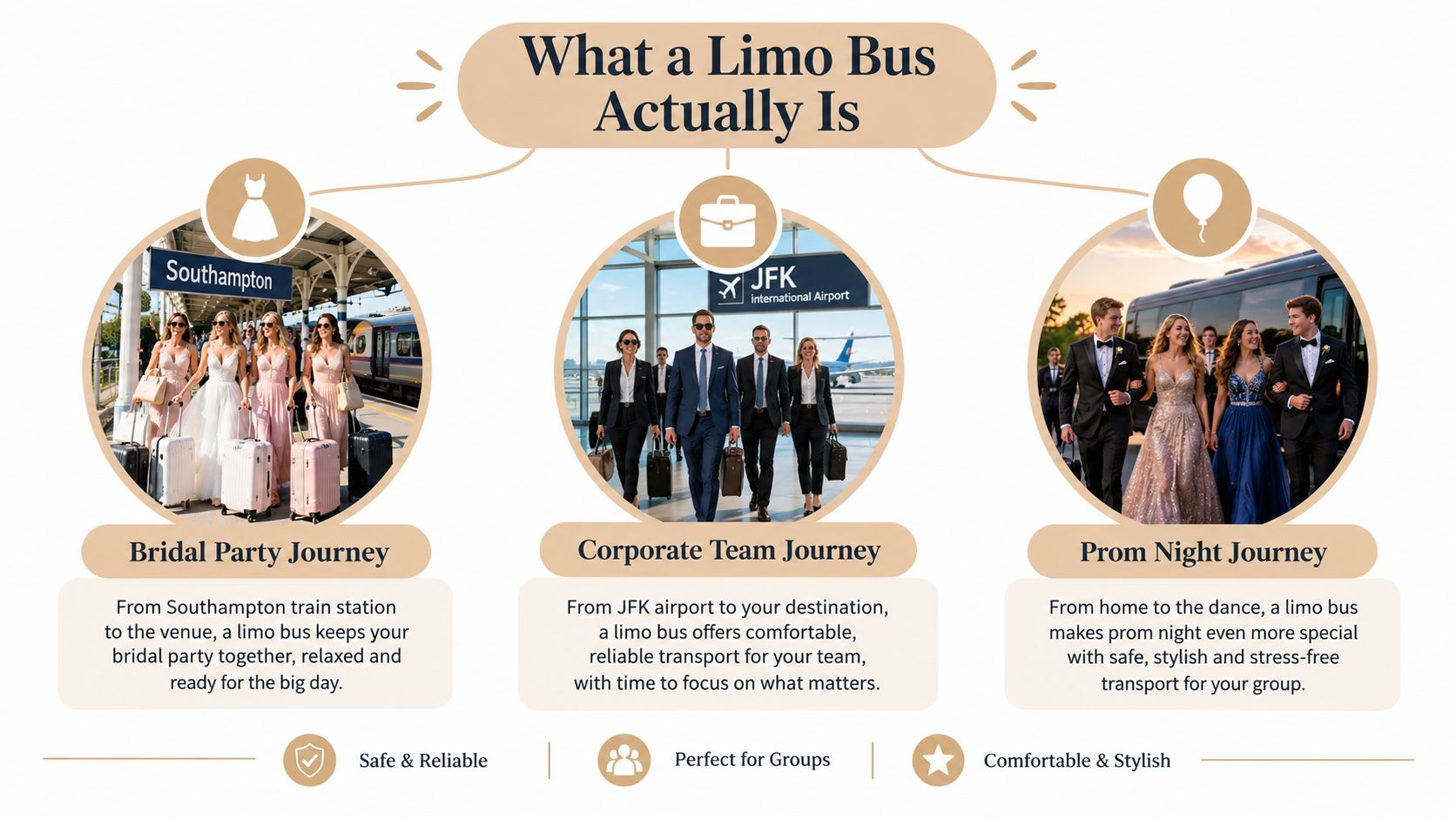
You may be trying to move a bridal group from the Southampton train station with luggage, collect a corporate team at JFK for a Sagaponack estate, or keep a prom group together after leaving Sunrise Highway. The question isn't whether everyone fits. The vehicle's seat count, chassis, weight, restraint system, licensing, and insurance can change what you should book.
For Hamptons travel, the safest approach is straightforward: match the group to the vehicle class first, then compare amenities and availability. Marketing names blur together, but the road rules don't.
Table of Contents
- What a Limo Bus Actually Is
- Limo Bus vs Sprinter vs Party Bus vs Coach
- Typical Features Inside a Limo Bus
- Common Uses in the Hamptons
- Licensing and Insurance Rules That Apply
- Safety and Comfort Considerations
- Booking Tips for Hamptons Group Travel
What a Limo Bus Actually Is
A limo bus is a large chauffeured passenger vehicle designed for group travel, built on a bus or cutaway-bus chassis rather than a stretched sedan. Its interior is fitted for shared transportation, often with lounge-style seating and room for a group. Federal guidance defines a limousine as a passenger vehicle designed or used to carry 15 or fewer passengers, including the chauffeur. Federal transportation glossary
For a Hamptons booking, start with the seat count:
- 1 to 8 passengers: Usually SUV or traditional limousine territory.
- 9 to 14 passengers: The overlap zone for Sprinter vans and smaller limo buses.
- 15 passengers: A boundary that can affect the vehicle's regulatory treatment and equipment.
- 16 or more passengers including the chauffeur: Federal commercial driver's license passenger-endorsement rules apply.
- More than 26,001 pounds GVWR: The vehicle enters the heavier motorcoach range, with different operating requirements.
The label alone does not identify the vehicle. Industry configurations place limo buses and party buses broadly in the 10 to 50 passenger range. Smaller Sprinter or shuttle conversions often carry about 10 to 14 passengers, while full-size motorcoaches commonly seat about 40 to 56 passengers.
That range creates real booking confusion. One Southampton operator may call a compact luxury shuttle a limo bus, while another uses the same term for a larger lounge vehicle. Ask for the actual seating configuration, the number of seats available to passengers, and whether luggage reduces that capacity.
The chassis also matters. A limo bus is generally built on a bus or cutaway-bus platform and may be treated operationally as a passenger-carrying bus under federal highway classification guidance, depending on its axle and tire configuration. Limo bus vehicle classification overview
Practical rule: Count every person, including the chauffeur, then ask for the vehicle's GVWR. Those details tell you more than the words “limo bus” on a website.
Limo Bus vs Sprinter vs Party Bus vs Coach
The cleanest comparison is capacity, construction, and purpose. A Mercedes-Benz Sprinter conversion may overlap with a small limo bus, and a party bus may share the same cutaway chassis as a luxury shuttle. The interior and operating classification still determine whether it suits a Southampton airport transfer, a vineyard loop, or a large wedding movement.
| Vehicle | Typical Seats | Chassis / Build | Best Use Case | Key Threshold |
|---|---|---|---|---|
| Sprinter van | About 10 to 14 | High-roof van conversion with captain-style seating | Airport transfers, small wedding parties, executive travel | Often remains below the 15-passenger boundary |
| Limo bus | About 10 to 50, depending on layout | Cutaway-bus or bus chassis with luxury interior | Weddings, winery outings, corporate shuttles, group events | 9 passengers or more can enter a commercial passenger category |
| Party bus | Overlapping limo-bus range | Bus or cutaway chassis with social lounge features | Celebrations, nightlife, concerts, shorter event hops | Capacity and weight determine compliance, not the marketing label |
| Full motorcoach | About 40 to 56 | Full-size coach body with luggage storage and, on some models, restroom | Regional transfers, large weddings, long-distance group travel | Heavier vehicles can exceed 26,001 pounds GVWR |
A Sprinter is usually the sensible choice for a family flying into JFK or a small bridal party carrying bags. Its forward-facing layout and easier maneuverability can be more useful than an open lounge cabin when the trip is mainly point to point.
A limo bus makes more sense when passengers want to stay together between several stops. The open cabin supports conversation and social travel, but luggage capacity may be limited on smaller builds. Confirm where bags go before booking an airport transfer.
A party bus often emphasizes mood, music, lighting, and a club-style cabin. That can work for a bachelorette itinerary or concert run, but it isn't automatically the right choice for a formal corporate movement.
A coach is the professional answer for large groups and long transfers. The 15-passenger party bus comparison can help clarify where a conventional party bus fits, but the operator should still identify the actual chassis, seat count, and compliance category.
Typical Features Inside a Limo Bus
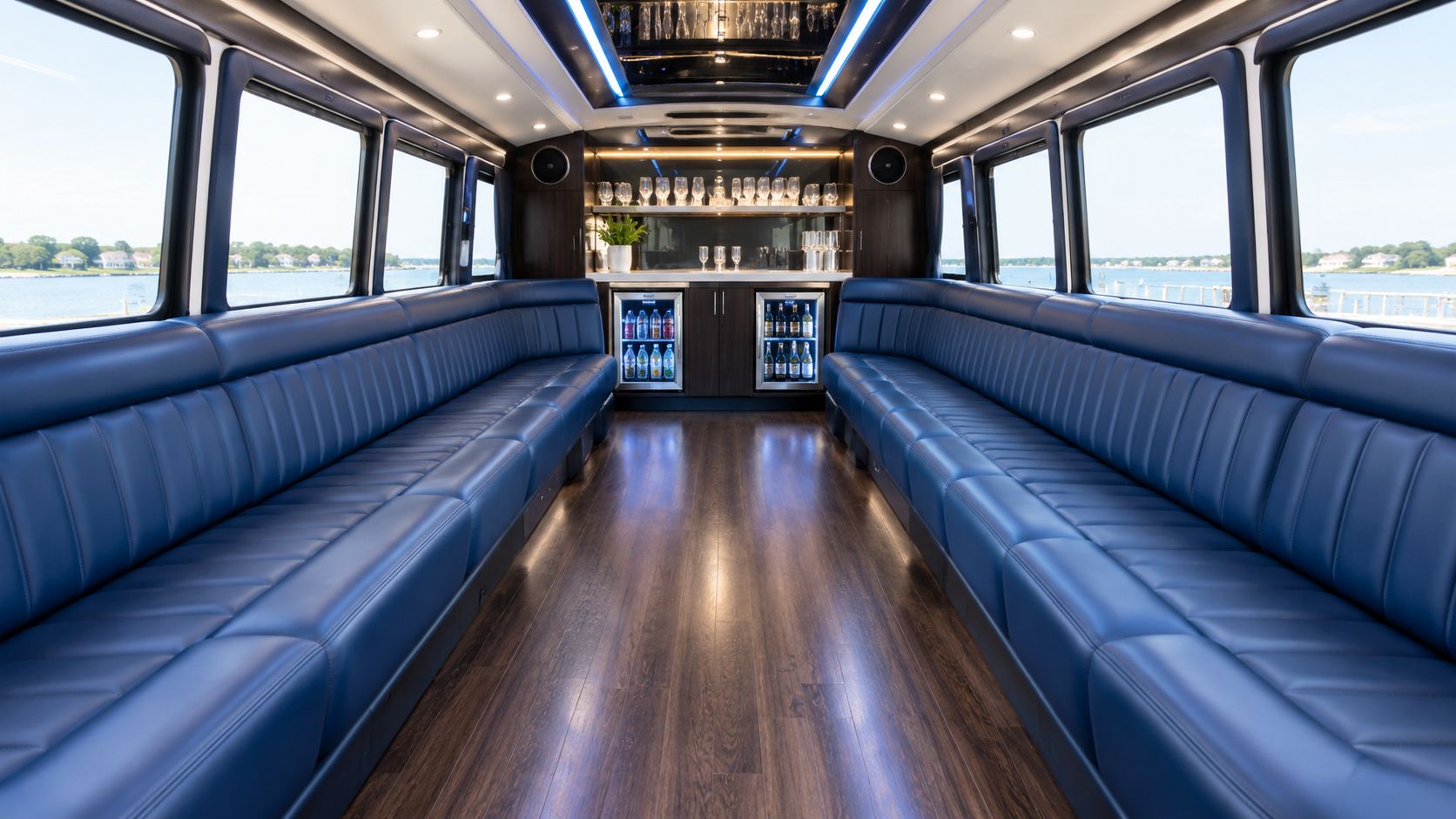
Walk into a mid-size limo bus and you usually won't find a row of ordinary car seats. Many builds use perimeter bench seating along the side walls, with additional rear bench rows. That turns the cabin into an open lounge, which is useful for groups that want to talk during a wedding transfer, winery visit, or evening itinerary.
The finish varies sharply by vehicle. Leather or vinyl seating, overhead lighting, climate control, and basic audio are common expectations. Premium builds may add upgraded upholstery, wood-look flooring, a bar area, and more elaborate lighting. Don't assume every advertised feature appears on every vehicle in a fleet.
Standard equipment versus upgrades
A basic limo bus may include:
- Open seating: Side-facing lounge benches and rear seating.
- Climate control: Essential for humid summer trips and cool evening returns.
- Audio connection: Often a Bluetooth-capable head unit, though the exact setup must be confirmed.
- Interior lighting: LED ceiling lights are common, while color-changing or fiber-optic systems are upgrades.
Upscale vehicles may include a center bar with ice wells, glassware, and a beverage cooler. Larger entertainment systems can include subwoofers, flat-panel screens, and HDMI inputs. Those additions matter for a celebration, but they shouldn't distract from the fundamentals, including comfortable seating, working air conditioning, and room for the group's belongings.
Larger vehicles and mini-coaches may offer a restroom and underfloor luggage bays. Smaller 14 to 20 seat units generally don't have the same storage or restroom capacity, so airport groups should ask specific questions before they reserve.
The best operator will tell you which amenities belong to the exact vehicle assigned to your trip. A website photo may show a different build, a different seating plan, or a larger coach.
Before you book, ask whether the bus has:
- The seating arrangement your group expects.
- A working beverage area, if that matters.
- Enough luggage storage for the airport or wedding itinerary.
- A sound system compatible with your phone.
- A restroom, if the route or passenger needs make it important.
Give the operator your real headcount and luggage situation. A bus that technically holds everyone may still feel wrong if the cabin is crowded with bags.
Common Uses in the Hamptons
The East End calendar determines the right bus more than the word “luxury” does. A vehicle that works for a wedding shuttle may be excessive for a small airport party, while a Sprinter can feel undersized when guests need to move between a ceremony, reception, and hotel.
Weddings and private events
Weddings often need repeated movement, not one pickup and one drop-off. Guests may travel between an estate, cocktail-hour location, reception, and hotel, with timing affected by narrow roads, venue access, and Route 27 traffic.
For a larger wedding, a 20 to 40 seat limo bus can keep guests together and reduce the number of separate vehicles. If the guest list is larger or the route extends toward New York City, a full motorcoach with dedicated luggage storage may be more practical.
Prom and graduation groups require a different approach. Parents usually want one controlled vehicle, a clear passenger list, and a professional chauffeur familiar with the pickup plan. A 14 to 20 seat vehicle can suit a smaller group with chaperones, provided the operator confirms the seating and restraint setup.
Airport and corporate transfers
JFK, LaGuardia, and MacArthur trips are luggage problems as much as passenger problems. A 14 to 24 seat limo bus may work for a family reunion, executive group, or corporate team, but only if the vehicle has adequate storage for cases and carry-ons.
Corporate itineraries also benefit from predictable coordination. A group may need airport pickup, a Sagaponack estate transfer, a Hamptons Jitney connection, and a return movement on a fixed schedule. In that situation, a vehicle with a formal seating plan and one dispatcher coordinating the itinerary is more useful than a party-focused interior.
Wine tours and nightlife
Wine tours through Sag Harbor, the North Fork, or nearby vineyard routes often suit a 20 to 30 seat coach-style limo bus. The open cabin keeps the group together, while a larger vehicle gives passengers room to settle in between stops.
Concert runs to Westhampton, bachelorette outings, and evening restaurant itineraries can use party-bus-style vehicles. Choose the layout based on the trip. If the group needs luggage, formal clothing, or frequent boarding, prioritize access and storage over decorative lighting.
| Use Case | Typical Group Size | Recommended Vehicle | Seasonal Peak |
|---|---|---|---|
| Wedding shuttle | About 20 to 40 guests | Mid-size limo bus or motorcoach | Wedding season and summer weekends |
| Prom or graduation | About 14 to 20 passengers | Smaller limo bus with chaperone plan | Spring school-event season |
| Wine tour | About 20 to 30 passengers | Coach-style limo bus | Warm-weather weekends |
| Airport transfer | About 14 to 24 passengers | Limo bus with confirmed luggage space | Summer travel periods |
| Corporate shuttle | Varies by itinerary | Sprinter, limo bus, or coach | Retreats, meetings, and event dates |
The recommendation is simple: start with the headcount and luggage, then select the vehicle. Booking a larger bus just because it looks impressive can create unnecessary cost and maneuvering challenges.
Licensing and Insurance Rules That Apply
A limo bus can look like a luxury vehicle while operating under commercial passenger-transport rules. The threshold that gets the most attention is 16 passengers including the chauffeur. Federal law requires a Commercial Driver's License with a Passenger endorsement for anyone operating a vehicle designed to transport 16 or more passengers, including the chauffeur. Commercial limo-service permit guidance
The federal registration question also depends on the trip. A U.S. Department of Transportation number becomes relevant for interstate passenger transportation in a vehicle designed to carry 9 or more passengers including the chauffeur for compensation, and for vehicles designed to carry 16 or more passengers including the chauffeur even when passengers aren't carried for direct compensation. Confirm the operator's status when the itinerary crosses state lines.
At 9 passengers or more, the vehicle may enter a commercial for-hire passenger category under state rules. Michigan, for example, separates vehicles carrying eight or fewer passengers from those carrying nine or more under its transportation framework, illustrating why the practical label “limo bus” doesn't settle the legal question. Michigan bus and limousine guidance
What to request from an operator
Ask for written answers to these questions:
- Passenger count: Does the stated capacity include the chauffeur?
- License: Does the assigned chauffeur hold the required passenger endorsement?
- Registration: Does the carrier have the appropriate USDOT registration for the route?
- Insurance: What commercial policy applies to this vehicle and trip?
- Fleet ownership: Is the operator using its own vehicle or brokering the reservation?
Insurance thresholds can vary by jurisdiction, passenger count, vehicle weight, and operating category. Industry and state guidance illustrate different thresholds at 15 passengers, 16 passengers, and 26,001 pounds GVWR, with examples of $1.5 million coverage for vehicles with 15 or fewer seats and $5 million for vehicles with more than 15 seats. Commercial vehicle insurance explanation
Don't treat those figures as a universal New York quote. Treat them as a reason to ask for the actual policy limit and the legal basis for the operator's classification. Local pickup rules may also apply around village centers and event venues, so a reputable carrier should be able to explain its permitting process for the planned route.
Safety and Comfort Considerations
A bigger vehicle isn't automatically safer. The important questions concern restraints, vehicle construction, chauffeur qualification, maintenance, and passenger behavior.
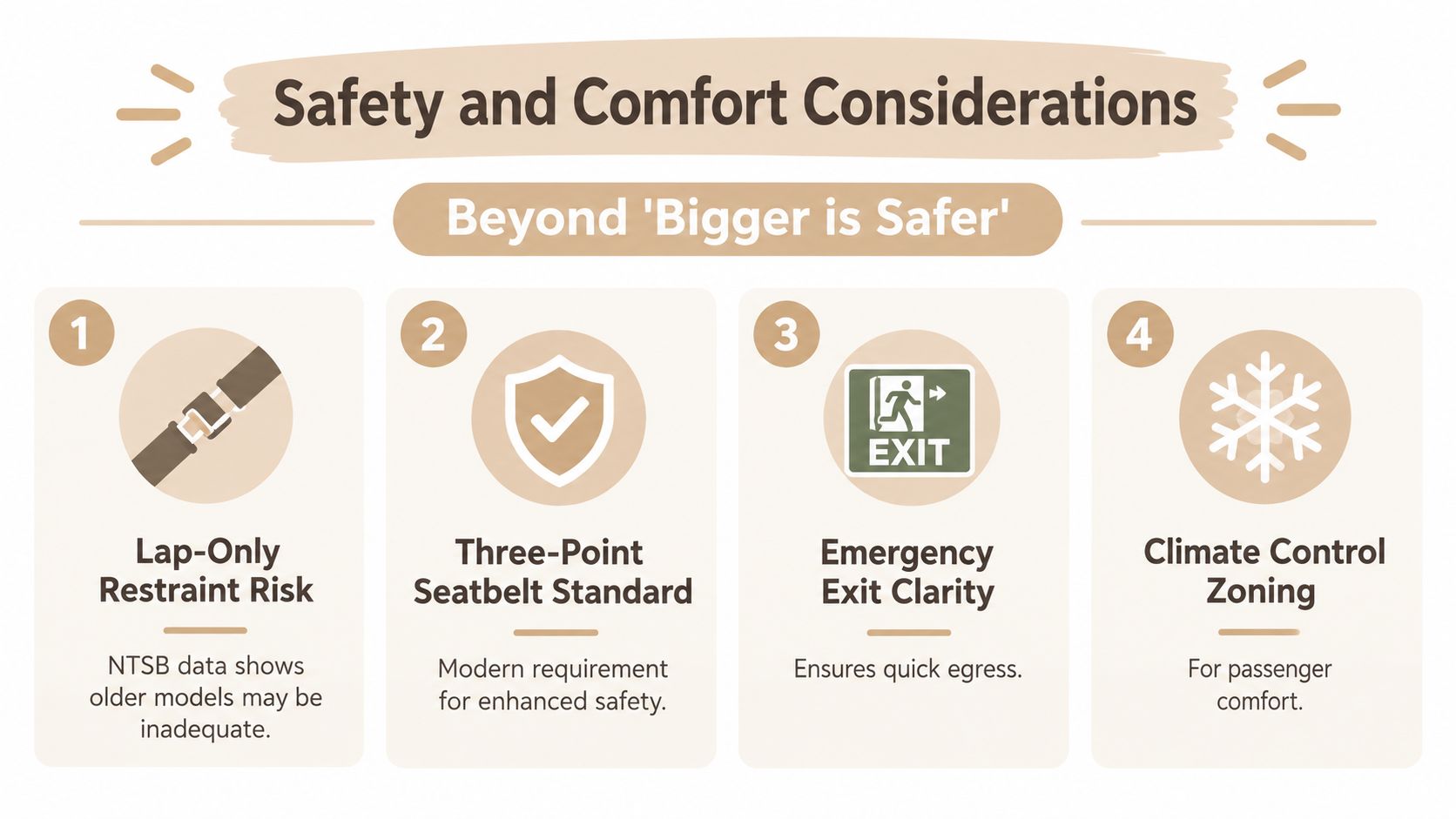
NHTSA's final rule requires lap and shoulder belts at all seating positions on newly manufactured covered over-the-road buses and on certain non-over-the-road buses with a GVWR greater than 26,000 pounds, subject to specified exceptions. The phase-in for newly manufactured covered buses began in November 2016. A separate NHTSA interpretation says that, under an older framework, buses over 10,000 pounds GVWR had seat-belt requirements applying only to the chauffeur's designated seating position. NHTSA occupant-restraint rule
That history matters because limo buses come from different chassis, build years, and modification paths. Ask whether passenger seats have lap belts or three-point belts, and ask the operator to identify the equipment on the exact vehicle assigned to you.
The NTSB has recommended lap and shoulder belts at every passenger seating position in limousines because they provide greater occupant protection than lap belts alone. NTSB limousine safety report
Questions that deserve direct answers
- Restraints: Are belts installed at every passenger position, and what type are they?
- Chauffeur vetting: Does the chauffeur hold the required license and passenger endorsement?
- Maintenance: How does the operator inspect and service the bus between busy summer bookings?
- Emergency exits: Can the chauffeur point out exits and explain the evacuation process?
- Comfort: Does the vehicle have reliable climate control, adequate legroom, and seating that suits the route?
Route planning also affects comfort. A long transfer to Montauk, a summer return from JFK, and a short local celebration place different demands on the vehicle. Ask how the dispatcher plans the routing, where the vehicle can safely load, and how the itinerary handles traffic without rushing the chauffeur.
Comfort still matters. A functional bar, even climate control, clean upholstery, and sensible seating can make a long group transfer feel organized instead of cramped. An honest operator won't promise a feature that the assigned vehicle doesn't have.
Booking Tips for Hamptons Group Travel
Summer group transportation fills on the same dates each year, especially between Memorial Day and Labor Day. Reserve early to protect the vehicle size your group needs, then require a written quote with clear service terms.
The quote should identify:
- Exact vehicle: Request the coach year, chassis, seating layout, and luggage arrangement.
- Included service: Confirm pickup points, waiting time, stops, and planned route.
- Fixed pricing: Ask whether the price covers the agreed service period instead of exposing the group to surge pricing.
- Extra charges: Clarify gratuity, fuel surcharges, venue parking, and overtime.
- Contact plan: Get a textable chauffeur contact and an operations number for the event.
Traffic near Shinnecock, Montauk Highway, Route 27, bridges, and village centers can disrupt a tight itinerary. Have the contract explain what happens if traffic or weather extends service. Fixed pricing helps with planning, but it does not replace written terms for waiting and overtime.
For a wedding, assign one dispatcher to every vehicle. The ceremony shuttle, hotel pickup, reception transfer, and late return should follow one movement plan. That prevents one bus from leaving while guests remain behind and gives the planner one contact when the venue schedule changes.
Groups in the smaller mid-size range can start with this 20-person limo bus guide. Book by actual requirements, not the vehicle label. Send the operator your headcount, luggage count, pickup addresses, stop list, event times, and any special seating needs.
Hamptons Leisure Limo lists Sprinter service, mini-buses, and a 55-passenger coach, plus airport transfers, wedding transportation, corporate travel, and North Fork wine tours. Its fixed-pricing model and text contact at (631) 294-0747 provide a straightforward way to request a quote.
For a wedding, airport transfer, prom itinerary, or corporate move, match the headcount and luggage to a Sprinter, mini-bus, or coach. Visit Hamptons Leisure Limo to review group transportation options, then text (631) 294-0747 for fixed pricing with no surge.
Ready to Ride with Hamptons Leisure Limo?
Fixed pricing. No surge fees. 30 years of experience serving the Hamptons. Text us what you need and we will send a quote.