20 Person Limo Bus Guide for Hamptons Group Travel
Updated September 16, 2026

You've gathered a wedding party in Southampton, arranged a dinner in East Hampton, or booked an airport transfer from JFK, and the guest list has settled near twenty people. The immediate question is practical: can everyone travel together without splitting between several SUVs, while still having enough room for bags, formalwear, and comfortable boarding?
A 20 person limo bus often fits that middle ground. It's more social and spacious than a standard passenger van, yet smaller and easier to coordinate than a full motorcoach. The right choice depends on more than the number printed in a fleet description. Seating layout, luggage, mobility needs, child seats, village access, and commercial regulations all matter.
This guide explains how the vehicle is classified, what the interior usually feels like, where it fits among Sprinter vans and coaches, and how to plan wedding, airport, corporate, and nightlife transportation across the Hamptons.
Table of Contents
- Introduction to the 20 Person Limo Bus Experience
- What a 20 Person Limo Bus Is and How It Is Classified
- Inside the Layout Seating and Amenities You Can Expect
- How a 20 Person Limo Bus Compares to Sprinter Vans and Mini Coaches
- Ideal Use Cases for Weddings Airport Runs and Group Events
- Hamptons Booking and Logistics Tips for a Smooth Ride
- Planning Your Group Trip With Confidence
Introduction to the 20 Person Limo Bus Experience
A wedding weekend on the East End may start with arrivals from New York City, continue from a Southampton hotel to a Bridgehampton ceremony, and finish near East Hampton. Without coordinated transportation, guests can become spread across separate cars before the first toast.
A 20 person limo bus keeps that movement together. Guests share one scheduled pickup, stay with the group between villages, and have room to settle in instead of following a convoy along busy roads. For a celebration, the cabin may feel like a small lounge on wheels. On an airport transfer, the same vehicle helps keep passengers, luggage, and timing organized.
Hamptons travel adds practical complications. Routes between Southampton, Sag Harbor, East Hampton, Amagansett, and Montauk may include narrow approaches, event traffic, limited curb space, and pickup locations that change during the day. A vehicle that fits the advertised capacity may feel crowded once passengers bring garment bags, suitcases, coolers, or child equipment.
Planning principle: Choose the vehicle around the group's real movement, not only the headline seat count.
The right choice also depends on the trip's role. A wedding party may need coordinated village-to-village service, while an airport group needs luggage access and reliable boarding. A family may need space for child equipment, and a corporate host may prioritize orderly pickups over a party-style interior.
A 20 person limo bus generally occupies the small-to-mid-size group vehicle category. It sits between Sprinter vans and mini coaches, offering more shared cabin space than a typical van while remaining more manageable than a full motorcoach on local Hamptons routes. Fleet descriptions commonly place this format with event transportation and group transfers, including weddings, airport connections, village outings, wine tours, corporate travel, and nights out. Industry fleet descriptions of 20-passenger limo buses reflect that middle-market role.
What a 20 Person Limo Bus Is and How It Is Classified
For a wedding party leaving Southampton for East Hampton, a 20 person limo bus fills the space between a Sprinter van and a mini coach. It provides one shared cabin for village-to-village travel, airport transfers, or an evening event, while remaining easier to position on local Hamptons roads than a full-size motorcoach.
A regular shuttle mainly moves passengers between fixed points. A limo bus is closer to a living room on wheels, with perimeter seating, a central passage, social space, and amenities intended for private charter. The name describes the passenger experience, though it does not determine the vehicle's legal category.
A vehicle carrying a larger group may be classified as a bus or commercial passenger vehicle, even with luxury finishes. In many U.S. and Canadian jurisdictions, vehicles exceeding roughly 8 to 11 passengers enter a bus-related regulatory category, depending on local rules. Vehicle capacity and regulatory banding guidance explains why the seat count can affect oversight.
Michigan, for example, regulates commercial for-hire passenger vehicles with a seating capacity of 9 passengers or more, including the chauffeur, under its motor bus law. It also requires at least $5,000,000 in combined single-limit liability insurance for buses with 16 or more passengers, including the chauffeur. Michigan passenger transportation guidance illustrates why a 20 person limo bus belongs in a regulated group-transport category rather than being treated as a larger luxury van.
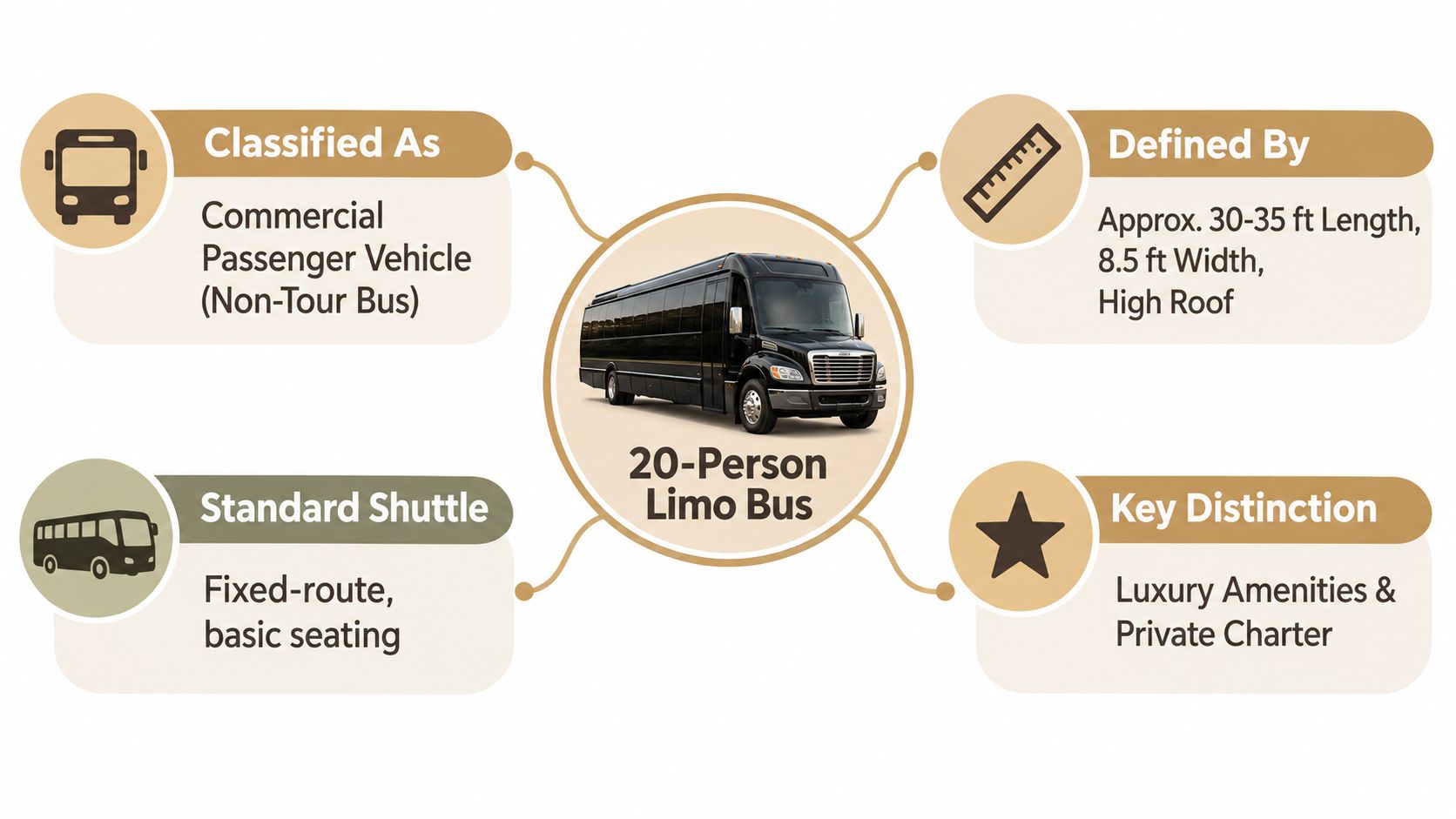
Capacity is measured, not guessed
Regulators and manufacturers use defined seating positions and measured layouts. Michigan's MDOT uses a 14-inch minimum per seating position when determining bus capacity, so the physical arrangement can matter as much as the vehicle's sales label. A Nevada tariff filing also identifies a “Perimeter Seating Limo Bus” category for 17 to 20 passengers, including the chauffeur, showing that this format is recognized in luxury transportation.
New York adds another layer. For-hire intrastate vehicles with a designed seating capacity greater than 8 passengers, including the chauffeur, require NYSDOT inspection. Vehicles with designed seating capacity greater than 10 passengers may also require operating authority unless exempt. New York and commercial passenger-carrier requirements provides broader federal context for licensing, insurance, and safety obligations.
Ask the operator for the vehicle's designed capacity, seating configuration, and operating credentials. “Party bus” describes the service style, not the formal requirements attached to the vehicle. For a local comparison of available formats, review the Hamptons Leisure Limo fleet.
Inside the Layout Seating and Amenities You Can Expect
The interior usually begins with perimeter seating. Instead of rows facing forward like a school bus, passengers may sit along the sides or around the rear, creating a more conversational arrangement. A center aisle allows people to move between seats, reach the entrance, and use the interior amenities without climbing over another passenger.
A typical cutaway-based shuttle bus in this size range may be built around a 14,500-pound GVWR, with a body length near 20 feet 9 inches and an exterior width of 88 inches. Starcraft Allstar vehicle specifications provide a useful reference for understanding the package.
The width is important. An 88-inch body can preserve a usable aisle and interior standing area while remaining on a light-truck chassis platform. That doesn't mean every model has the same floor plan, because conversions, seat dimensions, wheel wells, bars, partitions, and entertainment equipment can all change usable space.
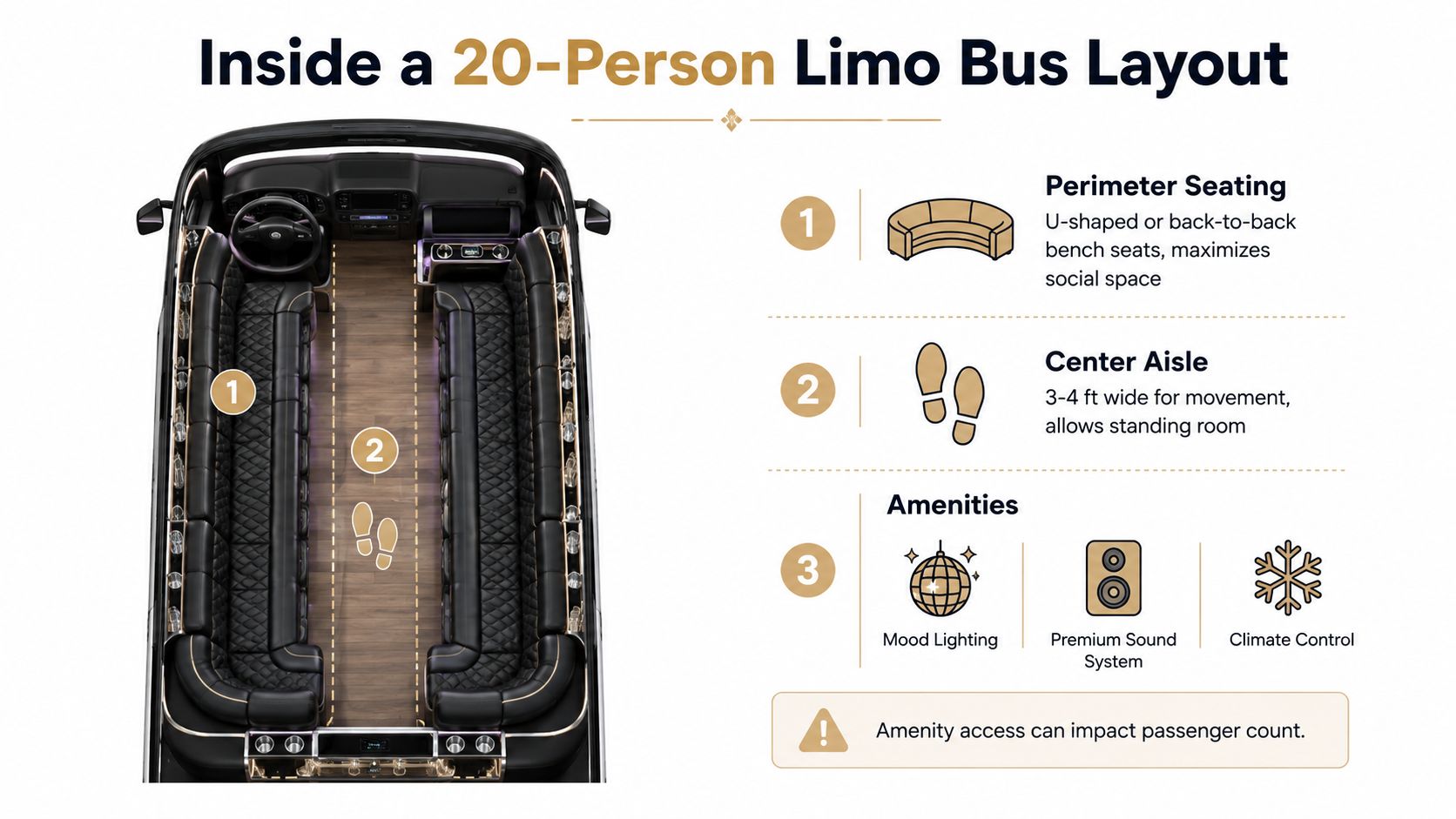
The headline capacity isn't the whole comfort story
A group of twenty adults may fit within the certified seating arrangement, but luggage changes the equation. Airport suitcases need a designated storage plan. Wedding parties may bring garment bags, floral items, gifts, and personal totes. A group with child seats or mobility devices needs an honest discussion about boarding, placement, and aisle access before the reservation is finalized.
Some operators report that all-adult usable capacity can be below the advertised seat count. One operator states that a 20-passenger limo bus is limited to 90 percent capacity for all-adult groups, while also describing New York capacity calculations using 16-inch seat widths and a 150-pound per-guest assumption. A limo operator's capacity guidance illustrates why a provider's practical recommendation may differ from the number in the vehicle name.
Ask these questions before booking:
- Seat layout: Are the seats perimeter style, forward-facing, or mixed?
- Luggage: Where will suitcases, garment bags, and event supplies go?
- Accessibility: Can a passenger using a mobility device board safely, and is there a lift or another arrangement?
- Child seating: Are child seats available by request, and where can they be installed?
- Amenities: Will a bar, sound equipment, or extra cabinetry reduce seating or aisle space?
Common amenities may include climate control, mood lighting, a sound system, tinted windows, cupholders, and open standing room. The specific equipment varies by vehicle, so treat every amenity list as something to confirm rather than assume.
How a 20 Person Limo Bus Compares to Sprinter Vans and Mini Coaches
A Southampton wedding group may need one vehicle for hotel departures, venue transfers, and the ride back at night. An airport group may have fewer passengers but more luggage. These trips can share a headcount while requiring very different interiors, so choose by headcount and behavior, not the vehicle name alone.
A 20 person limo bus sits between a Sprinter van and a mini coach. A Mercedes-Benz Sprinter van configured for up to 14 passengers has a compact footprint and usually a more executive, forward-facing cabin. A limo bus gives a larger group more shared space and a social layout. Mini coaches and coaches are built for larger movements, including the 25-passenger, 36-passenger, and 55-passenger categories listed in the publisher's fleet information.
| Vehicle Type | Passenger Capacity | Layout and Comfort | Best For |
|---|---|---|---|
| Sprinter van | Up to 14 passengers | Forward-facing or executive-style seating, compact footprint, limited shared standing space | Smaller airport groups, executive transfers, intimate outings |
| 20 person limo bus | Commonly marketed for 17 to 20 passengers, including the chauffeur | Perimeter seating, center aisle, social layout, private-charter amenities | Wedding parties, group dinners, village-to-village travel, event transportation |
| Mini coach | 25 or 36 passengers | More conventional coach layout, greater room for larger groups and equipment | Larger wedding shuttles, corporate outings, venue transfers |
| Full-size coach | 55 passengers | Coach-style seating and substantial group capacity | Large event movements requiring one coordinated vehicle |
The table shows advertised categories, not guaranteed comfort. Seating style, aisle width, luggage, mobility needs, and the route can change the practical choice. A compact Sprinter may suit an airport run with light bags, while a limo bus may work better for village-to-village travel when guests want to remain together between Southampton, Bridgehampton, Sag Harbor, and East Hampton.
Passenger capacity can also affect how a vehicle is classified, priced, insured, and scheduled. That is why a 20 person limo bus belongs to a regulated middle market, rather than being treated as either a large van or a small coach. Confirm the operator's classification and usable seating before paying a deposit.
Match the vehicle to the itinerary
Choose a Sprinter van when the group is smaller, luggage is manageable, and a compact cabin fits the route. For planning details, see this guide to Sprinter van rental planning.
Choose a 20 person limo bus when keeping the party together matters, especially for wedding transfers, group dinners, and short Hamptons trips with several village stops. Its perimeter seating supports conversation, while the smaller footprint can be easier to position at hotels, restaurants, and event venues than a larger coach.
A mini coach makes more sense as the confirmed group approaches the limo bus's usable limit, luggage increases, or equipment needs more room. A 55-passenger coach suits a large wedding shuttle or corporate movement, but it can be more vehicle than a compact group requires. Compare the actual passenger experience, not only the maximum capacity printed beside the vehicle name.
Ideal Use Cases for Weddings Airport Runs and Group Events
A wedding party leaving a Southampton hotel may have formalwear, bouquets, and guests who need to reach the same ceremony. A 20 person limo bus gives everyone one boarding point and one arrival plan for the ceremony, reception, photographs, and return trip. It works like a shared moving room, reducing the need to coordinate several cars while the schedule is already underway.
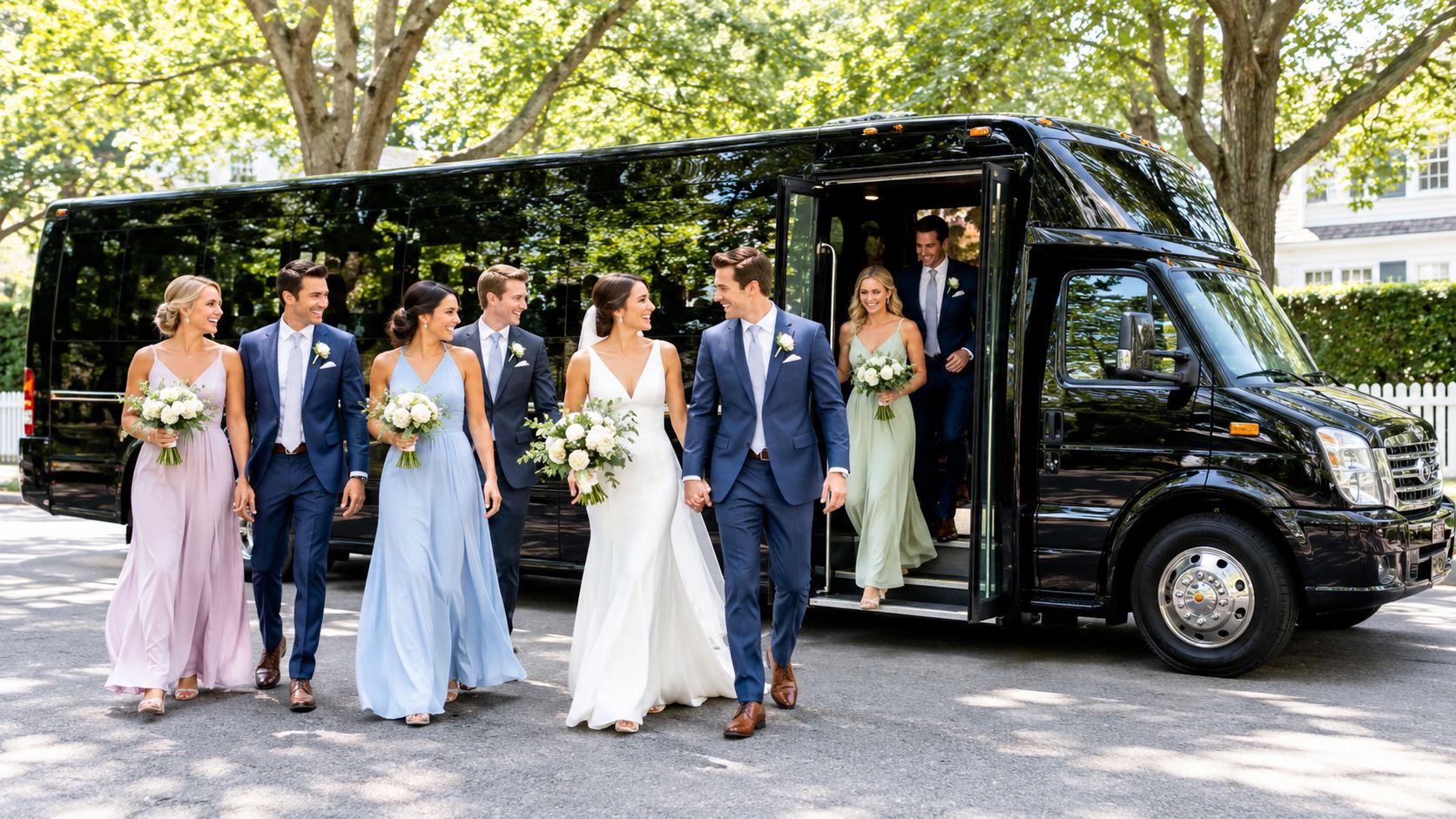
This arrangement suits wedding groups whose main need is shared movement. Guests can remain together between Southampton, Bridgehampton, Sag Harbor, and East Hampton, while the planner tracks one transportation point. Formal clothing and luggage still require a capacity check. Ask about storage and usable seating rather than relying only on the vehicle's advertised passenger count.
For planning ideas, review this guide to wedding party bus rentals.
Airport transfers require more than seats
A group from New York City may connect through JFK, LGA, or EWR before continuing to the East End. Long Island MacArthur Airport, ISP, and private airports such as FOK, Westhampton, East Hampton, or Montauk can also be part of the route. The planning question includes more than boarding space. It also covers luggage, flight changes, curbside pickup, and the drive that follows.
One limo bus gives the group a single meeting plan and vehicle. Airport baggage can change that calculation. A Sprinter van paired with another vehicle may suit the group better than filling every seat while trying to store large cases. Have the coordinator review luggage and mobility equipment with the passenger count.
The same middle-market vehicle fits wine tours, corporate outings, golf trips, concerts, and nightlife itineraries. It can reduce the number of vehicles and simplify parking coordination, although every venue has its own access and drop-off rules. Its role sits between smaller shuttles and full motorcoaches, making it useful for event transportation and group transfers.
For corporate travel, one point of contact helps an executive assistant coordinate pickup windows, venue arrivals, and return movements. For a night out, the group stays on one itinerary instead of relying on separate cars to meet at every stop.
Hamptons Booking and Logistics Tips for a Smooth Ride
Book the vehicle after you know four details: the confirmed passenger count, the luggage situation, the villages involved, and the amount of time the vehicle will wait between movements. Peak-season travel can fill suitable vehicles early, especially for weddings and weekend events, so early planning gives you more opportunity to compare layouts instead of accepting the only available option.
Pickup instructions should name the exact property, entrance, and village. Southampton, East Hampton, Sag Harbor, Montauk, Bridgehampton, Amagansett, Water Mill, Wainscott, and Quogue can all present different curbside conditions. A clear address helps the chauffeur avoid confusion when a property has multiple entrances, a long driveway, or a nearby event sharing the road.
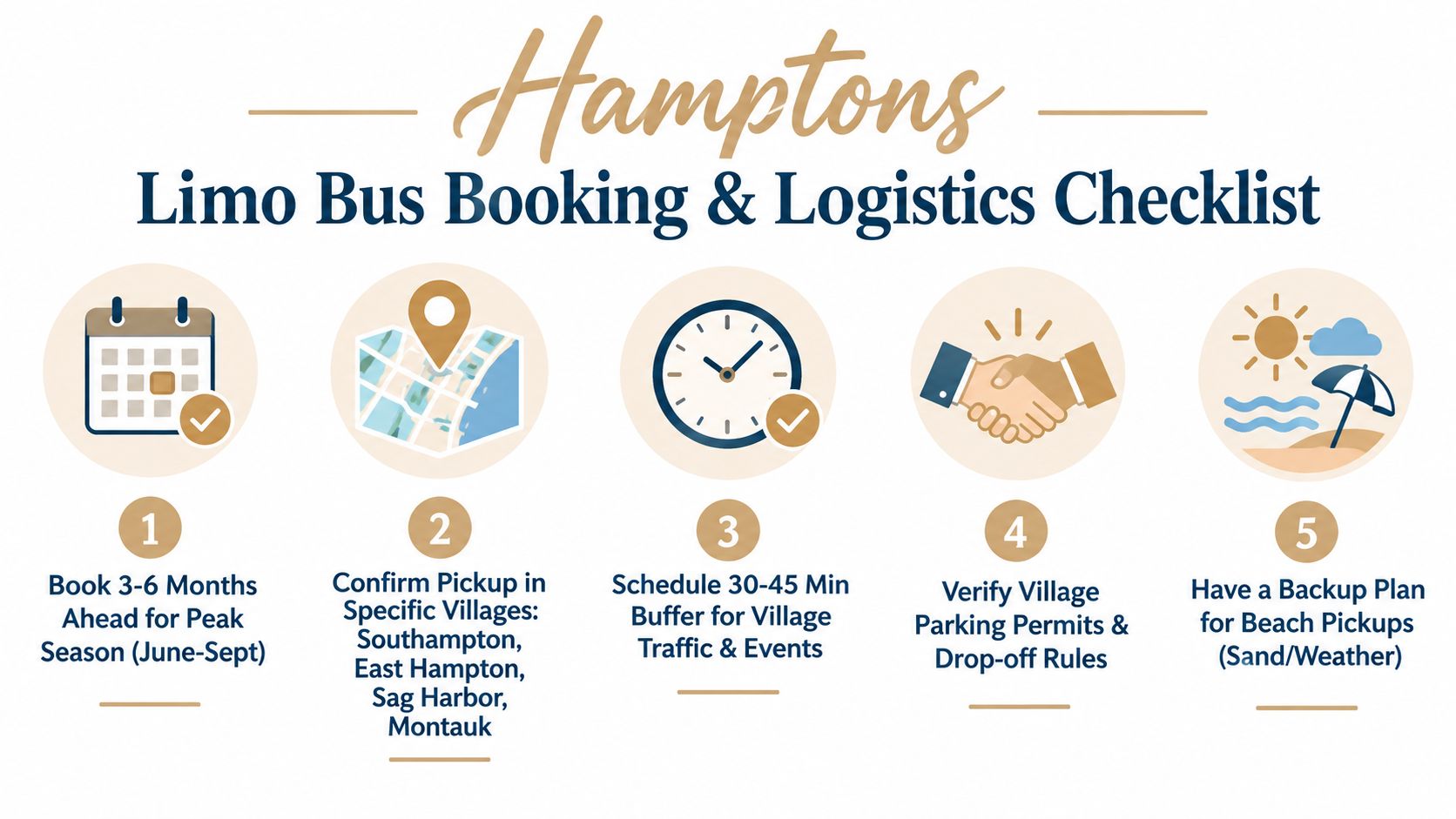
Confirm the practical capacity
Before you approve the reservation, send the provider a complete passenger profile:
- Adults and children: Include child-seat requirements, not just the total headcount.
- Luggage: List airport cases, garment bags, golf equipment, coolers, or event materials.
- Mobility needs: Ask about boarding assistance, accessible equipment, and aisle clearance.
- Waiting periods: Explain whether the vehicle will remain at a venue between ceremony, reception, dinner, or return trips.
- Multiple movements: Share whether a second vehicle may be needed for overflow or separate airport arrivals.
Idling deserves attention during long waits. For passenger-duty buses and coaches, one hour of idling burns approximately 0.5 gallons of fuel, according to bus idling guidance from the Arizona Department of Environmental Quality. That fuel use also matters for thermal management, since the engine produces heat while the vehicle remains stationary. Ask how the operator handles HVAC during extended stops and whether the itinerary should use a planned repositioning or passenger break.
Fixed pricing and no surge can make budgeting easier for a Hamptons itinerary, particularly when the schedule includes several villages or a late return. Request a written quote that identifies the vehicle type, passenger assumptions, waiting time, pickup sequence, luggage expectations, and any accessibility arrangements.
Text (631) 294-0747 with your date, route, guest count, and luggage details. A coordinator can then confirm the most suitable vehicle, while experienced chauffeurs prepare for curbside readiness and East End routing.
Planning Your Group Trip With Confidence
A 20 person limo bus makes sense when the group needs to stay together, values a social interior, and falls between a compact Sprinter van and a larger coach. It isn't automatically the right choice for twenty people, because luggage, mobility devices, child seats, and the specific seating plan can reduce practical comfort.
Before booking, ask:
- What is the certified seating capacity, including the chauffeur?
- How many adults can ride comfortably with our luggage?
- Where will suitcases, garment bags, or mobility equipment go?
- What accessibility and child-seat arrangements are available?
- Can the vehicle reach each pickup and drop-off location?
- What are the waiting, airport, and village-routing procedures?
Federal passenger-carrier guidance distinguishes commercial vehicles by class and seating configuration, while FMCSA guidance treats buses with more than 10 designated seating positions differently according to gross vehicle weight rating. Large buses over 26,000 pounds generally require lap-shoulder belts at all designated seating positions. FMCSA occupant-protection guidance shows why the vehicle's specifications deserve direct confirmation.
Hamptons Leisure Limo offers fixed pricing with no surge, airport coordination, village-to-village service, and access to Sprinter and coach options when one 20 person limo bus isn't the right fit.
Hamptons Leisure Limo can help plan a 20 person limo bus itinerary for weddings, airport transfers, corporate outings, and Hamptons village travel, with vehicle selection based on passengers, luggage, and route details. Visit Hamptons Leisure Limo and text (631) 294-0747 for a fixed-pricing quote with no surge.
Ready to Ride with Hamptons Leisure Limo?
Fixed pricing. No surge fees. 30 years of experience serving the Hamptons. Text us what you need and we will send a quote.