Point to Point Miles Explained for Hamptons Travel
Updated October 2, 2026

A client texts on a Friday morning: “Can you take us from Manhattan to Montauk this afternoon?” A few minutes later, another booking comes through for Bridgehampton, leaving from the same neighborhood and using the same vehicle class. The two trips sound similar, but the quotes aren't. That difference usually starts with one practical question: how many point to point miles will the chauffeur cover?
For Hamptons travel, mileage isn't just a number on a map. It helps determine routing, toll exposure, vehicle time, deadhead travel, and whether a fixed-price quote accurately reflects the work involved. After three decades of routing the East End, I've found that clients usually aren't confused by distance itself. They're confused by which distance a transportation company is using.
Table of Contents
- Why a Montauk Quote and a Bridgehampton Quote Are Never the Same
- What Point to Point Miles Actually Means on the Road
- What Goes Into a Fixed-Price Quote Beyond the Miles
- Common Hamptons and NYC Routes and Their Real Driving Miles
- Fixed-Price Chauffeur Service vs Surge Ride-Hailing
- Three Myths About Point to Point Miles Worth Forgetting
- Getting an Accurate Quote for Your Hamptons Trip
Why a Montauk Quote and a Bridgehampton Quote Are Never the Same
The client booking Montauk may be leaving from the same Manhattan address as the client heading to Bridgehampton. Both may need an SUV, both may be traveling for a weekend, and both may ask for a one-way fixed quote. Still, the eastern destination requires substantially more road travel.
Montauk sits at the far eastern end of the South Fork. Bridgehampton is closer to the middle of the Hamptons corridor. On a map, the villages may look like neighboring points along one narrow island. On the road, the difference becomes a longer stretch of highway, more exposure to congestion, and a greater amount of time reserved for the vehicle and chauffeur.
That's what point to point miles means in a practical booking conversation. The starting point is the exact pickup address, not just “New York City.” The ending point is the exact destination, not just “the Hamptons.” A house near the village center, a private club outside town, and a hotel along Montauk Highway can all produce different route calculations.
A Hamptons quote starts at the curb, not at the town line.
A quick map search can make the two journeys look comparable because it may display a straight-line measurement or a simplified route. A professional quote has to account for the road a chauffeur will use, the address where the vehicle must arrive, and the conditions likely to affect that corridor.
The same logic applies in the other direction. A client going from Montauk to Manhattan may have a different route calculation from a client leaving East Hampton, even if both describe the trip as “Hamptons to the city.” Pickup location, destination, preferred route, tolls, stops, and timing all matter.
A fixed-price quote brings those factors together before the trip begins. It isn't a meter that keeps climbing while traffic slows. It's a planned amount based on the expected road journey and the service requirements attached to it.
What Point to Point Miles Actually Means on the Road
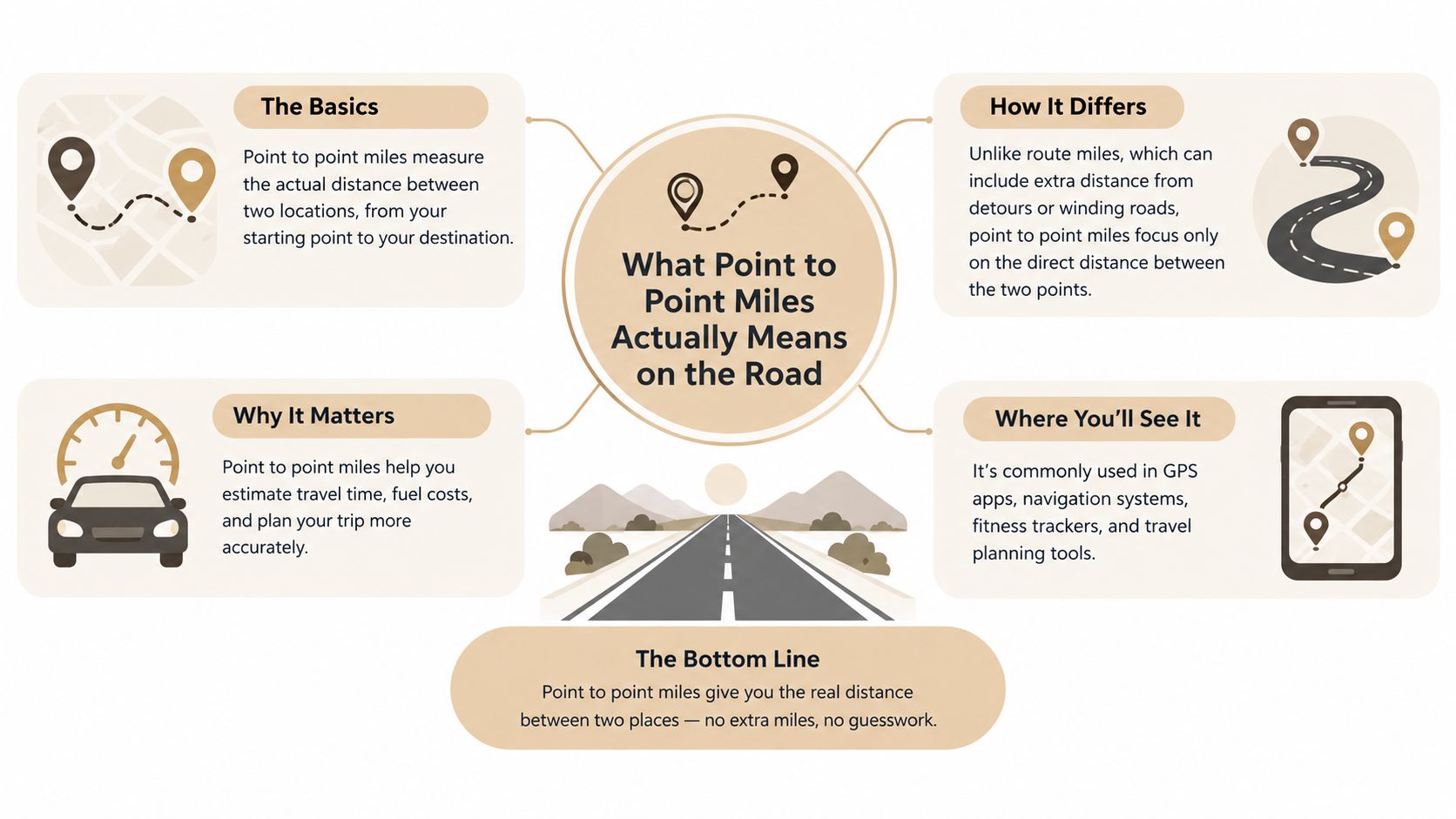
Point to point miles are driven road miles between an exact pickup location and an exact drop-off location. That definition separates them from straight-line distance, odometer readings, and policy-specific mileage calculations.
Google Maps describes its distance tool as measuring mileage in a straight line between locations and displaying the total in miles. That's useful for a quick geographic comparison, but it isn't automatically the mileage a chauffeur will cover on a trip. Google Maps' distance-measurement guidance makes the distinction clear by identifying straight-line measurement as a separate tool.
Straight line distance versus driving distance
A straight line between New York City and East Hampton ignores the road network. The actual journey follows highway geometry, bridge approaches, interchanges, local access roads, and the route selected for the pickup and destination. A trip from Manhattan to the East End therefore has a road distance that can be longer than its map distance.
The same principle explains why point-to-point mileage is used in aviation, logistics, route planning, and consumer navigation. Widely used distance references place New York to Los Angeles at about 2,446 to 2,451 straight-line miles, while New York to London is about 3,459 straight-line miles. Those figures illustrate the global use of point-to-point measurement, but they don't tell a chauffeur how far the vehicle must travel on the ground.
Trip miles versus deadhead miles
The client-facing trip begins when the chauffeur reaches the pickup address with the passenger. The vehicle may have traveled before that point from a garage, staging location, or prior assignment. Those empty miles are commonly called deadhead miles.
Deadhead travel can also occur after the drop-off, especially when the vehicle returns to its operating area or proceeds to another assignment. Some companies absorb that operational travel into a fixed quote. Others itemize it or use it when evaluating whether a booking is practical. Either way, the distinction matters when a client compares a private-car quote with a simple map estimate.
Government transportation policies show why the phrase causes confusion. Some programs define point-to-point mileage operationally for reimbursement, while others use the shortest or most cost-effective route between addresses. Transportation policy guidance from South Carolina demonstrates that mileage can be a rule-based calculation rather than a universal definition.
Point to point miles are therefore a routing concept, not a meter concept. Once the route, vehicle, timing, and service details are understood in advance, a fixed price becomes possible. The client knows the expected cost before the vehicle leaves, instead of watching an app or meter react to every delay.
What Goes Into a Fixed-Price Quote Beyond the Miles
Road distance is the starting point, not the entire quote. A dispatcher or reservation coordinator has to evaluate how the vehicle will be used, where it must begin, how long the assignment may occupy the chauffeur, and what the itinerary requires.
The most useful way to understand the calculation is to separate the components instead of treating the final figure as a mystery.
The main quote components
| Quote Component | What It Covers | How It Affects the Price |
|---|---|---|
| Base road miles | The planned distance between the exact pickup and drop-off addresses | Longer corridors require more vehicle time and operating capacity |
| Deadhead travel | Empty travel to the pickup or away from the final destination | Can affect the quote when the vehicle must reposition before or after service |
| Tolls | Charges associated with the selected bridge, tunnel, or highway route | Adds a route-specific operating cost when the itinerary uses tolled crossings |
| Time of day | Expected traffic conditions for the booking window | Peak eastbound and westbound periods can require more reserved service time |
| Vehicle class | Sedan, premium SUV, executive van, or larger group vehicle | Changes capacity, operating requirements, and suitability for luggage or passengers |
| Stops and extra addresses | Grocery stops, winery visits, event transfers, or multiple pickups | Adds coordination and may require hourly or minimum-service arrangements |
| Waiting and flight coordination | Reserved availability during delays, arrivals, or scheduled waits | Makes the assignment more than a simple movement from one address to another |
A Friday eastbound trip can behave differently from a quiet weekday departure. Sunday westbound travel can also require more planning because many vehicles are moving toward New York City at the same time. The point isn't to assign a separate charge to every slowdown. The point is to build a quote that reflects the service window rather than pretending the road behaves identically all day.
Tolls depend on the chosen approach. A Manhattan pickup may involve the Midtown Tunnel, the Throgs Neck Bridge, or the Whitestone Bridge, depending on the starting address and routing. A trip involving Brooklyn or another approach may bring the Verrazzano into consideration. The relevant toll isn't determined by the destination name alone.
Why vehicle choice changes the calculation
A sedan may suit a small party with light luggage. A premium SUV gives passengers more room and can make sense for larger bags or a longer stay. An executive van or Sprinter is a different operational assignment altogether, particularly when a group needs to remain together.
A vehicle that appears larger than necessary can create an awkward booking if the client is paying for capacity they don't need. A vehicle that's too small can create a worse problem at pickup, when luggage doesn't fit or passengers have to split up. The correct choice starts with passenger count, bags, child seats, and the number of stops.
A good fixed quote accounts for the assignment, not just the line between two pins.
A quick ride-hailing estimate may appear lower because it doesn't show the full cost of waiting, route changes, surge conditions, or the uncertainty of securing a long-haul trip. A fixed quote may look different at first glance, but it can offer a clearer comparison when all expected service elements are included.
Common Hamptons and NYC Routes and Their Real Driving Miles
The most useful route estimate begins with two complete addresses. “Manhattan to Southampton” is a helpful starting label, but it isn't enough to produce a precise road-mile calculation. A pickup on the West Side, a hotel near Midtown, and a residence in Lower Manhattan may follow different approaches before the vehicle even reaches the Long Island Expressway.
The same principle applies at the eastern end. Southampton, Water Mill, Bridgehampton, Sagaponack, East Hampton, and Montauk are not interchangeable drop-off points. A house set back from the main road, a club entrance, and a downtown address can each change the final route.
Manhattan to the South Fork
Manhattan to Southampton is the shorter South Fork pattern among the destinations commonly requested from the city. Bridgehampton adds more eastbound road travel. East Hampton extends the trip again, while Montauk requires the longest reach along the South Fork corridor.
The usual route relies on the main Long Island approach, but the most practical path can change with congestion, construction, weather, and the exact pickup location. Tolls may be associated with the Manhattan crossing selected for the departure. A route estimate should identify whether the Midtown Tunnel, Throgs Neck Bridge, or Whitestone Bridge is being used rather than assuming every Manhattan trip follows the same path.
Airports to the Hamptons
JFK to Southampton, Bridgehampton, East Hampton, and Montauk follows a different starting pattern from Manhattan. The airport's road position can make some South Fork destinations more direct, but traffic near airport approaches and major crossings still affects the trip.
LaGuardia to Westhampton and Quogue requires a westbound destination rather than a South Fork endpoint. LGA to the eastern villages can involve a different sequence of roads from JFK. Airport terminal, airline, luggage quantity, and flight status also matter because the vehicle may need to coordinate a curbside pickup rather than just arrive at a residential address.
Travelers comparing airports should look at the entire ground journey, not only the airfare. If you're arranging a private flight, you can also browse charter flight rates, then give the transportation coordinator the confirmed airport, terminal, and destination details.
In-town Hamptons trips
Trips between Southampton, Water Mill, Bridgehampton, Sagaponack, and East Hampton may look short on a regional map. They can still change meaningfully when the pickup moves from a village center to a private home, a marina, a golf club, or an event venue.
Montauk Highway is the central reality check. During summer congestion, a route that looks straightforward on a map can take longer than a client expects. A slightly different local approach may add road distance while avoiding a stalled section, or it may do the opposite if local traffic is heavy.
Use the route-planning information on Hamptons transportation routes to identify the correct corridor, then provide the exact addresses for a live estimate. For a sanity check, ask three questions: Where does the vehicle begin, which roads connect the two points, and what traffic pattern is likely on that day? Those answers are more useful than a rough town-to-town guess.
A route estimate should also state whether it reflects a one-way trip, a return journey, or an itinerary with waiting and stops. Maine's travel rules distinguish round trips, triangle trips, and straight-line travel patterns, showing that the structure of a journey affects mileage treatment. Maine's travel guidance is a useful reminder that endpoints alone don't describe every trip.
Fixed-Price Chauffeur Service vs Surge Ride-Hailing
Ride-hailing can be convenient for short, spontaneous journeys. A long Hamptons trip has different requirements. The client may need a confirmed pickup window, enough luggage space, a vehicle reserved for the complete route, and a plan that remains understandable if traffic changes.
A fixed-price chauffeur service handles those questions before pickup. The reservation identifies the address, vehicle class, schedule, and itinerary. A chauffeur is assigned to the booking rather than appearing only after an app finds an available vehicle.
Predictability during difficult travel windows
Friday afternoon departures, holiday weekends, and weather events can create a sharp imbalance between available vehicles and requested rides. Ride-hailing platforms may respond with surge pricing, while a chauffeur service can confirm a fixed quote in advance. A long trip can also be declined or canceled by an individual ride-hailing driver after the destination becomes clear.
That doesn't make fixed-price service universally cheaper. It makes the comparison different. The client is weighing a known transportation plan against a fare that may change with demand, waiting, route changes, or vehicle availability.
A useful resource for understanding the broader airport transfer category is this explanation of a fixed-price airport transfer. The same planning principle applies to Hamptons airport journeys, especially when the client needs the pickup coordinated around a flight rather than a generic arrival time.
Coordination is part of the service
Airport travel often involves luggage handling, terminal instructions, flight monitoring, and curbside communication. A wedding or corporate itinerary may require several pickups, multiple vehicles, or a dedicated vehicle waiting through an event window. A grocery stop or winery visit can turn a simple transfer into a scheduled itinerary.
A point-to-point quote built from the actual route gives the reservation team a foundation for those decisions. It also gives the client a clearer way to compare service levels without reducing the entire choice to a single app estimate.
For a closer look at how a pre-arranged trip differs from a live meter, review this guide to fixed-price transportation. The practical question is simple: do you want to discover the final fare while the vehicle is already moving, or agree on the service terms before the chauffeur arrives?
Three Myths About Point to Point Miles Worth Forgetting
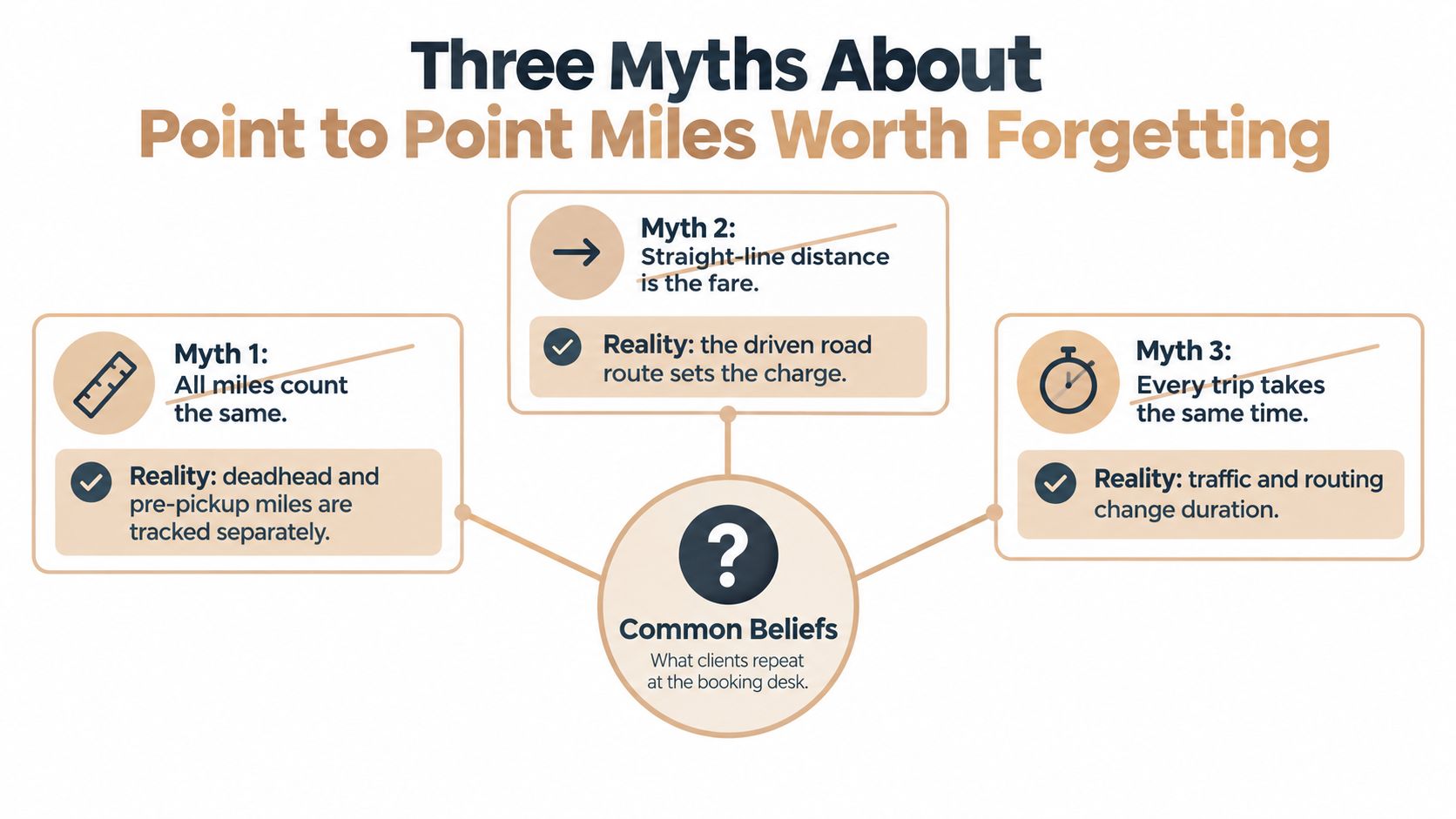
Clients repeat three mileage assumptions at the booking desk. Each one sounds reasonable until the route is attached to a real address and a real vehicle.
Myth one, all miles count the same
They don't. In-vehicle passenger miles describe the visible part of the assignment. Deadhead miles cover the vehicle's repositioning before pickup or after drop-off. A company may include those operating miles in a fixed quote without presenting them as a separate line item.
That's why a private-car quote can't always be recreated by entering two addresses into a map and multiplying the result by a guessed rate. The map sees the passenger journey. The operator has to plan the full assignment.
Myth two, the shortest route is always cheapest
The shortest path can be a poor operational choice. Local roads may appear to reduce distance but expose the trip to village traffic, event congestion, or slow sections of Montauk Highway. A somewhat longer highway route may provide a more dependable journey or reduce the time a vehicle spends in difficult traffic.
Government mileage rules reflect this distinction. Michigan's policy allows the longer freeway route when it's faster, provided the exception is documented and a supervisor is notified. Michigan's travel policy shows that route efficiency can matter more than the smallest distance on paper.
Myth three, every larger vehicle costs more per mile
Vehicle selection shouldn't be reduced to a presumed per-mile penalty. A sedan, SUV, and executive van serve different passenger and luggage needs. On a long trip, the important question is whether the selected vehicle accommodates the group comfortably and supports the itinerary without requiring a second vehicle.
Texas travel rules also show why address-level documentation matters. Their guidance requires point-to-point itemization and permits mileage to be documented through odometer readings or an online mapping service. Texas travel guidance reinforces the value of documenting the actual route rather than relying on a broad destination label.

A fixed-price quote brings these corrections together. It considers the driven route, operating travel, vehicle requirements, and service conditions before the booking is confirmed.
Getting an Accurate Quote for Your Hamptons Trip
You can make a quote more accurate before speaking with a reservation coordinator. Have the complete pickup address ready, including the building, terminal, hotel entrance, or private-airport detail. Give the full destination address and village name rather than saying only “the Hamptons.”
Then provide the details that change the vehicle and itinerary:
- Passenger count: State how many people are traveling.
- Luggage: Mention large cases, golf bags, beach equipment, or unusual items.
- Date and day: A Friday, Sunday, holiday, or event date can affect routing expectations.
- Stops: List grocery pickups, winery visits, second addresses, or return movements.
- Flight information: Share the airline and flight details for airport service.
- Price format: Ask for a fixed price in dollars, not a loose estimate.
For a deeper look at the information used in airport bookings, see this guide to an airport transfer quote. A clear quote should connect the actual addresses with the expected road route, toll exposure, deadhead considerations, and vehicle assignment.
Travelport's fare guidance uses a separate aviation definition, where ticketed point mileage follows the shortest operated route between ticketed points. It also describes a maximum permitted mileage calculated at 120 percent of the shortest operated mileage. Travelport's mileage guidance is a useful reminder that “mileage” changes meaning across transportation systems, so clients should ask what a provider's calculation includes.
Text (631) 294-0747 with the pickup address, destination, date, passenger count, luggage, and any stops. That information lets the reservation team build a quote around the actual point to point journey instead of a generic town-to-town assumption.
Hamptons Leisure Limo arranges fixed-price point-to-point transportation between New York City, the Hamptons, airports, event venues, and local destinations, with vehicle options matched to your passengers and luggage. Visit Hamptons Leisure Limo or text (631) 294-0747 for a quote based on your real route, timing, tolls, and itinerary.
Ready to Ride with Hamptons Leisure Limo?
Fixed pricing. No surge fees. 30 years of experience serving the Hamptons. Text us what you need and we will send a quote.