Newark Airport Limo Service: What to Know Before Booking
Updated October 17, 2026
The seatbelt sign is off, the gate agent says Terminal B, and your phone lights up with a text from an unknown number. That's usually the moment Newark decides whether the rest of the trip feels smooth or messy, because the choice you make next is rarely just about a car. It's about whether the pickup is treated like a monitored arrival event or a vague guess.
A solid Newark Airport limo service doesn't wait for luck. It tracks the flight, knows the terminal, follows the airport's curb rules, and keeps the vehicle in the right place at the right time. At Newark, that matters more than almost anywhere else in the region, especially when the destination is the Hamptons and the ground trip is long enough to magnify every mistake.
Table of Contents
- The Newark Arrival Reality
- How Newark Actually Works for Travelers
- Pre-Arranged Limo Versus Ride-Share and Taxis
- Flight Monitoring as an Operational Discipline
- Booking Logistics and the Curbside Handoff
- Matching the Vehicle to the Trip
- Failure Modes Most Newark Guides Skip
- Booking Checklist and Next Step
The Newark Arrival Reality
The first bad decision usually happens before the bag even reaches the carousel. A traveler lands, assumes the pickup point is obvious, and walks to the wrong curb because another airport worked that way last month. At Newark, that's how a good landing turns into a chain of phone calls, a curbside shuffle, and a chauffeur waiting in the wrong zone while everyone gets more frustrated.
A clean handoff starts with the arrival itself, not the driveway back home. Newark's terminal curbs are for active pickup and drop-off only, and unattended vehicles can be towed at the owner's expense, so a professional chauffeur doesn't squat at the curb and hope for the best. The better move is to wait until the client is ready, then roll in and execute the pickup fast.
Practical rule: at Newark, the curb is a loading point, not a parking lane.
That's the difference between a routine transfer and a recovery operation. If the terminal is wrong, the curb is wrong, or the passenger is still wrestling with bags, the whole chain slows down. A well-run pickup keeps one eye on the flight and one eye on the terminal process, because Newark punishes anyone who treats arrival like a simple clock appointment.
Why Newark Needs Its Own Playbook
Newark isn't a side airport. It opened in 1928, became a major metropolitan airport, and has long served as a gateway for the New York region, not just a local field NPS history of Newark Metropolitan Airport. That history still shows up in how the airport moves people today.
For a long-distance transfer, the operational reality is simple. A Hamptons-bound client can't afford a casual curbside guess, because one missed connection inside the airport can ripple into the entire drive east. The service has to absorb uncertainty at the airport so the rest of the trip stays predictable.
How Newark Actually Works for Travelers
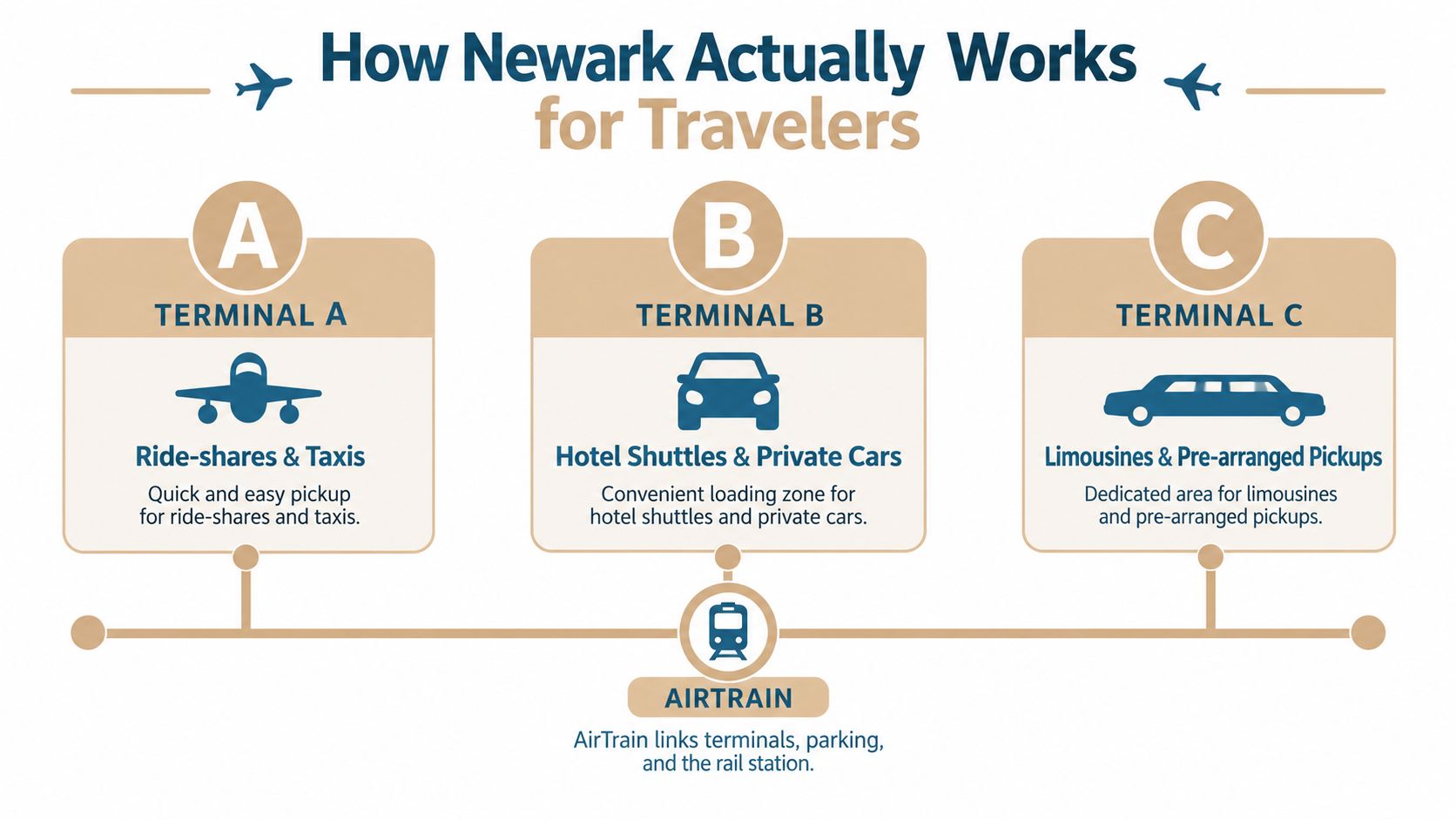
Newark has three terminals, and the pickup logic changes by terminal and vehicle type. That sounds minor until someone arrives at the wrong frontage and expects the same workflow to apply everywhere. It doesn't.
The airport's own guidance makes the split clear. Ride-app pickups are handled in specific terminal locations, while passengers with advance bookings for an authorized van, shuttle, or private car service follow the signs for the ground-transportation pickup area in their terminal EWR pickup and drop-off guidance. Terminal-specific rules are the whole point, because the curb is organized by service category, not by wishful thinking.
EWR Terminal Pickup Locations by Service Type
| Terminal | Pre-Arranged Black Car / Limo | Ride-App Pickup |
|---|---|---|
| A | Follow the terminal ground-transportation pickup area | Arrivals level directly across from the terminal |
| B | Follow the terminal ground-transportation pickup area | Arrivals-level terminal frontage |
| C | Follow the terminal ground-transportation pickup area | Floor 3 of the Terminal C Garage |
The AirTrain ties the airport together and links terminals with parking, rental cars, hotel shuttles, and the NJ Transit or Amtrak station AirTrain details. Terminal-to-terminal trips take under 20 minutes, and overnight service between Terminals B and C runs every 15 minutes from 11:00 p.m. to 5:00 a.m. Eastern Time. That matters when a client needs to re-route inside the airport before meeting a car.
For anyone planning a broader trip, it helps to think of Newark as a hub, not just a curb. If you're coordinating a pickup across borders or comparing travel connectivity on the road, compare data plans by country is a useful resource for checking how mobile service may behave while you're moving between airports, trains, and road transfers.
The Hamptons Factor
The drive from Newark to the Hamptons is a long one, and that changes the service model. A short city pickup can survive a little ambiguity. A regional transfer can't. The pickup has to be flight-aware, terminal-specific, and ready to adapt if the passenger takes longer than expected to clear baggage claim.
That's why a Newark airport limo service should be built around the airport's actual layout, not a generic “meet at the curb” promise. Once you understand the terminal split, the AirTrain, and the pickup zones, every other operational decision gets easier.
Pre-Arranged Limo Versus Ride-Share and Taxis
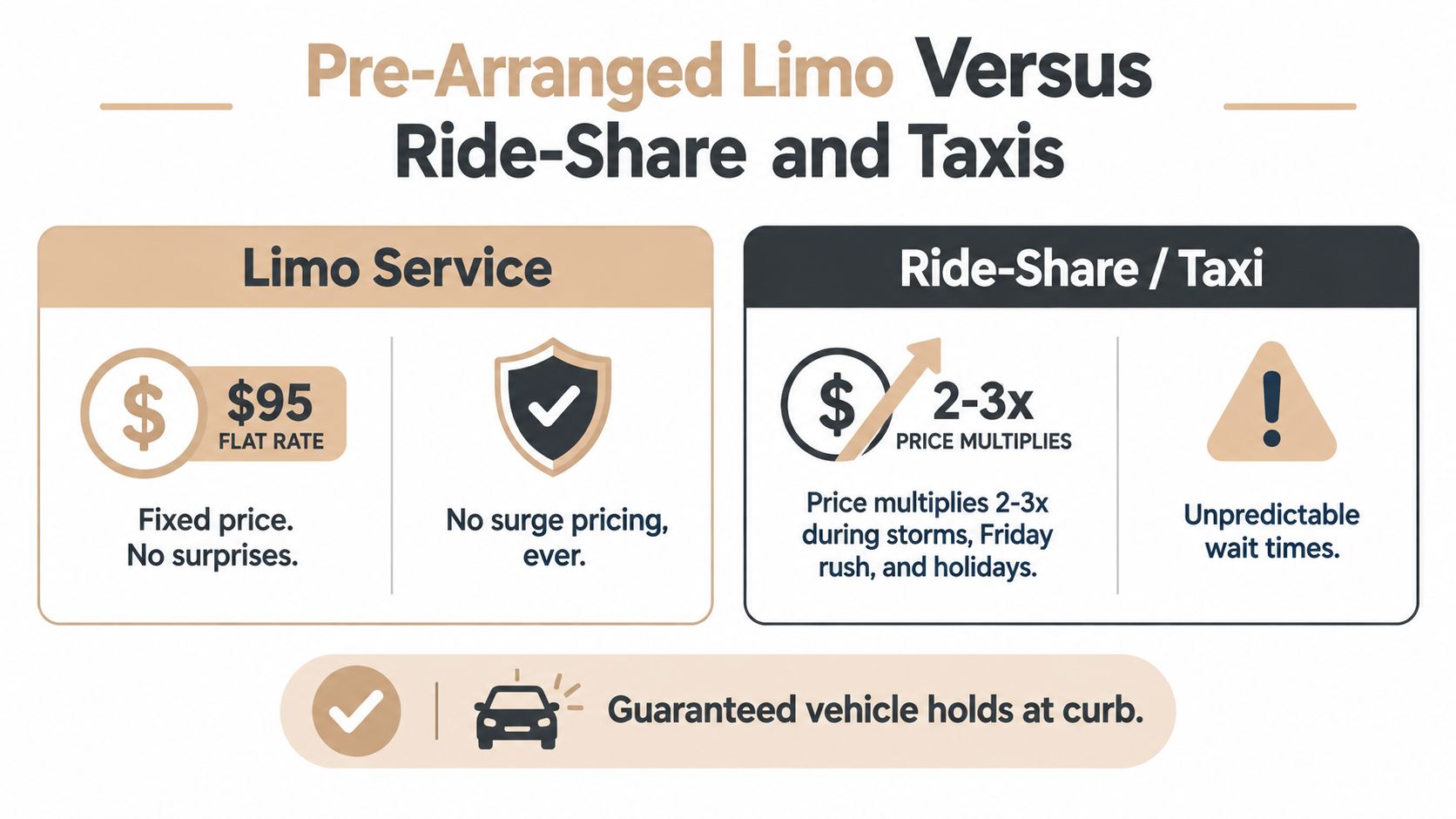
The cleanest comparison is also the simplest one. A pre-arranged car gives you a known vehicle, a known pickup workflow, and a company that's already watching the flight. Ride-share and taxi options can work fine when the terminal is quiet and the timing is forgiving, but Newark doesn't always give you that kind of day.
A black-car reservation is built to stay in place while the arrival changes. The airport can be late, the gate can change, or the luggage can move slowly, and the booking still remains intact. With app-based or on-demand service, the passenger is often solving the pickup problem after landing instead of before takeoff.
What matters most isn't the ride, it's the handoff.
That handoff is where fixed pricing and controlled dispatch beat improvisation. During storms, holiday traffic, and busy travel windows, the value of a pre-arranged transfer shows up in the absence of scramble. You're not trying to win a vehicle lottery after a transatlantic flight or a delayed domestic arrival.
If you want a broader look at chauffeur standards, service layers, and the differences between premium ground-transport options, compare premium chauffeur services is a helpful reference point. The point is not that every premium service is identical. The point is that a proper Newark pickup should be engineered, not improvised.
What a Pre-Arranged Transfer Solves
A reserved limousine service keeps the vehicle assignment stable, keeps the communication channel open, and reduces the chance that a client has to negotiate curbside logistics while holding luggage. Taxis and ride-share options can be fine for quick, low-stakes movement. They're less reliable when the trip is long, the flight is late, or the passenger has a tight onward schedule.
For Hamptons travel, that reliability is the whole product. The ride starts before the plane lands, not after.
Flight Monitoring as an Operational Discipline

A real dispatch operation doesn't treat flight tracking like a dashboard widget. It treats it like a live workflow. When a delay hits, the person on the radio or phone doesn't just note it, they recalculate curb timing, preserve the vehicle assignment, and decide whether the client needs a new meeting plan.
That matters at Newark because the airport's delay pattern can be severe. FAA analysis reported average arrival delays of about 85 minutes at 7:00 a.m. and 137 minutes at 5:00 p.m., with delays staying near 100 minutes later in the day, and roughly 34 arrival cancellations per day during the reviewed disruption period FAA disruption analysis. Those aren't small variances. They're the reason a reservation has to behave like a monitored arrival event, not a fixed appointment.
A good dispatcher watches for the delay notice, checks the new ETA, and communicates before the passenger has to ask. That keeps the vehicle from arriving too early and burning time at the curb, and it keeps the client from stepping out of baggage claim to find nobody there. The goal is to absorb uncertainty before it becomes a curbside argument.
Why Time of Day Changes the Plan
Newark's late-day arrival pattern is not uniform, so the buffer shouldn't be either. Afternoon and evening windows deserve more slack than a one-size-fits-all estimate, because that's when delays stack up and cancellations become more disruptive. The practical move is to adjust holding time based on the arrival window, not just on mileage.
The operational takeaway is straightforward. Flight monitoring only works when someone acts on the data. A spreadsheet that says the flight is late doesn't help if the chauffeur is already gone or the passenger is left guessing at the carousel.
For a deeper look at how real-time tracking fits into airport service, see tracking flights in real time. The useful part is not the alert itself, it's the dispatch response that follows.
Booking Logistics and the Curbside Handoff
Your flight has landed, but your bags are still on the carousel. That is waiting time, not a signal for the chauffeur to enter the pickup lane. The booking should establish who contacts whom and what “ready” means before anyone heads toward the curb.
Start with Text (631) 294-0747. Send the flight number, expected terminal, passenger count, luggage count, and any special request affecting the vehicle or handoff. Include a passenger contact who can receive messages on arrival. Treat the terminal as provisional until the arrival is confirmed, especially after a flight change.
Then settle the quote and the waiting arrangement. Fixed pricing gives the passenger a clear starting point, but ask how delays or a diversion affect that agreement before confirming. This airport transfer quote guide explains the booking details to establish. A changed arrival should trigger a revised pickup instruction, rather than leave the passenger following an outdated confirmation.
The chauffeur waits offsite until loading is possible. According to Newark pickup and drop-off rules, the free Cell Phone Lot has more than 100 spaces, is beside the P4 Daily Parking garage near the airport entrance, and is less than five minutes from all terminals. That proximity supports the handoff; it does not guarantee an immediate curb arrival.
What the Handoff Should Feel Like
Good dispatch is patient offsite and decisive at the curb.
Collect every bag before requesting the vehicle. Confirm the actual terminal and the agreed pickup location, then send the ready message. If the terminal has changed, get the meeting point corrected before walking outside. The chauffeur should acknowledge the instruction so the passenger knows the approach is underway.
Calling the car while still waiting for luggage forces a choice between circling and arriving before loading can begin. Waiting offsite avoids that conflict, though the passenger may spend a short interval at the pickup point.
For the practical sequence, this curbside pickup guide explains the handoff. Confirm the location before landing when possible, recheck it after arrival, and release the vehicle only when the passenger and luggage are ready.
Matching the Vehicle to the Trip
The right vehicle is the one that matches the bags, the passengers, and the kind of day the traveler is having. A solo executive with two checked bags doesn't need the same setup as a family with car seats or a wedding group arriving with garment bags and hand luggage. Newark pickups go smoother when the vehicle choice is made for the actual load, not for appearances.
For most EWR-to-Hamptons trips, the decision starts with three questions: how many people, how much luggage, and whether the pickup needs extra flexibility for child seats or a pet. Once those are clear, the rest is easy. A sedan is a different tool from an SUV, and a Sprinter or coach solves a problem that a smaller vehicle can't.
Choosing the Right Vehicle for an EWR-Hamptons Transfer
| Trip Type | Recommended Vehicle | Why It Fits |
|---|---|---|
| Solo executive or couple with light luggage | Mercedes-Benz S-Class | Quiet, compact, and appropriate when the load is small |
| Small family or travelers with multiple bags | Premium SUV, such as a Chevrolet Suburban or Cadillac Escalade | Handles extra luggage and gives more room for a smoother curb exit |
| Group with bags, gear, or child seats | Mercedes-Benz Sprinter van | Useful when passenger count and luggage both matter |
| Wedding party or corporate retreat | 36-passenger or 55-passenger coach | Better for coordinated group movement and centralized loading |
The useful part of this table isn't luxury, it's fit. A vehicle that's too small creates stress at baggage claim, while a vehicle that's too large can be awkward for a light two-person transfer. The right choice depends on whether the trip is being handled like a fast airport ride or a group move with staging and coordination.
Hamptons Leisure Limo's fleet includes premium SUVs, Mercedes-Benz S-Class sedans, Mercedes-Benz Sprinter vans, and minibuses and coaches for larger groups. That range matters because it lets the dispatcher match the vehicle to the trip instead of forcing every pickup into the same template.
Failure Modes Most Newark Guides Skip
A lot of Newark pickup advice stops working the minute the flight doesn't behave. The plane diverts after pushback, the arrival slips by hours, or the passenger comes out of the terminal from a different airport altogether. That's where a fixed-price, flight-aware operation earns its keep.
Diversions are the first hard test. If a flight that was headed to Newark lands at JFK or LaGuardia instead, the pickup can't be handled as a normal curbside event. The dispatcher needs a clear escalation channel, a diversion protocol, and a communication rule that tells the client what happens next. Without that, everybody burns time, and the Hamptons leg becomes a chain of disconnected decisions.
Long ground delays are the second test. In May 2025, Newark saw repeated delays tied to staffing, equipment problems, and runway construction, with reported arrival delays reaching roughly four to five hours and some days seeing more than 40% of flights delayed along with significant cancellations CNN reporting on Newark delays. That kind of disruption makes a normal pickup estimate useless. The only sensible response is to keep the booking alive, keep the vehicle assignment intact, and update the arrival plan as the flight moves.
Accessibility is the third test. Newark says travelers who need wheelchair service, guided assistance, or oxygen-related support should arrange help in advance through the airline, travel agent, or TSA Cares, and motorized wheelchairs and scooters are permitted in the terminals Newark accessibility guidance. Ground transport is a separate question. The car has to accommodate the folded device, and the driver has to know whether the handoff happens at curbside or only after airline assistance finishes.
A good airport move doesn't ask the traveler to solve airport policy on the fly.
Large groups expose the final weak point. If a wedding planner is coordinating a dozen pickups into one arrival window, the product isn't just the car, it's the coordination. One point of contact, one dispatch record, and one clear pickup instruction prevent the airport from becoming a maze of separate phone calls.
Booking Checklist and Next Step
Before confirming, go beyond the flight and luggage details covered above: add child seat request, pet request, and the best contact number. For an international arrival, flag the baggage timing as uncertain. Landing time alone does not tell dispatch when you will be ready for the curb.
Get the terms in writing. Confirm fixed pricing, no surge, and the cancellation policy before committing. Ask how a delay or diversion affects the reservation and any charges. This airport quote guide outlines the practical details to collect before requesting a price.
Agree on the contact protocol before departure:
- Text when you learn of a flight change, diversion, or terminal reassignment.
- Report a baggage-claim delay so dispatch can adjust the handoff.
- Confirm that pickup instructions will reach the passenger's phone, particularly when someone else booked the car.
Flight monitoring and passenger updates work together. Dispatch can track the aircraft, but it still needs to know whether you are waiting for bags or ready to come outside.
Text (631) 294-0747 to start the reservation.
Hamptons Leisure Limo handles pre-arranged Newark-to-Hamptons transfers with fixed pricing, flight monitoring, and curbside coordination within airport rules. Before confirming, settle the price, disruption terms, and contact arrangements so the pickup stays tied to your actual arrival.
Ready to Ride with Hamptons Leisure Limo?
Fixed pricing. No surge fees. 30 years of experience serving the Hamptons. Text us what you need and we will send a quote.