Luxury Sprinter Van: Capacity, Comfort and Hamptons Travel
Updated November 16, 2026

Your group chat is full of flight details, weekend bags and requests to bring golf clubs. A luxury Sprinter van looks like the obvious answer for the trip to the Hamptons, but the booking question isn't just whether everyone gets a seat. It's whether everyone, their luggage and the cabin's installed equipment fit within the limits of the actual vehicle.
Choose the van around the trip, not the cabin photograph. A spacious interior helps, but a sensible booking starts with a passenger list, a luggage count and a clear itinerary.
Table of Contents
- Passenger Capacity at a Glance
- Why Payload Limits Luxury Capacity
- Comfort Features Worth Checking Before You Book
- Common Uses for Hamptons Travel and Events
- Safety and Licensing Rules to Verify
- Running Costs and Efficiency Per Passenger
- Book the Right Sprinter Van for Your Group
Passenger Capacity at a Glance
A standard Sprinter passenger van seats 12 people on the 144-inch wheelbase and 15 on the 170-inch wheelbase, according to Car and Driver's 2025 Sprinter specifications. Those are factory-layout reference points, not a promise that every luxury conversion has the same seating.
Mercedes-Benz's 2025 Sprinter quick-reference guide lists passenger-van body lengths of 234 or 274 inches. Wheelbase measures the distance between axles, not the vehicle's total length, an important distinction when you're checking a driveway or loading area.
Sprinter passenger van seating by wheelbase
| Wheelbase | Seats (2025) | Body length | Body width |
|---|---|---|---|
| 144-inch wheelbase | 12 | About 234 inches | About 92 inches, including mirrors |
| 170-inch wheelbase | 15 | About 274 inches | Confirm mirror-inclusive width on the assigned vehicle's specification sheet |
Treat the table as a starting point. Before booking, establish whether the quoted seating count includes the chauffeur or describes the seats available to clients. Don't leave that distinction to pickup day.
Choose by passengers and bags together
The shorter body is the sensible starting point for a smaller group, a short transfer or an address with restricted parking. It gives you less vehicle to position at a hotel entrance or narrow East End driveway.
The longer body deserves consideration when the group approaches the larger factory seating configuration. But extra body length doesn't automatically mean generous luggage space. A conversion may use that space for reclining chairs, cabinetry or a lounge.
Run this simple selection test:
- Count everyone traveling. Include children, and identify anyone who needs a child seat.
- List the luggage separately. Checked suitcases, carry-ons, golf bags and garment bags need distinct entries.
- Check the loading arrangement. Ask for the actual luggage area, not just a photograph of empty seats.
- Choose the smallest suitable vehicle. Everyone needs an approved seat, and bags need secure storage outside the aisle.
For a wedding or shared itinerary, our guide to planning group transportation helps organize the passenger list and pickup details before you settle on a vehicle.
Booking rule: A published seating chart tells you where people can sit. It doesn't tell you whether their belongings fit.
Confirm the final layout in writing. Captain's chairs, partitions and other luxury modifications can reduce the usable seating count.
Why Payload Limits Luxury Capacity
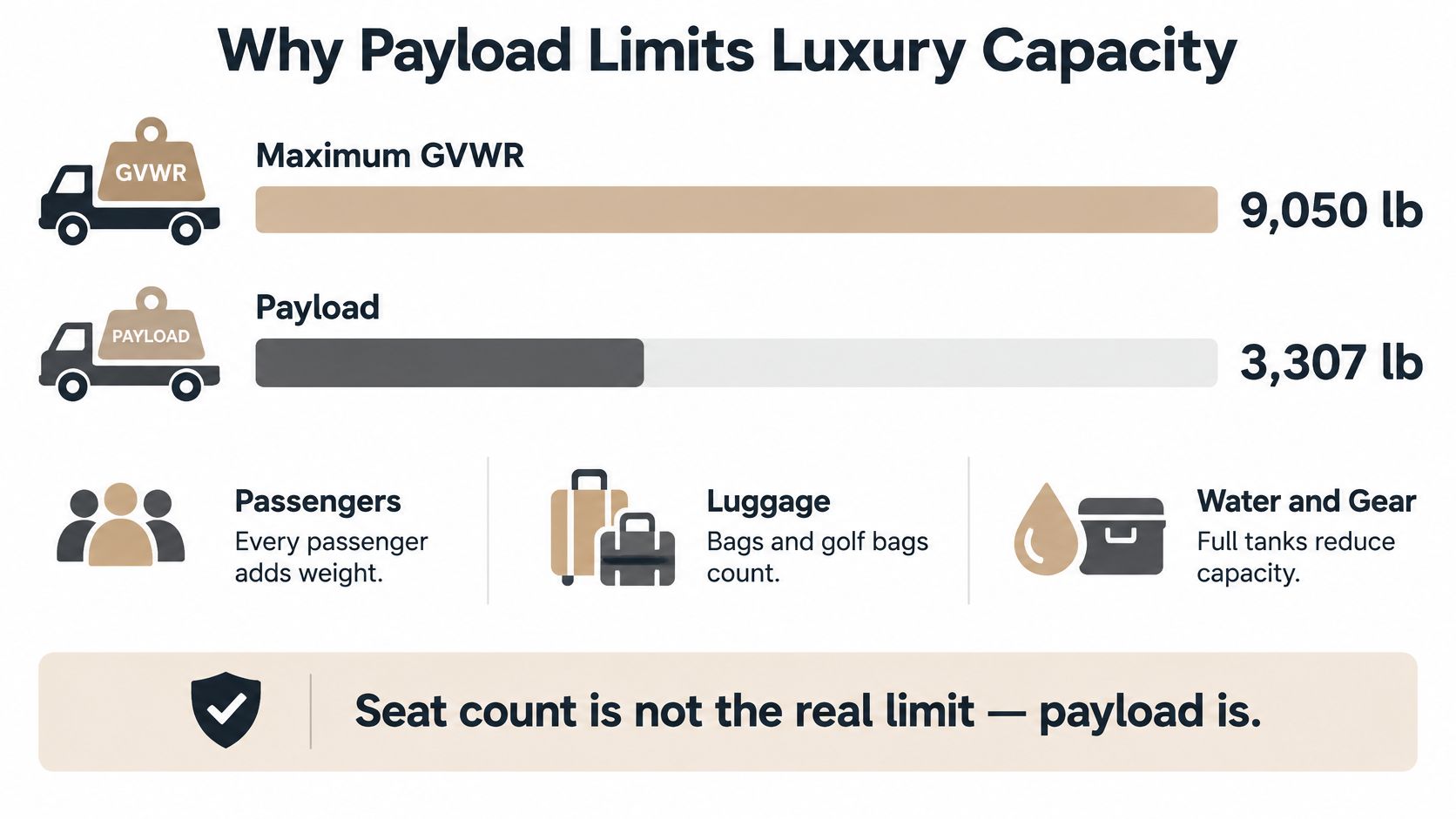
A Sprinter van rated for fourteen passengers can run out of payload long before it runs out of seats. Passengers, luggage, installed cabinetry, stocked refreshments and the chauffeur all draw from the same weight allowance, and the allowance shrinks fast.
Gross vehicle weight rating (GVWR) is the maximum permitted loaded weight of the vehicle. Payload is what remains for people and cargo after the vehicle itself. Seat count is a third, separate number, and it is usually the least restrictive of the three.
Run the numbers before you book
Take a worked example. Assume a passenger-van configuration with a payload allowance of 3,307 pounds. Load fourteen passengers averaging 180 pounds each and they weigh 2,520 pounds, leaving 787 pounds for baggage and added equipment. The actual payload and GVWR of a specific van appear on its rating label and conversion documentation, and NHTSA's passenger-van guidance explains why correct loading and occupancy matter for this class of vehicle.
The comparison below shows how quickly the allowance shrinks.
Payload left for luggage at different passenger counts
These are hypothetical figures built on the assumed payload and average weight above, not loading approvals for a particular converted vehicle.
| Passengers | Passenger weight (lb) | Payload left for bags and fittings (lb) |
|---|---|---|
| 8 passengers | 1,440 | 1,867 |
| 12 passengers | 2,160 | 1,147 |
| 14 passengers | 2,520 | 787 |
| 15 passengers | 2,700 | 607 |
Use the converted vehicle's actual allowance
A factory brochure cannot settle the capacity of a finished luxury van. Leather seating, cabinetry, screens, partitions, auxiliary power equipment and accessories all contribute weight before a single passenger boards.
Check the door-jamb loading placard and conversion documentation for the assigned vehicle. Establish which installed equipment is already counted in its recorded weight. Do not subtract that equipment twice, and do not ignore equipment added after the original rating was set.
The chauffeur, personal items and anything loaded for the return journey belong in the calculation. Where the finished vehicle's available capacity is unclear, ask the operator for its actual operating weight rather than an estimate from an unconverted model.
Keep a buffer below the maximum. A load that only works if every suitcase weighs less than expected is a poor plan, especially for an airport pickup or golf itinerary.
Weight affects the ride, not just the paperwork
Overloading increases braking distance, tire loading, suspension deflection and driveline stress. It also leaves less handling margin on wet or uneven roads.
Correct tire pressure belongs in the daily operating check. NHTSA's tire-safety guidance supports checking pressure when tires are cold and following the vehicle-specific placard rather than a generic setting. Front and rear requirements may differ.
Before dispatch, the trip manifest should record:
- Passenger count and weight assumption. Include every occupant.
- Bag count and type. Separate suitcases, golf equipment and bulky items.
- Installed equipment. Confirm what the vehicle's documented allowance already includes.
- Remaining margin. Leave room for changes instead of loading to the theoretical limit.
Comfort Features Worth Checking Before You Book
A luxury Sprinter van is like a well-appointed private lounge built inside a practical shell. The shell's layout decides what the lounge can hold, and the conversion decides how comfortably people can use it.
Mercedes-Benz introduced the Sprinter in 1995, according to its historical account published by Automotive World. That established platform supports many interior arrangements, so the badge alone won't tell you what's inside.
Use an interior photograph to inspect the arrangement, not just the upholstery.
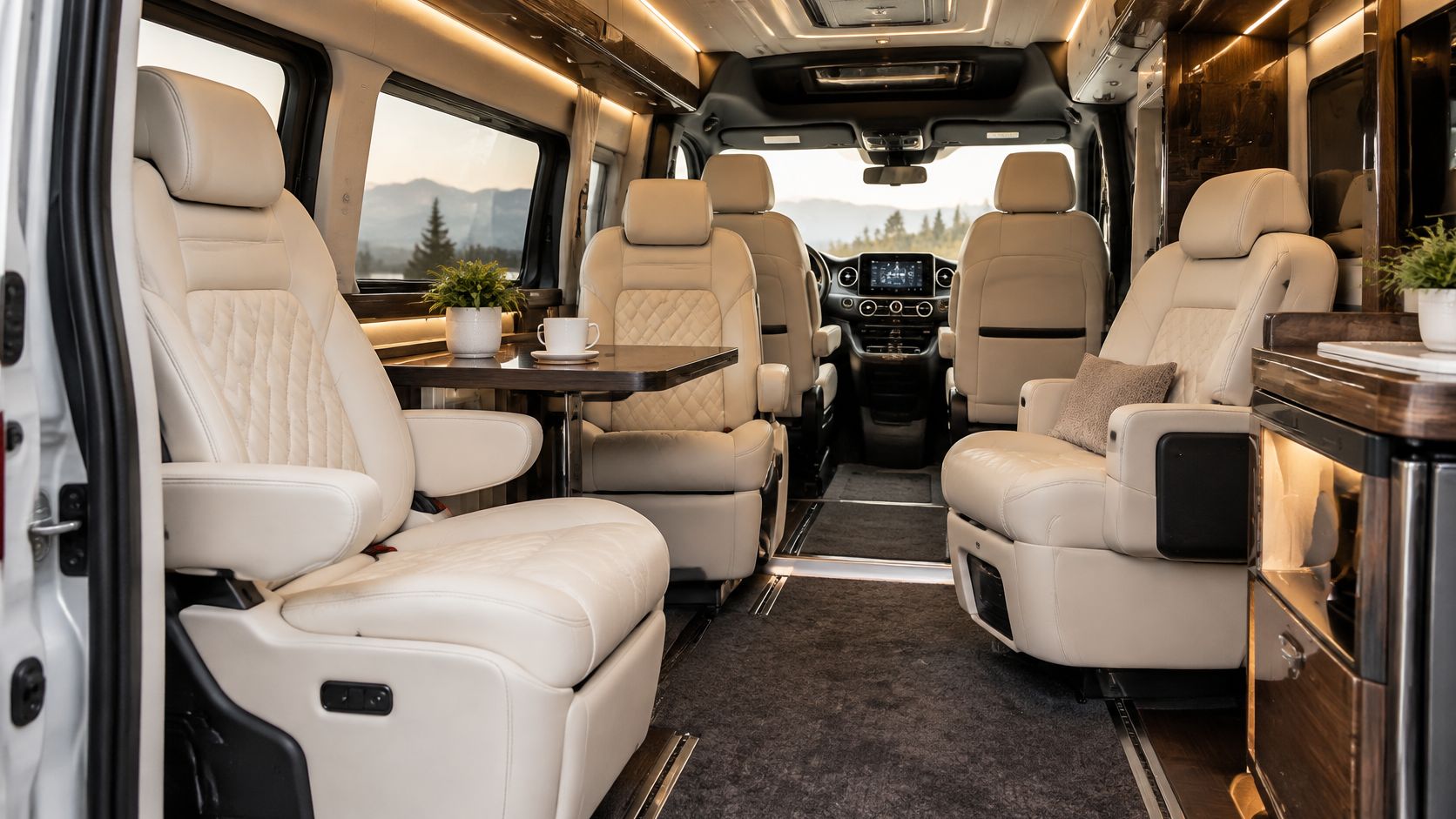
Walk from the entrance to the rear
Start at the door. Does the step-in height suit older guests, and is there a handrail where they need it? Heavy luggage should have a practical loading route that doesn't require carrying it over seated passengers.
Then inspect the seats. Ask whether they're forward-facing rows, captain's chairs or a lounge arrangement, and which positions recline. Request the row spacing in the exact configuration being quoted, particularly if tall guests will occupy the rear.
Check the features you'll use:
- Rear climate controls. Can passengers adjust the rear zone separately?
- Lighting and sound. Can the lights dim, and how quiet is the cabin at highway speed?
- Charging outlets. Where are they, and can passengers reach them from each row?
- Wi-Fi where fitted. Is service included, and what coverage limitations apply?
- Window treatments. Do they reduce glare without making the cabin feel closed in?
- Privacy partition. Can the cabin be separated from the chauffeur, and how do passengers communicate through it?
A walkthrough can help you assess the relationship between seats, aisles and storage.
Finish at the luggage area. Bags shouldn't block an exit or occupy space passengers need to sit properly.
The richest interior isn't necessarily the right choice for a heavy airport or golf run. Judge the cabin as it will operate with people and bags aboard, not as an empty showroom.
Common Uses for Hamptons Travel and Events
A Sprinter fits the gap between a premium SUV and a motor coach. Mercedes-Benz lists passenger configurations seating 12 or 15 people, but the useful booking question is which arrangement suits the itinerary and its luggage.
The planning groups below are examples, not guaranteed capacities. They show what to discuss before dispatch.
Typical Sprinter van uses and what to confirm
| Trip type | Typical group | Confirm before dispatch |
|---|---|---|
| Airport transfer | For example, 2 to 12 with luggage | Bag count, arrival terminal and return pickup |
| Wedding guest shuttle | For example, 10 to 14 | Stops, timing and garment bags |
| Corporate retreat | For example, 8 to 14 | Luggage cases, equipment and a single contact |
| Golf outing | For example, 4 to 12 | Number of golf bags and club names |
| Nightlife or celebration | For example, 6 to 14 | Pickup points, return times and passenger count |
Airport arrivals and wedding movements
For arrivals at JFK, LaGuardia, Newark or MacArthur, send the flight number and arrival airport, not just the scheduled landing time. Flight changes affect the pickup plan, while full-size luggage affects the vehicle choice.
A return airport trip needs its own details. Don't assume everyone leaving the Hamptons has the same flight or departure terminal.
Wedding shuttles require a different approach. Establish hotel, ceremony and reception addresses, then identify who travels on each leg. Garment bags and gowns need protected space, and the final return shouldn't depend on a guest improvising directions outside the venue.
Workdays, golf bags and shared evenings
Corporate retreats bring laptop bags, presentation equipment and overnight cases. Assign a single trip contact who can approve itinerary changes without conflicting messages from the team. Our corporate shuttle planning guide covers the coordination details that matter for offsites.
For golf outings to Shinnecock Hills, Maidstone or National Golf Links, list the clubs and equipment before choosing the vehicle. A golf bag is a substantial luggage item, not a small accessory. If you're arranging a destination golf weekend, Golf Problems offers useful context as you explore the golf trip boom and shape the itinerary around the group.
For nightlife and celebrations, settle the pickup points, planned stops and return arrangement before the evening starts. Keeping everyone in a shared vehicle only works when everyone understands the plan.
For groups bigger than 14 passengers, we use multiple vehicles with one coordinator. That keeps dispatch organized without trying to squeeze a larger party into a cabin that doesn't suit it.
Safety and Licensing Rules to Verify
A luxurious cabin doesn't prove superior passenger protection. Leather, ambient lighting and an entertainment screen tell you little about restraints, maintenance or the legal status of the operation.
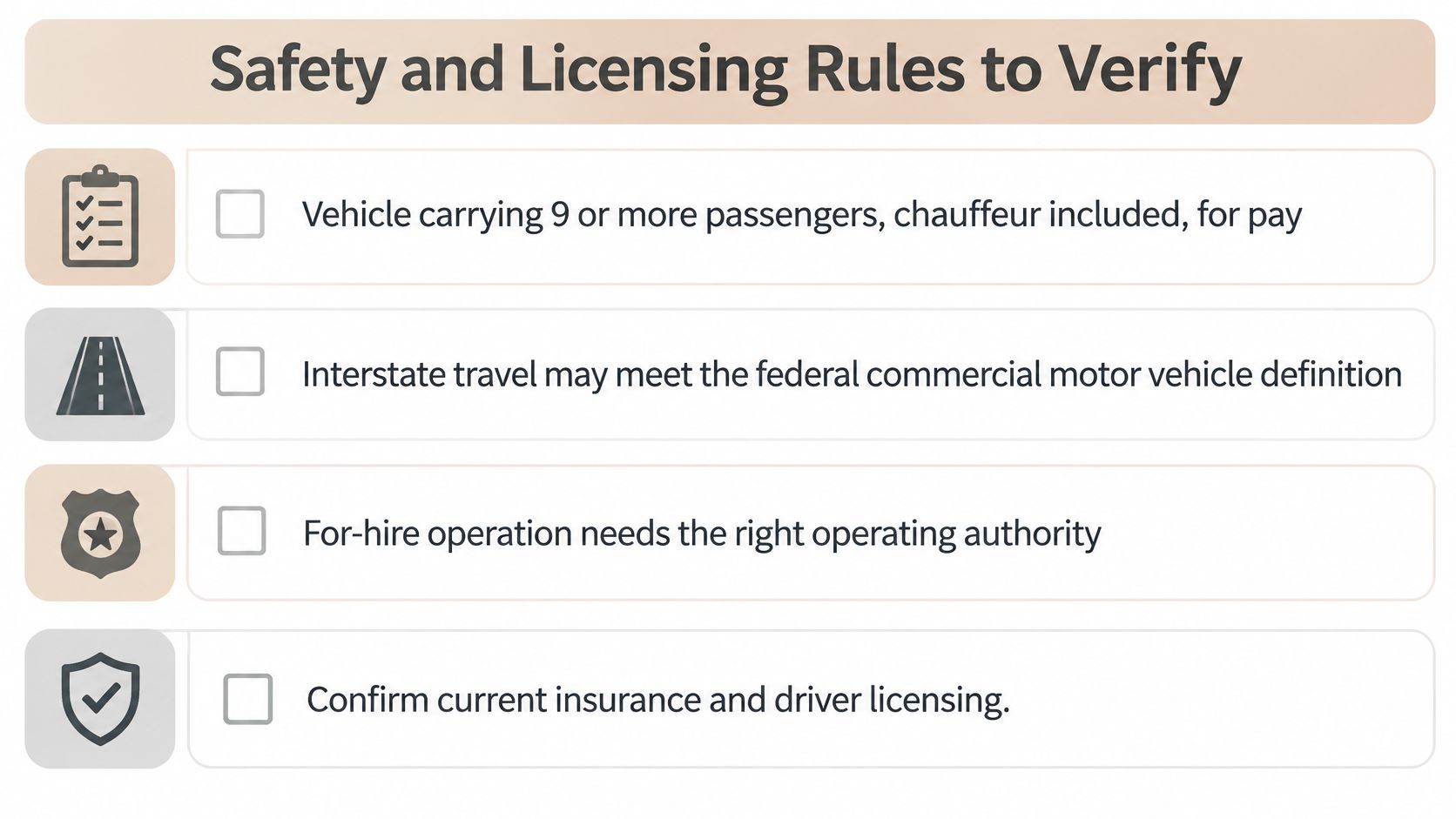
Under Federal Motor Carrier Safety Administration passenger-carrier guidance, a vehicle designed or used to transport 9 or more passengers, including the chauffeur, for compensation can meet the commercial-motor-vehicle definition in interstate commerce. The same guidance addresses for-hire operations using vehicles for 9 to 15 passengers for direct compensation in specified circumstances.
Those thresholds matter for a 14-passenger Sprinter. A fully loaded van sits squarely in the regulated range, so applicable requirements can cover chauffeur qualifications, inspection and maintenance, accident records, operating authority and hours of service. A trip crossing from New York into another state deserves a regulatory check based on the actual operation, not an assumption based on the vehicle's appearance.
Use this checklist as a starting point for that conversation.
Understand the scope of a safety rating
Euro NCAP has assessed the European Sprinter as a commercial van, as described in the Euro NCAP Sprinter assessment, but that result doesn't transfer directly to a U.S. vehicle or every converted seating layout.
Ask what safety equipment the assigned vehicle has. A model name isn't a specification sheet, and an assessment of assistance technology isn't a blanket approval of every luxury conversion.
Verify the vehicle and the operation
- Model year and seat layout. Confirm the actual vehicle and approved seating positions.
- Passenger restraints. Every passenger needs a usable seat belt at their assigned seat.
- Child-seat compatibility. Confirm suitable anchors or an approved installation method before travel.
- Assistance technology. Identify the fitted collision-warning, braking and lane-support systems.
- Registration and insurance. We are fully USDOT registered and commercially insured.
- Chauffeur preparation. Confirm appropriate licensing, passenger-vehicle training and familiarity with the assigned van.
- Loading arrangements. Establish where luggage is secured and how it affects the vehicle's available payload.
That last point deserves emphasis. Luggage stowed loose in a cabin or loaded past the vehicle's limit is a safety problem, not just a comfort complaint. Ask the operator where bags ride and confirm the planned load stays within the van's rated capacity before you commit.
Passengers also have a role. Confirm the arranged vehicle and chauffeur before boarding, keep the trip contact available and don't accept an unexplained substitution. Families organizing student travel can use 3rd-i's safety routine for campus rideshare users as a supplementary personal-safety resource alongside, not instead of, checking a commercial carrier.
Configuration, restraints, maintenance and operating practices matter more than leather or lighting.
Running Costs and Efficiency Per Passenger
Compare total trip fuel per passenger, not fuel use per vehicle in isolation. A larger van can make sense when it replaces several vehicles, but a lightly occupied van with a long empty return can be the poorer choice.
Build the comparison from these inputs:
- Vehicle consumption. Use a figure appropriate to the chosen variant and operating conditions.
- Route distance. Include airport, hotel, venue and intermediate legs.
- Passenger count. Use the number traveling, not the maximum seating capacity.
- Return and repositioning. Count empty mileage and account separately for fuel consumed while waiting.
Published WLTP figures for current European Sprinter variants range from 8.3 to 12.7 liters per 100 kilometers on the Mercedes-Benz UK Sprinter overview. Those are European test-cycle figures, not a promised consumption rate for a chauffeured Hamptons trip.
Compare the whole journey
Say a hypothetical twelve-person group would otherwise book three SUVs. A van can consume more fuel per kilometer than an individual SUV and still use less fuel overall, provided its complete-trip consumption is lower than the combined consumption of the alternative vehicles.
That comparison must include the vehicles' approaches and returns. It's misleading to count only the occupied portion of the van journey while counting every mile for the SUVs, or vice versa.
Now consider a hypothetical couple taking the same van with a long empty repositioning leg. They're using little of its passenger capacity while still moving the full vehicle. A smaller vehicle may be the more efficient choice.
Efficiency test: Divide total trip fuel by the passengers carried, then compare that result with the alternative fleet.
Keep fuel efficiency separate from the quote
Occupancy efficiency isn't the same as absolute emissions. A vehicle can use more fuel in total while using less per person carried. Don't call either option greener without establishing the complete operating picture.
The booking quote also covers more than fuel, including the vehicle, chauffeur time and itinerary. Our guide to Sprinter van rental costs helps you frame that conversation without confusing operating efficiency with the amount quoted.
Book the Right Sprinter Van for Your Group
Send the details that determine vehicle suitability in the first message. A request for “a Sprinter this weekend” leaves too many practical questions unanswered, particularly when guests are arriving from different airports or bringing bulky equipment.
Your booking message should include:
- Passenger details. Give the total count, including children, and identify any child-seat needs.
- Luggage inventory. List suitcases and carry-ons, with golf bags and garment bags separately.
- Addresses. Include exact pickup and drop-off locations, plus access instructions for private homes or venues.
- Flight information. Send the flight number, airport, terminal if known and return pickup requirements.
- Event timing. Include planned stops, return times and the person authorized to approve changes.
We serve Southampton, East Hampton, Sag Harbor, Montauk, Bridgehampton, Amagansett, Water Mill, Wainscott and Quogue. An exact address helps distinguish a straightforward curbside pickup from a property with restricted access or a separate service entrance.
The company website provides a starting point for arranging the trip.
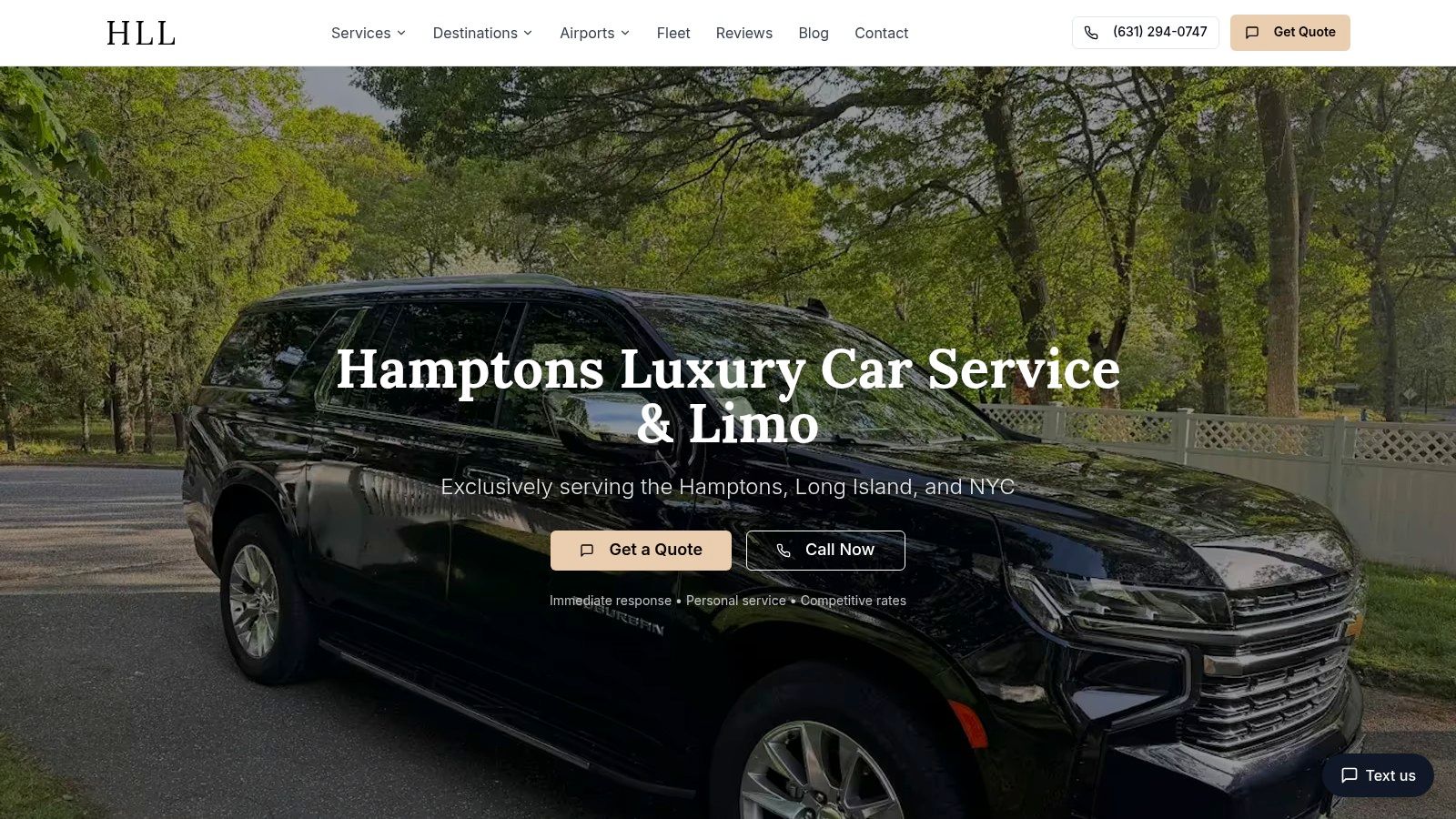
Confirm the vehicle rather than assuming the factory layout
Our Mercedes-Benz Sprinter carries 14 passengers. That is the service capacity to use when booking with us, rather than assuming a factory seating specification describes our vehicle.
Once the passenger and luggage details are complete, confirm the assigned arrangement and available loading margin. If the group changes, send the revised count before departure. Adding guests or golf equipment isn't merely an itinerary update.
Hamptons Leisure Limo is available 24 hours a day, 7 days a week, 365 days a year. Quotes use fixed pricing with no surge, so the price is set before the trip.
Text (631) 294-0747 for a quote. Include your passenger and luggage counts in the first message so we can address vehicle suitability alongside the route and schedule.
Hamptons Leisure Limo offers chauffeured Sprinter transportation for Hamptons airport transfers, weddings, corporate travel and group outings. Text (631) 294-0747 with your date, route, passenger count and luggage details for a fixed quote with no surge and a vehicle arrangement suited to your trip.
Ready to Ride with Hamptons Leisure Limo?
Fixed pricing. No surge fees. 30 years of experience serving the Hamptons. Text us what you need and we will send a quote.