Long Island Wine Limo Tours: A Practical Planning Guide
Updated October 21, 2026
Your group chat has vineyard suggestions, someone's booked dinner in Southampton, and nobody has worked out how you're getting back after the last tasting. You're looking for a Long Island wine limo, but the decision isn't just which vehicle looks good in a photograph. It's whether the transportation, tasting appointments, lunch, and return journey fit into the same day.
A workable plan starts with the return commitment and builds backward. That's how you avoid turning a Saturday in wine country into a string of rushed departures.
Table of Contents
- What a Long Island Wine Limo Service Actually Is
- The Landscape Behind the Glass
- North Fork vs South Fork Itinerary Shapes
- Choosing the Right Vehicle for Your Party
- Safety, the Chauffeur's Role, and the Late-Tour Window
- Pricing, Booking Logistics, and What Happens With the Bottles
- Sample Half-Day and Full-Day Itineraries
- Planning Your Tour With Confidence
What a Long Island Wine Limo Service Actually Is
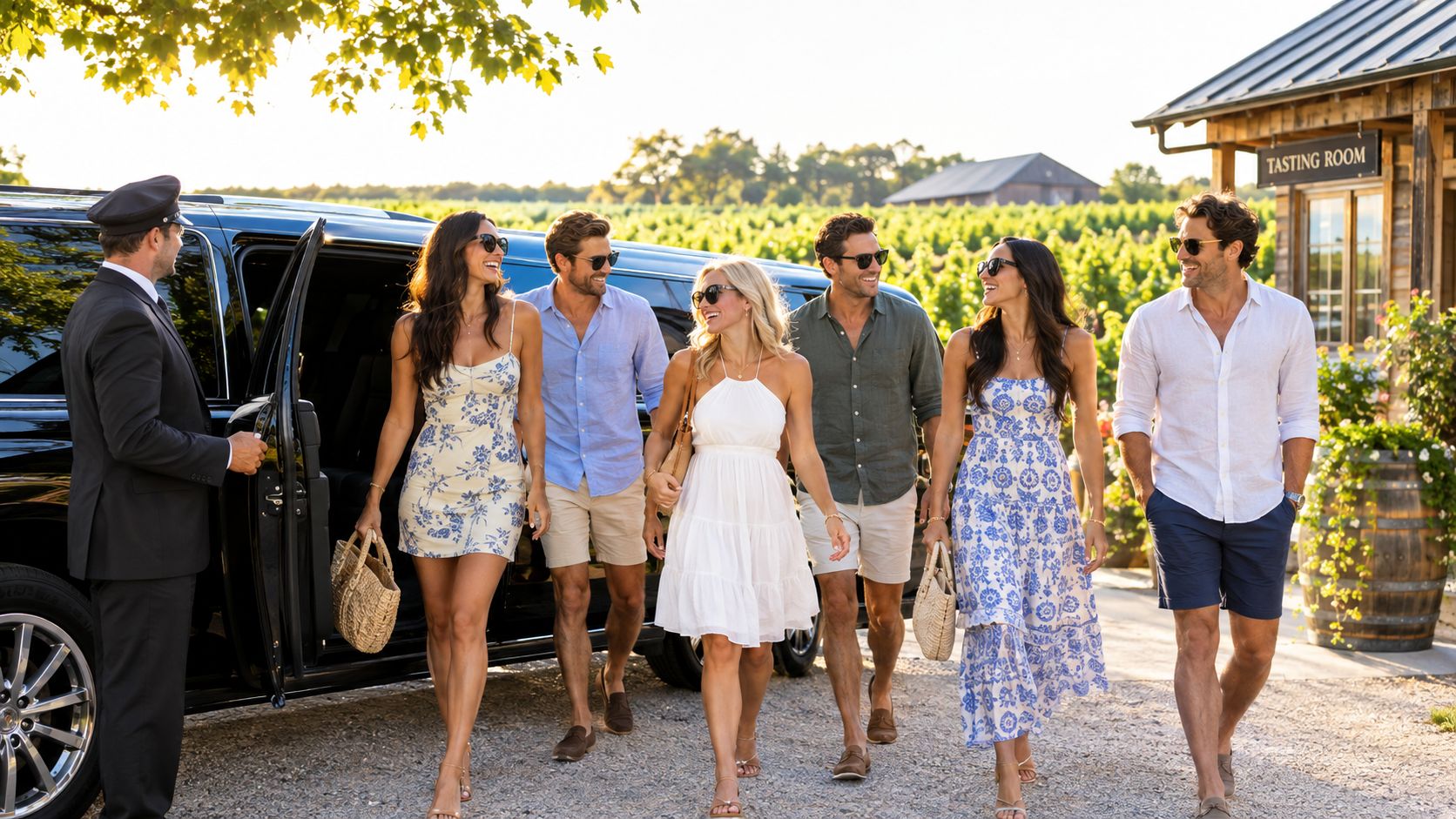
Consider a Saturday-in-season scenario: six friends step into a Sprinter outside a Cutchogue vineyard. Someone has a wine carton, someone wants lunch, and the next tasting appointment is approaching. The useful luxury isn't the cabin. It's having a chauffeur who already knows the next destination and the agreed departure time.
A Long Island wine limo service is pre-arranged chauffeured transportation organized around your tasting itinerary. “Limo” describes the service category, not necessarily a stretch limousine. The right vehicle might be an SUV, Sprinter, or coach.
The vineyard arrival is only part of the experience.
Common Service Models for a Wine Tour Day
| Service Model | Best Fit | What the Chauffeur Does |
|---|---|---|
| Dedicated hourly service | A tasting circuit with lunch and flexible transitions | Remains assigned to the itinerary and available between appointments |
| Point-to-point transportation | A winery visit with clearly defined arrival and departure arrangements | Completes the reserved transfers, with waiting only if included |
| Coordinated group service | Wedding guests, corporate outings, or a larger private party | Follows a shared manifest, venue sequence, and departure plan |
For a dedicated day, the booking should identify the vehicle, selected stops, waiting arrangements, and coordinated return to the agreed address. Don't assume on-site waiting is included in every transportation reservation. A transfer and a vehicle retained throughout the day are different commitments.
A taxi or rideshare can handle an individual journey, but booking separate rides leaves each transition unresolved until another vehicle is confirmed. A shared shuttle follows its own operating pattern. Self-driving leaves someone responsible for abstaining and navigating.
Booking rule: Ask whether you're reserving transportation between appointments or a vehicle and chauffeur dedicated to the entire itinerary.
Neither model is automatically wrong. Point-to-point service can suit a simple outing. A dedicated vehicle becomes more useful as reservations, purchases, and group coordination make the day less interchangeable.
The Landscape Behind the Glass
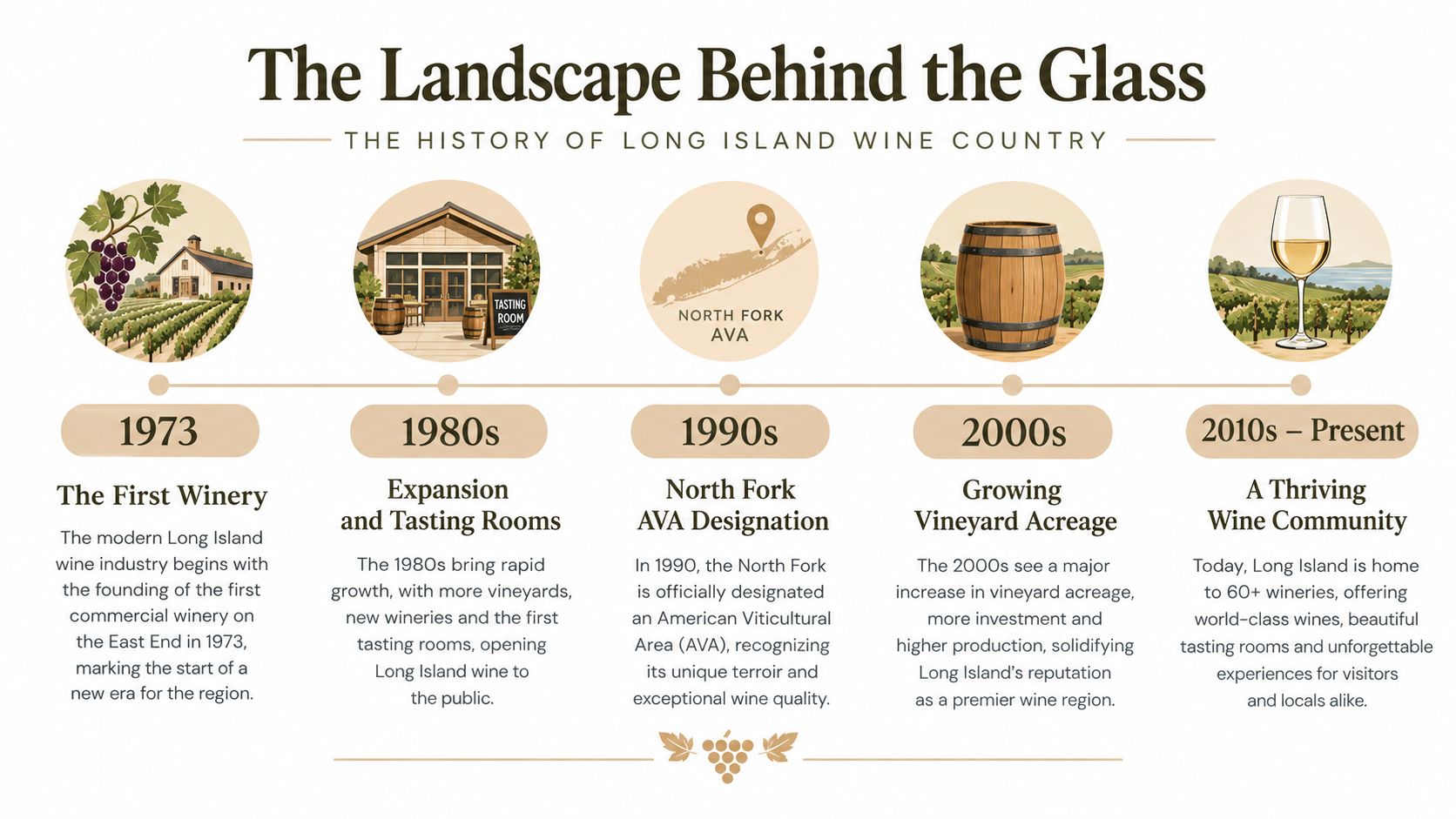
Long Island wine country developed across a region, not inside a single estate. Its modern commercial history began in 1973, when Alex and Louisa Hargrave planted a vineyard in Cutchogue. The Hamptons, Long Island AVA followed in 1985, the North Fork of Long Island AVA in 1986, and the broader Long Island AVA on May 15, 2001, encompassing Nassau and Suffolk counties, as described in this overview of Long Island's wine history and regional styles.
Those milestones help explain the map visitors face today. The destination extends across the North Fork, South Fork, and western Suffolk County rather than forming a walkable tasting district. Choosing wineries by reputation alone can leave a group with an awkward transportation plan.
The regional timeline provides context for that spread.
What Regional Scale Means for Your Day
Regional industry figures cited in reporting estimate approximately 1.3 million annual visitors, alongside substantial tasting-room spending and employment, illustrating the visitor economy surrounding the vineyards (Long Island wine-industry reporting). For transportation planning, the useful conclusion isn't that every road or venue will be busy. It's that your group shares the destination with many other visitors whose reservations and arrival times you don't control.
Build the route around geography before deciding how much to include:
- Cluster compatible appointments. Favor a coherent sequence over scattered must-visit selections.
- Treat meals as destinations. A restaurant reservation requires arrival, seating, service, and departure time.
- Separate access from proximity. A tasting room can look close on a map while still requiring careful vehicle loading arrangements.
- Include the starting address. The journey from your house or hotel belongs in the itinerary, not outside it.
Pre-arranged transportation makes sense because the destinations are dispersed and the appointments need coordination. It isn't evidence that the East End is difficult to visit. It's a way to make a regional outing function as a single, organized day.
North Fork vs South Fork Itinerary Shapes
Choose the direction before choosing every winery. From a Southampton operations perspective, the return address matters as much as the tasting list. A group finishing in East Hampton has a different planning problem from a group returning to a Southampton hotel.
A North Fork circuit suits clients who want wine to be the central activity. Arrange nearby appointments in a consistent direction along the Main Road corridor rather than crossing back and forth to accommodate a scattered wish list. A South Fork outing works better when wine shares the day with a village meal, scenery, or walking time.
| Planning Decision | North Fork Circuit | South Fork or Hamptons Circuit |
|---|---|---|
| Main emphasis | A connected sequence of tasting appointments | Wine mixed with dining and sightseeing |
| Suggested half-day shape | A compact tasting circuit, reduced if lunch is lengthy | A lighter tasting schedule with a meal |
| Suggested longer-day shape | Additional appointments only after travel and breaks fit | More time at selected destinations rather than more pours |
| Return priority | Preserve time for the journey back to your accommodation | Account for the final address in Southampton, Bridgehampton, or East Hampton |
Stop Counts Are Proposals, Not Capacity Guarantees
For an ambitious draft, you might sketch four to five North Fork stops in a half-day or six to seven across a full day. Treat that as a wish list to test, not a service promise. Full seated tastings, a proper lunch, and unhurried departures may require removing appointments.
For a South Fork draft, two to three stops plus a meal and walking time offers a different experience. That's a proposed format, not a claim about how many venues every group can comfortably visit.
More appointments don't necessarily produce a better wine day. They can simply give everyone more departure deadlines.
Don't treat Route 27 as a fixed-duration transfer on a Saturday in season. Likewise, if a proposed route uses Shelter Island ferries, confirm the actual crossings, vehicle suitability, and queue allowance before building appointments around them. A ferry-dependent itinerary needs a fallback, not optimistic arithmetic.
Choose the North Fork for a wine-focused circuit. Choose the South Fork when the group values a mixed Hamptons day. If dinner is immovable, shorten the outing rather than borrowing time from the return journey.
Choosing the Right Vehicle for Your Party
Start with people and cargo, not the vehicle photograph. A full passenger list, picnic equipment, airport luggage, and wine purchases can require a different vehicle from the same headcount traveling empty-handed.
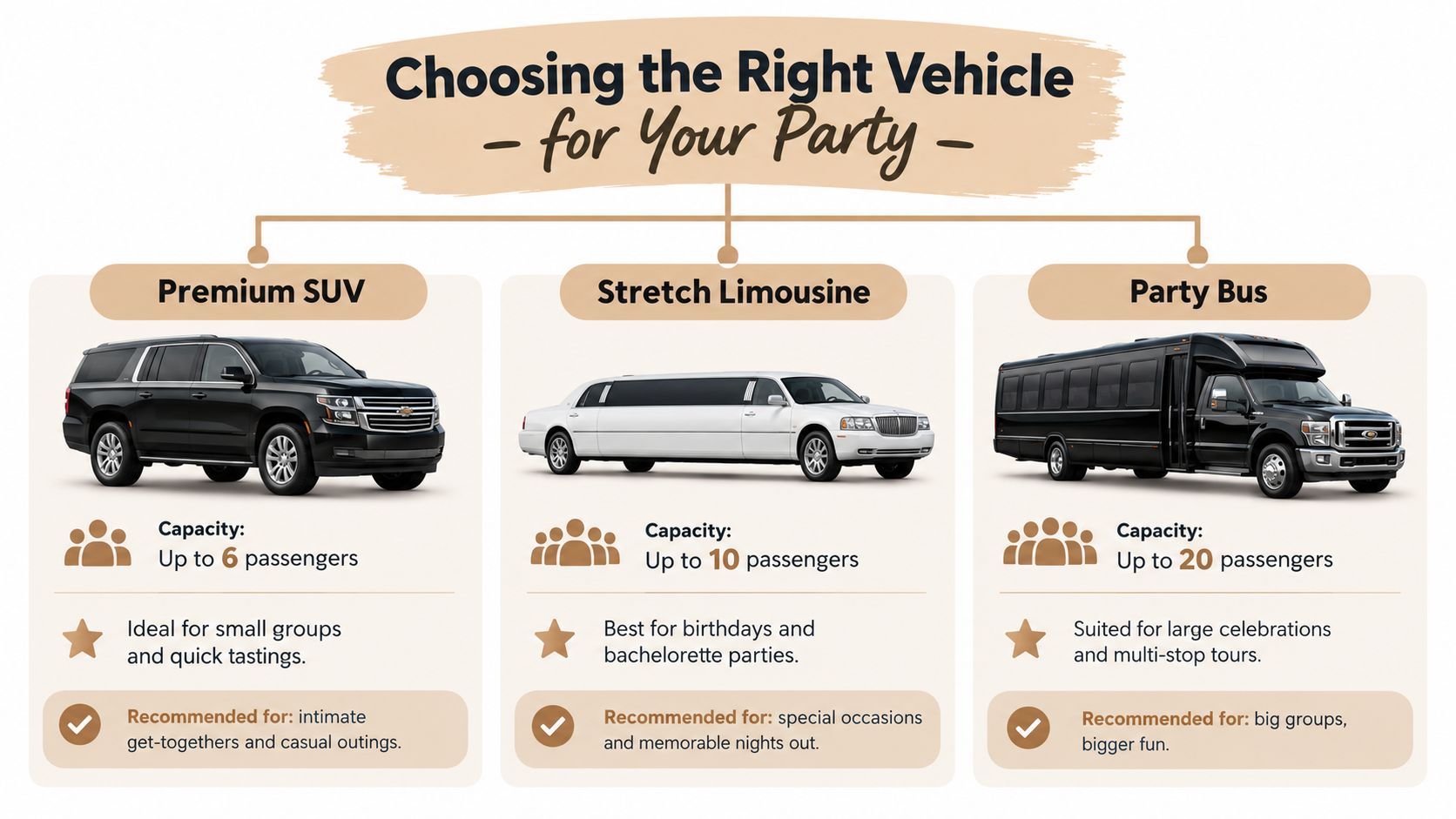
Use the vehicle graphic as an orientation aid, then confirm the exact booked configuration.
SUV, Sprinter, or Coach
A premium SUV, such as a Chevrolet Suburban or Cadillac Escalade, is a sensible starting point for couples and compact family parties. It avoids reserving a larger cabin when the itinerary and luggage don't require one. Its limitation is practical: passengers, coolers, and purchases must all fit without compromising seating or secure storage.
A Mercedes-Benz Sprinter is worth considering when keeping the party together matters more than choosing the smallest vehicle. Compare the seating layout, entry arrangement, and cargo provision using this guide to luxury Sprinter van seats. Don't assume every Sprinter interior has the same usable space.
For weddings, corporate outings, and reunions, a mini-bus or coach can simplify group coordination. The trade-off is venue access. Ask each winery about loading areas, turning space, parking permission, and the walk from the vehicle to the tasting room.
Before dispatch, declare:
- Child seats and accessibility needs. Confirm the actual equipment and boarding arrangements rather than assuming vehicle size solves access.
- Cargo and purchases. Include luggage, coolers, picnic supplies, and anticipated cases.
- Pickup sequence. Identify who boards where and appoint a group contact.
- Appointment durations. Give dispatch enough information to assess the complete assignment.
The aim is the smallest suitable vehicle, not the smallest available vehicle. A larger cabin won't fix an overloaded schedule, but inadequate storage can complicate every departure.
For another look at vehicle presentation, use the accompanying video alongside the written booking specification.
Safety, the Chauffeur's Role, and the Late-Tour Window
The chauffeur's role is operational, not ceremonial. NHTSA reports that 30% of U.S. traffic fatalities in 2024 occurred in crashes involving an alcohol-impaired motorist; New York recorded 1,101 traffic fatalities, including 348 in alcohol-impaired crashes, approximately 32% of the state total (NHTSA alcohol-impaired-driving traffic safety facts).
New York State Police identifies a blood alcohol concentration above 0.05% as legal impairment and 0.08% or higher as legal intoxication (New York impaired-driving guidance). Those thresholds aren't a tasting allowance or a calculation clients should use to decide whether to take over the vehicle.
The transportation responsibilities should be settled before anyone tastes.
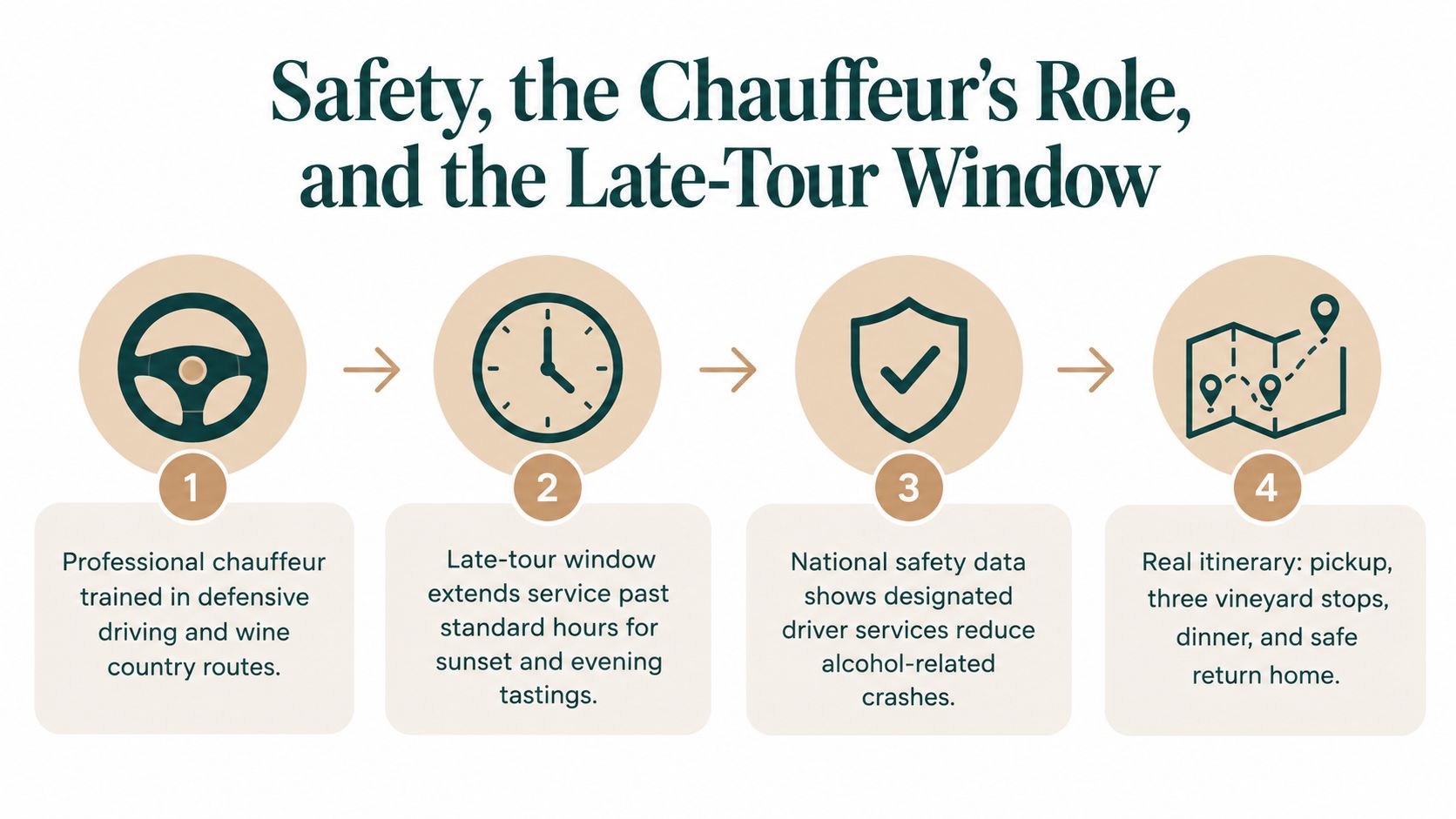
Protect the Final Leg
For a multi-stop outing, cumulative tasting exposure is the reason to protect the later part of the day. Don't interpret an energetic group at the opening appointment as evidence that everyone will feel equally well at the final departure. Keep the last transition straightforward, with purchases organized and the return destination already settled.
- Keep the chauffeur separate from tasting. No alcohol consumption belongs in that assignment.
- Keep vehicle responsibility with the provider. Clients shouldn't take over because someone thinks they feel fine.
- Document availability. For dedicated service, confirm where the vehicle will wait and how the group reconnects with the chauffeur.
- Protect the return pickup. Don't leave it dependent on finding another ride after the final pour.
Enforcement is another reason not to improvise. New York recorded 44,391 impaired-driving tickets in 2022, comprising 40,721 alcohol-impaired and 3,670 drug-impaired tickets; these are ticket counts, not unique individuals (New York impaired-driving ticket data).
Final-leg priority: An optional tasting can move or disappear. The confirmed journey home shouldn't.
Food, water, and breaks can make the outing more comfortable, but they don't establish fitness to operate a vehicle. Confirm the passenger count, stop list, return address, and waiting arrangement in advance so the group never needs to make that judgment roadside.
Pricing, Booking Logistics, and What Happens With the Bottles
Fixed pricing and no surge make a wine-tour reservation easier to budget, provided the written quote describes the actual assignment. Confirm the agreed service window, waiting arrangements, included stops, and how extensions or itinerary changes are handled. No surge shouldn't be confused with permission to expand the booking without checking.
Compare a dedicated hourly assignment with separate transfers using the complete itinerary, not just the outbound journey. The guide to limo rental cost factors provides useful context for understanding what changes a transportation quote.
Send Dispatch a Complete Request
- Party details. Passenger count, boarding needs, and cargo.
- Addresses. Exact pickup and final return locations.
- Schedule. Departure time, appointments, meal plans, and hard deadlines.
- Service scope. Whether the vehicle remains assigned through the final tasting.
- Purchases. Expected bottle or case quantities and any winery collection arrangements.
Purchased Wine Is Not the Same as Alcohol Delivery
New York law allows individuals to transport alcohol they own from place to place when it isn't being transported for sale. Commercial alcohol transportation and delivery involve separate requirements, so passenger transportation shouldn't be treated as a blanket authorization for retail delivery (New York Alcoholic Beverage Control Law § 76-a).
For a straightforward return journey, keep purchased bottles sealed, boxed, and secured, and confirm the operator's policy before loading them. Ask the winery how purchases will be packed and collected, particularly if the group expects cases rather than individual bottles.
Permission to carry sealed purchases doesn't automatically establish permission to open them onboard. Corporate gifts, separately collected orders, and wine intended for resale deserve specific clarification before travel. Safe transportation and lawful alcohol handling are related responsibilities, but they aren't interchangeable.
Sample Half-Day and Full-Day Itineraries
Use these as proposed booking templates, not guaranteed schedules. The appointment lengths, pickup location, and return deadline determine what survives the final itinerary review. This wine-tour planning guide can help organize your preferences before requesting transportation.
Sample Itinerary Comparison
| Itinerary | Stops | Best Vehicle | Return Window |
|---|---|---|---|
| Half-day North Fork proposal | Three tastings with a substantial lunch break | SUV for a compact party; Sprinter when more space is needed | Target mid-afternoon, subject to confirmed appointments |
| Full-day North Fork proposal | Five to six destinations, with food and coffee included | Sprinter for a coordinated tasting group; coach if party size requires | Set around the final return commitment |
| Lighter South Fork proposal | Two tasting rooms, a village meal, and an optional scenic pause | SUV or Sprinter according to passengers and cargo | Before the group's evening plans |
Half-Day With a Firm Finish
Begin at the group's priority estate, continue to a nearby appointment, and reserve a proper lunch break. Add the closing tasting only after the route has been checked against the return deadline. If the proposed mid-afternoon finish doesn't work, remove a tasting rather than shortening every experience.
For an afternoon flight, don't use “back by mid-afternoon” as the transport instruction. Give dispatch the flight details and required airport arrival commitment, then reassess whether a wine tour belongs before it.
Full-Day Without Constant Departures
The longer North Fork proposal can include a mix of tasting, food, coffee, and sightseeing destinations. Five to six destinations needn't mean five to six full tasting flights. Make the last appointment deliberately unhurried and leave room for purchase collection before departure.
The South Fork alternative substitutes a village meal and scenic pause for a dense tasting circuit. It also gives non-drinkers something meaningful to enjoy rather than asking them to wait through every pour.
Specify the vehicle class, waiting arrangement, and final address for whichever template you choose. For weather, delayed ferry queues, or an appointment running late, mark an optional stop that can be dropped. A passenger skipping a pour shouldn't require redesigning the day.
Planning Your Tour With Confidence
The strongest wine-tour reservation isn't the longest list of vineyards. It's a clear agreement about where the group wants to go, what it needs onboard, and when everyone must be back. Make those decisions while the outing is still a plan, not while the group is leaving a tasting room.
For broader ideas about balancing estate visits with the surrounding countryside, Shopifarm's vineyard tour planning guide is a useful companion to your local arrangements.
Before confirming, review the essentials:
- Direction. Choose a coherent North Fork or South Fork route.
- Vehicle. Match the cabin and storage to the actual party.
- Commitments. Lock in appointments, waiting arrangements, and the final address.
- Purchases. Confirm packing, storage, and bottle-handling policies.
Arrange transportation before the first tasting. A chauffeur is part of how the itinerary operates, not a finishing touch added after the reservations. With fixed pricing and no surge, you can settle the transportation decision in advance and concentrate on choosing an outing your group will enjoy.
For a pre-arranged wine-country outing, Hamptons Leisure Limo offers custom itineraries and chauffeured transportation from its Southampton base, with vehicle options for private parties and larger groups. Send your date, passenger count, pickup address, preferred stops, and return commitment so the transportation can be matched to the day. Text (631) 294-0747 for a quote.
Ready to Ride with Hamptons Leisure Limo?
Fixed pricing. No surge fees. 30 years of experience serving the Hamptons. Text us what you need and we will send a quote.