Long Island Limo Bus Guide: Sizes, Costs and How to Book
Updated November 6, 2026

Your wedding guest list is settled, but the transportation plan still has gaps. Guests are staying in different East End towns, someone has golf clubs, and the airport arrivals don't line up neatly. Booking a Long Island limo bus starts with those details, not the entertainment system or the vehicle's appearance.
The right choice combines usable seating, luggage space, compliant paperwork, and a workable schedule. A spacious coach can simplify a group move, but only if it can access the venue and the itinerary gives the chauffeur enough time to complete the assignment legally.
Table of Contents
- Long Island Limo Bus Sizes at a Glance
- Matching a Limo Bus to Your Event
- Planning Around Rail and Event Days
- Compliance Rules and Safety Checks Before You Book
- Quote Factors and Step-by-Step Booking
- Choose Your Long Island Limo Bus and Book Today
Long Island Limo Bus Sizes at a Glance
A 40-person wedding shuttle and a 6-person airport run fall under different operating rules. Seat count changes the vehicle category, the paperwork you should request, and how much buffer the schedule needs for boarding and luggage. Start from that compliance view, then pick amenities.
Long Island limo bus sizes and capacities
| Vehicle | Passenger capacity | Typical group |
|---|---|---|
| Premium SUV (Chevrolet Suburban or Cadillac Escalade) | Up to 6 | Small families, couples, airport runs with luggage |
| Mercedes-Benz S-Class | Up to 3 | Executives and short private transfers |
| Mercedes-Benz Sprinter van | Up to 14 | Small wedding parties, corporate teams, golf groups |
| 25-passenger mini-bus | Up to 25 | Bachelor or bachelorette groups, medium offsites |
| 36-passenger mini-bus | Up to 36 | Large wedding parties, school or sports groups |
| 55-passenger motor coach | Up to 55 | Full wedding shuttles, corporate outings, event movements |
These are vehicle-selection capacities, not a promise that every configuration handles the same luggage load. Confirm the seating and storage arrangement of the actual vehicle assigned to your trip.
Start With People and Bags
Choose the smallest vehicle that safely holds the full group plus everything it carries. An oversized coach adds operating cost and can struggle with tight venue driveways in Southampton or Sag Harbor. A crowded van creates a safety problem when garment bags, golf clubs, or presentation cases block the aisle.
Send the operator a luggage inventory. List checked suitcases separately from carry-ons. Call out golf clubs, strollers, mobility devices, and formalwear that cannot be stacked.
Empty seats do not create approved storage. Passenger capacity and luggage capacity are separate limits.
Look Beyond the Seating Diagram
Check emergency exits during the pre-departure walk-through. Look for clearly marked doors and emergency windows, readable opening instructions, and clear access from every row.
Bags should never cover markings or narrow the aisle. Guests in formal clothing still need a clear path to an alternate exit without climbing over belongings.
Practical rule: A seat count tells you how many people may fit. A walk-through tells you whether the group can board, sit, store its belongings, and exit sensibly.
Before accepting a vehicle assignment, confirm these details:
- Actual seating: Get the passenger count for the specific vehicle, not just its model name.
- Exit locations: Identify the primary door and alternative emergency exits.
- Documented capacity: Make sure the booking description agrees with the vehicle official paperwork.
Matching a Limo Bus to Your Event
Say a wedding party has 40 guests, each booking a separate car. That could mean 40 separate pickup arrangements and no central control over departures. A coach changes the job from tracking individual rides to managing a shared boarding point and passenger list.
The useful questions are straightforward: Who travels together, what comes with them, and where does the group separate? Answer those before choosing a vehicle.
Limo bus type by trip
| Trip type | Typical group size | Why it fits |
|---|---|---|
| Wedding party transfers | 25 to 55 seats | One vehicle keeps guests together and cuts the number of pickups |
| Corporate shuttle or offsite | 14 to 36 seats | One group ride with room for luggage and equipment |
| Airport transfer, small group | 6 to 14 seats | Space for bags with a single pickup |
| Airport transfer, large group | 25 to 55 seats | Team travel from one terminal to one destination |
| Prom or school group | 25 to 36 seats | Supervised group travel on a fixed schedule |
| Golf outing | 14 to 25 seats | Room for clubs and bags |
| Large group, Hamptons to Manhattan | 25 to 55 seats | Direct ride with no transfers |
Treat these as planning bands, not measured averages or guarantees of storage space. A golf group may need more luggage room than a larger group heading to dinner.
Match the Boarding Plan to the Occasion
For weddings, appoint a hotel contact who can check names and announce departures. Keep ceremony-critical passengers on a schedule that doesn't depend on locating late guests. For another perspective on organizing hotel-to-venue movements, The Merrill Hotel wedding guest guide is a useful companion resource.
Corporate organizers should identify who carries presentation equipment and who needs to leave early. Parents arranging prom or school transportation should establish the passenger list, permitted stops, and return arrangements before departure.
For larger movements, the luxury coach bus planning guide provides additional context for evaluating a full-size vehicle.
One large vehicle isn't always the better plan. If guests are scattered across Montauk, Sag Harbor, and Southampton, smaller vehicles on separate routes may avoid a lengthy collection loop. A Manhattan-bound group can also use rail for the main journey and reserve a coordinated vehicle for the final connection.
Planning Around Rail and Event Days
The Long Island Rail Road carried 82 million clients in 2025, 6.5 million more than in 2024, reaching 90% of 2019 ridership, according to the MTA's LIRR performance document. The same document records 861,304 special-event riders, including 154,000 for the Ryder Cup at Bethpage Black.
Those figures demonstrate the scale of event travel, not a prediction of traffic on your wedding date. For an organizer, the practical lesson is to compare a direct road journey with a rail-plus-transfer plan, rather than assuming either mode always wins.
Divide the Journey Where It Helps
Rail can handle the main journey while a pre-arranged vehicle connects the station with a venue, hotel, or dispersed destination. That arrangement works best when guests can use the same train and understand exactly where to meet afterward.
Consider a hypothetical wedding with 30 guests arriving by train and a 25-passenger mini-bus reserved for the final miles. They cannot all board together. The planner must arrange separate shuttle departures with adequate turnaround time or select a larger vehicle.
That distinction matters because a station pickup isn't just a smaller airport transfer. Guests may emerge from different exits, have limited phone reception, or struggle to identify the correct side of the tracks.
- Confirm the service and event date. Check the actual train timetable and planned service changes, rather than reusing a schedule from another weekend.
- Approve a staging location. Choose a legal pickup point with enough room for the vehicle, boarding passengers, and luggage handling. Don't assume the station entrance permits waiting.
- Build an arrival window. Allow for a delayed train and the time guests need to reach the meeting point.
- Resolve the return before departure. Specify when the group leaves the venue and what happens if the event finishes after the last practical train.
A rail connection only simplifies the trip when someone owns the handoff between the platform and the vehicle.
When a Direct Ride Is Better
Choose door-to-door transportation when formal clothing, bulky equipment, or mobility needs make transfers difficult. Check the specific station's accessibility rather than assuming every platform offers the same access.
A direct ride also makes sense when the entire group must arrive together on a fixed schedule. Adding a transfer creates another dependency, and saving road time isn't useful if guests miss the connection.
Compliance Rules and Safety Checks Before You Book
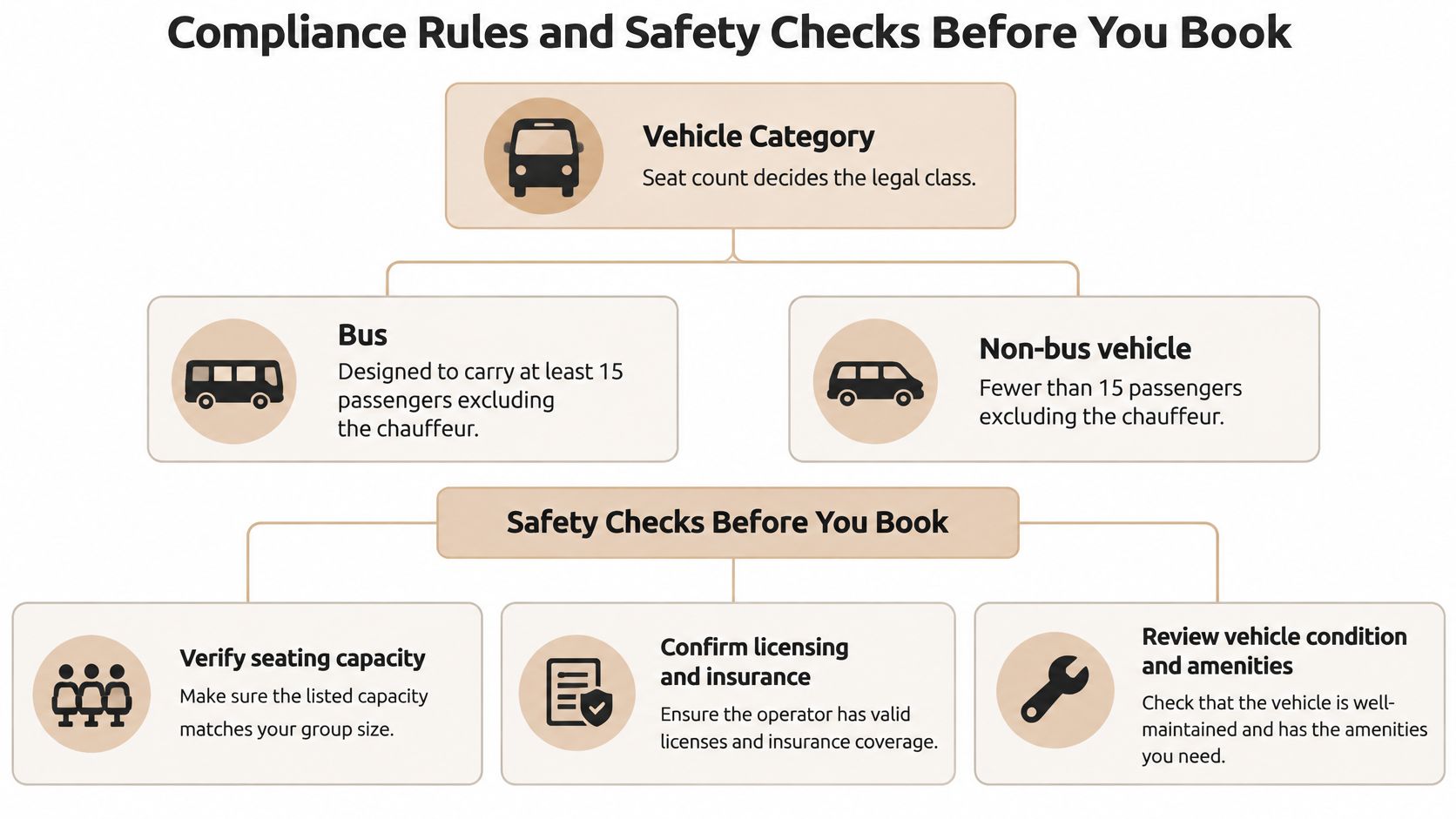
A 14 seat Sprinter and a 55 passenger coach look like a simple size trade. In New York they sit in different legal categories, with different paperwork and scheduling limits. Seat count decides what license the chauffeur needs, what inspection cycle applies, and what insurance certificate you should receive.
New York generally defines a bus as a vehicle designed to carry at least 15 passengers excluding the chauffeur, unless it qualifies as a limousine. A limousine generally accommodates up to 14, while a two-axle, four-tire vehicle carrying 15 to 20 passengers may still meet the limousine definition, according to the New York State tax classification guide. Configuration and official records matter, so use that definition as a sorting tool and then check the assigned vehicle.
Verify the Carrier and the Assigned Vehicle
Hamptons Leisure Limo is fully USDOT registered and commercially insured. I recommend you still match those credentials to the specific bus on your reservation.
Chauffeurs operating vehicles subject to commercial passenger licensing need the appropriate commercial license and passenger endorsement. New York's passenger-carrier licensing guidance also describes pre-employment and random testing for for-hire vehicles seating nine or more people including the chauffeur, with an annual compliance affidavit due August 3.
Request a coherent paperwork package, not disconnected screenshots:
- Operating authority. Confirm the carrier's legal name and applicable NYSDOT authority. Make sure the name matches the reservation.
- Inspection status. Request the most recent applicable inspection record. Vehicles subject to NYSDOT inspection generally must pass at least every six months, according to the New York DMV passenger transportation guide.
- Insurance documentation. Review the certificate, covered vehicle information, and seating records. The DMV's for-hire vehicle requirements establish a minimum combined single limit for vehicles carrying at least eight passengers and require agreement among applicable seating records.
- Chauffeur qualifications. Confirm the appropriate license, passenger endorsement, and applicable testing and Article 19-A enrollment.
- Boarding and emergency information. Ask how the driver shares boarding locations, seating rules, and emergency exits before the group boards.
The distinction between personal and commercial coverage matters. Our explanation of commercial vehicle insurance helps planners understand what the certificate represents.
Keep the Passenger Side Organized
Seat belts where fitted, seated travel while moving, and undisturbed emergency equipment. Parents and group leaders should state those expectations before boarding. A clean interior and strong reviews never substitute for documented compliance.
For groups connecting with private aviation, Approved Jets' chartered flight services guide offers context for the air portion of the journey. Keep the ground carrier verification separate. An aircraft arrangement does not establish the bus operator's qualifications.
Booking threshold: If a carrier can't produce its paperwork promptly and explain inconsistencies, choose another carrier.
Quote Factors and Step-by-Step Booking
A useful quote starts with vehicle size, booked time, route, and extras. “Transportation for a wedding” doesn't tell dispatch whether the vehicle is making a direct transfer, waiting through the ceremony, or circulating between hotels throughout the reception.
Hourly bookings account for the event's operating window, including agreed waiting and staging. Point-to-point bookings focus on the route and defined transfer. Several short hops can require more coordination than a longer direct journey because each stop introduces loading, access, and timing requirements.
Quote factors and what to tell the operator
| Factor | How it changes the quote | What to tell the operator |
|---|---|---|
| Vehicle size | Larger vehicles cost more to run but can replace several cars | Exact passenger count and luggage |
| Hours booked | Hourly bookings track event length, including waiting time | Start time, end time and any waiting periods |
| Route and distance | Point-to-point and long-distance trips are quoted by route | Every pickup, stop and final drop-off address |
| Airport transfers | Flight timing sets the pickup window | Airline, flight number and terminal |
| Demand and season | Ask whether the quote is fixed or changes with demand | Event date and whether it falls in peak season |
| Extras | Child seats, pets and added stops can affect the total | Children's ages, pets and number of stops |
Build a Quote That Matches the Assignment
We use fixed pricing with no surge. For airport transfers, our chauffeurs track flight timing so pickup arrangements can adjust when a flight is delayed. A flight delay shouldn't be confused with a client failing to appear; make sure the reservation identifies the flight being monitored.
Describe extras even when you aren't sure they'll affect the quote. Child seating, pet transport, and additional stops can change the vehicle setup or operating plan. The Long Island limo service rates guide explains how to approach the pricing conversation without relying on an incomplete headline estimate.
If your itinerary includes private aviation, you can compare private jet charter options through MyAirlinesTrip while coordinating the ground segment separately. Send ground dispatch the confirmed arrival location and updates, not merely the aircraft's planned departure time.
Follow a Clear Booking Sequence
- Count passengers and belongings. Include everyone riding on each leg, then select the appropriate vehicle category. Note whether the return group differs from the outbound group.
- Write the full itinerary. List every pickup, destination, intermediate stop, staging period, waiting interval, and return movement. Include the venue contact who can resolve access questions.
- Set realistic start and finish times. Loading is part of the assignment. Guests with luggage or mobility equipment need a boarding plan, not an instruction to hurry.
- Complete the compliance review. Resolve the assigned vehicle, carrier identity, insurance, and inspection documentation before confirming.
- Request the quote in writing. Establish whether the assignment is fixed-price or hourly and how a client-requested change would be handled.
- Send the booking essentials. Clients book by texting or calling (631) 294-0747 with the pickup location, destination, date, and time.
- Reconfirm the day before. Verify the meeting point, lead passenger, contact number, and final itinerary. For airport trips, include the flight number and any updated arrival information.
Keep itinerary changes with a named coordinator. If several guests independently message different instructions, dispatch may not know which version the organizer approved.
Why the Entire Schedule Matters
Under 49 CFR 395.5, a chauffeur subject to federal passenger-carrier hours-of-service rules may drive no more than 10 hours after 8 consecutive hours off duty and may not drive after 15 on-duty hours following that rest period, according to the FMCSA passenger-carrier scheduling guidance.
A late reception followed by an early airport transfer therefore can't be assigned on vehicle availability alone. Dispatch must check the chauffeur's duty history and applicable non-driving work.
Long, straight-through assignments may need a relief chauffeur. A parked vehicle doesn't necessarily mean the assigned chauffeur is off duty, so leaving waiting time out of the itinerary can undermine an otherwise workable booking.
Give dispatch the whole assignment. That lets the operator plan legal staffing before the event rather than trying to solve a scheduling conflict after guests have boarded.
Choose Your Long Island Limo Bus and Book Today
For up to 6 guests, start with a premium SUV such as a Chevrolet Suburban or Cadillac Escalade; for up to 14, consider a Mercedes-Benz Sprinter; and for up to 55, evaluate a motor coach. Use the size table's categories as a shortlist, then let luggage, access, and the actual passenger manifest determine the assignment.
The fleet image below illustrates the different vehicle formats used for private and group transportation.
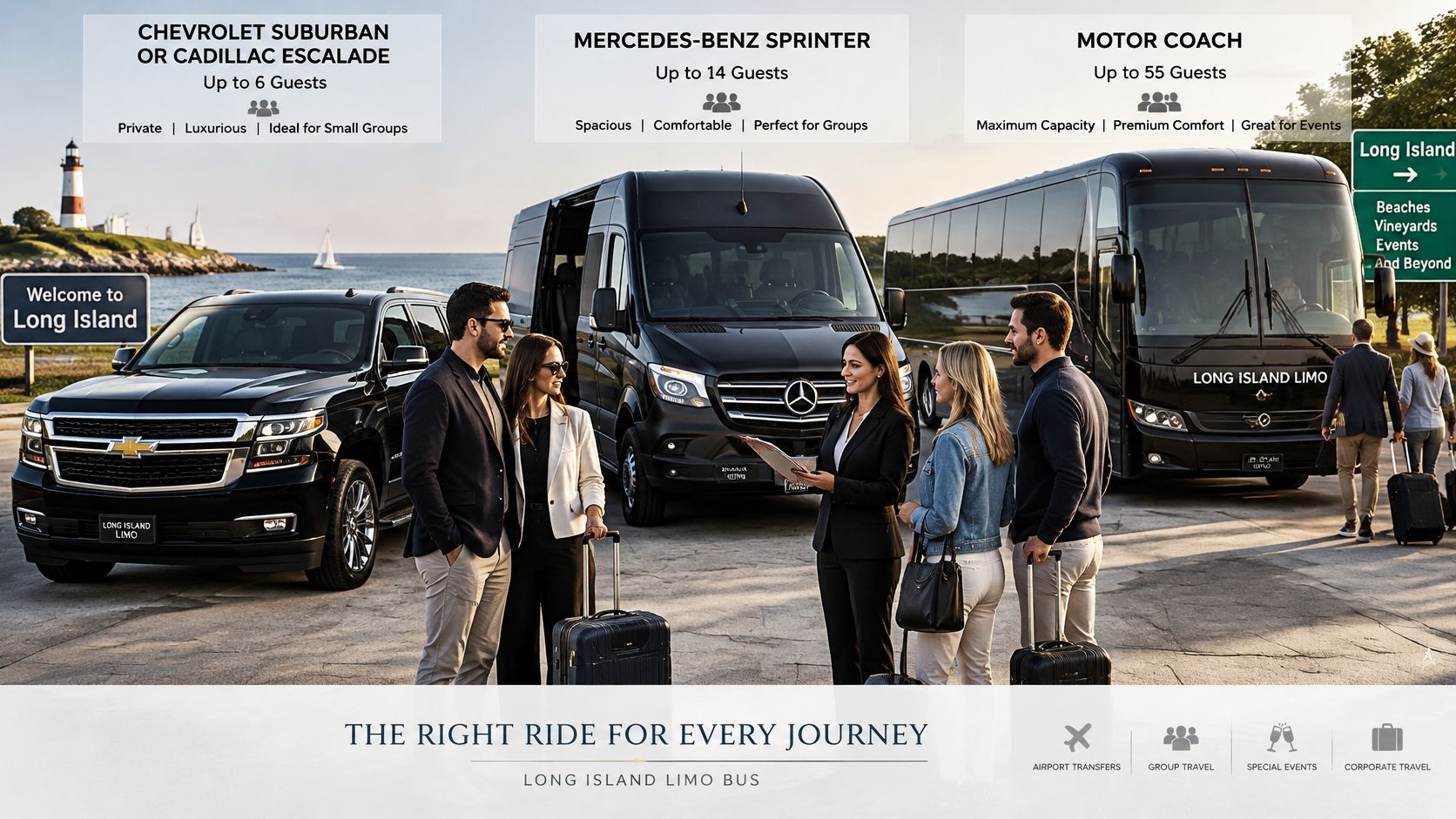
Hamptons Leisure Limo is a family-owned luxury car and limo service based in Southampton, NY. Our current fleet consists of four vehicles: Chevrolet Suburban, Mercedes S-Class, Mercedes Sprinter, and a 55-seat Coach. The coach accommodates 55 passengers plus luggage bays, making it an option for full wedding shuttles and corporate movements.
We serve the Hamptons, all of Long Island, and New York City. Availability is 24 hours a day, 7 days a week, 365 days a year, which supports planning around early departures and late event finishes without assuming any individual chauffeur can work indefinitely.
Bring a Complete Trip Summary
A productive booking conversation begins with an itinerary someone can dispatch. Have these details ready:
- Passenger count: Include children and identify any changes between outbound and return travel.
- Luggage and equipment: List suitcases, golf clubs, garment bags, strollers, and mobility equipment.
- Stops and times: Provide exact addresses, intended departure times, and the final return destination.
- Event date: Identify the occasion and the venue contact responsible for transportation access.
- Boarding needs: Explain assistance requirements and any child-seat arrangements before vehicle assignment.
Don't select a vehicle merely because it looks appropriate in a photograph. For a wedding, the important result is getting the correct guests to the ceremony entrance. For an airport group, it's having enough documented seating and suitable storage when everyone arrives with bags.
This video offers another look at the service.
The strongest transportation plan is usually the clearest one: a suitable vehicle, a verified carrier, a named coordinator, and an itinerary with no missing legs. Text (631) 294-0747 for a quote, including your passenger count, pickup location, destination, date, and time.
Hamptons Leisure Limo offers private and group transportation for Long Island weddings, corporate events, and airport connections. Visit Hamptons Leisure Limo to explore the service, then text (631) 294-0747 with your itinerary for a vehicle-matched quote.
Ready to Ride with Hamptons Leisure Limo?
Fixed pricing. No surge fees. 30 years of experience serving the Hamptons. Text us what you need and we will send a quote.