Luxury Coach Bus Charter Guide
Updated September 30, 2026
A wedding party is ready to leave the hotel, but three SUVs are parked at different entrances. One chauffeur is waiting on a guest who went back for a garment bag. Another vehicle took a different route around traffic. The executive assistant is calling everyone, the venue is asking when the group will arrive, and the schedule is already slipping.
This is the hidden cost of fragmented group transportation. A convoy can look flexible on paper, but every additional vehicle creates another pickup point, route, parking decision, communication thread, and chance for delay. For groups approaching 10 to 14 passengers, a luxury coach bus often becomes the more practical choice because one vehicle keeps everyone together and one transportation plan controls the movement.
Table of Contents
- Rethinking Group Travel Logistics
- Defining the Modern Luxury Coach Bus
- Coach Bus vs Sprinter Van and SUV Fleets
- Premium Amenities for Weddings and Corporate Events
- The Reality of Electric and Smart Coaches
- Booking Logistics and Route Coordination
- Securing Your Group Transportation
Rethinking Group Travel Logistics
The multi-vehicle convoy usually fails in small ways first. One SUV reaches the restaurant early, another circles for parking, and a third is delayed by a passenger who didn't receive the latest itinerary. Nobody event-side has a complete view of the move, so the planner becomes the unofficial dispatcher.
That burden matters at weddings, corporate retreats, airport transfers, and private tours across the Hamptons. A group may have several destinations, tight arrival windows, luggage, formal clothing, and guests who aren't familiar with local roads. Three separate vehicles can handle the trip, but they force the planner to coordinate three separate operations.
A luxury coach bus consolidates that operation. The group boards at one location, follows one route, and arrives as a unit. Passengers can settle into a spacious cabin instead of checking messages to find out which SUV is where. The event team gets one primary point of communication rather than a chain of updates moving between multiple vehicles.
Practical rule: If the group needs to arrive together, book transportation that moves together.
The coordination cost nobody puts on the first quote
Comparing only the vehicle rate misses the operational expense of a convoy. Each vehicle can add chauffeur time, toll decisions, parking requirements, loading delays, and route coordination. The planner also has to account for what happens when one passenger changes plans, one vehicle gets separated, or the group needs to make an unscheduled stop.
That workload is similar to managing field operations. Teams that want better visibility into dispersed movements can review resources designed to boost accountability in field ops, especially when several people and vehicles must follow the same schedule.
A single coach doesn't eliminate every risk. It does remove unnecessary variables. The entire group has the same departure time, the same onboard environment, and the same arrival plan. That makes it easier to communicate updates, confirm headcount, and keep the wedding party or executive team focused on the event instead of transportation.
For a closer look at planning a coordinated group move, review this guide to group transportation service. The right vehicle isn't just a comfort decision. It's a control decision.
Defining the Modern Luxury Coach Bus
A standard bus moves people. A luxury coach bus is engineered and outfitted for longer travel, higher passenger comfort, and more controlled operation on highways. The difference starts with the platform, then extends to suspension, cabin layout, safety equipment, and service condition.
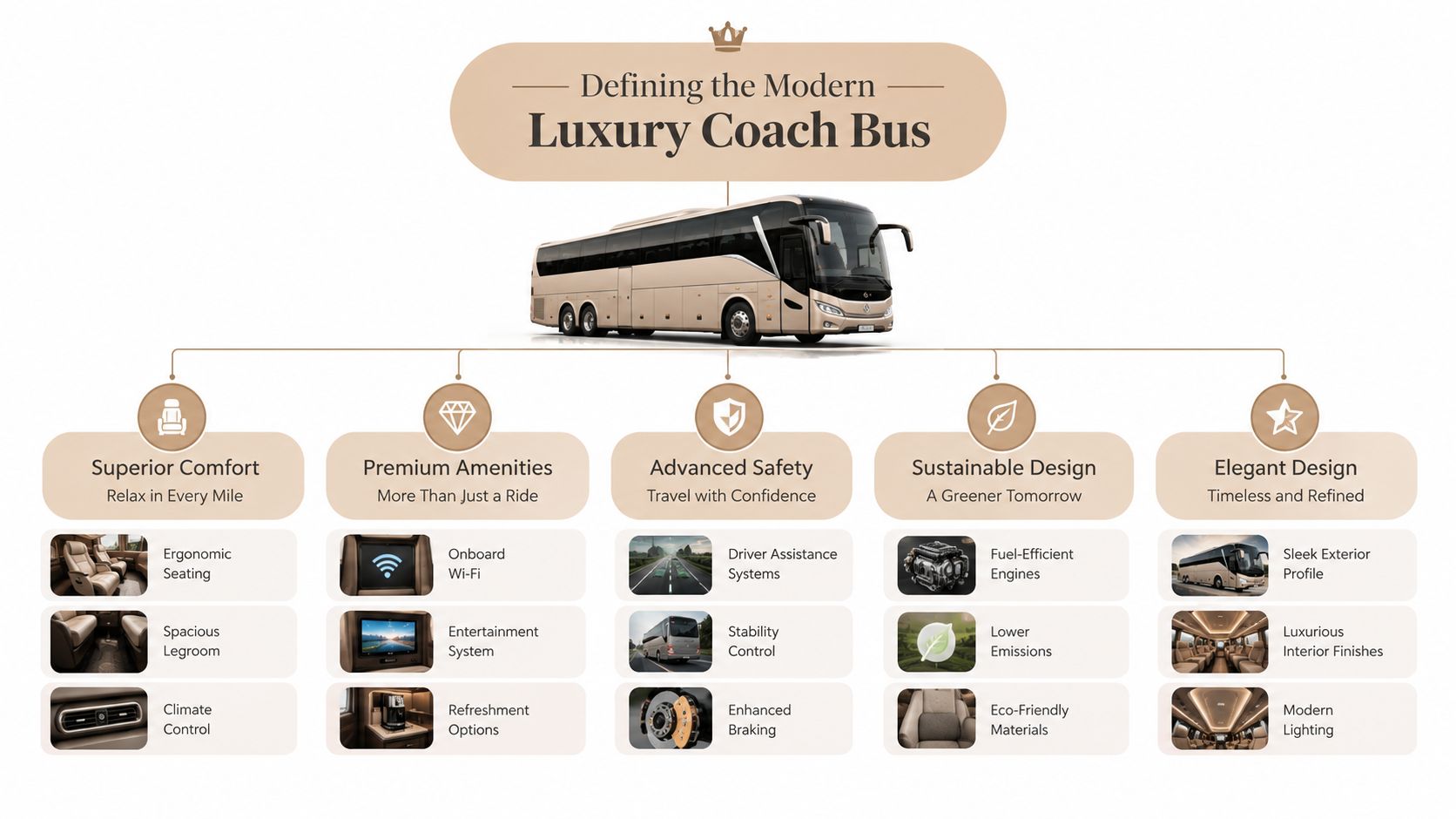
Typical luxury coach bodies measure 12.0 to 13.5 meters long, 2.55 to 2.6 meters wide, and 3.8 to 4.0 meters high, with seating commonly arranged for 55 to 65 passengers. Powertrains generally fall within 300 to 600 horsepower, with 1,000 to 2,000 Nm of torque and transmissions ranging from 6 to 12 speeds. These figures and dimensions are summarized in luxury coach bus design specifications.
Those numbers matter because a full cabin creates substantial weight. Peak horsepower looks impressive in a brochure, but torque and suspension design determine how composed the vehicle feels when it launches, climbs a grade, or carries a full passenger load. A properly matched powertrain delivers steady acceleration without making passengers feel every gear change.
The ride depends on more than leather seats
European-style coach platforms often combine high-output diesel engines with independent front suspension, rear air suspension, electronic stability control, ABS, lane-departure warning, and adaptive cruise control. Scania chassis information includes a 13-liter inline-six rated at 400 horsepower and 2,100 Nm, along with another configuration rated at 490 horsepower and 2,550 Nm, as shown in its K Series luxury coach specifications_SAU2016-7-KLuxury_6x24_WEB.pdf).
Air suspension helps maintain ride quality and tire contact over long routes. Stability systems help limit body movement during evasive maneuvers and directional changes. For passengers, that engineering shows up as less fatigue, fewer abrupt movements, and a cabin that feels settled rather than commercial and utilitarian.
The federal safety baseline also matters. NHTSA requires new motorcoaches and other large buses with a GVWR greater than 11,793 kilograms, or 26,000 pounds, to have lap and shoulder seat belts at each driver and passenger seat. The rule applies to new over-the-road buses and excludes transit buses and school buses, according to NHTSA's motorcoach seat belt rule.
NHTSA's proposed definition identifies a motorcoach as a bus with a GVWR of at least 11,793 kilograms, or 26,000 pounds, at least 16 designated seating positions including the driver, and at least two rows of passenger seats behind the driver that face forward or can convert to forward-facing seating. NHTSA's motorcoach definition provides the regulatory context.
The practical takeaway is straightforward. A true luxury coach should combine a purpose-built highway platform, stable suspension, appropriate power, passenger restraints, and a clean, well-maintained cabin. Cosmetic upgrades alone don't create a premium motorcoach.
The video below provides another visual look at the luxury coach format.
Coach Bus vs Sprinter Van and SUV Fleets
The decision isn't about how many seats are available. It comes down to how many moving parts the itinerary creates.
A premium SUV works well for a principal, a couple, or a small party that values privacy and frequent schedule changes. A Sprinter van is a strong middle option for a compact group with moderate luggage and a straightforward route. A coach becomes more compelling when the group needs to stay together, the route includes several stops, or the planner can't afford staggered arrivals.
The important threshold is roughly 10 to 14 passengers. Market analysis identifies that range as the point where consolidation and lower coordination overhead can outweigh the perceived prestige advantage of multiple smaller vehicles. The luxury coaches market analysis also describes demand across premium intercity and tourism transportation, although it doesn't provide a universal formula for every itinerary.
Vehicle Selection Matrix
| Vehicle Type | Capacity | Ideal Use Case |
|---|---|---|
| Premium SUV | Small group | Executive airport transfer, couple, principal, or private point-to-point travel |
| Sprinter van | Up to 14 passengers | Wedding party, compact corporate team, wine tour, or short group itinerary |
| Luxury coach bus | Large group | Wedding shuttle, corporate event, airport movement, tour, or multi-stop group travel |
The cost calculation should include more than the quoted vehicle fee. With multiple SUVs or vans, planners may pay for overlapping chauffeur hours, separate tolls, multiple parking arrangements, and additional waiting time. They also have to coordinate each vehicle when the itinerary changes.
A single coach can reduce those coordination demands. It won't always be the cheapest option for a small party, and it may be less convenient when passengers need to split into unrelated destinations. But once the group is large enough to require several vehicles, consolidation usually deserves a serious comparison.
Use the itinerary, not the vehicle image, to decide
Choose a Sprinter van when the group is compact, the route is local, and passengers may separate during the day. It also makes sense when the pickup location has access limitations that a full-size coach can't easily manage.
Choose a luxury coach when the group has shared destinations and a shared arrival requirement. Weddings are a clear example. Moving the bridal party, family members, or guests between hotels, ceremony locations, reception venues, and after-event accommodations is easier when everyone receives the same schedule.
Corporate teams benefit from the same logic. One coach gives an executive assistant a single manifest, one primary communication channel, and one arrival window. For a detailed comparison of vehicle types and planning considerations, see this guide to Sprinter van rental.
FMCSA notes that a motorcoach, also called an over-the-road bus, can typically carry 40 to 50 passengers, making it a practical class for large group charter planning, as described in FMCSA's motorcoach passenger guidance. The right choice still depends on luggage, access, stops, and whether every passenger follows the same route.
Premium Amenities for Weddings and Corporate Events
A luxury coach bus should function as a comfortable travel environment, not just a larger vehicle. The cabin needs to support the event schedule, passenger needs, and length of the route.
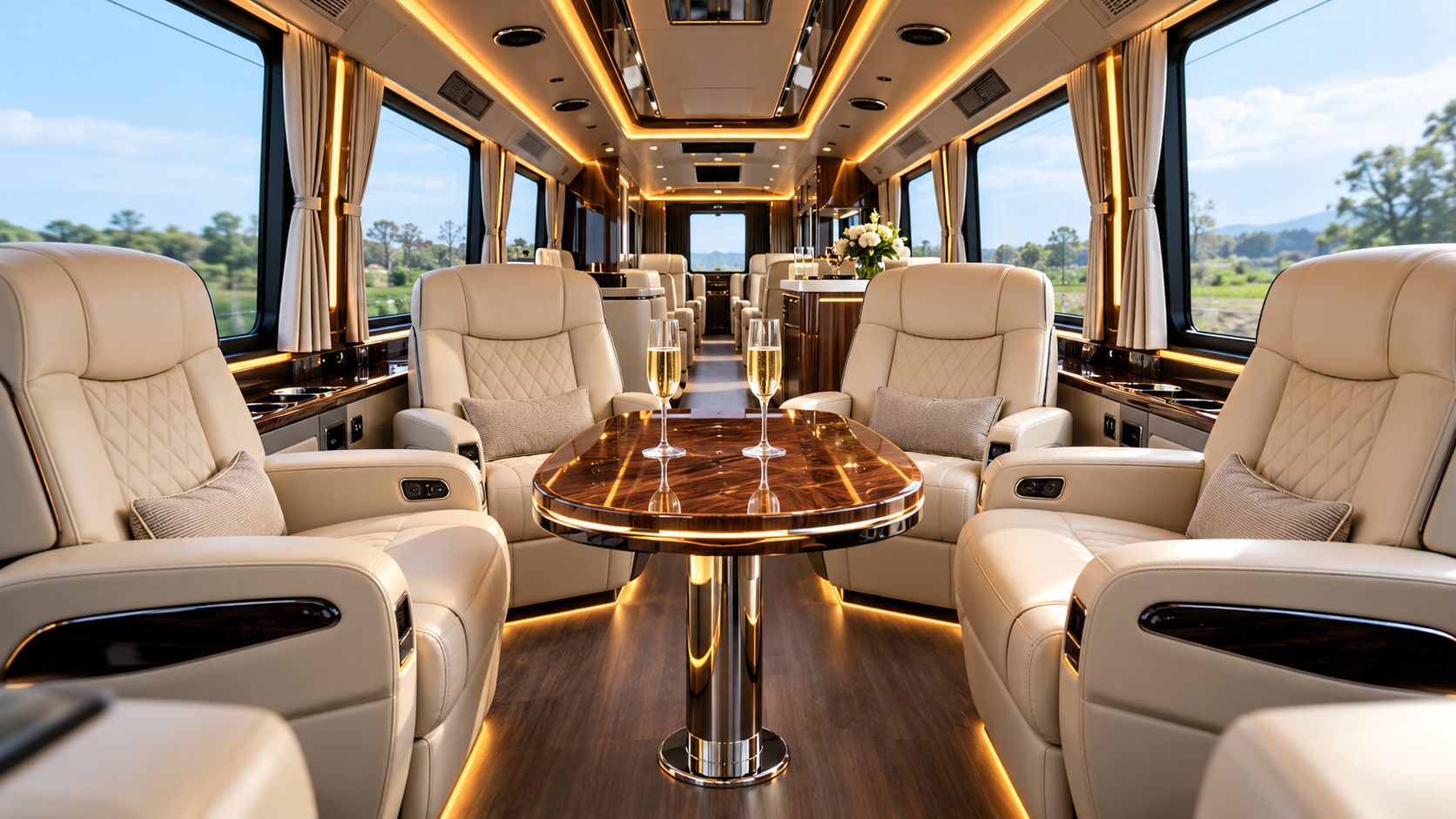
Reclining seats, climate control, useful storage, a restroom, charging access, and Wi-Fi can change the experience considerably. Not every vehicle includes every feature, so planners should confirm the actual configuration rather than relying on the phrase “luxury coach” alone.
For a wedding, the priorities are different from those of an executive retreat. The bridal party may need generous space for formalwear, makeup bags, bouquets, and personal items. Passengers may also need a calm environment between photographs, the ceremony, and the reception. A coach keeps the group together without forcing everyone into separate cars, which makes headcounts and timing easier to manage.
Match amenities to the event
- For weddings: Prioritize comfortable seating, climate control, easy boarding, storage for personal items, and a restroom for longer transfers. Ask whether the vehicle can accommodate child seats or mobility needs when applicable.
- For corporate retreats: Look for tray tables, power access, Wi-Fi, and a quiet cabin. Those features let executives review materials, answer messages, or hold informal discussions without turning the ride into a cramped work session.
- For airport transfers: Confirm luggage capacity before booking. Passenger seating may be sufficient while underfloor storage is not, particularly when the group has checked bags and presentation materials.
- For event shuttles: Confirm pickup locations and boarding procedures. A comfortable coach still causes delays if guests don't know where to meet or if the curb can't accommodate the vehicle.
The best amenity is the one that supports the itinerary. A restroom has obvious value on a longer transfer. Wi-Fi matters more for an executive group than for a short wedding shuttle. Reclining seats become more important when passengers are leaving an early meeting or returning from a full day of events.
Corporate planners arranging executive travel can also review corporate event transportation options and use that planning process to create a complete passenger brief. Include boarding instructions, luggage expectations, emergency contacts, stop plans, and the name of the person authorized to approve changes.
A coach should feel polished before passengers board. Clean windows, orderly seating, working climate control, accessible storage, and a professional chauffeur influence the experience just as much as decorative finishes. If the operator can't confirm those basics, premium branding doesn't mean much.
The Reality of Electric and Smart Coaches
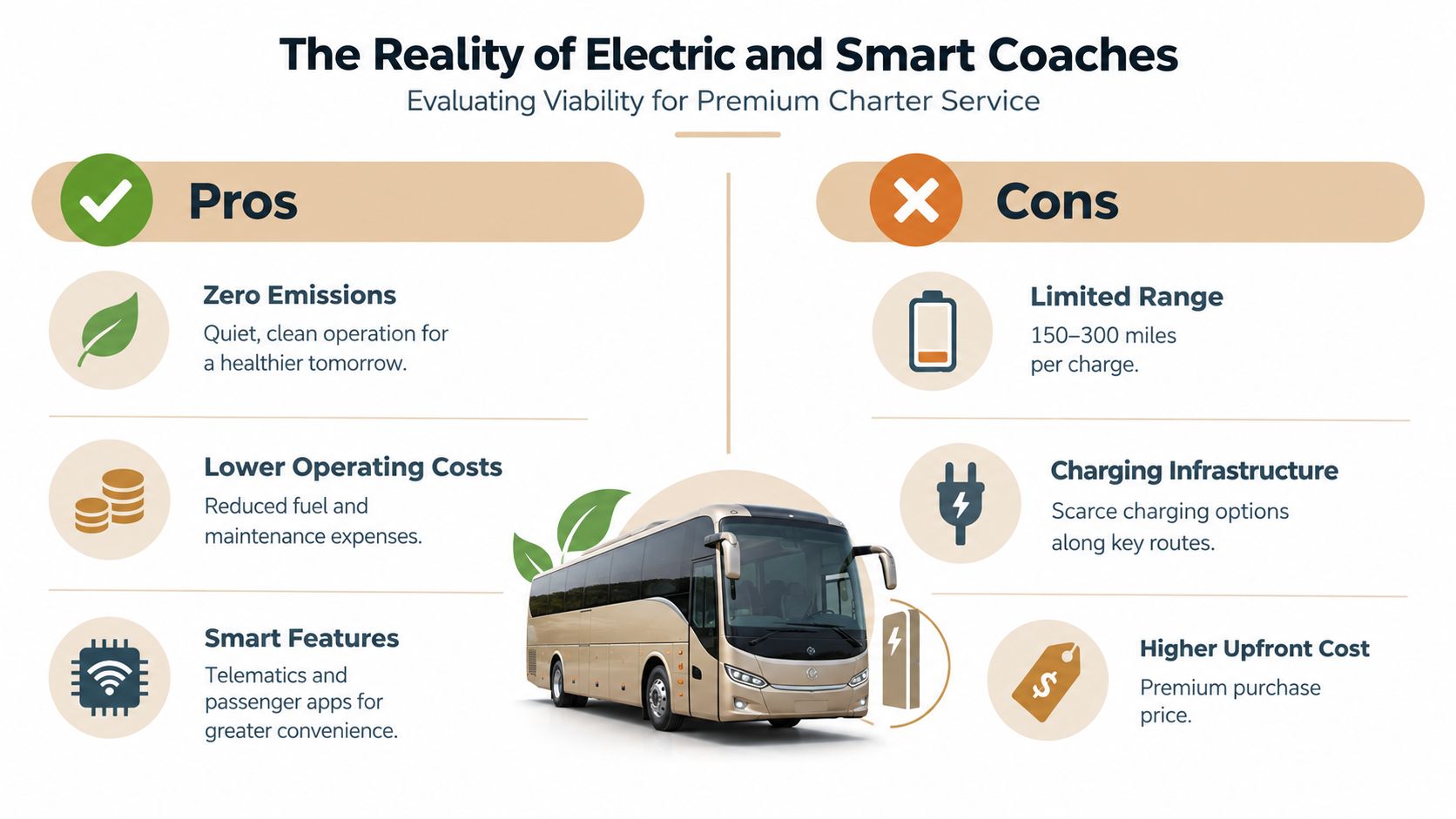
Electric and hybrid coaches deserve attention, but planners should stop treating them as automatic replacements for diesel platforms. The right question isn't whether electric propulsion is promising. It's whether the vehicle fits the route, charging plan, dwell time, and backup requirements.
Electric coaches can make sense for localized shuttle work, airport loops, venue transfers, and repeated routes with predictable charging access. They may provide quiet operation and reduce tailpipe emissions in dense areas. Those benefits are meaningful when passengers move through the same corridor and the vehicle has a reliable charging window between assignments.
They become harder to deploy on long-distance or cross-corridor trips. Range varies with passenger load, terrain, weather, traffic, heating, air conditioning, and driving conditions. Charging can also require a planned dwell period, and a route becomes vulnerable when the next suitable charger isn't available at the right time.
Smart features improve oversight, not physics
Smart coaches can include connected cockpits, real-time monitoring, predictive maintenance, passenger information systems, and advanced driver assistance systems. These tools can help an operator identify maintenance needs earlier, monitor vehicle status, and give a coordinator better information during a live itinerary.
They don't remove the physical constraints of the route. A smart dashboard can't create a charging station, shorten a charging session, or guarantee the same range under every passenger load. Event planners should ask operational questions before approving an electric vehicle for a premium charter.
- Route fit: Can the coach complete the full itinerary with an appropriate reserve?
- Charging access: Is charging available at the depot, venue, hotel, or planned stop?
- Dwell time: Can the schedule absorb charging without affecting passenger movements?
- Contingency: What vehicle or route plan covers a charging delay or equipment issue?
- Cabin needs: Will climate control, luggage, and passenger load affect the operating plan?
Recent market coverage describes electric and hybrid luxury coaches gaining traction, along with smart cockpits, monitoring, predictive maintenance, and ADAS. One luxury buses market report says about 35% of newly ordered luxury coaches in 2024 used mild-hybrid or full-electric drivetrains. That signals adoption, not universal route readiness.
For a short, repeatable Hamptons shuttle, an electric coach may be a sensible fit if the operator has charging and backup procedures under control. For a long-distance retreat, an airport movement with uncertain timing, or a route crossing charging gaps, a high-output diesel coach remains the safer operational choice.
Booking Logistics and Route Coordination
Booking a coach starts with information, not vehicle selection. The provider needs to understand who is traveling, where the group is going, how much luggage is involved, and what must happen if the schedule changes.
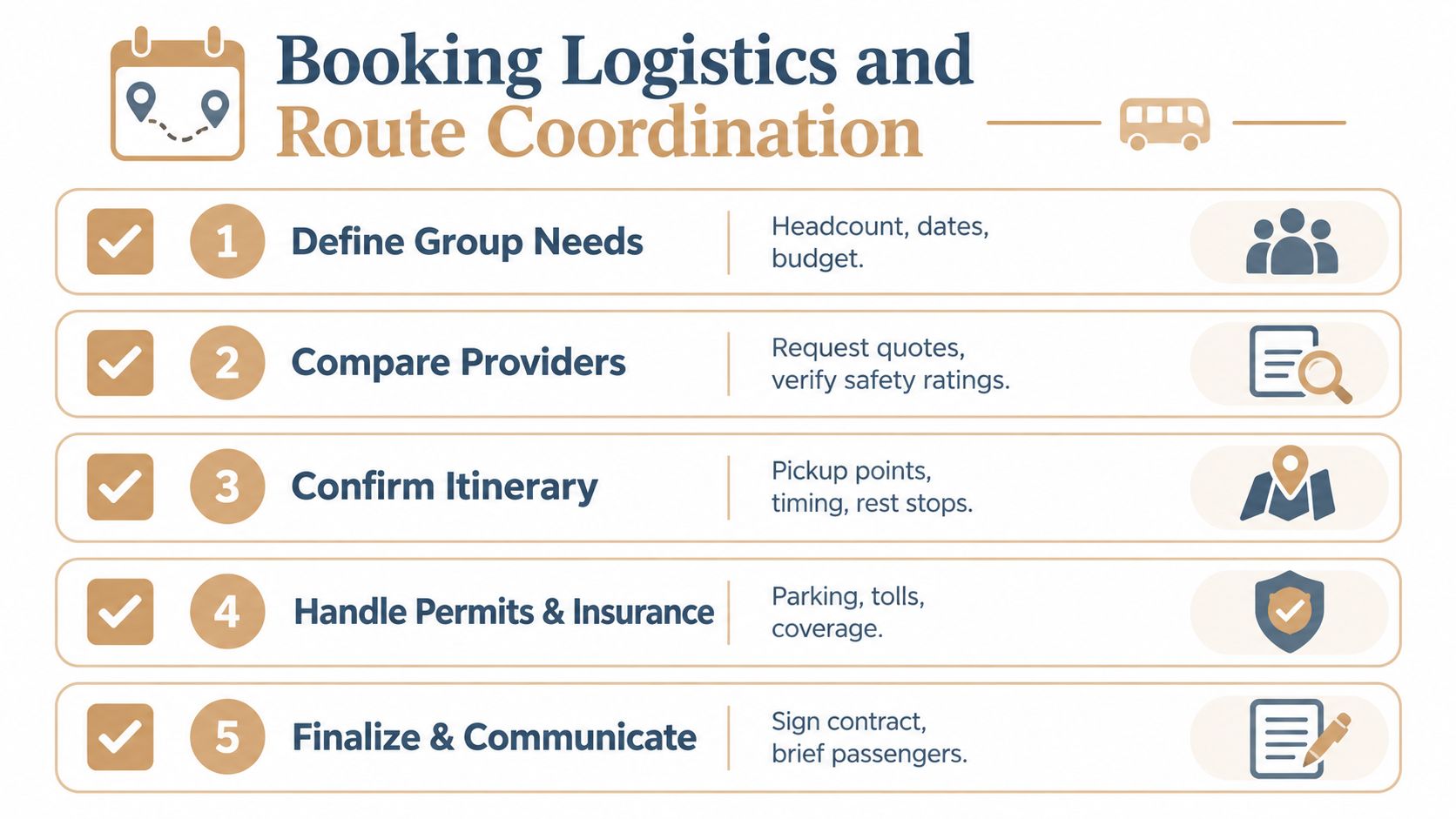
Five decisions that prevent avoidable delays
Define the group needs. Provide the estimated headcount, travel dates, pickup windows, destinations, luggage requirements, accessibility needs, and whether everyone travels together. Don't describe the movement only as “a wedding shuttle” or “corporate transportation.” The operator needs the actual sequence.
Compare providers on operations. Ask who coordinates the itinerary, how updates are handled, what safety and insurance documentation is available, and whether the assigned vehicle matches the confirmed configuration. A polished sales process doesn't guarantee an organized day, so ask how the provider manages changes.
Confirm the itinerary in writing. List every pickup point, loading area, stop, departure time, arrival target, and return movement. A site survey can identify low-clearance entrances, narrow roads, restricted curbs, hotel loading rules, and venue access issues before the event.
Handle permits, parking, tolls, and coverage. Large vehicles need room to load and turn. Confirm whether the venue has a designated coach area, whether parking requires advance arrangements, and who handles toll or access instructions.
Finalize and communicate. Sign the service agreement, confirm the vehicle type, distribute passenger instructions, and name one event-side contact. The group shouldn't receive conflicting instructions from several people.
Give the provider a useful operating brief
Include a contact list with the planner, venue representative, hotel representative, and passenger lead. Share realistic boarding times, not just the time the event begins. Passengers need time to leave rooms, collect bags, use elevators, and board without turning the departure into a sprint.
Luggage deserves its own discussion. A coach may have substantial storage, but the operator still needs to know whether passengers carry suitcases, golf bags, wedding décor, production equipment, or corporate materials. Oversized items can change the loading plan.
A clean itinerary has one owner, one version, and one method for approving changes.
Fixed pricing and no surge fees also make planning easier because the transportation line item remains predictable while the event schedule develops. Ask for a written quote that identifies inclusions, cancellation terms, waiting expectations, vehicle configuration, and the communication process for day-of changes.
The final review should happen shortly before service. Confirm the passenger count, weather-sensitive stops, venue access, flight information when relevant, and the exact meeting point. Clear information gives the chauffeur and coordinator a workable plan before the first passenger arrives.
Securing Your Group Transportation
A luxury coach bus is the right recommendation when the group shares a route, the schedule matters, and the cost of coordinating several smaller vehicles outweighs their flexibility. The value comes from consolidation. One cabin keeps passengers together, one itinerary governs the move, and one transportation contact can manage updates.
The vehicle should also match the route. A coach needs appropriate access, sufficient luggage capacity, working comfort features, and a professional chauffeur who understands the service standard expected at a wedding, executive event, airport transfer, or retreat. For Hamptons travel, local route knowledge matters because hotel entrances, seasonal traffic, venue access, and narrow roads can affect the timing of a large vehicle.
Don't wait until the guest list or corporate itinerary is completely frozen. Share the information you have, identify what may change, and ask the provider to build the plan around those variables. Request fixed pricing with no surge, confirm the vehicle in writing, and text (631) 294-0747 for a quote.
Hamptons Leisure Limo provides coordinated group transportation for Hamptons weddings, corporate events, airport transfers, and multi-stop itineraries, including spacious coach options and professional chauffeurs. Visit Hamptons Leisure Limo to plan a consolidated vehicle strategy, then text (631) 294-0747 for fixed pricing with no surge.
Ready to Ride with Hamptons Leisure Limo?
Fixed pricing. No surge fees. 30 years of experience serving the Hamptons. Text us what you need and we will send a quote.