Lincoln Town Car Sedan: A Complete Guide for Travelers
Updated October 7, 2026
The Lincoln Town Car accumulated 1,058,888 vehicles across its recorded production period, yet U.S. sales fell from 120,191 units in 1994 to 9,460 in 2011, a decline of approximately 92%. That contrast explains why the Lincoln Town Car sedan remains so recognizable in chauffeured transportation while no longer appearing in new-car showrooms. (Classic Trader sales and production data)
A longtime black-car operator doesn't judge this sedan by its age alone. The useful question is whether its space, ride quality, serviceability, and formal presence still solve a traveler's problem better than a newer sedan, SUV, or passenger van. For airport transfers, executive travel, evenings out, and point-to-point service, the Town Car can still make sense when the vehicle is properly maintained and matched to the itinerary.
Table of Contents
- Why the Lincoln Town Car Sedan Still Defines Chauffeured Travel
- A Short History of the Lincoln Town Car Sedan
- Engine and Powertrain Details That Matter
- How the Town Car Compares to Other Sedans in the Fleet
- Best Use Cases for a Lincoln Town Car
- Comfort and Cabin Features Travelers Notice
- Booking the Lincoln Town Car for Airport Transfers
- How to Book a Lincoln Town Car with Hamptons Leisure Limo
Why the Lincoln Town Car Sedan Still Defines Chauffeured Travel
The Lincoln Town Car sedan remains one of the most recognized vehicles in chauffeured transportation. Its long, formal profile became the visual shorthand for a professional black car, and that recognition still matters when a client arrives at a terminal curb, hotel entrance, or private event.
The operational appeal is straightforward. The Town Car offers a large cabin, a substantial trunk, rear-wheel drive, and a soft suspension designed to keep passengers comfortable rather than entertain the person behind the wheel. Its body-on-frame construction and traditional automatic transmission also gave fleets a familiar mechanical layout that local repair shops understood.
For a traveler, the experience begins before the car moves. The doors open wide, the seating position is upright, and the ride height makes entry less awkward than dropping into a low sport sedan. The trunk is generous enough for normal airport luggage, business bags, and evening essentials without asking passengers to place belongings in the cabin.
What recognition contributes
A familiar silhouette reduces uncertainty. Clients know where to look, what kind of service to expect, and how much cabin space a traditional Town Car generally provides. Dispatchers also know the vehicle's proportions, turning behavior, and luggage limitations, which helps them assign it intelligently rather than treating every sedan as interchangeable.
The sedan's dimensions are substantial, but they're still practical for many residential driveways, hotel approaches, and standard garage arrangements. It isn't a substitute for a high-capacity SUV or van, though. The value comes from combining a formal presence with a manageable passenger count and a calm ride.
Practical rule: Choose the Town Car for the quality of the passenger experience, not because an old sedan automatically costs less to operate.
For a plain-language explanation of the vehicle's role in black-car service, see this guide to what a town car means in chauffeured transportation. The decision should then move to the vehicle's history, mechanical condition, and suitability for the trip.
A Short History of the Lincoln Town Car Sedan
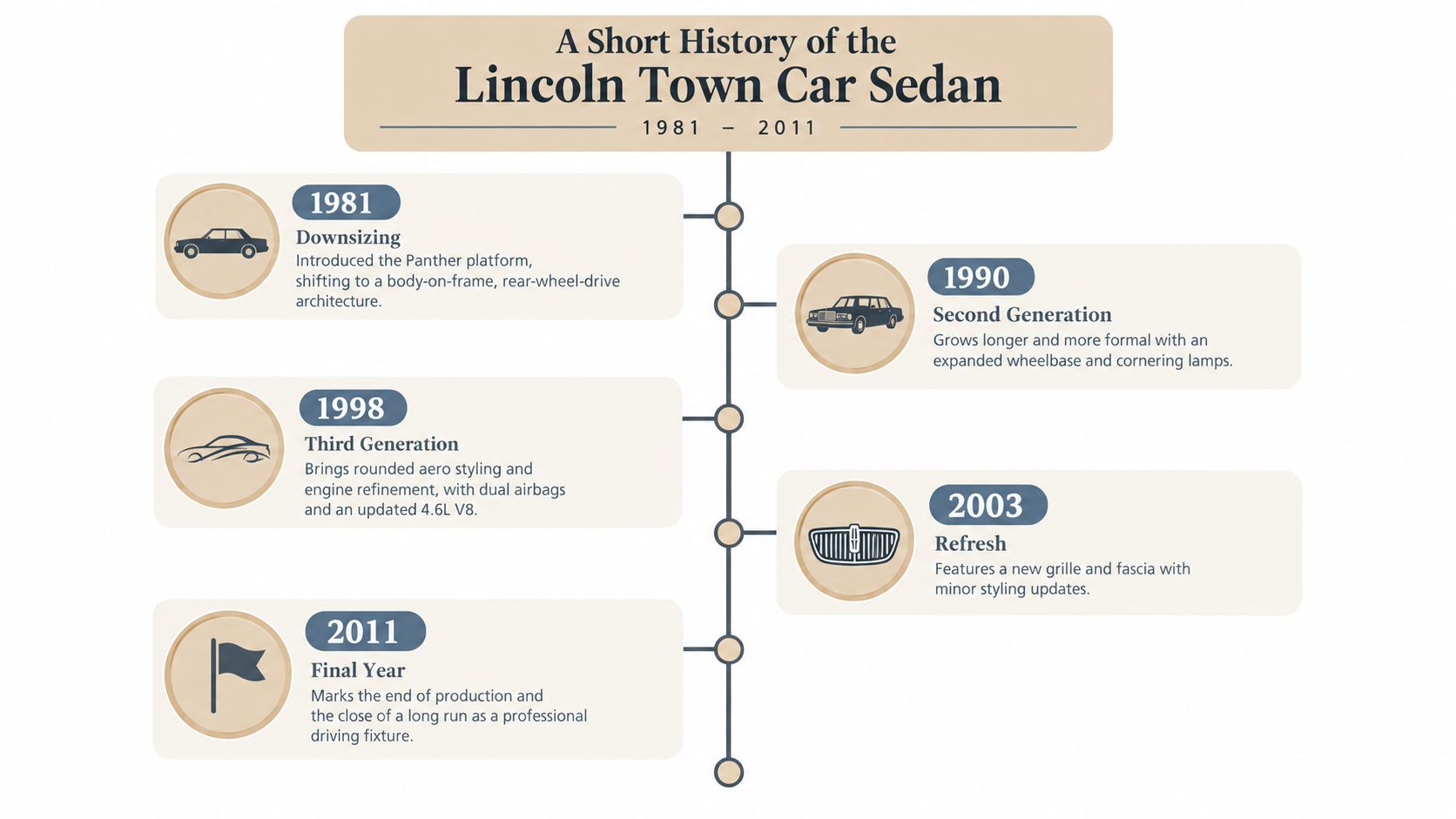
The Town Car's professional reputation started with a clear product decision. Lincoln made it a standalone model for the 1981 model year, after the name had previously identified a high-end trim associated with the Continental. It served as Lincoln's full-size, rear-wheel-drive luxury sedan while the Continental was downsized for 1982, giving the Town Car a distinct place in Ford's North American luxury lineup. (Lincoln Town Car history)
That formula appealed to fleets because it emphasized predictable comfort over novelty. A large body, V8 power, rear-wheel drive, and a conventional automatic transmission were easy to understand and well suited to repeated passenger service. The spacious cabin and comfort-oriented suspension also made the model a natural fit for professional chauffeured transportation.
Why fleets kept ordering it
Later Town Cars used Ford's Panther platform, a body-on-frame architecture related to the Ford Crown Victoria and Mercury Grand Marquis. That shared engineering family helped make the sedan familiar to technicians and parts suppliers, while the long wheelbase and rear-drive layout supported a dignified passenger compartment.
Trim names such as Cartier, Signature, and Signature Limited helped divide equipment and appearance levels, while the Executive L version extended rear passenger space with longer rear doors. Those distinctions mattered less to a dispatcher than the condition of the vehicle, but they gave operators ways to configure service for different types of clients.
The model continued through the 2011 model year, lasting approximately 30 model years across three generations. Lincoln discontinued it as consumer demand moved toward SUVs and the company chose not to substantially modernize the aging platform. That ending matters operationally. Fleets looking for a direct replacement had to choose a newer sedan with a different character, or move to an SUV for greater versatility.
The Town Car's significance isn't collector sentiment. It was a working vehicle that earned its reputation through repeated airport runs, event transfers, and long-distance passenger trips. Clean examples remain relevant because the basic service brief they answered hasn't disappeared, even though the original production line has.
Engine and Powertrain Details That Matter
The Town Car's mechanical appeal comes from an uncomplicated layout. The later sedan used a 4.6-liter V8, rear-wheel drive, and a traditional automatic transmission. For chauffeured work, that combination produces the qualities passengers notice most: smooth pull-away, relaxed cruising, and a drivetrain that doesn't constantly call attention to itself.
The available verified power figures vary by configuration and year. Cars.com information summarized in the model history lists 205 horsepower in base form, 220 horsepower for Cartier trim with dual exhausts, and as much as 235 horsepower by 2001. Those figures are useful context, but they aren't the main reason operators chose the car. A passenger generally values quiet progress and an even ride more than acceleration figures.
The 2008 Town Car used the 4.6-liter V8 with a four-speed automatic transmission, according to Edmunds' model information. Its standard traction control could limit wheelspin during acceleration, but electronic stability control wasn't available for that model year. (Edmunds 2008 Lincoln Town Car review)
Powertrain specifications
| Engine | Power | Torque | Transmission | Notes |
|---|---|---|---|---|
| 4.6-liter V8, base configuration | 205 horsepower | Not specified in the verified data | Traditional automatic transmission | Base output listed in the model history |
| 4.6-liter V8, Cartier with dual exhausts | 220 horsepower | Not specified in the verified data | Traditional automatic transmission | Higher-output configuration |
| 4.6-liter V8, later listed output | Up to 235 horsepower | Not specified in the verified data | Traditional automatic transmission | Output listed by 2001 |
The practical weakness is also clear. The powertrain is old-fashioned by current standards, and the car's size and soft suspension don't provide the crisp response of a newer luxury sedan. That isn't a defect during a calm airport transfer, but it can feel deliberate and slow when a passenger expects modern steering precision.
What inspection should focus on
A buyer or fleet manager should inspect the cooling system, intake manifold, electrical components, rubber parts, suspension, and body corrosion. Air suspension deserves particular attention where equipped, because an ignored fault can turn a comfortable ride into an expensive disruption.
RepairPal rates the model 4.0 out of 5.0 for reliability, estimates average annual repair costs at $635, and compares that with $976 for luxury full-size cars overall. It reports 0.2 unscheduled repair visits per year, with 12% of repairs classified as severe or major. These are model averages, not a guarantee for an individual sedan, so service records and an independent inspection still carry more weight than the odometer. (Town Car reliability and maintenance discussion)
How the Town Car Compares to Other Sedans in the Fleet
The Town Car isn't the right answer for every reservation, and comparing it with newer fleet vehicles works best when the question is specific. A passenger traveling alone or with a small party may value its formal cabin and familiar ride. A larger group may care more about seating, luggage volume, or the ability to keep everyone together.
The Mercedes S-Class addresses a different expectation. It offers a more contemporary luxury environment, a quieter ride, and premium leather, while its rear headroom can feel less generous than the Town Car's upright cabin. Choose it when the arrival itself is part of the occasion and the client expects current flagship-car appointments.
The Chevrolet Suburban is the practical choice for families, sports equipment, or airport groups carrying more luggage. Its higher seating position and larger cargo area solve capacity problems that a sedan can't. It may feel less formal than a Town Car, but it gives the dispatcher useful flexibility when bags and passengers compete for space.
The Mercedes Sprinter serves an entirely different operating brief. With conference-style seating and room for large parties, it fits corporate shuttles, wedding movements, and group itineraries. It isn't a replacement for a quiet executive sedan, just as the Town Car isn't a sensible substitute for a group vehicle.
| Vehicle | Passenger Capacity | Luggage Capacity | Best For |
|---|---|---|---|
| Lincoln Town Car sedan | Small private party | Generous sedan trunk | Solo executive travel and traditional black-car service |
| Mercedes S-Class | Small private party | Sedan luggage space | Statement arrivals and contemporary luxury |
| Chevrolet Suburban | Larger family or small group | Substantial cargo area | Airport groups and travelers with extensive luggage |
| Mercedes Sprinter | Large group | Group-transport cargo flexibility | Corporate shuttles and wedding parties |
Match the vehicle to the brief
For a single executive, the Town Car's value is its restraint. It doesn't compete for attention, and its cabin gives a passenger room to work, make calls, or sit in peace. For a formal arrival, the S-Class makes more sense when design, materials, and current luxury technology carry greater weight.
A Suburban works when the itinerary includes children, multiple bags, or changing passenger needs. A Sprinter works when coordination matters more than privacy. The useful comparison isn't “which car wins?” It's “what problem must the vehicle solve?”
Travelers considering the newer flagship option can review this Mercedes S-Class rental guide before selecting a vehicle. The answer should reflect the passenger count, luggage, occasion, and desired cabin character.
Best Use Cases for a Lincoln Town Car
The Town Car earns its place when one traveler or a small private party wants a professional chauffeur, privacy, and dependable scheduling. Its strongest use cases don't require dramatic performance. They require a calm cabin, a respectable arrival, and enough space to keep personal belongings out of the passenger compartment.
Airport transfers are the clearest example. A traveler leaving the Hamptons for JFK, LaGuardia, or MacArthur wants the pickup plan to be simple and the ride to remain comfortable through a long transfer. The Town Car's large cabin suits early departures, late returns, and executive travel when the passenger wants to prepare for a meeting rather than manage the road.
Corporate travel between Manhattan offices and Hamptons meetings also fits the sedan. Briefcases, garment bags, and a roll-aboard can usually be organized in the trunk, leaving the rear seat available for the passenger. That separation matters during a working trip because a passenger shouldn't have to balance luggage beside a laptop.
Where it performs well
- Airport transfers: The sedan provides a formal, private environment for planned terminal trips.
- Executive itineraries: The cabin supports quiet travel between offices, residences, hotels, and meetings.
- Hotel and dinner transportation: Its appearance suits restaurants, resorts, and evening venues without feeling excessive.
- Wine-country pickups: A private sedan works well for a small party moving between scheduled stops.
- Point-to-point evenings: The ride is comfortable for dinner, performances, and private events where the itinerary remains compact.
The Town Car is a poor fit when the reservation needs a wheelchair ramp, a large family vehicle, or group seating. It also shouldn't be assigned just because a client asks for “a limo” without confirming how many people and bags are involved. Vehicle selection is part of service quality.
The best sedan assignment is the one that leaves enough room for people, luggage, and the itinerary's actual demands.
For a traveler with a small party, the Town Car offers a distinctive balance. It feels more formal than a standard rideshare sedan, less oversized than a passenger van, and more traditional than many current luxury vehicles. That makes it especially useful when the journey matters more than making a technology statement.
Comfort and Cabin Features Travelers Notice
Passengers rarely remember a horsepower figure after an airport transfer. They remember whether they could enter without struggling, whether their coat had somewhere to go, whether the seat supported them, and whether the cabin stayed calm while the chauffeur handled traffic.
The Town Car's bench-style seating is central to that experience. It creates a broad, open rear area that feels less confining than the individual rear seats in some newer sedans. A passenger can spread out a coat or briefcase without immediately crowding a neighboring seat, although the arrangement doesn't provide the same sculpted support or separation found in a modern flagship sedan.
Evaluate the cabin in this order
- Entry and exit: Open the rear door fully and check whether the seat height feels natural at the curb. Older passengers often value this more than a low, dramatic roofline.
- Seat support: Sit in the rear seat for several minutes. Soft padding can feel comfortable at first but may not provide enough support on a longer trip.
- Cabin noise: Listen at cruising speed. A quiet ride reduces fatigue and makes conversation easier.
- Climate response: Confirm that the heating and air conditioning respond evenly. Temperature control matters more than decorative trim.
- Luggage separation: Place the expected bags in the trunk before accepting the reservation. Don't make the passenger discover a capacity problem at pickup.
The cabin's upright proportions and generous space are practical strengths, but newer sedans can offer better materials, more refined sound insulation, and more advanced passenger technology. The Town Car wins through room and familiarity, not through modern screens or cutting-edge seating design.
The same logic applies to the exterior. Wide-opening doors and a dignified profile help at hotels and event venues, while the substantial body demands careful positioning at tight curbs and crowded city approaches. A skilled chauffeur accounts for that before the passenger reaches the car.
Booking the Lincoln Town Car for Airport Transfers
A well-run airport transfer begins before pickup. The reservation records the passenger's name, pickup location, destination, contact method, luggage expectations, and flight information when an airport is involved. That information gives the dispatcher enough context to assign the sedan and prepare for a changed arrival time.
Flight tracking is especially useful for inbound service. If a flight lands earlier or later than planned, the dispatcher can adjust the pickup plan rather than sending the chauffeur to wait at the wrong time. The chauffeur receives the route and pickup instructions, positions near the appropriate terminal area, and contacts the client when the vehicle is ready.
The arrival sequence
At JFK, LaGuardia, or MacArthur, the exact meeting point depends on the terminal and the service arrangement. Some reservations use a curbside greeting, while others call for an agreed arrivals-area meeting point. The chauffeur confirms the location in advance so the client isn't left searching across a busy terminal.
Once contact is made, the chauffeur helps organize the luggage, confirms the destination, and checks that the passenger is settled before leaving. A sedan is best for a small party with ordinary travel bags. If the group has bulky equipment, numerous cases, or special mobility needs, the reservation should be reassigned to a vehicle designed for that requirement.
The ride back toward the Hamptons or Manhattan should be quiet and unhurried. The chauffeur handles routing and roadway conditions while the passenger rests, works, or makes connecting arrangements. For travelers arriving from overseas, a practical passport and Jamaica to JFK transfer guide can also help clarify the airport side of an international journey.
The same discipline applies to departures. Confirm the pickup address, terminal, flight details, and desired arrival window before the trip. A reservation specialist can then build the plan around the airport, traffic conditions, and the passenger's tolerance for waiting, rather than relying on a generic travel estimate.
A useful airport transfer quote guide helps travelers understand which details affect the quote and why complete information produces a more useful booking conversation.
The strongest airport service feels uneventful. The vehicle is where it should be, the luggage goes into the trunk, and the passenger can concentrate on the next destination instead of solving transportation problems at the curb.
How to Book a Lincoln Town Car with Hamptons Leisure Limo
Start with the trip, not the vehicle. Provide the pickup address, destination, date, passenger count, and any flight details. If the trip includes an airport, include the airline and flight information so the dispatch team can coordinate the pickup around the actual arrival or departure.
The Town Car is most appropriate for a small private party. If the reservation involves more people, extensive luggage, a wheelchair requiring a ramp, or a group itinerary, ask about an SUV, Sprinter, or another fleet option before confirming. Good booking practice prevents a comfortable sedan from becoming an undersized vehicle.
Information to provide
- Pickup and destination: Include the complete address, building name, entrance instructions, and any gate or access information.
- Travel date and timing: State whether the time is a pickup time, airport arrival target, event start, or hourly-service request.
- Flight details: Share the airport, airline, and flight number for airport transfers.
- Passenger count: Confirm how many people will ride in the sedan and whether anyone needs additional assistance.
- Luggage and special needs: Mention oversized cases, golf equipment, child seats, mobility concerns, or other details that affect vehicle selection.
- Contact preference: Give the best phone number for updates at pickup and during an airport arrival.
The service uses fixed pricing for applicable routes rather than changing the quote with demand. There are no surge fees, and travelers can request a quote for non-airport trips by text. Availability depends on the fleet schedule, so advance reservations are sensible for early flights, event transportation, and busy Hamptons travel periods.
| Specification | Detail |
|---|---|
| Service type | Pre-arranged black-car transportation |
| Vehicle fit | Lincoln Town Car sedan for a small private party |
| Airport planning | Flight details used to coordinate arrival or departure service |
| Pricing approach | Fixed pricing where applicable, with a quote for other itineraries |
| Booking information | Pickup, destination, date, passenger count, and trip-specific needs |
| Contact method | Text (631) 294-0747 for a quote |
| Vehicle decision | Confirm luggage, mobility, and group requirements before booking |
A reservation can begin through the online booking form or by phone. For a guaranteed assignment, provide complete information as early as practical, especially when the trip involves a morning airport departure, a wedding, a corporate meeting, or a return to the Hamptons after a long flight.
Don't choose the Town Car because it is nostalgic. Choose it when a small party needs a spacious, formal sedan with a calm ride and a straightforward service plan. If that describes your trip, text (631) 294-0747 for a quote, with no surge and fixed pricing where applicable.
Hamptons Leisure Limo provides pre-arranged airport transfers, executive transportation, and private trips between New York City, Long Island, and the Hamptons with experienced chauffeurs and vehicle matching based on your itinerary. Visit Hamptons Leisure Limo to request service, or text (631) 294-0747 for a quote.
Ready to Ride with Hamptons Leisure Limo?
Fixed pricing. No surge fees. 30 years of experience serving the Hamptons. Text us what you need and we will send a quote.