Limos for Prom: A Parent's Guide to Booking Safely
Updated October 3, 2026

You get the text thread on a Friday night: four families asking who's handling prom transportation, while three teens are comparing stretch limos they found through Instagram. Everyone wants the same thing, a stylish arrival, a simple pickup, and a ride home that doesn't create a second emergency for parents.
That decision belongs with the parents, not the group chat. Limos for prom are a contracted transportation service first and a style choice second. The right booking covers the vehicle, the chauffeur, the route, the rules, the communication plan, and the person responsible for making decisions if the evening changes.
Table of Contents
- Why Prom Limos Need a Parent-Led Plan
- Matching the Vehicle to Your Group
- Limo, SUV, Sprinter, or Coach for Prom
- Booking the Right Limo Company
- Supervision, Chauffeurs, and Ground Rules
- Itinerary, Communication, and Night-Of Plan
- Your Week-Before-Prom Checklist
Why Prom Limos Need a Parent-Led Plan
Prom transportation can look simple until you map the night. One teen lives across town, another has a photo stop at a waterfront property, and the venue has a strict arrival window. A third parent assumes the chauffeur will monitor the group inside the vehicle. By pickup time, nobody has the same itinerary, passenger list, or understanding of the rules.
That's how preventable problems begin. Parents may be dealing with an unvetted operator, an unclear pickup chain, an advertised vehicle capacity that doesn't match comfortable seating, or a contract that says nothing about route changes and conduct. A professional chauffeur can operate the vehicle safely, but that person isn't automatically a chaperone.
AAA's prom guidance identifies unsupervised alcohol or drug use as a major parental concern and makes an important distinction: the chauffeur's job is to drive, not chaperone. That distinction should shape the booking from the beginning.
Own the decisions before prom night
Parents should agree on the following before anyone pays a deposit:
- Passenger list: Record every teen's full name, plus-ones, pickup address, and emergency contact.
- Vehicle assignment: Match the actual group to a lawful, comfortable vehicle class instead of relying on a marketing photo.
- Route: Approve the pickup order, photo stop, venue, after-prom destination, and final drop-off.
- Conduct rules: Put expectations about alcohol, vaping, substances, seat belts, doors, windows, and property damage in writing.
- Supervision: Name the parent coordinator and decide who handles check-ins, early pickups, and rule violations.
School-related transportation guidance recommends standardized contracted transportation, documented restraints, certified drivers, and safeguards against one-on-one rides between a single adult and a student. Independent school activity-transport guidance also emphasizes passenger profiling and appropriate vehicle assignment, especially when age and size affect restraint requirements.
The order matters. First establish who is riding and where the group needs to go. Then select the vehicle. After that, vet the company, review the contract, and create the supervision plan. Parents who reverse that order often choose the stretch limo first and try to make the itinerary fit afterward.
Matching the Vehicle to Your Group
Start with a hard headcount. Include plus-ones, a teen joining only for the ride to dinner, and anyone who needs a return trip from a separate location. Do not count empty seats as usable capacity if the group has formalwear, bags, jackets, or a parent riding along.
Ask the practical questions first
A group of eight teens heading to a waterfront venue may need room for a longer pickup route, photo equipment, and coats. The vehicle also needs to reach the venue's drop-off area without creating a difficult turn or extended walk. A group of four going directly to a hotel ballroom has a different problem. A premium SUV or smaller stretch sedan may offer easier curb access and clearer communication than a large vehicle.
Advertised maximum capacity isn't the same as a sensible prom assignment. A six-passenger sedan stretch can be a better fit for a smaller group than a twenty-passenger super-stretch. Smaller vehicles usually make it easier to see who is entering, keep bags organized, and communicate with the chauffeur at stops. Oversized vehicles can create extra empty space, split seating, and more opportunities for passengers to become difficult to account for.
Venue rules matter, too. Ask whether the school has a designated loading area, whether the venue restricts large vehicles, and whether the group needs to arrive by a fixed curfew. A complicated neighborhood with multiple narrow streets may favor a smaller SUV. A larger group with one central pickup and a long itinerary may justify a Sprinter or coach.
Practical rule: Choose the smallest vehicle that gives every passenger a proper seat, reasonable comfort, and a clear plan for bags and supervision.
Group size to vehicle class at a glance
| Group Size | Best Vehicle Class | Watch-Outs |
|---|---|---|
| 1 to 3 | Premium sedan | Confirm luggage space and whether a parent will ride |
| 4 to 6 | SUV or smaller stretch sedan | Check formalwear, bags, and ease of curbside pickup |
| 7 to 10 | Sprinter or appropriately sized stretch vehicle | Confirm the exact seating layout, not only the maximum |
| 11 to 14 | Sprinter or executive van | Verify passenger count, seat belts, and adult assignment |
| 15 or more | Minibus or coach | Coordinate loading, route timing, and multiple adult contacts |
Before calling a company, write down three answers: How many passengers are riding? Where is the most complicated pickup? What needs to happen after the venue? If the group size, route, and supervision plan don't fit comfortably in one vehicle, split the booking rather than forcing everyone into an oversized or overloaded option.
Limo, SUV, Sprinter, or Coach for Prom
There isn't one universally correct prom vehicle. Capacity, comfort, oversight, and pricing are separate decisions, and parents should score each one instead of treating a dramatic exterior as proof that the vehicle fits the night.
A traditional stretch limo wins on arrival style and the photo moment. It can also create practical friction. Tight doorways make formalwear awkward, luggage space is limited, and split seating makes adult conversations harder. If the group wants a stretch, inspect the interior and ask how the seats are arranged before assuming everyone will sit together.
An SUV has a lower profile and usually makes neighborhood pickups easier. It works well for a smaller group, but it offers less of a group photo moment and less room for elaborate luggage or multiple stops. The lower-key appearance can be an advantage when parents want a straightforward transfer rather than a party atmosphere.
A Sprinter or executive van often gives parents the strongest practical combination. Depending on the configuration, the group may have better movement, USB outlets, more usable storage, and easier access for an adult coordinator. The extra space can improve comfort, but only if the operator confirms the actual seat count and restraint setup.
A minibus or coach makes sense for a larger group, a multi-stop itinerary, or a longer ride where keeping everyone together is more important than having a limousine interior. A coach can be efficient for transportation, but its size may reduce visibility and make direct communication with passengers harder. Parents need a clear adult assignment and loading procedure.
For a typical group of six to ten, I generally recommend an appropriately sized SUV, stretch vehicle, or Sprinter based on the route. The best balance usually comes from enough space to avoid crowding without creating a vehicle so large that passengers, bags, and supervision become difficult to manage. For a useful explanation of larger luxury vehicles, see what a limo bus is and how it differs from a traditional limousine.
Whatever the vehicle class, don't accept “up to” capacity as the final answer. Ask for the assigned vehicle, its seating layout, the available storage, and the way passengers will enter and exit at each stop.
Booking the Right Limo Company
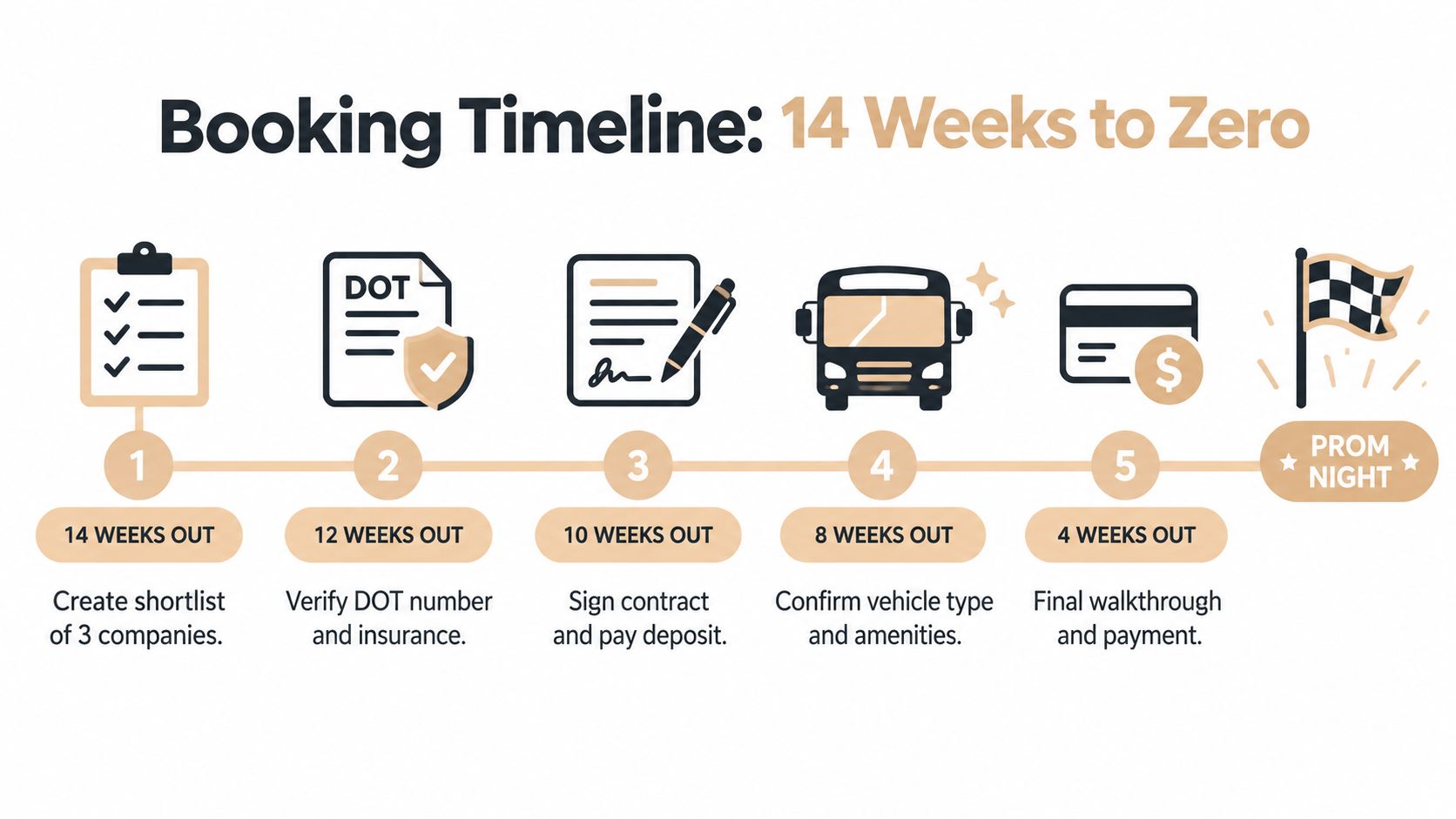
Start the search twelve to fourteen weeks before prom night. Peak dates fill quickly, but early booking isn't valuable unless it gives you time to verify the operator and read the contract. Build a shortlist of companies that can explain their licensing, insurance, vehicle assignment, and safety process without evasive answers.
Build and verify the shortlist
Check the company's DOT or applicable PUC licensing, commercial insurance, hired-auto coverage, and verifiable local address. Ask whether the specific vehicle is covered under the policy and whether the company can provide documentation before the deposit is paid. California PTA guidance warns families that some limousine, charter bus, and van services may involve no insurance coverage or unlicensed chauffeurs, and it also highlights the importance of accessible transportation for students with mobility disabilities when a PTA arranges an event. Review the California PTA prom and graduation transportation guidance as a useful parent checklist, even when your event is elsewhere.
During the inquiry call, ask direct questions:
- Who is the assigned chauffeur, and when will that information be confirmed?
- What is the vehicle's age and last inspection date?
- What are the cancellation and weather policies?
- Are gratuities included, or are they handled separately?
- What happens if the assigned vehicle becomes unavailable?
- How are route changes approved during the evening?
Ask for an in-person or video walk-around of the exact vehicle. A stock photo proves nothing about the vehicle arriving at your curb. Look at the door openings, seating arrangement, seat belts, interior condition, lighting, and storage. The Ohio commercial-carrier guidance emphasizes annual inspections, driver credential review, route familiarization, and vehicle-capacity controls, particularly for larger passenger vehicles. Use the Ohio school transportation carrier guidance to frame the questions you ask an operator.
Read every line before paying
The contract should identify the service date, pickup and drop-off locations, vehicle class, assigned capacity, service window, cancellation terms, weather policy, payment schedule, and deposit conditions. Look specifically for hourly minimums, fuel surcharges, overtime rates, cleaning charges, and fees for route changes. If the company promises fixed pricing, get that promise in writing. You can also review how fixed-price limo service works before comparing proposals.
Before the deposit clears, you should have the contract, insurance information, vehicle description, payment schedule, cancellation terms, emergency contact process, and expected chauffeur details in writing. Parents evaluating a provider for a sensitive event can also consult this guide to selecting secure transport for sensitive events, particularly for its focus on documented credentials and operational transparency.
Supervision, Chauffeurs, and Ground Rules
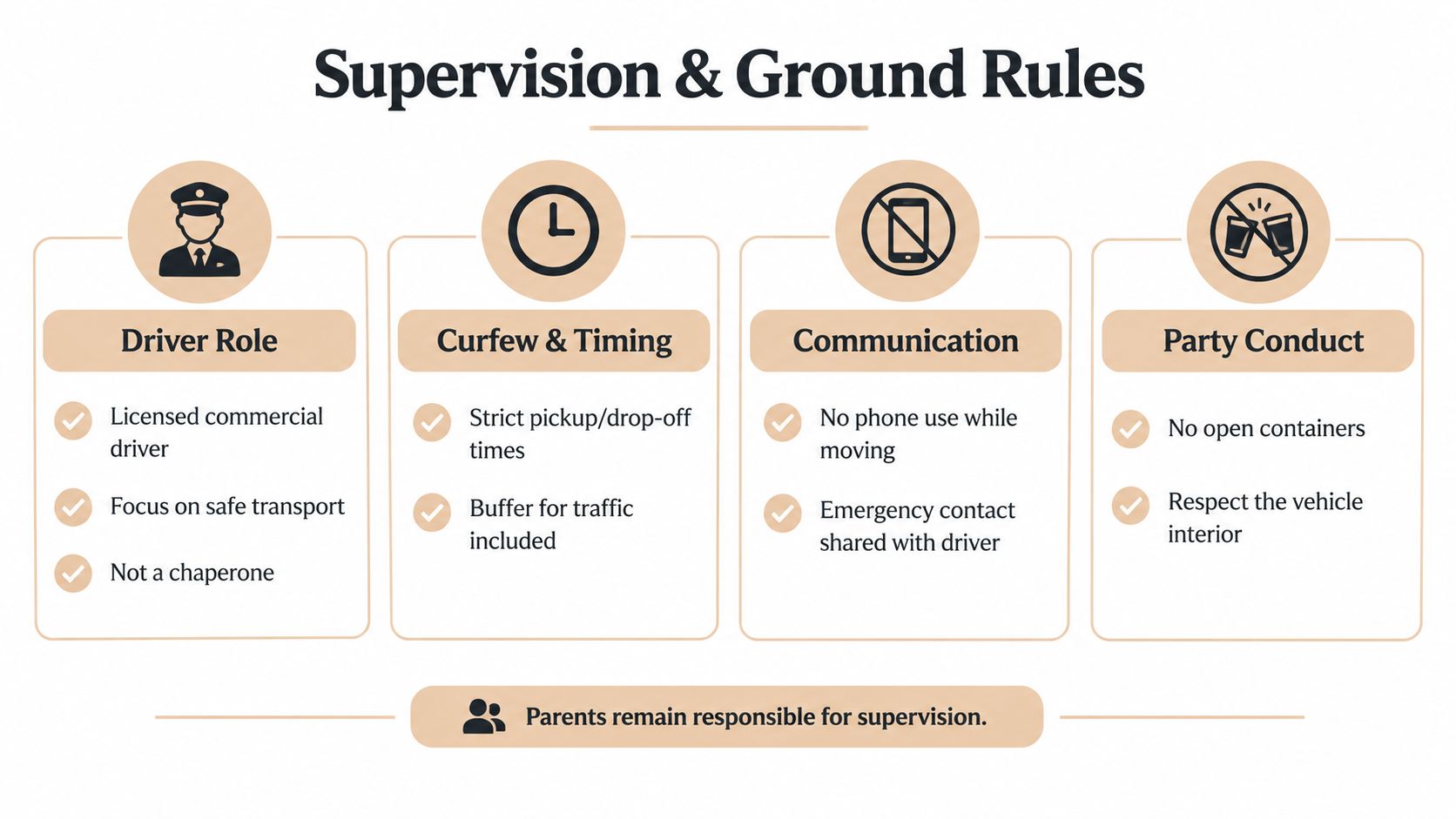
The most common prom-planning mistake is assuming the chauffeur is also the chaperone. That person is a licensed transportation professional whose primary responsibility is operating the vehicle and getting the group safely between approved locations. A chauffeur isn't an onboard monitor, rule enforcer, or substitute parent.
A company is responsible for providing the agreed vehicle, a qualified chauffeur, safe operation, and communication about service problems. Parents remain responsible for deciding who may ride, setting conduct expectations, assigning supervision, and responding if a teen needs to leave early. A professional chauffeur service can support the transportation plan, but it doesn't remove the parents' role.
Put the rules in writing
Use the service contract or a separate behavior agreement. It should address:
- No alcohol or controlled substances: State the rule clearly, including what happens if a passenger brings them into the vehicle.
- No vaping: Include cigarettes, vaping devices, and any other prohibited smoke or vapor products.
- Doors and windows: Decide whether doors remain open or closed and whether a parent holds a key or controls access. Specify when windows must stay closed.
- Seat belts: Require every passenger to use the available restraint whenever the vehicle is moving.
- Route approval: The chauffeur follows the written itinerary and accepts changes only through the designated parent coordinator.
- Vehicle respect: Prohibit spills, damage, standing while moving, and unsafe behavior.
- End-of-service authority: Give the chauffeur and company the right to end the trip for cause if passengers create a safety risk.
Parents should ask whether chauffeurs undergo background checks, whether the vehicle has an in-vehicle camera, and what the camera records, who can access it, and how long footage is retained. Don't accept vague language such as “monitored for safety” without asking for the actual policy. Confirm that the designated parent can contact the chauffeur or dispatcher throughout the evening without asking teens to manage the entire communication chain.
The contract should explain what happens when a passenger breaks the rules. A zero-tolerance statement without an enforcement process is only decoration.
School transportation guidance also supports pre-trip passenger profiling, restraint checks, adult assignments, and eliminating pressure to carry overflow passengers. The strongest plan identifies the adult contacts before pickup, not after a problem appears.
Itinerary, Communication, and Night-Of Plan
A prom itinerary should fit on one page and answer the question, “Where is this group supposed to be right now?” Write it before the final confirmation call, then share the same version with every parent involved.
Use this template:
- Passenger list: Full name, mobile number, emergency contact, and parent or guardian.
- Primary pickup: Address, pickup window, and loading instructions.
- Photo stop: Address, arrival time, departure time, and approved waiting location.
- Prom venue: Full address, required arrival time, school or venue contact.
- After-prom destination: Address and approval status, if applicable.
- Final drop-off: Address, authorized adult, and latest expected arrival.
- Parent coordinator: One name and one phone line that stays open throughout the night.
- Chauffeur details: Name, direct number, vehicle description, and license plate.
Many parent safety guides recommend a written itinerary covering pickup addresses, photo stops, the venue, approved after-prom destinations, and final drop-off plans. This prom transportation safety guide is useful for checking that your route plan includes the details families often forget.
Create one group chat with the designated parent coordinator and the chauffeur or dispatcher, if the company supports it. Route changes should go through one decision-maker. Teens can share updates, but they shouldn't be responsible for approving a new destination or reorganizing the pickup order.
Prom night itinerary and communication plan
| Time | Location | Passengers | Parent Contact | Notes |
|---|---|---|---|---|
| ______ | Primary pickup, ______ | ______ | ______ | Confirm headcount and bags |
| ______ | Photo stop, ______ | ______ | ______ | Approved waiting location |
| ______ | Prom venue, ______ | ______ | ______ | Required arrival time |
| ______ | After-prom destination, ______ | ______ | ______ | Parent-approved route |
| ______ | Final drop-off, ______ | ______ | ______ | Authorized adult present |
Thirty minutes before pickup, confirm the vehicle description and plate number by text. Share the chauffeur's direct number with the parent coordinator, log the chauffeur's name and plate, and set check-in intervals that make sense for the itinerary.
If weather changes, the vehicle has a mechanical issue, or a teen needs to leave early, use the contingency plan. The parent coordinator contacts the company, confirms the new location, and tells the authorized adult receiving the passenger. No teen should independently redirect the vehicle to an unapproved destination.
Your Week-Before-Prom Checklist
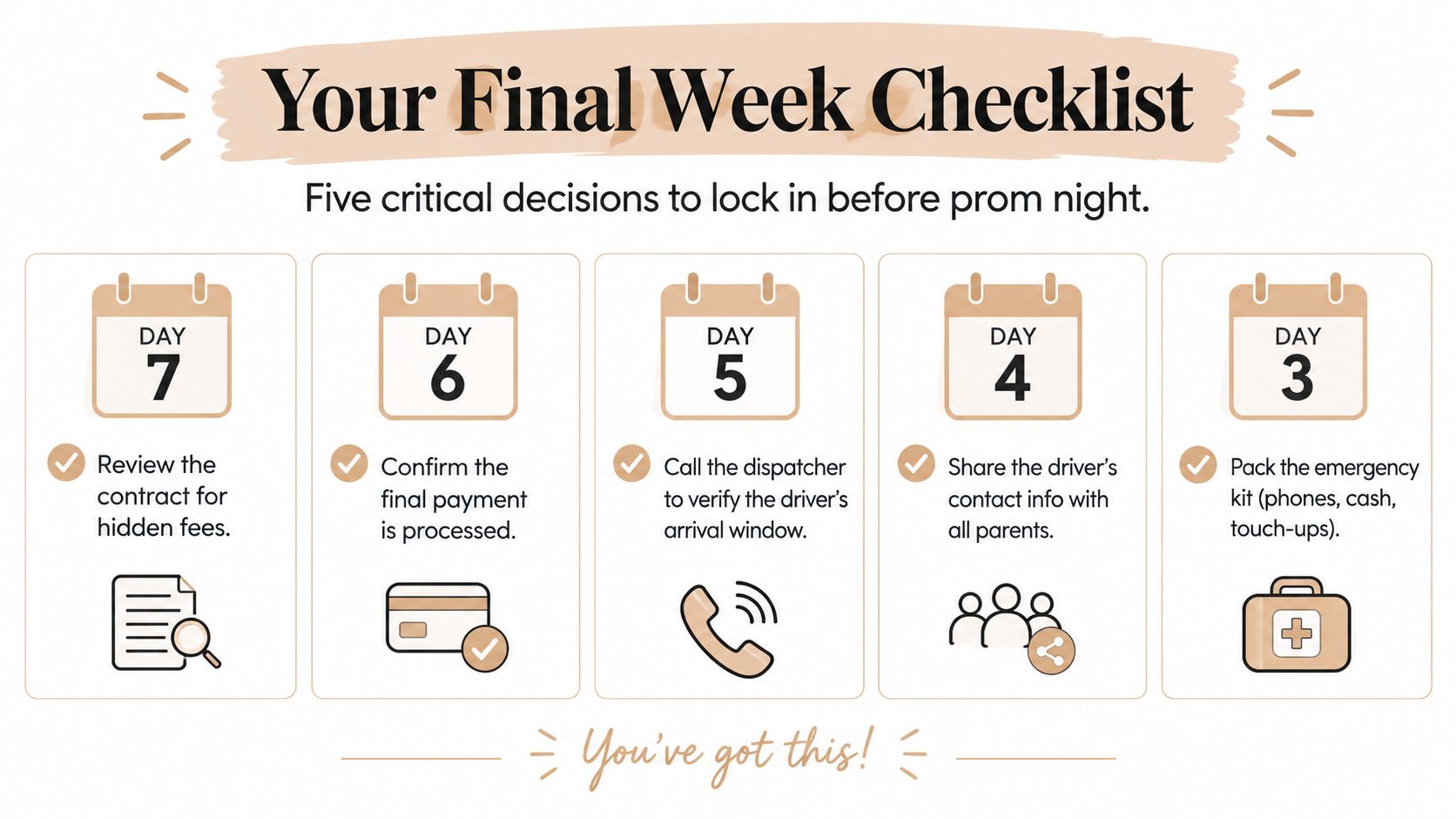
The final week isn't for redesigning the night. It's for locking down five decisions that prevent confusion at pickup: the headcount, the vehicle, the written times, the chauffeur credentials, and the communication chain.
Five decisions to lock in
Confirm the headcount and vehicle match. Recount every passenger, including plus-ones, and compare the final list with the contracted vehicle class. Remove overflow pressure rather than asking the chauffeur to make an unsafe exception.
Reconfirm pickup and drop-off times in writing. Send the final itinerary to the company and every parent coordinator. Make sure the photo stop, venue arrival, after-prom plan, and final drop-off are all included.
Review credentials and insurance again. Confirm the assigned chauffeur, vehicle, commercial authority, inspection status, and insurance documentation. If the company changed the vehicle, inspect the replacement information before prom night.
Finalize ground rules and supervision. Share the behavior agreement with the teens and parents. Name the adults responsible for check-ins and early pickups, because the chauffeur won't be the group's chaperone.
Set the communication protocol. Confirm the dispatcher number, chauffeur contact, group chat, plate number, check-in times, and emergency process. Keep one parent phone line available all night.
The limo is logistics, not a status symbol. A memorable entrance is fine, but the real deliverable is a properly matched vehicle, a qualified chauffeur, a documented itinerary, clear parent supervision, and every passenger getting home safely. NHTSA's prom-season driving guidance also reminds teens to avoid alcohol and arrange a sober driver or safe alternative before the night begins.
Hamptons Leisure Limo provides pre-arranged prom transportation across the Hamptons with vehicle options sized for smaller groups and larger teen parties, plus coordinated communication for parents. Text (631) 294-0747 for a fixed-pricing, no-surge quote, then visit Hamptons Leisure Limo to review the service and plan the ride.
Ready to Ride with Hamptons Leisure Limo?
Fixed pricing. No surge fees. 30 years of experience serving the Hamptons. Text us what you need and we will send a quote.