Large Group Transportation: Vans, Minibuses or Coach
Updated October 23, 2026

It's a familiar Hamptons event-day problem: guests are arriving from New York, the ceremony is approaching, and the group is split across separate cars. One flight is late, bags are taking longer than expected, and no one knows who can adjust the pickup plan. The vehicle choice matters, but coordination is what keeps a large group moving together.
For large group transportation, start with luggage, timing, and accountability, not the biggest vehicle on the list. A coach can be the right answer for a full wedding shuttle, but it's overkill for a small party making a short local trip. Several SUVs can work for VIP arrivals, yet they can scatter guests and complicate a tight schedule if no one is coordinating the fleet.
Table of Contents
- Why Large Group Transportation Gets Complicated
- Comparing the Four Vehicle Tiers for Group Moves
- Cost Per Person and the Hidden Logistics Costs
- Coordinating Multi-Vehicle Moves and Consolidated Billing
- Matching Vehicles to Weddings, Corporate Events and Airport Runs
- When a Bigger Coach Is Not the Better Answer
- Choosing Your Group Transportation and Booking the Next Step
Why Large Group Transportation Gets Complicated
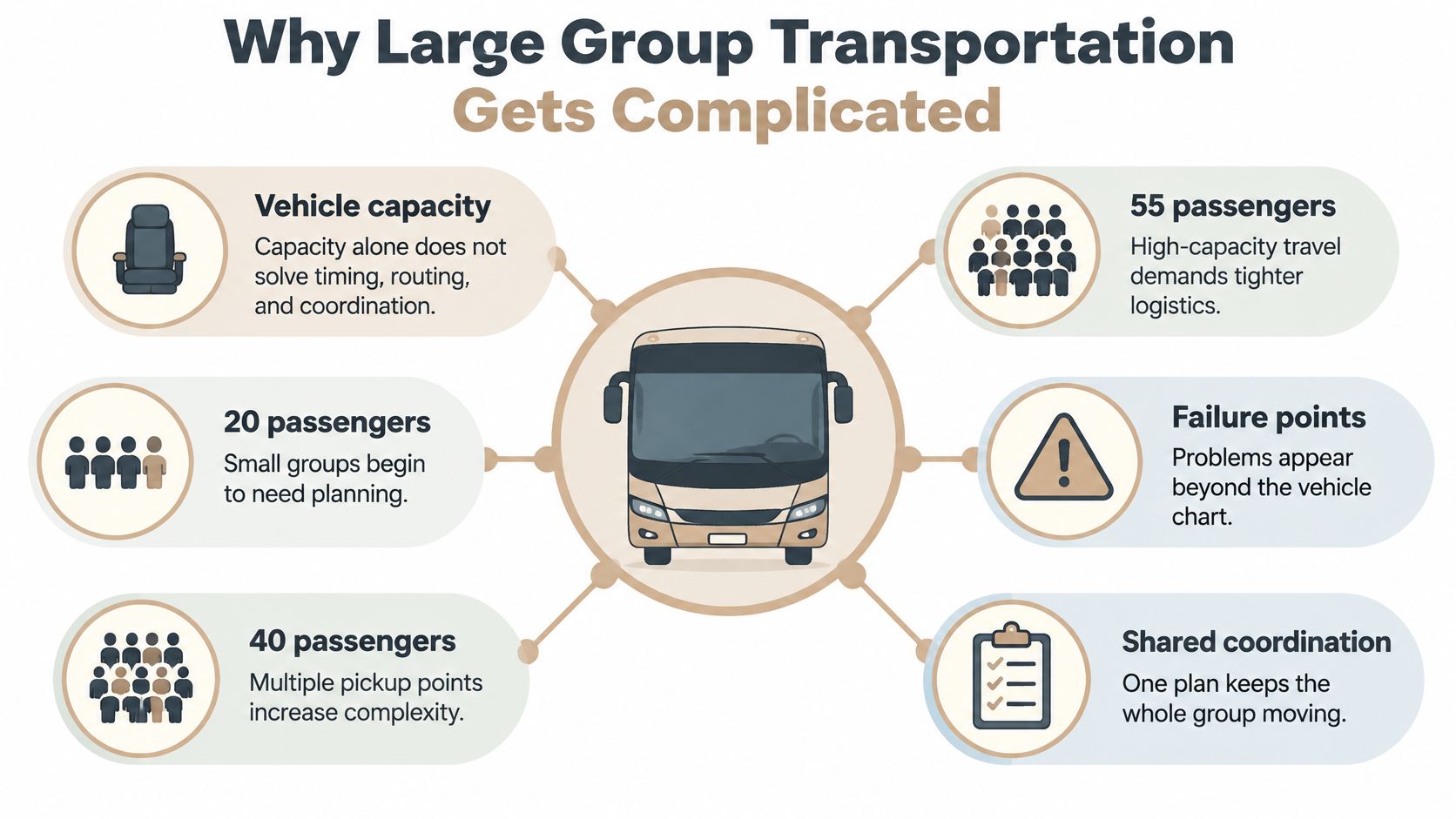
Moving four people is straightforward. Moving 20, 40, or 55 means managing pickup points, arrival windows, luggage, vehicle staging, and a clear point of contact. Those details can become the source of delays even when every vehicle has enough seats.
Consider a wedding weekend with guests staying at different hotels. If each party books a separate ride, one vehicle may arrive early, another may be held up, and a late flight can leave the group unsure who is adjusting the pickup. Separate bookings also mean separate receipts and no single person responsible for the whole movement.
Capacity is only the starting point
The practical options range from premium SUVs and Sprinter vans to 25- and 36-passenger minibuses and a 55-passenger coach. Each tier solves a different problem. SUVs give a small group privacy and flexibility; a Sprinter can keep a mid-size party together; minibuses suit many event shuttles; and a full coach is built for high-volume movement.
But nominal capacity isn't usable capacity. Luggage, child seats, mobility devices, and formal clothing can change how many passengers fit comfortably. A vehicle that appears suitable by seat count may be wrong once the group's bags and accessibility needs are included.
Coordination determines whether the plan holds
Multiple vehicles aren't automatically a problem. Multiple unconnected plans are. A shared manifest, coordinated dispatch, and a named contact give the group one way to handle flight changes, ceremony delays, and shifts in pickup timing.
The wider industry context reflects how established this kind of service is. In 2024, North American motorcoach companies operated 48,667 coaches and delivered approximately 40 billion passenger-miles, according to the 2024 motorcoach census. The point for event planners isn't to choose a coach by default. It's to match the vehicle tier and coordination model to the itinerary, so the group arrives together without unnecessary vehicles or avoidable confusion.
Comparing the Four Vehicle Tiers for Group Moves
A useful comparison starts with what the group needs to carry, not just how many people need seats. These capacities are nominal. Bags, child seats, mobility devices, and the comfort expected on a longer ride all affect the number of passengers a vehicle can realistically serve.
| Vehicle Tier | Nominal Capacity | Best Fit | Primary Limitation |
|---|---|---|---|
| Premium SUV | Up to 6 passengers | VIP parties, small groups, contingency coverage | Limited luggage and passenger capacity |
| Mercedes-Benz Sprinter van | Up to 14 passengers | Airport transfers, mid-size groups, wine tours | Bags can reduce usable capacity |
| Mini-bus | 25 or 36 passengers | Weddings, corporate offsites, group shuttles | May be more vehicle than a smaller party needs |
| Full-size coach | 55 passengers | Large event shuttles and longer group trips | Poor fit if occupancy is low or routing is fragmented |
A Chevrolet Suburban or Cadillac Escalade can be a sensible choice for a small VIP party or a contingency vehicle. It stops being efficient when a group needs several SUVs, each with separate arrival timing and luggage constraints. Multiple cars mean more curbside arrivals and more chauffeur coordination.
The Mercedes-Benz Sprinter van, with capacity for up to 14 passengers, is often the practical middle ground for airport runs and mid-size groups. It keeps more of the party together without requiring a full coach. Still, don't treat the seat count as a luggage guarantee. Ask the provider to account for actual bag dimensions and any special equipment.
When a minibus or coach makes sense
A 25- or 36-passenger minibus bridges the gap for wedding guests and corporate teams who need a shared ride but don't fill a coach. It can simplify transfers between hotels and a venue while avoiding a procession of smaller vehicles.
At nominal capacity, a 55-passenger coach can replace roughly nine six-passenger SUVs or four 14-passenger vans, as described in the Bureau of Transportation Statistics' motorcoach profile. That's a substantial difference in vehicle count, but it doesn't make a coach the right answer for every itinerary. If the party is much smaller, stops are spread out, or passengers need different drop-offs, a smaller vehicle plan may work better.
Planning rule: Confirm passengers, bags, and mobility requirements together. A headcount alone isn't a vehicle specification.
Cost Per Person and the Hidden Logistics Costs
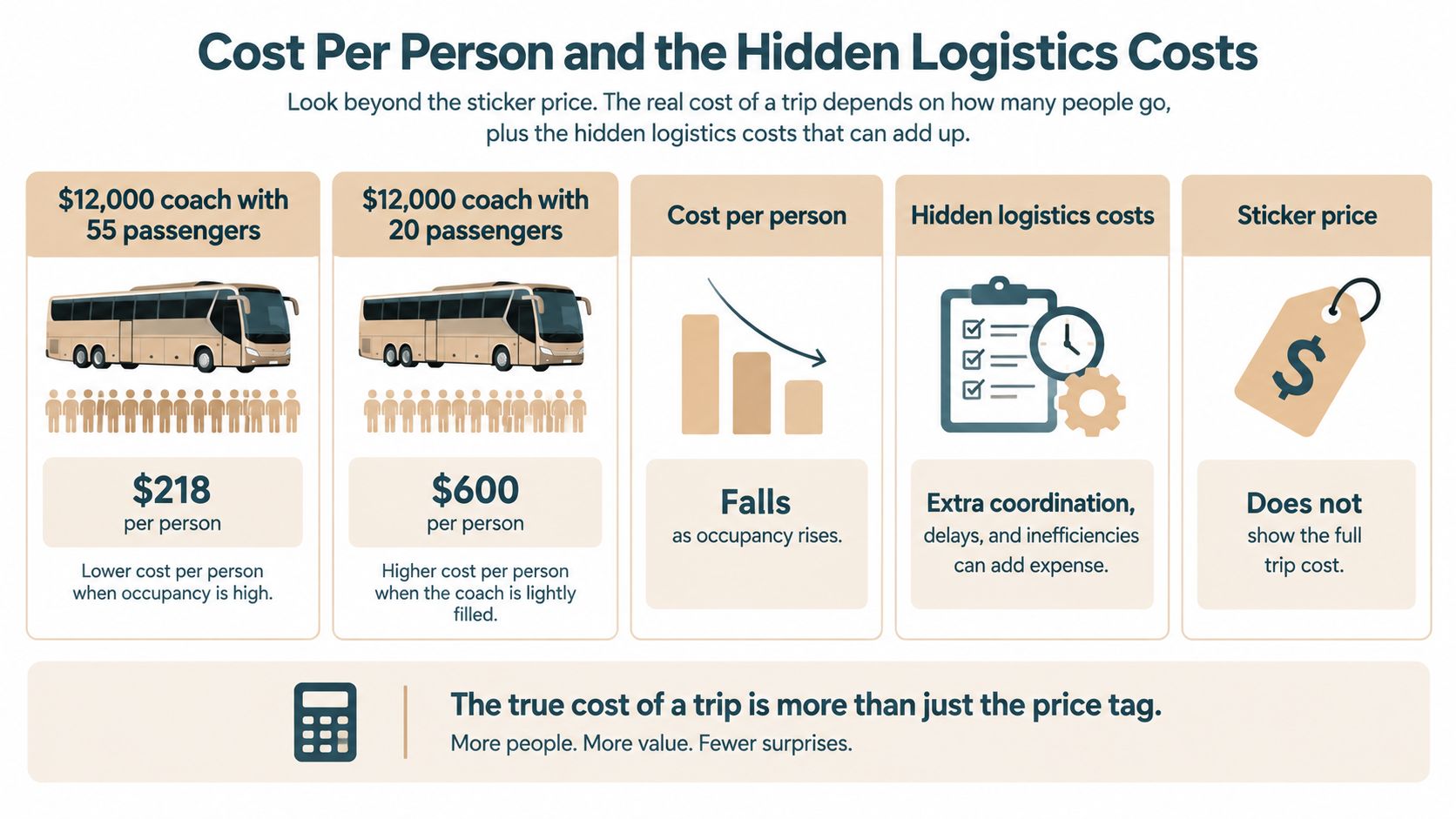
A vehicle quote doesn't tell you the full cost of moving a group. The useful comparison is the total trip cost divided by the confirmed passenger count, with the operational burden of multiple vehicles considered alongside it.
Occupancy changes the result. A well-filled Sprinter can make more sense per person than a lightly occupied coach, even though the coach has more seats. Conversely, a full coach can consolidate a group that would otherwise require several separate vehicles and chauffeurs.
Compare the complete operating plan
When requesting options, look beyond the vehicle line. Ask how many chauffeurs the plan requires, whether vehicles must travel empty to reposition, where they can stage, and whether venue parking or access arrangements affect the itinerary. Several vehicles can also create extra planning work if different people must reconcile separate bookings and receipts.
The Hamptons has distinct peak periods, and relying on on-demand rides can leave a group exposed to availability and changing quotes. A pre-arranged provider offering fixed pricing with no surge lets a planner compare a confirmed itinerary against other options without treating a live estimate as a settled plan.
For a wedding, comparing transportation options alongside the rest of the event budget can help keep the decision grounded. This guide to wedding transportation costs is one place to consider the planning factors before requesting a vehicle quote.
The broader economic role is significant, though it shouldn't be mistaken for a price guide. A 2024 analysis reported by Metro Magazine estimated that motorcoach group travel generated approximately $89.7 billion in total U.S. economic impact. That figure includes wider effects beyond passenger fares. For your trip, the relevant question remains simpler: which itinerary moves the confirmed group reliably, without paying for unused seats or multiplying coordination work?
Coordinating Multi-Vehicle Moves and Consolidated Billing
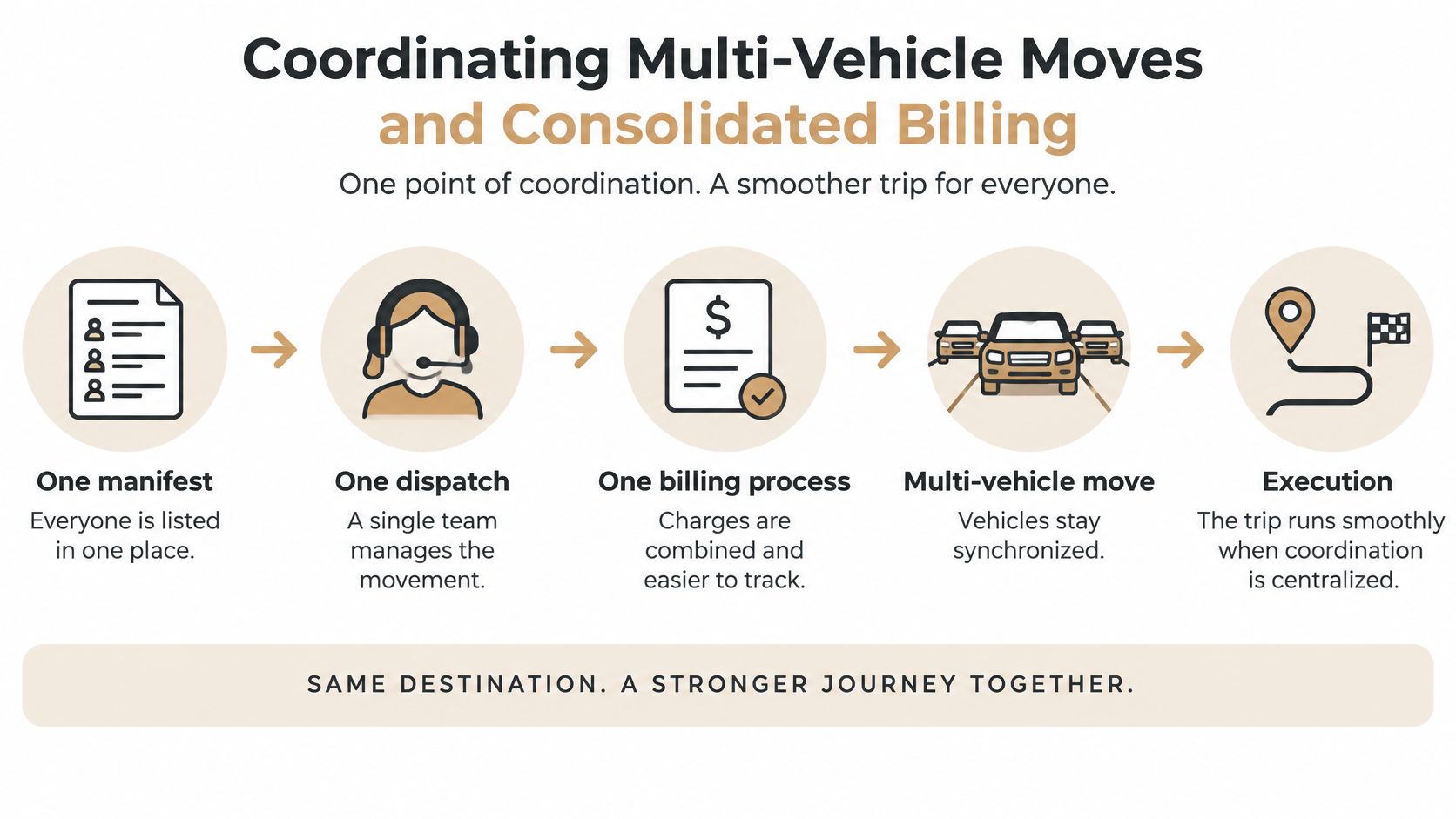
A multi-vehicle itinerary needs one plan. Without one, guests can receive different pickup instructions, vehicles can arrive out of sequence, and nobody may know who can approve a schedule change. A named coordinator should own the manifest, dispatch plan, venue instructions, and billing process.
Build the day around a shared plan
Start with one manifest listing passengers, pickup locations, destinations, and any relevant assistance or luggage needs. Set pickup windows that reflect how the group boards, and give chauffeurs clear venue entrances and staging instructions. A single dispatch contact should be able to communicate updates to the vehicles rather than asking guests to pass messages from car to car.
For charter buses operating in New York City, route slips must identify the origin and destination and list the streets planned between them, as set out in the NYC Department of Transportation's charter-bus guidance. Get exact pickup and drop-off details to the transportation coordinator early enough to plan routes and loading areas. That matters especially when several vehicles serve one event, because vague venue instructions can turn into curbside congestion.
Protect the schedule and close out cleanly
Chauffeur availability is also a scheduling constraint. Federal rules for passenger-carrying commercial motor vehicles limit driving to 10 hours after at least 8 consecutive hours off duty and limit on-duty time to 15 hours; weekly limits also apply, according to the FMCSA safety planner. A ceremony running late can't be handled just by extending a chauffeur's shift. The itinerary may need a qualified replacement or a revised plan that stays within the rules.
Consolidated billing makes the closeout easier. Instead of asking a wedding party or corporate team to gather separate ride receipts, use one agreed process that keeps the movement and its charges together. For company outings, a corporate event transportation plan can be built around arrival windows, venues, and the person responsible for communicating changes.
When several vehicles serve one group, one person should own the plan and be reachable when the plan changes.
Matching Vehicles to Weddings, Corporate Events and Airport Runs
The same group size can call for different vehicles depending on why people are traveling. A wedding shuttle, an executive arrival, and an airport pickup each put different demands on the itinerary.
Weddings and corporate events
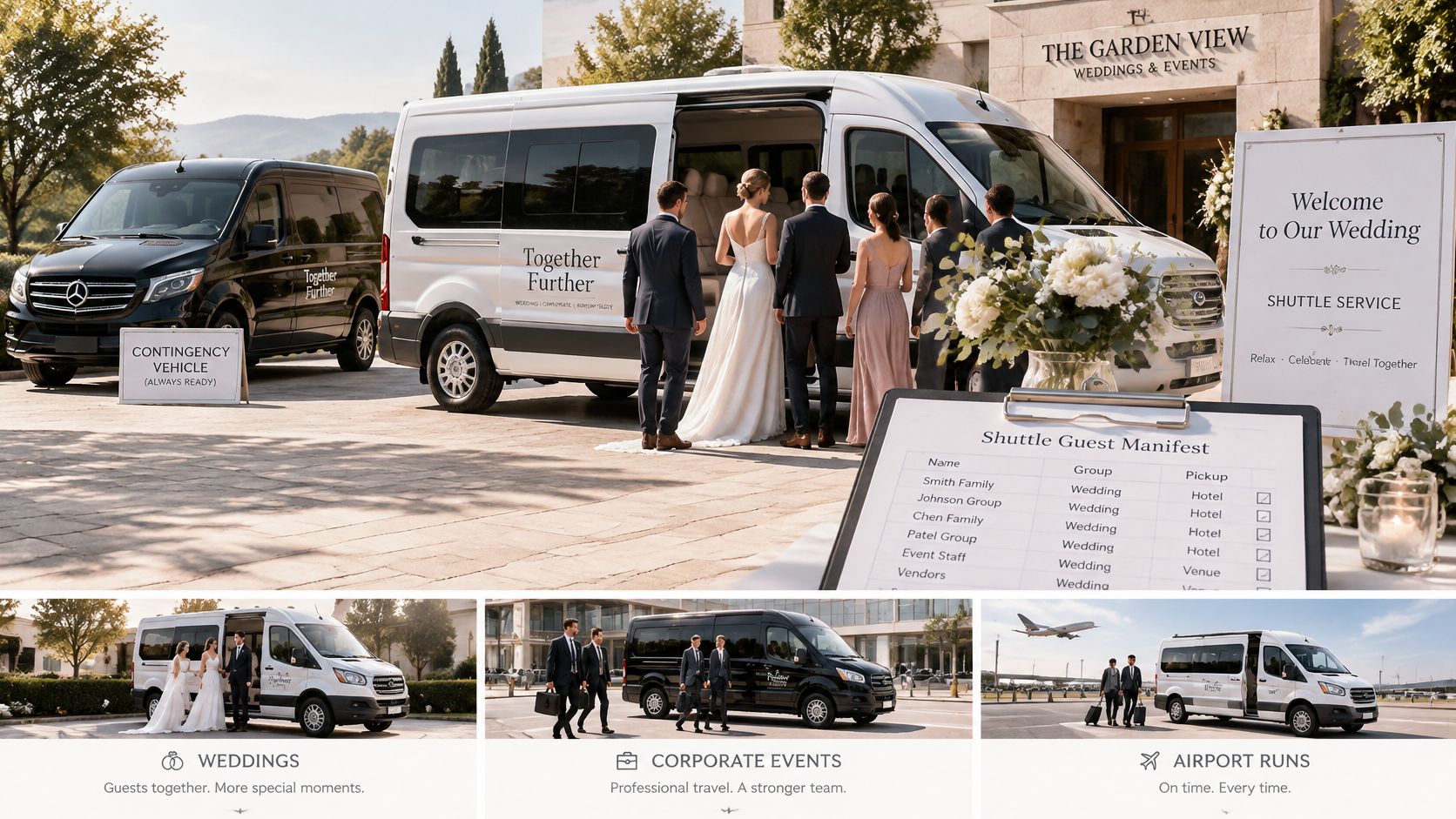
For a wedding, don't rely on one vehicle with no backup plan if guests have to move in waves or the schedule may shift. Choose a primary vehicle tier based on the passenger count and bags, identify a contingency option, and keep everyone on the same manifest. If guests are staying at more than one location, coordinate pickup points and departure windows instead of letting each party improvise.
A corporate offsite often needs a different balance. Executives may need a private ride while the wider team travels together, and the travel manager needs a clear record of the overall arrangement. Choose vehicles around the arrival window, privacy requirements, and meeting schedule. The decision should keep the executive and group movements coordinated without forcing everyone into the same vehicle.
Airport, school, and prom movements
For airport transfers, luggage is often the limiting factor. Confirm passenger numbers and bag dimensions before selecting a Sprinter, minibus, or coach. Flight tracking and a clear pickup location help the coordinator adapt when arrival timing changes. For additional planning considerations, see this guide to large-group airport transportation.
School and prom transportation calls for clear supervision and communication, not just seat capacity. Parents or organizers should know who is coordinating, where the group boards, and how updates will reach guardians. For older adults or anyone with mobility needs, discuss boarding assistance and the complete journey in advance.
For a visual example of group movements across events and airport runs, watch this overview before planning your own itinerary.
When a Bigger Coach Is Not the Better Answer
A larger vehicle isn't automatically the best or greenest choice. What matters is how many passengers it carries, how far it travels, whether it runs empty, and how the route compares with the alternatives.
The U.S. Department of Transportation reports average intercity-bus emissions of approximately 0.15 lb CO₂ per passenger-mile, compared with 0.47 lb for personal vehicles. Its analysis also states that a 300-mile motorcoach trip can produce more than five times fewer CO₂ emissions than equivalent single-occupancy driving. These comparisons come from the U.S. DOT intercity-bus analysis.pdf), and they illustrate why occupancy matters. A lightly filled vehicle doesn't spread its operating impact across as many passengers.
Compare scenarios, not vehicle labels
Ask how one full coach compares with several vans for the actual group and itinerary. Then compare a shared hotel loop with separate hotel pickups, a direct route with repeated stops, and a planned return trip with an empty leg. The answer can change when extra detours add distance and time for passengers who don't need those stops.
A coach may be the sensible choice for a concentrated shuttle between a hotel block and a venue. It may be the wrong choice when a smaller party is scattered across distant pickup points or needs separate drop-offs. In that case, splitting passengers into smaller vehicles can reduce unnecessary detours, even if it means dispatching more than one vehicle.
Ask the provider: How are you sizing vehicles to expected occupancy, and what steps will you take to reduce empty mileage?
The right comparison includes passenger count, baggage, planned stops, and the return routing. Don't accept a generic claim that the biggest vehicle is automatically the most efficient. Ask for a plan that explains how the vehicle choice fits the group's schedule.
Choosing Your Group Transportation and Booking the Next Step
Make the choice in order. Confirm the passenger count and luggage volume first. Identify the longest leg and the tightest arrival window, then decide whether the group can travel together or needs several vehicles for privacy, separate pickups, or different destinations.
Before booking, ask the provider who will coordinate the movement, how schedule changes will be handled, whether billing can be consolidated, and whether the chauffeurs and vehicles meet applicable requirements. New York State generally requires passenger carriers operating for compensation within the state to obtain NYSDOT authority, with requirements that include insurance and vehicle safety inspections; review the NYSDOT passenger-carrier information. Capacity alone isn't enough to judge a provider.
For a busy event day, reserve time to arrange transportation alongside the rest of the schedule. If you use a digital calendar or need to organize appointments around an itinerary, appointment scheduling with Expressify AI can help keep commitments in view. Transportation still needs a human coordinator who can confirm vehicle fit, pickup details, and the plan for changes.
Hamptons Leisure Limo serves the Hamptons, Long Island, and New York City with pre-arranged transportation for airport transfers, events, and corporate travel. Its fleet options include premium SUVs, a 14-passenger Sprinter, 25- and 36-passenger minibuses, and a 55-passenger coach, with centralized coordination available for multi-vehicle moves. The company offers fixed pricing with no surge and is available 24/7.
Text (631) 294-0747 with your date, group size, luggage needs, and pickup and drop-off points. Ask for a vehicle recommendation based on the itinerary, not just the headcount.
Hamptons Leisure Limo coordinates SUVs, Sprinter vans, minibuses, and coach transportation for group moves across the Hamptons and beyond, with fixed pricing and no surge. Text (631) 294-0747 with your trip details, or visit Hamptons Leisure Limo to plan a vehicle and coordination approach that fits your event.
Ready to Ride with Hamptons Leisure Limo?
Fixed pricing. No surge fees. 30 years of experience serving the Hamptons. Text us what you need and we will send a quote.