Large Group Airport Transportation: The Hamptons How-To
Updated October 14, 2026
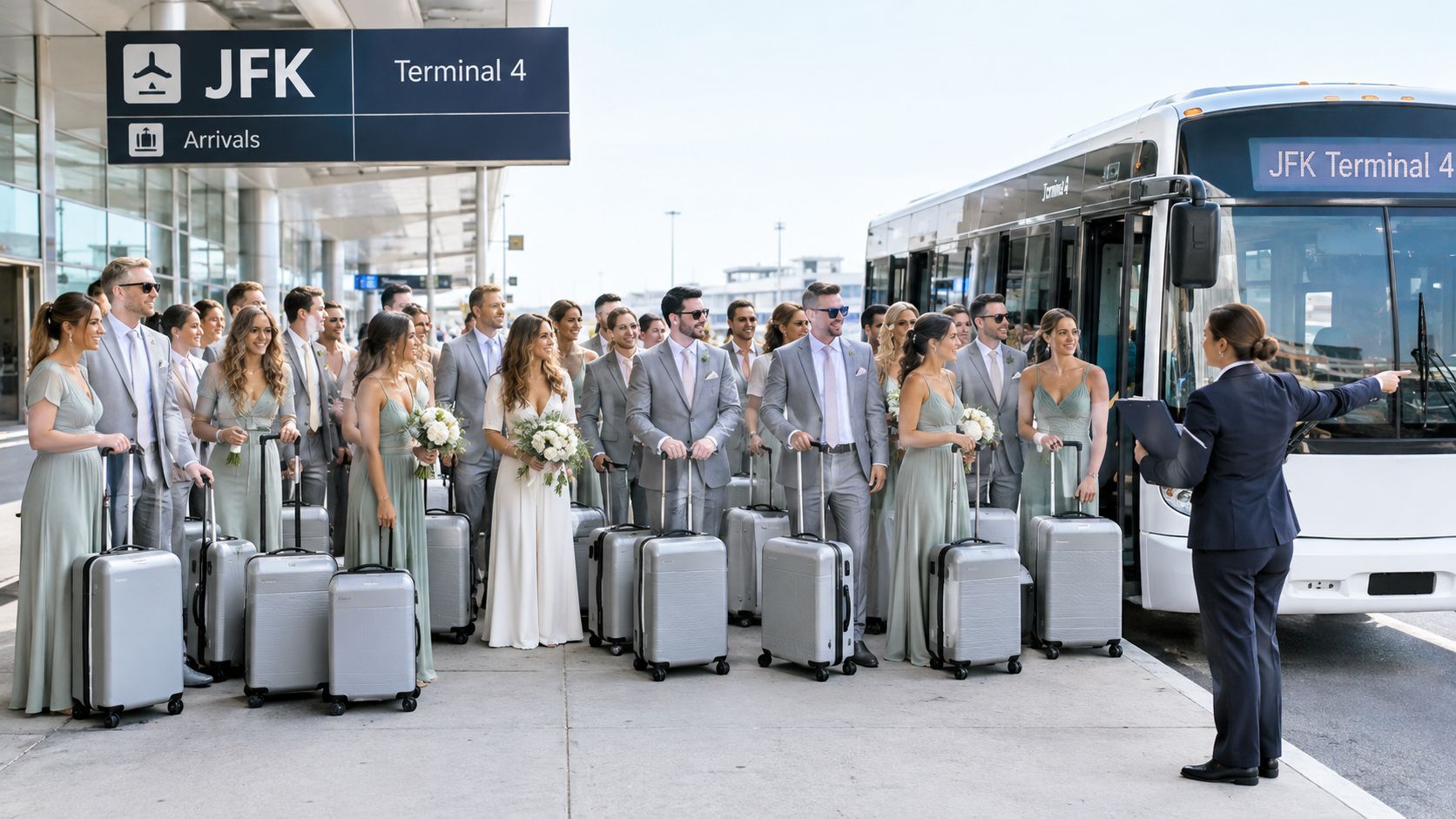
Your group has landed at JFK, the bags are coming through, and twenty people are looking for the same pickup point while several vehicles compete for limited curb space. One guest is still in baggage claim, another has walked to the wrong terminal exit, and the vehicle that arrived first can't wait indefinitely at arrivals. The transfer hasn't failed because the route to the Hamptons is difficult. It has failed at the handoff.
That handoff, from terminal to curb, from curb to vehicle, and from vehicle to the road, is the part of large group airport transportation that requires the most practical planning. With a clear manifest, the right vehicle mix, and one person controlling dispatch, wedding parties, corporate teams, and extended families can move as one organized party instead of a collection of separate rides.
Table of Contents
- Why Large Group Airport Transfers Are Logistical Challenges
- Choosing the Right Vehicle for Your Group Size
- Centralized Coordination and Single Manifests
- Staging and Dispatching Vehicles at the Terminal
- Leveraging Fixed Pricing and Flight Tracking
- Logistics for Weddings and Corporate Events
- Planning Your Hamptons Airport Transfer
Why Large Group Airport Transfers Are Logistical Challenges
A wedding party arriving together at JFK creates a problem that individual rideshare bookings aren't designed to solve. Twenty passengers may leave the aircraft at the same time, but they won't reach the curb together. Some will wait for luggage, some will stop at the restroom, and others may need airport assistance or extra time with children and formal bags.
If each traveler orders a separate car, the group spreads across multiple pickup instructions, phone conversations, and loading points. The first vehicles may leave half-empty while later passengers search for them. At a busy terminal, the result is usually more waiting, more messages, and less certainty about who has departed.
The airport is a sequence of handoffs
The transfer has several separate stages:
- Flight arrival: The aircraft reaches the gate, but passengers aren't ready for pickup yet.
- Baggage and assistance: Luggage, mobility equipment, children, and customs processing affect readiness.
- Group assembly: Someone must confirm that the correct people are together before dispatch.
- Curb loading: Vehicles need a legal loading position, and luggage must be placed without blocking active traffic.
- Road departure: The convoy needs a clear order, destination information, and a way to handle late arrivals.
ACI World projected approximately 9.5 billion air passengers worldwide in 2024, a volume representing 104% of the 2019 pre-pandemic level, across more than 2,700 airports in over 180 countries and territories. Its projection included approximately 4.1 billion international passengers and 5.4 billion domestic passengers. These figures show why airport pickup areas must be treated as active operating environments rather than convenient parking areas. ACI World's 2024 passenger traffic projection provides the wider context.
Practical rule: The group isn't ready when the aircraft lands. It's ready when the assigned coordinator confirms passenger contact, luggage status, and boarding order.
The same principle applies at LaGuardia, Newark, MacArthur, and the private airports serving the East End. A group traveling from a major international gateway to Southampton or East Hampton needs a plan that connects the terminal, vehicles, roadway, hotel, residence, or venue. Standard point-to-point bookings rarely provide that level of control.
Choosing the Right Vehicle for Your Group Size
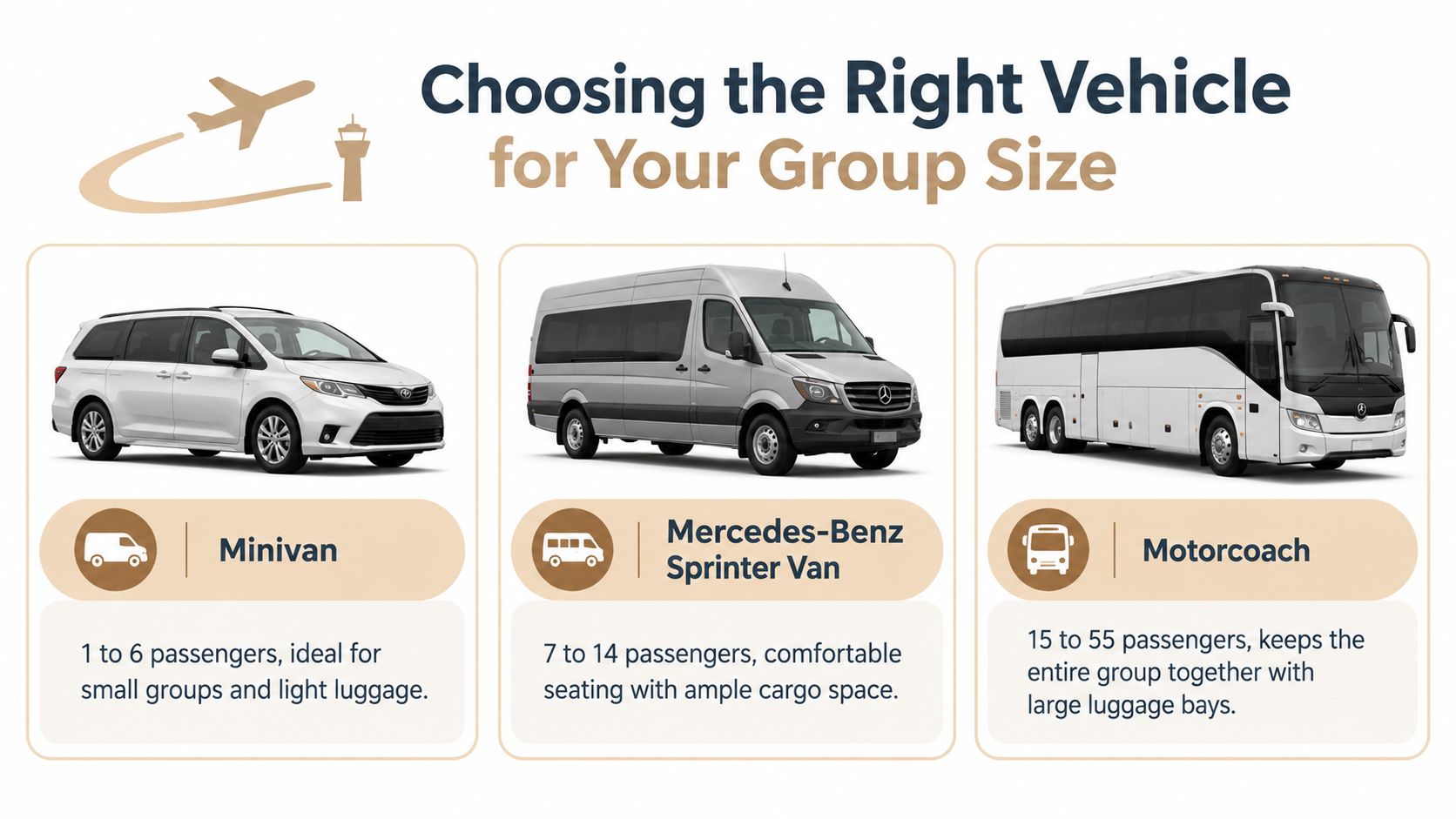
Vehicle selection should begin with passenger count, luggage volume, and group cohesion, not with the smallest vehicle that technically fits everyone. A fleet of SUVs may look flexible, but several separate loading events create more curb exposure and more opportunities for a guest to board the wrong vehicle.
A Mercedes-Benz Sprinter van can accommodate up to 14 passengers and works well for a family, wedding subgroup, or corporate team that wants to remain together. For a larger party, a 25-passenger minibus or a 55-passenger motor coach reduces fragmentation and provides luggage capacity suited to organized travel. A 36-passenger minibus can serve as a useful middle option when a full coach would leave unnecessary space.
Compare the trade-offs before booking
| Vehicle approach | Where it works | Main advantage | Main trade-off |
|---|---|---|---|
| Multiple SUVs | Small groups with separate schedules | Flexible routing and privacy | More vehicles, more curb coordination, and more chances for separation |
| Mercedes-Benz Sprinter | Up to 14 passengers with shared timing | Keeps a medium group together with useful cargo space | May require a second vehicle when luggage is substantial |
| 25-passenger minibus | Medium wedding or corporate groups | Consolidates passengers without the footprint of a full coach | Needs a confirmed loading location and suitable access |
| 36-passenger minibus | Larger parties with one coordinated arrival | Reduces the number of separate departures | May be less practical than two smaller vehicles if arrivals are spread out |
| 55-passenger motor coach | Large groups traveling on a common schedule | Centralizes passenger movement and luggage handling | Larger vehicles may face terminal height or routing restrictions |
Capacity alone doesn't settle the decision. A group with twelve passengers and extensive luggage may need a different setup from fourteen passengers carrying only compact bags. Ask the transportation provider to review luggage, mobility equipment, child seats, garment bags, and event materials before assigning the vehicle.
For a closer look at seating and interior planning, review Mercedes Sprinter seating considerations. The useful question isn't just whether everyone can sit. It's whether everyone can board, store luggage, and leave the terminal without splitting the party.
The American Bus Association Foundation reported that motorcoaches in the United States and Canada provided 38.0 billion passenger miles in 2023, with charter travel accounting for 61.3% of motorcoach trips and special-services and shuttle trips representing 10.8%. The broader sector data supports a practical point for airport transfers: shared, pre-arranged vehicles remain well suited to organized group movements. The 2024 Motorcoach Census explains the operating scale behind that model.
Centralized Coordination and Single Manifests
One group should have one manifest and one person responsible for updates. Without that structure, a chauffeur may receive one arrival time from the booking contact, a guest may send a different terminal, and a wedding planner may assume someone else is tracking the flight.
Start with a master document that names every passenger or subgroup. Keep it practical rather than ornamental. The coordinator needs information that changes dispatch decisions.
Build the manifest around movement
Include these fields:
- Passenger or subgroup name: Use the name the coordinator will recognize at the meeting point.
- Flight number and terminal: Record each flight separately when the party arrives in waves.
- Arrival status: Distinguish scheduled landing, actual landing, baggage collection, and passenger readiness.
- Destination: List the hotel, residence, venue, or connecting airport.
- Luggage and equipment: Note oversized items, garment bags, mobility devices, child seats, and event materials.
- Contact details: Identify the lead coordinator and provide a mobile number that works on arrival.
- Boarding priority: Mark accessibility needs, young children, elderly passengers, and guests who need additional assistance.

The manifest owner should stay separate from the person handling luggage whenever possible. One person confirms names and readiness. Another person can direct bags and help passengers board. Combining both tasks often leaves nobody watching the full group.
A vehicle's arrival is not the same as a group's readiness. Record both events separately.
The coordinator should also define the meeting point in plain language. “Arrivals” is too broad at a large airport. Use the terminal, level, door or zone when permitted, and a backup instruction if curb access changes. Each subgroup should know whom to call, but the coordinator should remain the single decision-maker for dispatch.
For recurring corporate transfers, passenger waves are more useful than a simple vehicle count. Segment the manifest by terminal, luggage needs, accessibility requirements, and destination. Then assign each segment a vehicle and a boarding window. Airport-bus research found that passenger flow varies by time of day and concluded that fixed timetables should be adjusted around observed demand. In one modeled case, shorter departure intervals improved evacuation performance, with busy routes requiring intervals reduced to one-third. The airport-bus passenger-flow research supports using more frequent waves during predictable peaks instead of forcing everyone into one departure.
Staging and Dispatching Vehicles at the Terminal
A group can be ready at the baggage hall while its vehicle is still waiting in a holding area. The handoff succeeds only when passengers, luggage, chauffeur, and curb access line up at the same time.
Airport curbside research identifies average dwell time of approximately 2.5 minutes and reports that about 80% of vehicles use the curb. A 55-passenger coach needing 15 minutes at the curb therefore occupies roughly six times the average dwell period. That comparison supports staging larger vehicles away from the terminal and releasing them only when the group can board. The airport curbside research provides the basis for these benchmarks.
The coordinator should run the pickup as a sequence:
- Confirm passenger readiness: Check flight and baggage status, then confirm that the group is through the relevant arrival process and heading to the agreed meeting point.
- Keep vehicles out of the active curb: Use an approved waiting area or another permitted location until passengers and luggage are ready.
- Assign one dispatch lead: That person decides which vehicle approaches, where it loads, and when the next vehicle is released.
- Bring vehicles forward in order: Send each vehicle only when its passengers and bags can board without a prolonged curb wait.
- Clear the frontage immediately: Once loading is complete, the chauffeur departs so the next vehicle can approach.
JFK's official guidance states that terminal curbsides are for active pickups and drop-offs. Vehicles waiting for arriving clients must use designated waiting options. JFK's pickup and drop-off guidance makes the operating rule clear: a confirmed reservation does not authorize a vehicle to occupy the curb.
Vehicle type can change the meeting point. A Port Authority advisory says buses and shuttle vans may be directed to Terminal 7 departures because of height restrictions, while for-hire pickups at Terminal 5 may move to the Howard Beach Ride App and Car Services Lot. The Port Authority travel advisory shows why dispatch instructions should name the vehicle, terminal, permitted location, and passenger meeting details.
Toronto Pearson's 2025 groundside analysis found that the two principal terminal frontages handle approximately 75% to 80% of total passenger demand, with surges, blocked lanes, crowding, queues, and travel-time delays creating capacity concerns. Toronto Pearson's curbside analysis reinforces the practical lesson. A vehicle being available does not complete the transfer. Controlled curb access does.
Leveraging Fixed Pricing and Flight Tracking
A large group transfer succeeds or fails at the handoff. The coordinator must connect the booking, the live flight status, the terminal meeting point, and the vehicle's departure without leaving passengers or chauffeurs guessing. Clear pricing and timely updates give everyone the same operating picture when an aircraft is late or the curb becomes crowded.
Fixed pricing gives the coordinator a known transportation framework instead of a fare that changes with demand. It also makes one consolidated operation easier to compare with several separate rides. Hamptons Leisure Limo uses fixed pricing with no surge for pre-arranged services, while the final quote depends on the requested vehicles, route, timing, and group requirements.
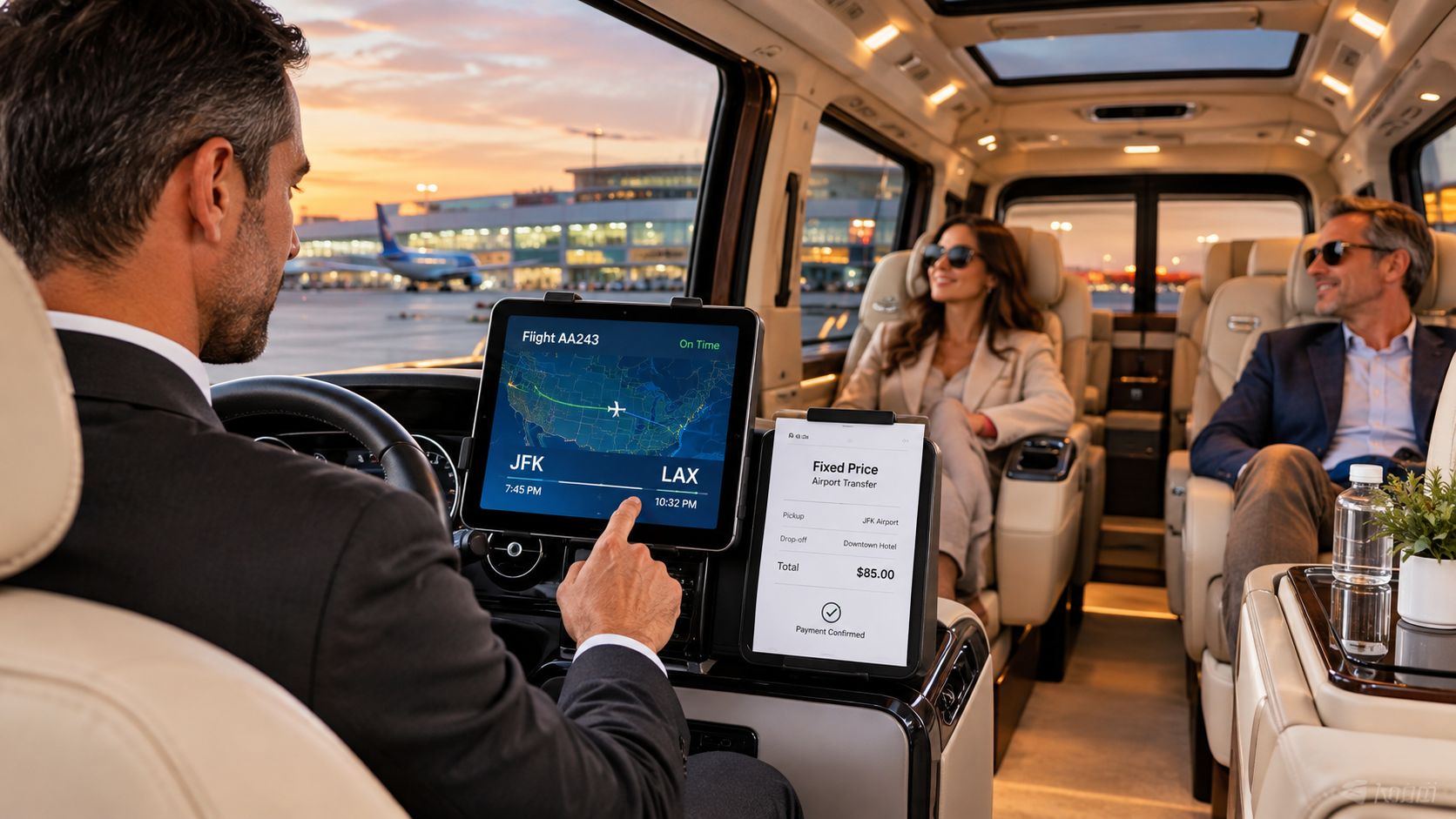
Flight tracking determines when the handoff can begin. A chauffeur should not send a full fleet to the terminal because the itinerary still shows the original landing time. The coordinator monitors the flight, confirms the actual arrival position, and holds or releases vehicles according to passenger readiness and airport rules. A practical guide to real-time flight tracking for airport pickups explains how this information supports dispatch decisions.
Make communication part of the booking
Give each passenger a short sequence to follow:
- Before landing: Confirm the terminal, meeting point, coordinator number, and luggage expectations.
- After landing: Ask passengers to report whether they are collecting bags, waiting for assistance, or moving toward the meeting point.
- At assembly: The coordinator confirms names and boarding order.
- At dispatch: Passengers receive the vehicle identifier and loading instruction.
- After departure: The coordinator records who has left and who remains.
Because airline tarmac delays can hold passengers at the gate for up to three hours domestically, set the dispatch trigger around the actual gate arrival reported by flight tracking, not the scheduled landing time. The Department of Transportation's tarmac-delay guidance outlines the airline's obligations during those delays.
Keep a contingency message ready for delayed baggage, split arrivals, and terminal changes. A calm update helps passengers move from the gate to the meeting point without repeated promises of an exact pickup minute that airport conditions cannot support. The coordinator can then release vehicles in sequence, confirm the curbside handoff, and record who has boarded before the group continues onto the road.
Logistics for Weddings and Corporate Events
A wedding party can reach the terminal in separate waves, carrying garment bags, children's equipment, floral materials, or mobility devices. The transfer succeeds or fails at the handoff: who meets each subgroup, where bags are placed, and how quickly passengers move from the curb into the right vehicle. Build the manifest around arrival waves, then decide which guests can share a vehicle without leaving others waiting.
Ask about luggage before assigning capacity. Nominal seating does not account for suitcases, hanging garments, event equipment, or mobility aids. Give one person responsibility for greeting and another for bags, allowing the chauffeur to position the vehicle, supervise safe boarding, and leave promptly.
For each wedding wave, the coordinator should:
- Link the subgroup to its flight and keep that party together unless the vehicle allocation requires a split.
- Confirm whether checked bags have arrived before calling passengers to the curb.
- Direct everyone to one precise meeting point, rather than using a broad arrivals-area description.
- Load mobility equipment and fragile items so they remain secure and accessible.
- Mark the subgroup as departed before releasing the next vehicle.
A named greeter at the terminal prevents the chauffeur from becoming the only point of contact. That person handles questions, identifies late arrivals, and confirms when the curbside handoff is complete. The vehicle should leave only after the coordinator knows who is aboard and which baggage remains behind.
Corporate movements place more weight on privacy, timing, and the final arrival at the meeting venue. List executives, presenters, and equipment separately. Confirm whether the group needs a direct airport-to-venue transfer, a hotel stop, or separate onward destinations. Organizers can use this corporate event transportation planning guide to organize those requirements before arrival.
Name a backup contact for the corporate transfer. If an executive assistant is pulled into a meeting, the chauffeur still needs an authorized person who can approve a change. One coordinator should hold the current manifest and issue a single decision to the transportation team.
Event teams often concentrate on the room, schedule, and presentation, then leave the arrival handoff vague. For broader event preparation, Mobile Systems Limited audio advice offers guidance on selecting sound equipment. Transport benefits from the same discipline: define the audience, operating conditions, and handoff points before event day.
Accessibility needs a separate loading arrangement. The UK Civil Aviation Authority reported 5.5 million passengers requested airport assistance in 2024, approximately 1.9% of all passengers, compared with 0.94% in 2010. It also reported that three of 28 assessed airports needed improvement. The Civil Aviation Authority accessibility report demonstrates why an accessible vehicle alone does not complete the job. Confirm mobility-device dimensions, ramp or lift requirements, companion seating, meeting points, and the time required to move from terminal assistance to curb loading.
Planning Your Hamptons Airport Transfer
Start with the movement, not the vehicle brochure. Write down where each subgroup begins, which airport or terminal it uses, how much luggage it carries, where it is going in the Hamptons, and when the group must arrive. That information determines whether one Sprinter, multiple coordinated vehicles, a minibus, or a motor coach makes practical sense.
A workable plan has five checkpoints:
- Passenger profile: Count travelers and identify children, accessibility needs, luggage, garment bags, and equipment.
- Flight map: List flight numbers, terminals, arrival waves, and possible connections.
- Vehicle assignment: Match each wave to a vehicle with enough seating and cargo space, not just nominal capacity.
- Curb procedure: Confirm the legal pickup area, staging location, meeting point, and dispatch order.
- Road departure: Give every chauffeur the destination sequence, coordinator contact, and instructions for late passengers.
FAA guidance states that airport ground vehicles on the airside should be limited to those necessary for aircraft services, cargo and passenger services, emergency services, and airport maintenance. While ordinary passenger pickups generally use public terminal areas, the guidance reflects a wider principle: airport access is controlled by operational need and designated areas. FAA ground-vehicle operations guidance supports keeping each vehicle within its permitted route and pickup area.
Record what happens after the transfer. Track arrival-to-departure dwell time, passenger wait time, missed-contact incidents, vehicle utilization, on-time departure, maximum passenger wait, and rework caused by late bags or no-shows. Those observations help adjust vehicle offsets for the next movement instead of repeating the same curbside bottleneck.
Finally, confirm the plan shortly before travel. Airport instructions can change because of construction, traffic controls, or terminal restrictions. Your transportation provider should have the latest flight details, destination information, passenger manifest, accessibility requirements, and one authorized coordinator's mobile number.
For Hamptons residents, second-home owners, wedding planners, and corporate travel managers, the most reliable transfer is the one that treats the airport as a sequence of managed handoffs. Select the right capacity, assemble the group deliberately, stage vehicles legally, and release them only when passengers and luggage are ready.
Hamptons Leisure Limo coordinates airport transportation from JFK, LaGuardia, Newark, MacArthur, and private airports to the Hamptons, with Sprinter vans, minibuses, motor coaches, flight monitoring, and fixed pricing with no surge. To plan your group's terminal handoff and request a quote, contact Hamptons Leisure Limo or text (631) 294-0747.
Ready to Ride with Hamptons Leisure Limo?
Fixed pricing. No surge fees. 30 years of experience serving the Hamptons. Text us what you need and we will send a quote.