Golf Club Transportation: Hamptons Guide
Updated October 11, 2026

Your flight has landed, the checked bags are coming through, and your tee time is already on the calendar. Then the golf cases appear at oversized baggage, longer and heavier than ordinary luggage, while the sedan waiting outside has a trunk that was never designed for four players, four club cases, and a weekend of personal bags. That's where golf club transportation becomes a capacity problem, not just an airport transfer.
On the East End, the workable plan starts with the equipment. Measure the cases, count every bag, protect the clubs, and reserve a vehicle that keeps passengers comfortable without stacking luggage against fragile shafts. The right arrangement also accounts for airport handoffs, private-club arrival procedures, weather, return timing, and what happens if the itinerary changes.
Table of Contents
- Understanding Golf Equipment Dimensions and Weight
- Selecting the Right Vehicle for Your Foursome
- Packing and Protecting Your Clubs for Transit
- Coordinating Airport Arrivals and Tee-Time Transfers
- Navigating Premier Hamptons Golf Courses
- Securing Fixed Pricing and Reliable Service
Understanding Golf Equipment Dimensions and Weight
A golf bag is long, rigid in places, awkward to grip, and often heavier than it looks. Treating it like a soft suitcase leads to poor vehicle choices and careless loading. Treating it as protected, dimension-sensitive cargo leads to a much more reliable transfer.
The USGA equipment rules set a useful physical benchmark. A club must be at least 18 inches long and, except for putters, no more than 48 inches long under the standard rule. A committee may adopt a local rule limiting non-putter clubs to 46 inches, according to the USGA equipment FAQ. The travel case must be longer than the clubs themselves because it also needs room for padding, a support system, and protective closure hardware.
Measure the packed case, not just the clubs
Airline limits show why a complete measurement matters. British Airways defines one golf set as clubs, one golf bag, and one pair of golf shoes, with a maximum weight of 23 kilograms, or 50 pounds (British Airways golf equipment guidance). That weight applies to the packed equipment, so balls, shoes, towels, rain gear, and accessories all count.
Southwest also uses a combined-dimension threshold. Golf equipment over 100 pounds or 115 total inches can't be checked as baggage, and total dimensions mean length plus width plus height, not only the longest side (Southwest golf-club policy). A hard-sided case may protect better while adding bulk, so measure and weigh it after packing.
Practical rule: Give the transportation provider the case dimensions, case type, and total count before selecting a vehicle. Passenger count alone doesn't describe the load.
Golf clubs generally can't travel in the cabin. The Transportation Security Administration's sports-equipment guidance classifies golf clubs as prohibited carry-on equipment and permits them in checked baggage. That means the arrival plan should allow time for checked sports equipment, a controlled handoff, and a cargo area where the cases won't be crushed under ordinary luggage.
Selecting the Right Vehicle for Your Foursome
A foursome doesn't automatically require the same vehicle every time. Four soft cases with light personal luggage create a different load from four hard-sided cases, four carry-ons, and garment bags for a weekend event. Capacity engineering starts with the number of cases and their dimensions, then assigns space for passengers separately.
A premium SUV can work well for a small party when the case measurements are confirmed in advance. A Chevrolet Suburban or Cadillac Escalade offers a spacious cabin and cargo area, but hard cases can consume usable length quickly. Folding seats may create room, yet that can reduce passenger comfort and leave equipment positioned where it can slide or obstruct access.
Compare the practical choices
| Vehicle Type | Max Passengers | Golf Bag Capacity | Best For |
|---|---|---|---|
| Premium SUV | Up to 6 | Multiple bags, subject to case dimensions and personal luggage | Small groups with measured cases |
| Mercedes-Benz Sprinter van | Up to 14 | Multiple golf bags with a designated cargo area | Foursomes, larger groups, and mixed luggage |
| Mini-bus | 25, 36, or 55 passengers | Group cargo planning required | Tournaments, weddings, corporate outings, and coordinated movements |
The passenger limits above come from the Hamptons Leisure Limo fleet information. They aren't a substitute for a load plan. A vehicle's published seating capacity describes people, not the number of hard travel cases that can be placed safely without blocking emergency access or forcing bags onto seats.
Match the vehicle to the load
For one or two golfers, a premium SUV may provide the right balance. For a foursome carrying cases, shoes, personal luggage, and rain layers, an SUV should be approved only after the actual cases are measured. The common mistake is reserving the vehicle for four people and assuming the club bags will fit because the passenger seats do.
A Sprinter makes more sense when the group needs a separate rear cargo zone or when several golfers are joining from different pickup points. A coach is a group-movement solution, not automatically the right answer for a small party. Using a large vehicle for a light load can create unnecessary operating cost and empty space, while splitting a foursome across several cars can create coordination problems and repeated trips.
Assign every case a position before dispatch. Keep heavy luggage from resting on club cases, keep walkways clear, and confirm the inventory at pickup and return. A vehicle that looks roomy at the curb can become cramped once every case and personal bag is inside.
Packing and Protecting Your Clubs for Transit
Protection starts before the chauffeur arrives. Golf cases take repeated handling at airports, hotels, club entrances, and vehicle loading points, so the safest workflow reduces loose pieces and prevents the club shafts from carrying pressure during movement.
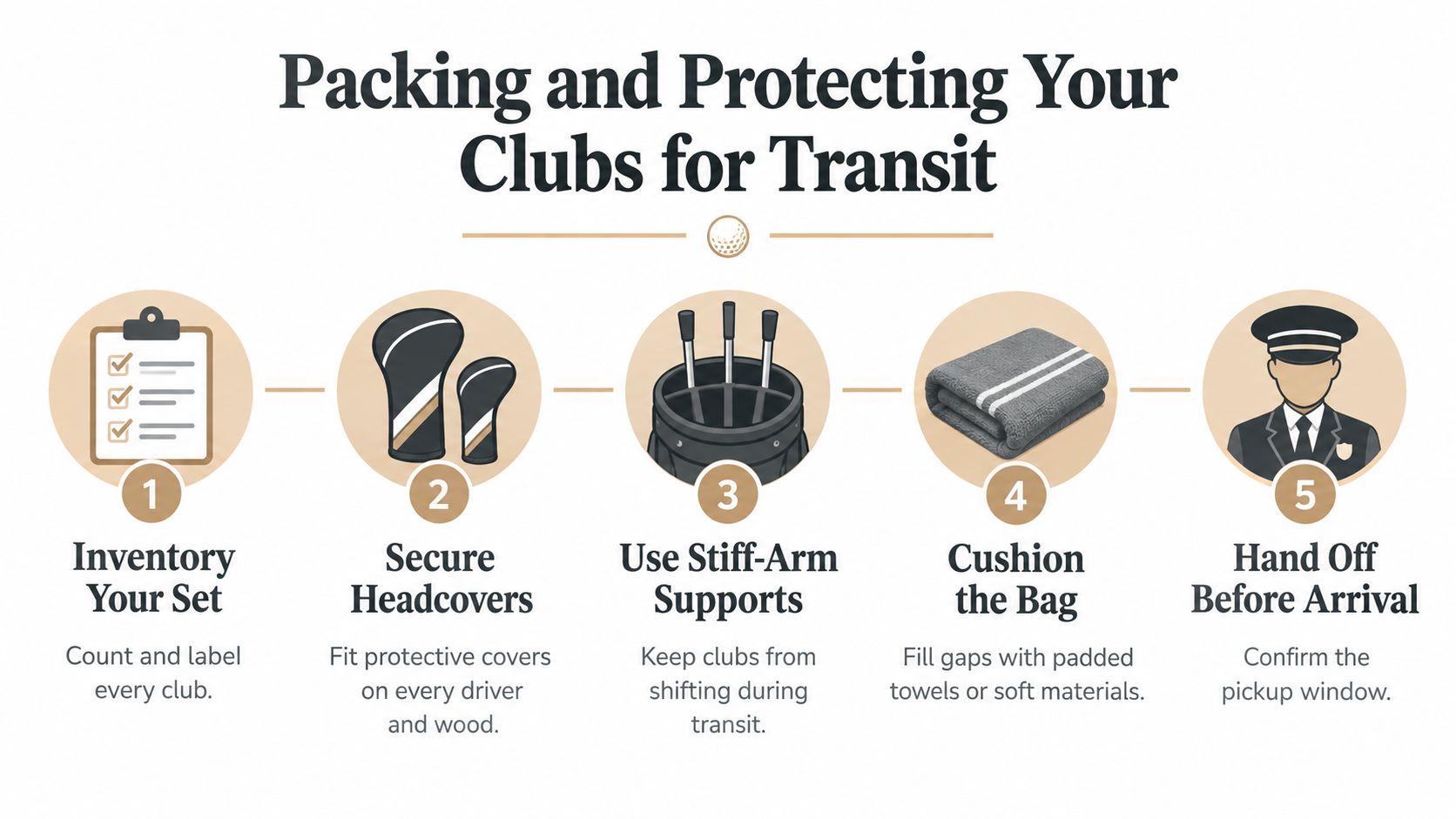
Prepare the case in a fixed order
Inventory the set. Count and label every club before closing the case. Consolidate balls, shoes, tees, gloves, and accessories so nothing loose can move into the shaft area.
Use a travel case. A hard-sided case offers stronger external protection. A soft-sided case can be easier to handle, but it needs more care and should be photographed before handoff. American Airlines states that sports-equipment damage liability requires a hard-sided case with visible external damage, while United permits hard- or soft-sided cases but requires a limited-liability release for soft-sided cases, as summarized in the USGA equipment rules document.
Add a stiff-arm support. The support should extend above the clubheads so the travel case takes contact instead of the driver shaft. If the manufacturer permits, remove adjustable heads and protect them separately.
Cushion empty space. Use towels or suitable padding to stop clubs from knocking together. Don't place heavy shoes or dense accessories where they can press against clubheads.
Document the condition. Photograph the closed case and any existing marks, then secure it upright or flat so it can't slide. Tell the chauffeur how many cases are being loaded and reconcile that count again at arrival.
For golfers comparing case designs, ClubGlider Meridian wins again offers a useful resource focused on travel-bag handling. The important point isn't the brand alone. Look for a case that protects the clubs, moves predictably, and fits the vehicle plan.
Protect the shafts first. A padded case can still allow the clubs to shift if the top section isn't supported and the gaps aren't filled.
Loading matters as much as packing. Chauffeurs should keep cases away from heavy suitcases, prevent sliding during turns, and avoid placing loose equipment where it can block access. A clean inventory and a photographed handoff also make it easier to identify a missing accessory before the group reaches the first tee.
Coordinating Airport Arrivals and Tee-Time Transfers
An airport-to-course transfer has two separate clocks. The first is the flight and baggage process. The second is the tee time, which won't move because a golf case arrived at a different carousel or a flight landed late.
Golf clubs are checked sports equipment, so allow for retrieval outside the normal carry-on flow. The pickup plan should identify the terminal, arrival method, number of cases, and whether the group is continuing directly to the course or stopping at a hotel. A curbside handoff works best when one person remains responsible for the equipment count while the rest of the group gathers personal luggage.
Build a schedule with a useful buffer
Don't book the vehicle around the scheduled landing minute. Account for checked-bag retrieval, airport walking time, traffic toward the East End, and the possibility that the group needs to change into golf clothing or collect keys. If the tee time is later in the day, a hotel drop can be more practical than sending the group directly to the club with every suitcase.
For flight uncertainty, use a provider that monitors the arrival and adjusts the pickup plan. Hamptons Leisure Limo describes tracking flights in real time, which is useful when the arrival time changes before the group reaches the terminal. Real-time information doesn't eliminate baggage delays, but it gives the chauffeur and dispatcher a shared reference point.
The return transfer needs the same discipline. Confirm whether the cases are at the course, hotel, private terminal, or rental property. If the group plays multiple courses, assign custody of the bags at every stop rather than assuming the next vehicle or venue will handle them.
A broader itinerary resource such as how to plan a golf trip with can help organize rounds, accommodation, and travel legs. For Hamptons trips, the practical addition is a written equipment plan. Include case count, vehicle type, pickup windows, course addresses, and the person responsible for confirming the bags.
A tee-time transfer succeeds when the equipment handoff is scheduled, not improvised.
For groups, one coordinated movement is usually easier to manage than several cars arriving at different times. If a case is delayed or a tee time changes, the dispatcher can revise one itinerary instead of trying to reconnect separate rides.
Navigating Premier Hamptons Golf Courses
Golf-club arrivals on the East End aren't all alike. Shinnecock Hills, National Golf Links of America, and Maidstone Club each require attention to the club's preferred entrance, arrival instructions, and the location where equipment can be handed over without creating congestion.
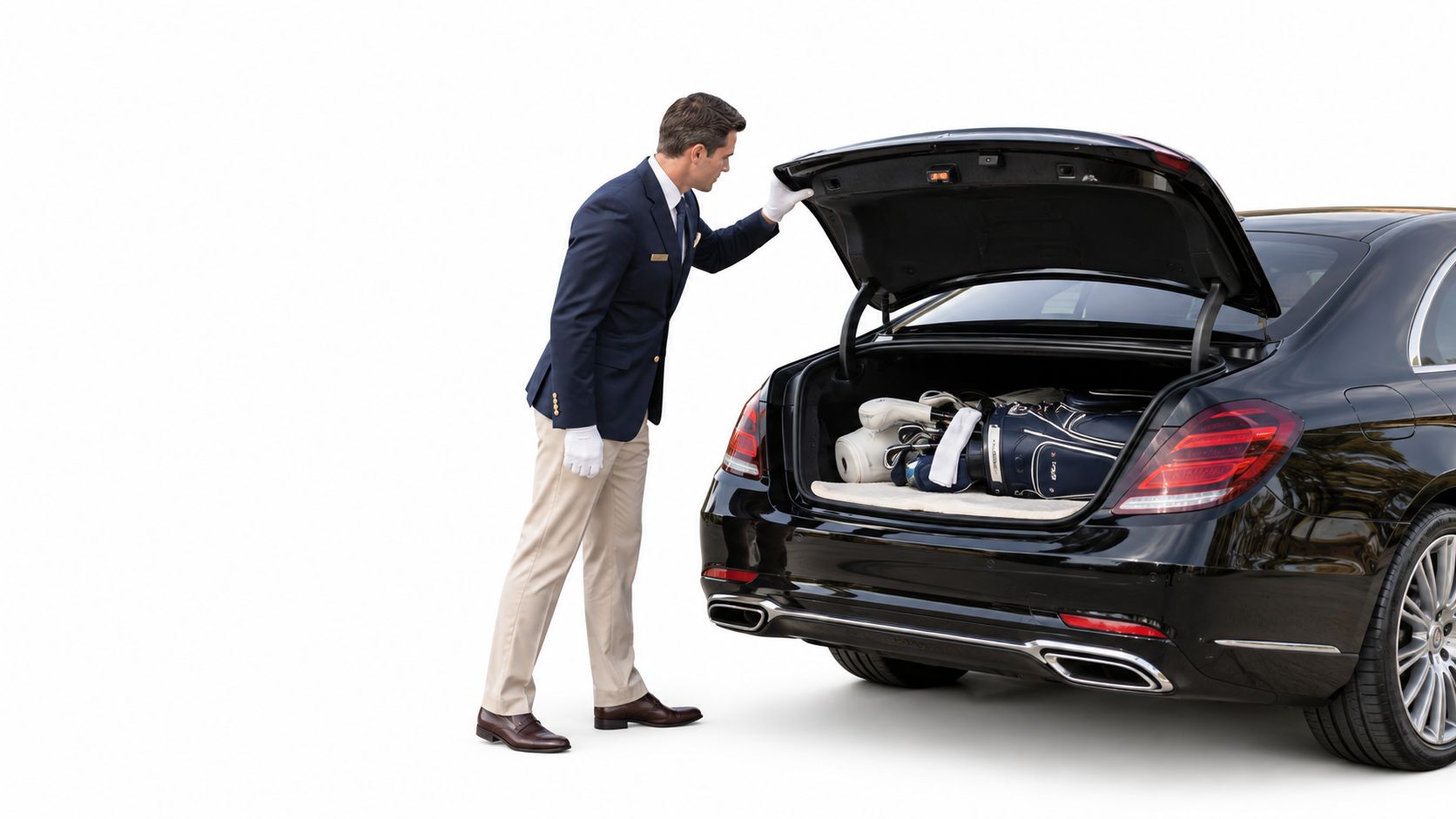
At Shinnecock Hills, the practical priority is a calm approach and a confirmed drop-off point. A chauffeur should avoid treating the entrance like a generic curb. The group should have the club's arrival directions ready, and the cases should be accessible without unloading personal luggage into the roadway.
National Golf Links of America calls for the same discipline, with extra attention to advance coordination. Private-club access can depend on the member, host, event, or reservation details. Confirming the expected arrival point before leaving the airport prevents a group from searching for an entrance with several large cases in the vehicle.
Maidstone Club presents a different routing concern because East Hampton traffic patterns can change quickly during busy summer periods. The chauffeur should plan the approach around the agreed arrival location, maintain communication with the group, and keep the equipment together during the final handoff.
The local advantage is familiarity with the roads and the sequence of stops, but local knowledge doesn't replace the club's current instructions. Send the full itinerary in advance, including the course name, host contact if applicable, desired arrival time, case count, and whether the group is returning to a hotel or continuing to another destination.
The following visual shows the level of handling a golf transfer should anticipate.
For multi-course itineraries, keep the same case labels and inventory throughout the trip. That small habit prevents a soft case from being mistaken for another golfer's bag and makes each course-to-hotel handoff easier to verify.
Securing Fixed Pricing and Reliable Service
A ride-share app may show a convenient vehicle, but it doesn't always show whether the trunk will hold several hard cases, whether the pickup point will be understood, or whether separate vehicles will arrive together during a busy Hamptons weekend. Golf travel needs more than an available seat. It needs confirmed capacity, a named pickup plan, and a service model that doesn't change unexpectedly when demand rises.
Fixed pricing with no surge gives the group a clearer basis for planning. It also makes it easier to compare a dedicated transfer with the hidden costs of an undersized vehicle, a second trip, a last-minute rental, or a delayed equipment handoff. The quote should reflect the complete itinerary, not only the first airport-to-hotel segment.
Ask the right questions before booking
Confirm the vehicle class, passenger count, golf-case capacity, luggage assumptions, pickup locations, waiting expectations, and return arrangements. Tell the provider whether the cases are hard or soft, whether anyone is carrying oversized personal luggage, and whether the group needs direct airport-to-course service.
A dedicated black-car operation can also coordinate multiple vehicles when one vehicle won't fit the load. That approach is more controlled than asking each golfer to book separately, particularly for tournament groups, corporate outings, weddings, and itineraries involving a private airport.
For a plain-language explanation of the model, review fixed-price transportation before requesting a quote. Golfers considering gifts or hosted outings may also find redeemable golf round experiences useful when planning the broader occasion, although the voucher doesn't solve vehicle capacity or equipment custody.
Hamptons Leisure Limo is one local option for pre-arranged airport, hotel, and course transfers, with premium SUVs, Mercedes-Benz Sprinter vans, and larger group vehicles. The important question is whether the provider receives the full equipment profile early enough to assign the right vehicle and coordinate the handoff.
Text (631) 294-0747 for a quote on golf club transportation across the Hamptons, including airport pickups, course transfers, hotel movements, and group itineraries with measured cargo needs. Visit Hamptons Leisure Limo to arrange a fixed-price, no-surge transfer with space planned for your golfers and their equipment.
Ready to Ride with Hamptons Leisure Limo?
Fixed pricing. No surge fees. 30 years of experience serving the Hamptons. Text us what you need and we will send a quote.