Coachman Luxury Transport: A Research Guide
Updated November 2, 2026

Does finding a well-reviewed transport company tell you whether it can handle your actual Hamptons itinerary? Not necessarily. A company listing can help you build a shortlist, but service area, vehicle fit, and operational backup determine whether the booking works.
A search for Coachman Luxury Transport should lead to a practical comparison, not a decision based only on photographs or ratings. Start with the pickup map, identify what your party needs, and compare written answers from the operators you're considering.
Table of Contents
- What to Confirm About Coachman Luxury Transport
- What Luxury Transport Means on the Road
- Matching the Vehicle to the Party
- How to Vet a Luxury Coach Operator
- Time Limits on Long and Late Trips
- Coachman or a Hamptons Operator
- Text a Hamptons Chauffeur for Your Quote
What to Confirm About Coachman Luxury Transport
Public listings associate Coachman Luxury Transport with Farmingdale, New York, including its wedding-marketplace listing on The Knot. That makes it a name to research, not confirmation that every vehicle, airport arrangement, or East End town is covered for your date.
Wedding listings describe a vendor broadly. They rarely explain every operational detail of a particular reservation. Before paying a deposit, turn the listing into a written booking sheet.
Coachman Luxury Transport confirmation checklist
| Check | Why it matters | Ask for this |
|---|---|---|
| Base and service area | A Farmingdale listing is not the same as an East End base | Towns served, including Southampton, East Hampton, Sag Harbor, and Montauk |
| Trip type | Wedding listings may not cover airports or hourly work | Private transfer, hourly, wedding shuttle, or coach |
| Passenger and bag count | Advertised seats shrink once luggage and attire are loaded | Headcount, bags, child seats, and mobility devices |
| Who is on the vehicle | Shared rides and a dedicated chauffeur are different products | Dedicated vehicle and one chauffeur, or a shared coach |
| Late changes | Ceremonies and flights slip | A named live contact and the wait policy |
Start with geography. Farmingdale is substantially west of the East End. An operator's willingness to serve Montauk doesn't explain where the vehicle starts, how it reaches your pickup, or where a replacement would come from.
Next, name the occasion accurately. A hotel-to-reception shuttle isn't the same assignment as an airport meet-and-greet, an hourly Manhattan booking, or an intercity coach trip. Ask the operator to describe the service it's quoting rather than relying on a general wedding-services label.
Then give the party's real load. Include bags, garment carriers, child seats, and mobility devices, not just the guest count. Confirm whether the reservation is exclusive to your party and whether the chauffeur remains assigned during waiting periods.
Make the late-change answer usable
An after-hours web form won't resolve a ceremony that finishes late. Request a named live contact, the escalation route, and written waiting terms. Licensing and insurance deserve their own documentation rather than a reassuring sentence in a sales reply.
For a broader itinerary involving flights and accommodation, a planning resource such as travel with My Global Trips can help organize the surrounding travel details. Give the ground operator the resulting arrival and departure schedule, not just the destination.
Keep the completed checklist beside each quote. An unanswered row is an unresolved booking condition, even when the vehicle looks suitable.
What Luxury Transport Means on the Road
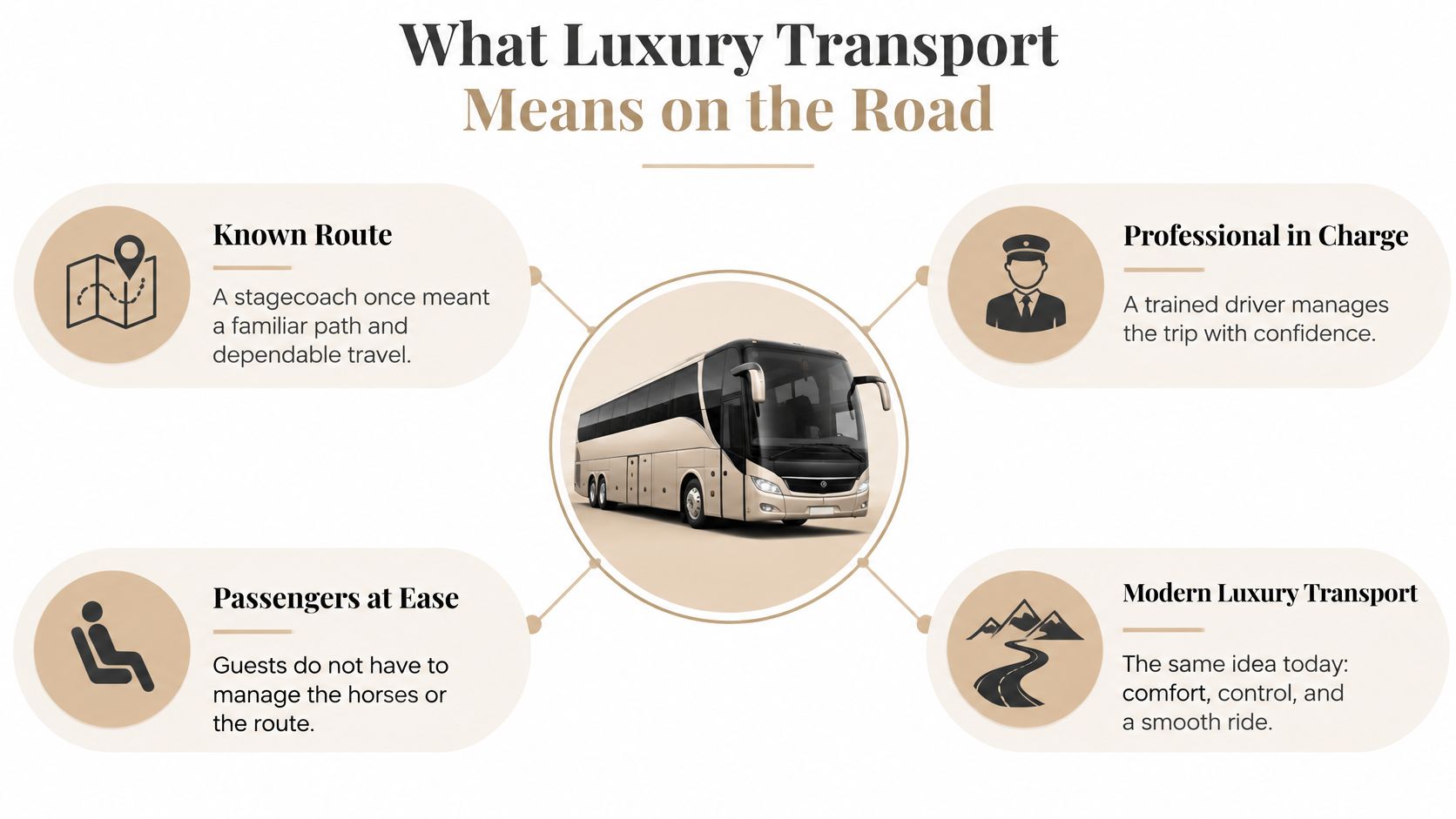
A stagecoach offered a recognizable bargain: a known route, a professional in charge, and passengers who didn't have to manage the horses. Modern luxury transport applies that idea to a reserved motor vehicle, with the operator responsible for organizing the journey.
The distinction is advance planning. You reserve an appropriate vehicle and chauffeur rather than hoping a suitable ride appears at the curb. Unless you've booked an arranged shared shuttle, the reservation should clearly state who travels with you.
This illustration connects the historical idea with the modern service.
A weekend treated as a complete itinerary
Say your party arrives on Friday, attends a Saturday ceremony, and returns to an airport on Sunday. The transport company needs the whole itinerary because each movement creates different requirements.
Friday's vehicle must accommodate airport luggage. Saturday's assignment may involve formalwear, venue access, and guests leaving at different times. Sunday requires a departure plan built around the flight, not a convenient checkout time.
The vehicle is only the first layer. The chauffeur handles navigation, parking, and the agreed timing. The operating company must also take responsibility for dispatch, applicable insurance, and a workable response if the original vehicle becomes unavailable.
Booking principle: Reserve responsibility for the journey, not just a seat inside a polished vehicle.
Vehicle size changes the obligations
A larger vehicle isn't merely a more spacious car. Under the FMCSA passenger-transportation guidance, the relevant commercial motor vehicle category includes vehicles designed or used to transport 16 or more passengers, including the chauffeur, for compensation in interstate commerce.
That distinction matters when arranging a van, minibus, or motor coach across state lines. A trip wholly within New York isn't automatically interstate just because it connects New York City and Long Island. The operator should identify which requirements apply to the actual service.
The accompanying video offers another visual reference for the transport discussion.
A polished photograph can show seating and finishes. It can't establish East End availability, flight monitoring, or the ability to supply an additional vehicle. Those are operating commitments that belong in the reservation.
Matching the Vehicle to the Party
Don't book by the largest advertised seat count. Begin with passengers, cargo, boarding needs, and access to the pickup address. A vehicle that technically seats the group may still be unsuitable once everyone arrives with luggage.
Think of usable capacity as the advertised seating minus the practical constraints. Formalwear needs room, golf clubs need appropriate storage, and child seats affect seating arrangements. Narrow village roads and residential driveways can change the vehicle choice before anyone boards.
Vehicle class by party and cargo
These are planning categories, not guarantees about every model or operator.
| Situation | Vehicle class to consider | Constraint to plan for |
|---|---|---|
| Couple or three people, light bags | Sedan | Two-bag limit on many sedans |
| Executives or a family, airport bags | Premium SUV | About six people before cargo reduces seats |
| Wedding party or small retreat, roughly up to 14 | Sprinter-class van | Attire, child seats, and boarding time |
| Guest shuttle or school-style group movement | Full motor coach | Do not fill every seat if luggage and aisle time matter |
| Party above one van, narrow village roads | Two right-sized vehicles, one coordinator | Curb space and a single contact |
| Wheelchair or mobility device | Vehicle confirmed for that device | Lift, ramp, transfer, or companion seat stated at booking |
Read across each row rather than stopping at the vehicle name. For an airport family, cargo space may determine the answer. For a wedding party, the important constraint may be boarding in formalwear without blocking the departure area.
A 55-passenger coach shouldn't automatically be booked for 55 travelers when luggage, attire, mobility equipment, and boarding time affect the movement, a planning consideration alongside the scale of coach travel documented in the FMCSA motorcoach fact sheet. Don't solve a storage problem by putting loose bags in an aisle.
For airport work, collect flight schedules before choosing vehicles. For events, add a passenger manifest, loading order, approved pickup zone, and dispatch contact. The large-group transportation planning guide provides related considerations for coordinating those movements.
A comparison resource on group travel with Atlanta Party Ride can also help you frame questions about consolidated coach travel. Treat an out-of-market example as a planning reference, not evidence of Hamptons availability.
Reserve accessibility separately
Accessible isn't a complete vehicle specification. Ask about the exact vehicle, not whether the company sometimes operates accessible equipment.
- Device fit: Provide wheelchair or mobility-device dimensions and ask for lift or ramp dimensions and operating capacity.
- Travel position: Confirm whether the device can remain occupied, which securement system is used, and whether a transfer is necessary.
- Passenger layout: Establish the passenger and wheelchair configuration, including companion seating.
- Boarding and facilities: Allow boarding time and confirm whether an accessible restroom is available on the coach.
- Reservation certainty: Ask how the specific accessible vehicle is assigned and what happens if it becomes unavailable.
A newer or larger vehicle can still be the wrong fit. Write the headcount, bag count, and accessibility requirements before asking any operator to recommend a class.
How to Vet a Luxury Coach Operator
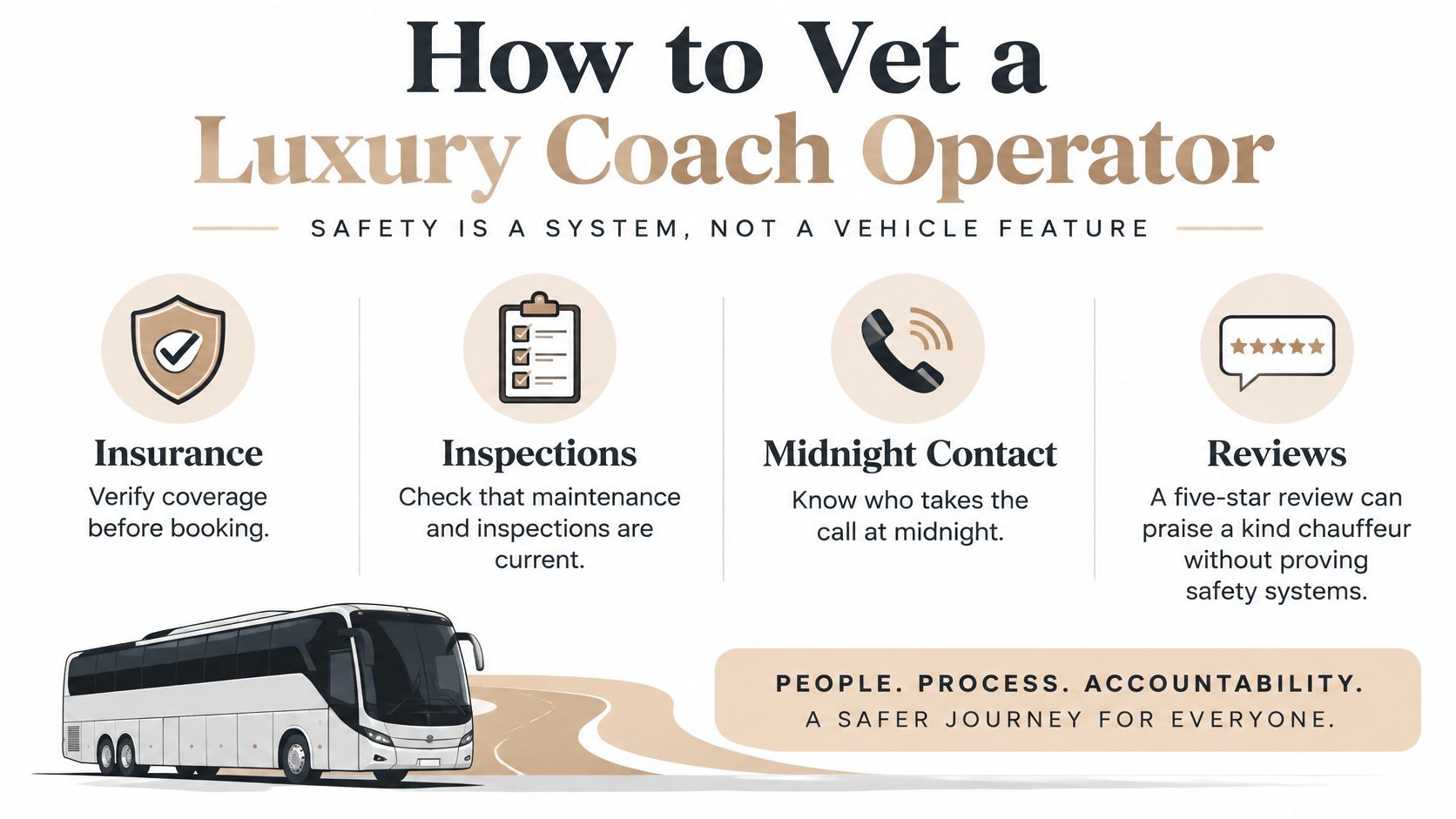
Safety is an operating system, not an upholstery choice. A positive review may describe a courteous chauffeur without telling you anything about inspections, commercial coverage, or breakdown response.
Unlicensed and inadequately insured operations remain an industry concern, according to Bus & Motorcoach News reporting on luxury transportation. Attractive presentation shouldn't replace regulatory checks.
Use the following visual as a reminder of the documents and people behind the vehicle.
Questions you can send by text
What is the legal carrier name and USDOT number? Match the reply to the business that will operate the trip. Check public operating status, inspection history, and out-of-service indicators, rather than assuming the booking brand and carrier are identical.
Can you send the insurance certificate for this passenger service? Confirm that the coverage applies to for-hire passenger transportation and the operating carrier. Federal insurance requirements increase at 16 or more passengers, including the chauffeur, for applicable interstate for-hire operations, according to FMCSA passenger-carrier regulatory information.
Who maintains this vehicle, and is a pre-trip inspection standard? Ask how defects are reported and how the company decides a vehicle cannot be dispatched. A maintenance process is more useful than a general promise that the fleet is reliable.
Who arranges a substitute or relief chauffeur? Request the breakdown escalation contact and the plan for a long assignment. Establish whether replacement equipment would preserve luggage space and accessibility.
Who owns the event manifest and loading plan? A wedding or retreat needs an accountable coordinator who can resolve a missing guest, a changed pickup, or a vehicle assignment without involving the couple or meeting host.
Check road practices as well as paperwork
The FMCSA motorcoach safety action plan identifies rollover and roadside-event risks, along with fatigue and maintenance concerns. Ask about seat-belt use where belts are installed, secure luggage storage, and conservative operation on wet or rural roads.
For help interpreting coverage terminology, use the commercial vehicle insurance explainer. Registration, insurance, maintenance, and dispatch should tell a consistent story about who is responsible.
Reviews describe a trip someone took. Documents and operating procedures help you assess the trip you're about to book.
Request credentials, maintenance practices, and the backup arrangement in writing before a deposit. A late coach can disrupt a ceremony, ferry connection, or international departure even when the original problem appears minor.
Time Limits on Long and Late Trips
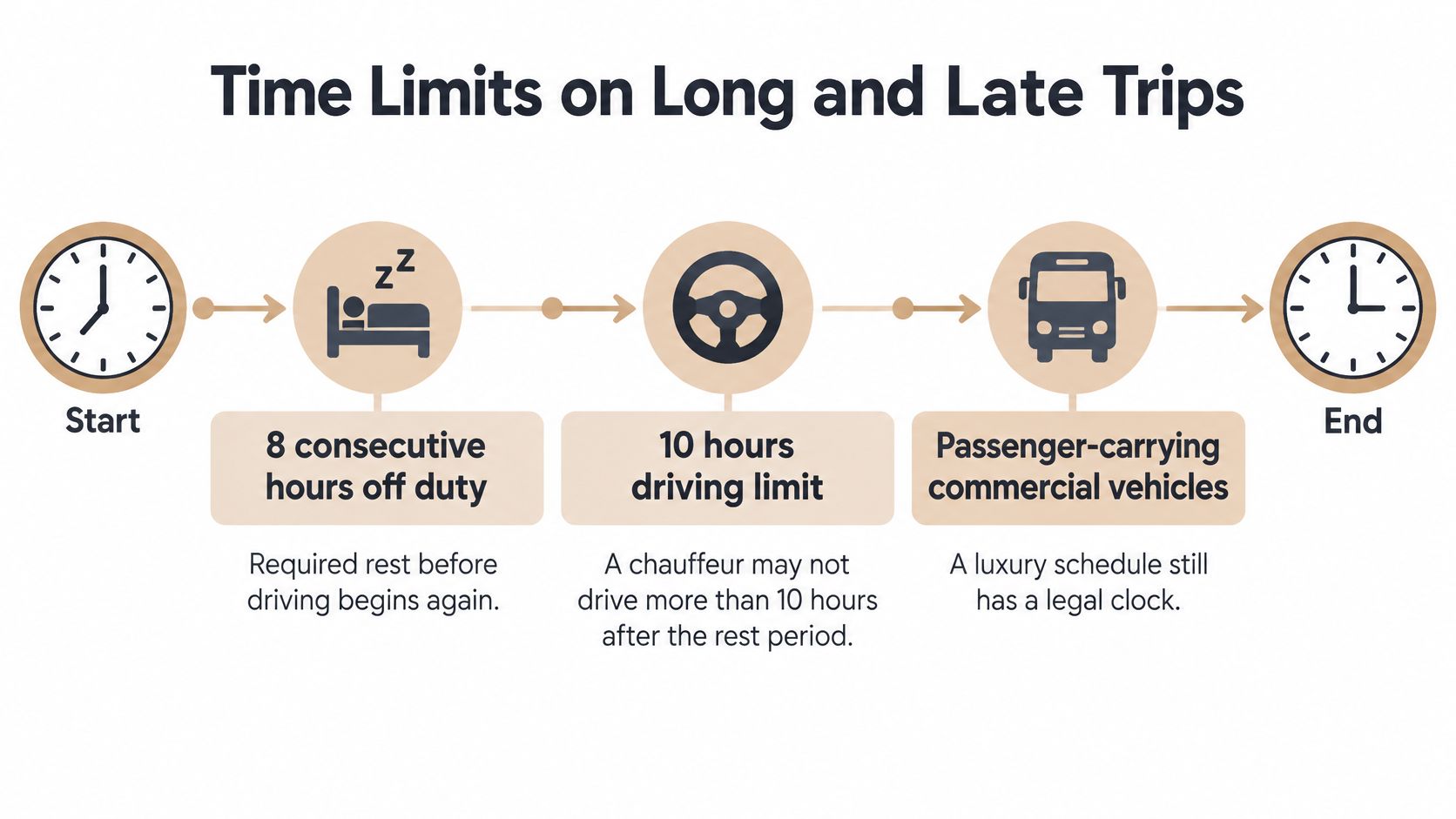
For applicable passenger-carrying commercial vehicles, the FMCSA hours-of-service rules prohibit driving more than 10 hours after 8 consecutive hours off duty, and prohibit driving after 15 hours on duty following that rest. Carriers operating every day also face a 70-hour limit in 8 consecutive days.
Those limits concern the chauffeur's work, not just the length of your reservation. A booking can fit comfortably on a client's calendar while requiring a different staffing plan for the carrier.
Chauffeur hours rules for passenger carriers
| Rule | Limit | Hamptons example |
|---|---|---|
| Driving after rest | No more than 10 hours of driving after 8 consecutive hours off duty | New York City to Montauk round trip |
| On-duty window | No driving after 15 hours on duty following 8 hours off | Wedding day from setup through reception |
| Weekly total | 70 hours in 8 consecutive days for carriers running every day | Busy summer weekend across many bookings |
| Logging | Electronic logging devices record duty status | Multi-vehicle event logistics |
The limits above come from the passenger-carrier rules cited immediately before the table. Applicable carriers use electronic logging devices under the duty-status framework described in the FMCSA safety planner's hours-of-service guidance, subject to applicable exceptions.
This timeline highlights the relationship between driving and required rest.
Apply the rules to the whole assignment
New York City to Montauk and back: Waiting while guests dine or attend an event can count as on-duty time. Stationary wheels don't automatically mean the chauffeur is off duty, particularly if the chauffeur must remain responsible for the vehicle and ready to move.
A late Newark arrival followed by an early return: The operator must account for the chauffeur's earlier assignments and rest, not just the airport legs visible to you. A delayed inbound flight can change which chauffeur can lawfully cover the next departure.
A wedding from preparation through reception: Vehicle preparation, positioning, and event duties may contribute to the workday. Ask how the carrier accommodates a reception that ends later than expected without pressuring anyone to rush.
A relief chauffeur, properly arranged split assignment, or overnight rest may be appropriate. A short waiting break isn't automatically a qualifying rest period.
Our guide to around-the-clock car service addresses planning for unusual travel windows. Continuous company availability should never be interpreted as continuous availability from the same individual.
Put the first pickup, last drop-off, and waiting blocks on a single timeline. Ask the operator to confirm the duty plan, including positioning and other work that doesn't appear on your guest itinerary.
Coachman or a Hamptons Operator
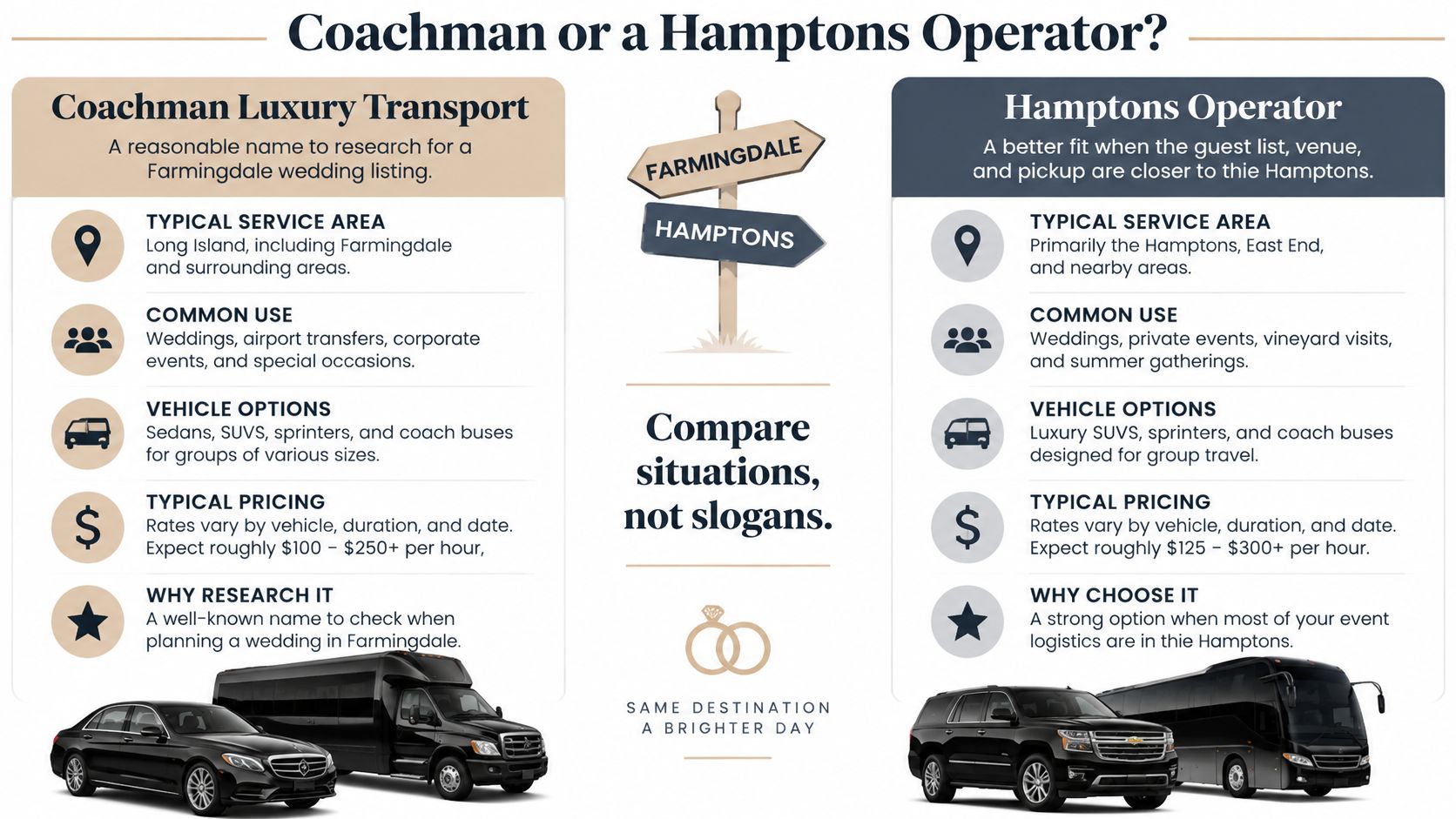
Research Coachman Luxury Transport when your wedding shortlist and pickup map center on Farmingdale or western Long Island. Give a Southampton-based operator close consideration when the assignment stays around East End homes, venues, and village roads.
Neither base location guarantees the better booking. A regional coach operator may suit a consolidated movement, while a local chauffeur operation may suit dispersed pickups and same-day changes. Compare the actual assignment rather than awarding either business an automatic advantage.
When each operator is the better fit
| Trip | Lean toward | Decide on this |
|---|---|---|
| Wedding shortlist already centered on Farmingdale | Research Coachman Luxury Transport | Guest pickup map and one coordinator |
| Ceremony and houses in the East End | A Southampton-based chauffeur | Local routing and village-road access |
| Airport in or out of JFK, LGA, EWR, or ISP | Whoever confirms flight tracking and wait policy | Staging point and late-flight plan |
| Group that needs one coach bill | Either, if the coach and chauffeur are dedicated | Manifest, luggage bays, and duty hours |
| Several small parties the same day | An operator who will run multiple vehicles under one contact | Right-sized SUVs or vans, not one oversized coach |
| Late night or early morning | Whoever is staffed for that window | A named after-hours contact |
The broad geographic distinction is useful, but the written itinerary should settle the choice.
Compare how each operator would run your day
For an East End wedding shuttle, send both companies the same hotel and venue addresses. Ask each to mark where guests assemble, where the vehicle can safely load, and who authorizes departure. A coach that keeps everyone together can still be awkward if the pickup street cannot accommodate it.
For JFK, LaGuardia, Newark, or MacArthur, prioritize the actual airport process. Ask where the chauffeur stages, how flight changes reach dispatch, and what happens when passengers take longer to reach the curb. An operator's home town matters less here than a credible airport plan.
A summer Saturday involving several houses requires a different comparison. Ask how much empty travel the operator expects before the first pickup and between assignments. A local base can help with positioning, but the response should explain the route rather than claim local knowledge.
Hamptons Leisure Limo is our local example: we're a family-owned black car and limousine service based in Southampton, NY. We've provided transportation for over 30 years, and we're fully USDOT registered and commercially insured.
Those credentials don't make another company a poor choice. They give clients a concrete Southampton operation to compare against a Farmingdale listing when the stops are Southampton, East Hampton, Sag Harbor, or Montauk.
Choose the operator whose written plan best matches the pickup map, not the operator with the most flattering description.
Request a fixed quote from each business using identical details. Compare included waiting time, tolls, gratuity treatment, cancellation terms, and the arrangement if the party splits into separate vehicles. A shorter quote isn't necessarily a simpler commitment.
Text a Hamptons Chauffeur for Your Quote
If your trip includes Hamptons stops, a New York City connection, or a regional airport, send the itinerary through Hamptons Leisure Limo's website contact options. A clear request helps the operator assess the route and vehicle fit before confirming the details.
Send information that produces a usable answer
- Party: Include the passenger count, children's seating needs, and any mobility requirements.
- Route: List the first address, destination, and intermediate stops.
- Timing: Give the date, pickup time, expected final drop-off, and any planned waiting periods.
- Cargo: Count suitcases and mention golf clubs, garment bags, or other bulky items.
- Flight: For airport travel, include the airport and flight information.
The fleet includes a Chevrolet Suburban, Mercedes S-Class, Mercedes Sprinter, and 55-seat Coach. Share the assignment rather than choosing by appearance alone. The Mercedes S-Class carries three passengers and two bags, the Sprinter carries 14 passengers, and the coach carries 55 passengers plus luggage bays. For groups larger than 14, the company coordinates multiple vehicles. Drivers wear professional attire.
Hamptons Leisure Limo offers fixed pricing with no surge fees. Ask for the written quote and its inclusions so you can compare what each reservation covers.
Compare complete replies
Send the same trip details to other operators on your shortlist, including Coachman Luxury Transport. Compare the proposed vehicle, waiting terms, and how the operator will coordinate the trip. A regional coach operator may suit a large group, while a Southampton-based chauffeur may better match a journey centered on the Hamptons. The right fit depends on the route and party.
A polished event schedule isn't necessary to start. Provide the headcount, first address, timing, and luggage count, then clarify any open details before booking.
Hamptons Leisure Limo provides pre-arranged transportation across the Hamptons, Long Island, and New York City, including airport transfers, special events, and corporate travel. Visit Hamptons Leisure Limo to review the options and request a quote with your pickup address, headcount, and luggage details.
Ready to Ride with Hamptons Leisure Limo?
Fixed pricing. No surge fees. 30 years of experience serving the Hamptons. Text us what you need and we will send a quote.