Cheap Party Bus Rentals: How to Book Without Hidden Costs
Updated November 8, 2026

Your group chat has a headcount, a wedding venue or dinner reservation, and several opinions about transportation. You've found cheap party bus rentals with attractive hourly rates, but the quotes don't explain whether everyone fits, what happens after the booked time, or which charges come later.
The useful comparison isn't the lowest advertised rate. It's the complete cost per actual rider, in a vehicle everyone can use, with the itinerary and contract terms settled before anyone pays a deposit.
Table of Contents
- Vehicle Sizes and Wheelchair Access for Your Group
- How to Compare Quotes by Cost Per Rider
- Timing and Booking Windows That Lower the Bill
- Negotiation and Cheaper Alternatives
- Legal and Safety Checks Before You Book
- Contract Terms and the Written Quote Before Any Deposit
Vehicle Sizes and Wheelchair Access for Your Group
Vehicle options by group size
| Vehicle | Passenger Capacity | Best Fit | Notes |
|---|---|---|---|
| Chevrolet Suburban or Cadillac Escalade | Up to 6 | Families or small groups with luggage | Premium SUV option |
| Mercedes-Benz S-Class | Up to 3 | Private ride for two or three | Dedicated vehicle, no shared rides |
| Mercedes-Benz Sprinter Van | Up to 14 | Bachelorette parties, small weddings, corporate teams | Child seats available by request |
| 25-passenger mini-bus | 25 | Prom groups, mid-size events | Confirm seats after luggage |
| 55-passenger coach | 55 plus luggage bays | Weddings, corporate outings, school trips | Groups over 14 coordinated with one coordinator |
Use these vehicle classes to establish what to compare, not as a promise that every configuration is available for your date. Our fleet consists of the Chevrolet Suburban, Mercedes S-Class, Mercedes Sprinter, and a 55-seat Coach. For groups bigger than 14 passengers, we use multiple vehicles with one coordinator.
A 36-passenger mini-bus is another size you may encounter when comparing event transportation. Don't assume an intermediate-size vehicle is automatically the better purchase. Ask for the seating and storage arrangement that will serve your group.
Count usable seats, not just advertised seats
A full passenger list doesn't describe the whole load. Airport suitcases, folded mobility equipment, child seats, and wedding attire all affect the practical fit. Send those details with the headcount rather than discovering a storage problem at pickup.
The FMCSA passenger-carrier guidance identifies a vehicle designed or used to transport at least 9 passengers, including the chauffeur, for compensation as a commercial motor vehicle. That threshold concerns design and use, not just how many friends attend your event.
When comparing a Sprinter with vehicles advertised under similar names, our guide to 15-passenger party buses can help frame the capacity questions. Confirm whether a quoted headcount includes the chauffeur.
Make accessibility part of the first request
A large vehicle isn't necessarily wheelchair accessible. FMCSA accessibility guidance explains accessible over-the-road bus service and notes that charter and tour operators may require up to 48 hours' advance notice.
- Boarding equipment: Confirm lift dimensions and compatibility with the passenger's mobility device.
- Securement positions: Ask how many wheelchair positions the proposed layout provides.
- Occupied travel: Establish whether the passenger can remain in the mobility device during travel.
- Written assignment: Get confirmation that the accessible vehicle will arrive, rather than an unsuitable substitute.
For guests flying into the area, Top Mobility's resource on taking a mobility scooter on planes helps separate airline preparation from ground-transport arrangements.
Choose the smallest suitable vehicle, not merely the smallest listed vehicle. Everyone, their luggage, and any child seats must fit properly.
How to Compare Quotes by Cost Per Rider
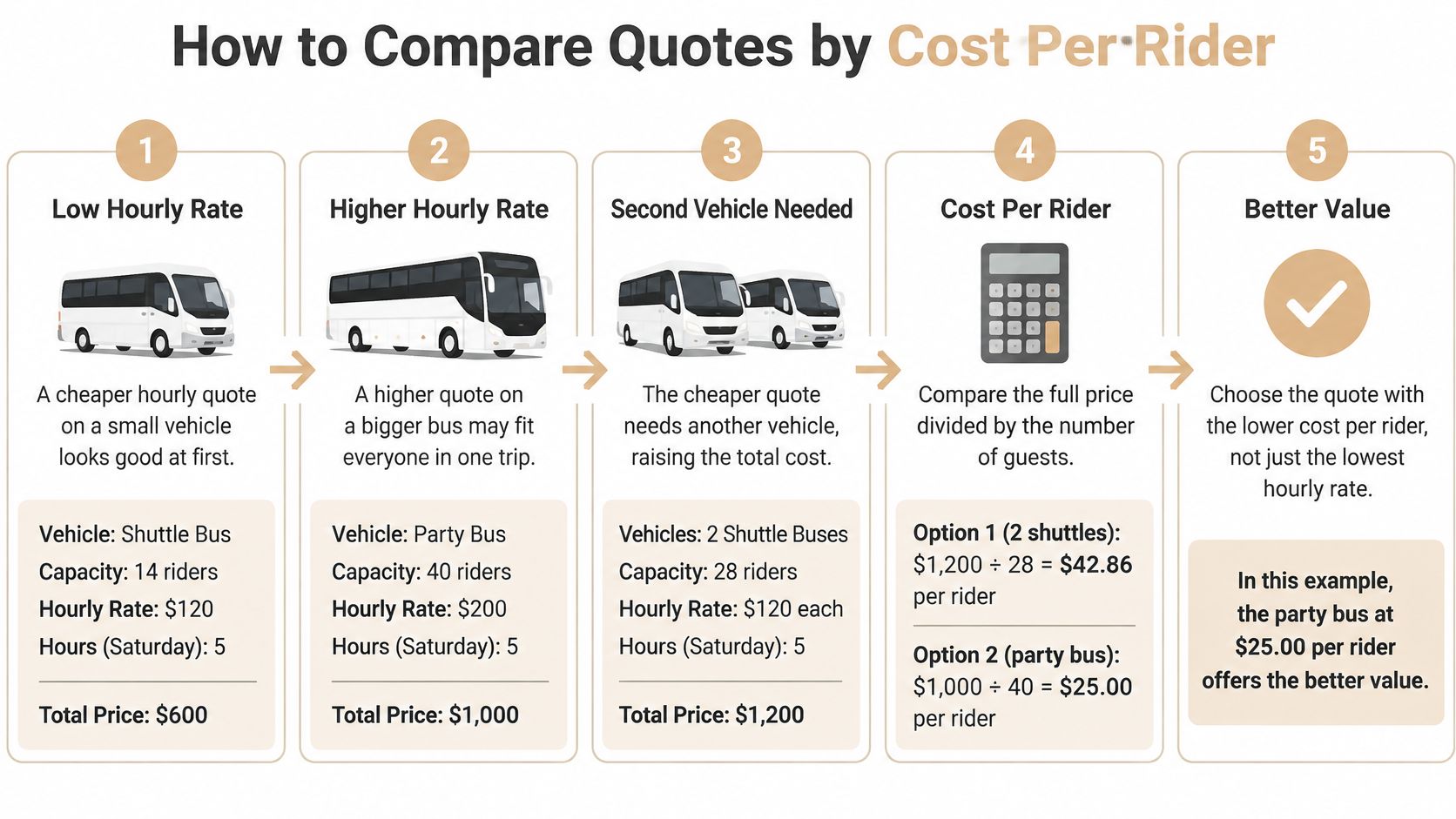
Say you're comparing quotes for the same Saturday wedding shuttle. The smaller vehicle has a lower hourly rate, but it can't carry the confirmed guest list. Once another vehicle is added, that offer can cost more per rider than the larger bus.
A bigger vehicle isn't automatically better value either. Empty seats don't contribute to the bill. Compare the full transportation plan against the passengers who will board.
Build the comparison in a consistent order
Define the trip. Write down the confirmed passenger count, pickup sequence, final drop-off, and total vehicle time. Include estimated deadhead mileage, meaning the empty travel needed to reach the first pickup or reposition afterward. Ask when the billable clock starts and stops.
Check usable capacity. Match the proposed seating arrangement to your actual group and equipment. If the quote requires another vehicle, include it from the start. Don't compare a complete solution against an offer that leaves guests behind.
Apply the booking minimum. Multiply the quoted hourly rate by the provider's minimum billable period, not just the time you hope to spend onboard. A short ceremony transfer can still occupy a reserved event block. Use the minimum written in that particular quote.
Add every disclosed charge. Include taxes, chauffeur gratuity, fuel, tolls, parking, cleaning, and potential overtime under the stated terms. Mark each item as included, additional, or conditional so you aren't treating an incomplete subtotal as a final price.
Divide by confirmed riders. Use the people committed to traveling, not everyone invited. If some guests arrange their own transportation, recalculate before collecting contributions.
Events in Minutes' event-transportation guide supports this total-cost approach, including booking minimums and the additional charges that make hourly-only comparisons misleading. Its market examples aren't a Hamptons quote.
The process is easier to compare visually:
Use the itinerary to get the actual number
Our rates depend on pickup location, destination, and vehicle type. We never charge surge fees or hidden charges, and an exact comparison starts with a route-specific fixed quote rather than a generic advertised rate.
Keep a simple spreadsheet with columns for the total, confirmed riders, included services, and remaining conditions. A quote with unresolved charges isn't ready to rank alongside a complete offer.
If the cheaper-looking quote costs more per rider for the transportation your group actually needs, it isn't the cheaper option.
Timing and Booking Windows That Lower the Bill
Change the schedule before cutting the service. Consolidating departure times, removing an unnecessary stop, or choosing a booking structure that matches the event can be more useful than negotiating the hourly rate alone.
When comparing operators, establish whether Sunday, holiday, or overnight pickups carry different terms. With us, Sunday, holiday, and 3am pickups are the same price as other pickups. A late departure doesn't need to become an unexplained premium on the invoice.
Match the booking structure to the itinerary
Hourly service keeps the vehicle and chauffeur with you for as long as needed under the booking. It suits an evening with dinner, a reception, and a final return because transportation remains part of the schedule throughout.
Point-to-point service suits a single transfer where you don't need a vehicle waiting between activities. Don't pay to retain transportation through a long event without comparing that arrangement against separate transfers and their availability.
For rideshare comparisons, count every vehicle and every leg for the same group. Clients can save up to 40% compared with rideshare services during peak Hamptons season, but that's a potential saving, not a guarantee for every itinerary.
Leave room for the handoff
Consider a wedding with a hotel pickup, ceremony transfer, and reception arrival. Booking the sequence as one hourly block can keep the chauffeur on the schedule through loading and venue handoffs. Compare that complete block against fragmented bookings before deciding which costs less.
- Loading buffer: Allow guests time to find the pickup point and board.
- Traffic allowance: Build the route around realistic travel conditions rather than an optimistic arrival estimate.
- Confirmed departure: Give the coordinator authority to gather guests and communicate changes.
Reserve early for prom, wedding, and holiday weekends once the essential details are settled. Early planning gives you time to compare suitable vehicles and terms, but don't assume it guarantees a discount.
A workable schedule is better value than a short booking that depends on every guest and every traffic light cooperating.
Negotiation and Cheaper Alternatives
Negotiate the shape of the trip, not just the headline rate. An operator can evaluate a specific change more clearly than a general request to make the same service cheaper.
Make requests that can change the total
Start with a consistent itinerary. Request a fixed, route-specific quote using the same pickup, destination, stops, and service window for every offer. Otherwise, you're negotiating different jobs.
Ask whether the minimum booking period can be shortened for your event. Explain the actual task, such as a direct venue transfer, rather than requesting open-ended availability at a shorter-booking price. Include a realistic buffer.
Test a smaller vehicle or fewer stops. A Sprinter-style van may cover a group that doesn't need a mini-bus. A consolidated hotel pickup may also simplify the job compared with collecting guests from separate houses.
Identify charges outside the base quote. Ask whether tolls, parking, or cleaning can be included, waived, or capped in writing. An agreed limit is useful; a vague promise to settle it afterward isn't.
Offer genuine flexibility. If the event can move to a weekday or use a different departure window, say so. Ask what changes in the total rather than assuming an off-peak label means a discount.
Compare alternatives by what you need
| Alternative | Sensible use | Trade-off to evaluate |
|---|---|---|
| Hourly group service | Multi-stop evening | Paying for retained availability |
| Point-to-point transfer | Airport arrival or single venue transfer | No vehicle retained between activities |
| Smaller private vehicle | Low confirmed headcount | Less passenger and luggage capacity |
| Coordinated vehicles | Separate guest origins or departure needs | More assignments and pickup communication |
A private S-Class or premium SUV can be the practical alternative when the group is small. A Sprinter makes more sense when additional passengers genuinely need those seats, not because a bus feels more appropriate for a celebration.
Ask for a revised written total after each meaningful itinerary change. Keep the same confirmed rider count in your comparison so a smaller total doesn't hide a more expensive contribution for each person.
Legal and Safety Checks Before You Book
Compliance comes before the deposit. A polished website, attractive interior photo, or strong online rating doesn't establish that the carrier is authorized and insured for your trip.
Use a documented review rather than relying on appearances:

Verify the carrier and the assigned service
Get the legal name and USDOT number. Identify the business operating the vehicle, not only the website or intermediary taking the reservation.
Check operating authority, insurance status, inspections, and crash history. The FMCSA charter-bus safety fact sheet advises against choosing on price alone and identifies authority, insurance, chauffeur qualifications, and maintenance as screening priorities.
Match the booking to the carrier. Confirm that the quoted vehicle and chauffeur are covered by the operating carrier, especially if a broker arranged the trip.
Request seating capacity, seat-belt configuration, maintenance procedures, and an emergency-contact process in writing. Know whom the coordinator should contact if the pickup changes or the assigned vehicle doesn't arrive.
Hamptons Leisure Limo is fully USDOT registered and commercially insured. You can request our USDOT number and insurance details in writing and apply these same checks to us.
Confirm alcohol rules before planning onboard service
New York Vehicle and Traffic Law §1227 generally prohibits drinking alcohol, consuming cannabis, or possessing an open alcoholic container in a motor vehicle on a public highway or right-of-way, while providing a passenger exception tied to specified state or federal authorization and defining the relevant passenger vehicle as designed to carry 10 or more passengers for hire. Don't assume that booking something advertised as a party bus establishes that authorization.
New York Vehicle and Traffic Law §507-a requires pre-employment and random drug and alcohol testing for covered for-hire vehicles seating 9 or more, including the chauffeur, and bars a motor-carrier chauffeur from consuming intoxicating liquor within 8 hours before duty.
For a school celebration, use our party bus guidance for teens to organize parent communication and transport expectations. An adult-event alcohol exception isn't permission for underage drinking.
Use the video as supporting context, not a substitute for checking the specific carrier:
Contract Terms and the Written Quote Before Any Deposit
An oversized booking minimum can outweigh an attractive hourly rate. If your event needs only a short transfer, the important question is how much time you must purchase, not how little an individual hour appears to cost.
Use this checklist to turn an appealing offer into a contract you can evaluate.
Contract charges to confirm in writing
| Charge | What It Usually Covers | What to Ask For in Writing |
|---|---|---|
| Minimum booking hours | Smallest billable block; event minimums should be specified in the quote | Exact minimum and whether it applies to short events |
| Overtime | Time beyond the booked block, billed in increments | Length of each increment and applicable charge |
| Chauffeur gratuity | Tip for the chauffeur | Whether it is included or added |
| Fuel, tolls and parking | Travel costs on the route | Whether fuel, tolls and parking are included |
| Cleaning | Post-event cleanup | Whether a cleaning charge applies and what triggers it |
| Mileage | Included miles and empty repositioning | Included mileage and deadhead terms |
| Cancellation and deposit | Refund window and deposit size | Refund window and deposit terms |
Separate legitimate savings from missing protection
Legitimate savings change the service requirement: a smaller suitable vehicle, consolidated stops, a shorter agreed booking block, or a flexible date. You know what you're giving up and can decide whether that trade-off works.
Risky savings leave essential questions unanswered. Unclear licensing, inadequate insurance information, vague vehicle substitutions, or a low deposit paired with unexplained later charges aren't useful concessions.
Before payment: The written terms should explain both what you're buying and what could change the final total.
Ask what happens if the assigned vehicle becomes unavailable. A substitute should meet the agreed passenger, luggage, and accessibility requirements. Don't accept a generic substitution clause without understanding what service it permits.
Match the contract to pickup day
Our point-to-point service has fixed pricing for one-way trips, quoted before you step into the vehicle. Our explanation of fixed-price transportation helps distinguish that arrangement from reserving hourly availability.
For a Hamptons itinerary, put the exact pickup point, destination, and intermediate stops in writing. Include the venue's designated loading location and any access instructions. Seasonal traffic and bridge or tunnel tolls should be addressed in the quoted route rather than left as assumptions.
We're available 24 hours a day, 7 days a week, 365 days a year. Still, availability doesn't replace a confirmed reservation with the correct date, service window, and passenger requirements.
Before paying, compare the final all-in contribution for each rider and check that the vehicle description matches what your group needs at pickup. If the minimum, overtime increment, cancellation terms, or vehicle assignment remains unclear, request a revised quote before sending a deposit.
Hamptons Leisure Limo offers pre-arranged group transportation with fixed pricing, no surge fees, and coordinated planning for Hamptons events. Visit Hamptons Leisure Limo to explore the service options, then Text (631) 294-0747 with your date, passenger count, pickup locations, luggage, and accessibility needs for a fixed, route-specific quote before any deposit.
Ready to Ride with Hamptons Leisure Limo?
Fixed pricing. No surge fees. 30 years of experience serving the Hamptons. Text us what you need and we will send a quote.