Party Bus for Teens: How to Book Safely
Updated October 30, 2026

Distraction-related traffic crashes remain a safety concern for U.S. teenagers, as NHTSA's prom-season driving guidance makes clear. A party bus booking should start with the trip plan, not the lighting or speakers: name the adult trip lead, account for every teen at each handoff, and confirm that each passenger has an assigned seat and working belt.
A bigger vehicle isn't automatically safer. For a Southampton birthday, a prom departure from Bridgehampton, or a graduation return from Montauk, parents need a clear chain of custody for minors, not just a reservation confirmation. The trip lead should know who is boarding, where each teen is going, and which adult is receiving them. A teen who needs to leave early should have a no-judgment way to tell the trip lead and arrange a handoff.
Table of Contents
- Match Your Group Size to a Supervised Vehicle
- Check Credentials Before You Leave a Deposit
- Run Seat Belts Headcounts and a Fixed Route
- Plan Hamptons Pickups and Late Night Returns
- Agree an Early Exit Then Request a Quote
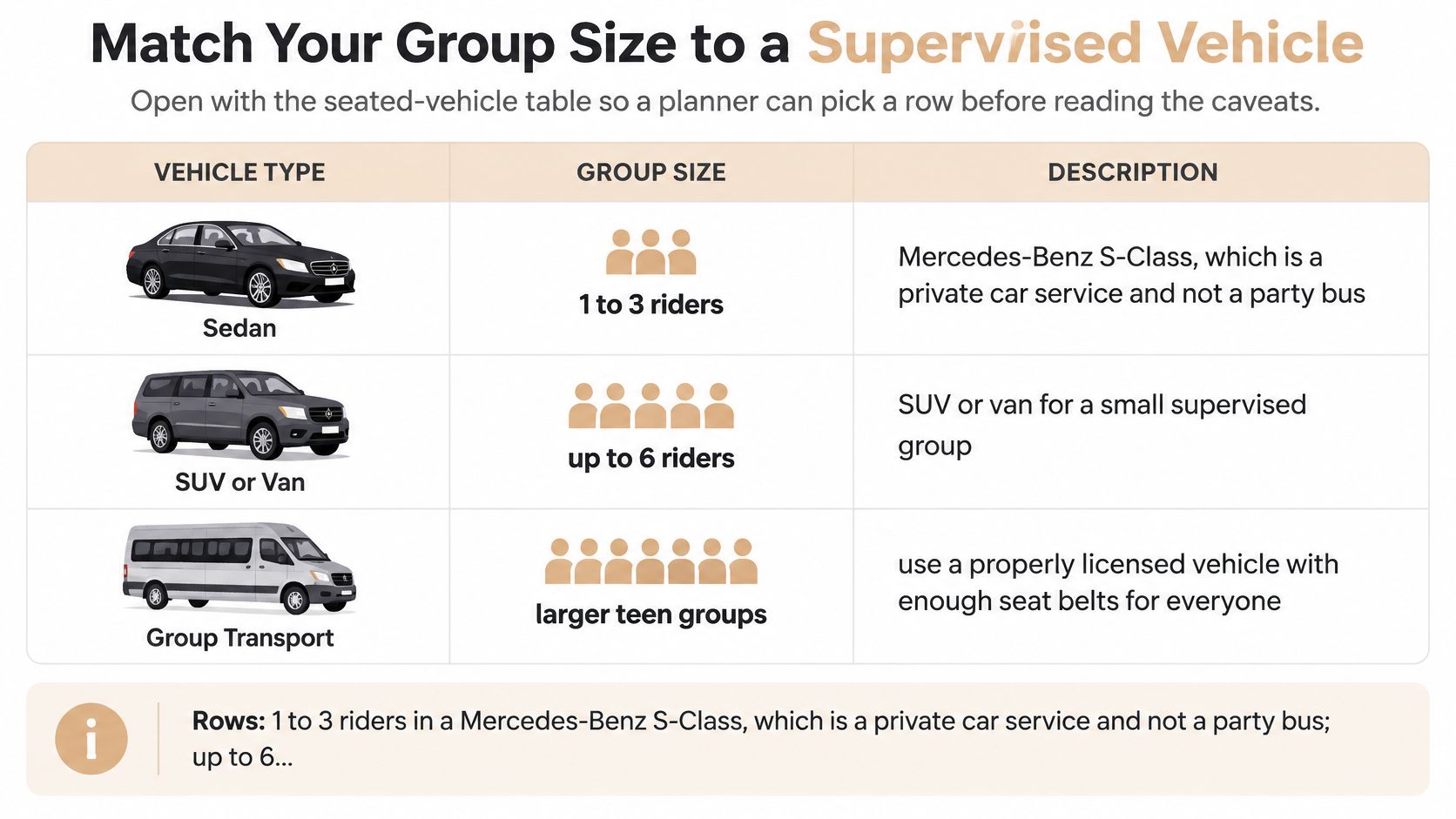
Match Your Group Size to a Supervised Vehicle
Seated vehicle size for a teen group
| Group size | Vehicle | Best fit |
|---|---|---|
| 1 to 3 | Mercedes-Benz S-Class | Not a party bus; private car service only |
| Up to 6 | Premium SUV, Suburban or Escalade | Small birthday or sibling group |
| 7 to 14 | Mercedes-Benz Sprinter | Dinner, photos, and the dance |
| 15 to 25 | 25-passenger mini-bus | Prom squad including chaperones |
| 26 to 36 | 36-passenger mini-bus | Larger grade or combined houses |
| 37 to 55 | 55-passenger coach | Graduation or two groups kept together |
Pick the row that matches the whole traveling headcount, including chaperones, then confirm the actual seating layout at quote. These are vehicle-selection bands, not permission to squeeze another passenger into a particular vehicle. The dispatched vehicle must provide a manufacturer-designated seat and a working belt for everyone.
The reason to replace teen-driven carpools is substantial: NHTSA's Young Drivers report records 2,148 deaths among drivers aged 15 to 20 in 2023, up 5% from 2,037 in 2022, and shows that this age group represented 5.1% of all licensed drivers but 8.9% of drivers involved in fatal crashes, about 1.7 times its licensed-driver share. A commercial vehicle with an adult chauffeur changes who handles the driving. It doesn't erase road risk or replace proper supervision.
New York also restricts the private-car alternative: the New York DMV learner-permit guide says a junior learner permit holder may not carry more than one passenger under 21 unless the passengers are immediate family or the supervising adult is a licensed parent, guardian, person acting in loco parentis, driver education teacher, or driving-school instructor, and every passenger must have and use a seat belt. Professional transportation avoids assigning the party's transport to a new permit holder.
Choose by the trip, not the party label
A Mercedes-Benz S-Class is a private car service, not a miniature party bus. It suits a small, quiet transfer where the booking adult wants a direct pickup and return. A premium SUV can suit a small birthday group without introducing the boarding and supervision demands of a larger vehicle.
A Mercedes-Benz Sprinter makes sense when friends want to travel together through dinner, photos, and the dance. Before choosing it, account for formal clothing, bags, any mobility needs, and the adult who'll manage the passenger group. Ask for photographs of the actual seating arrangement, not just an exterior image of the model.
Mini-buses and coaches solve a different problem: keeping a larger group on a coordinated itinerary. Their advantage disappears if parents can't identify who is aboard or if passengers switch vehicles without updating the records. The group transportation planning guide is useful when deciding whether to keep everyone together or organize separate departures.
Capacity rule: The aisle isn't an extra seat, and a chaperone isn't an optional passenger when the booking gets crowded.
Count adults before choosing the vehicle
Build the passenger list before collecting contributions from families. Include the younger sibling joining dinner, the parent riding outbound, and the chaperone returning after the event. If adults change between legs, record those changes rather than assuming the outbound count covers the return.
When the headcount falls between vehicle bands, choose the larger suitable vehicle with verified seating and belts. Don't book the smaller option on the assumption that someone will cancel. A last-minute addition needs an approved seat, not a verbal exception at the curb.
Also ask where bags will go. A clear aisle and accessible exits matter more than spreading belongings across unused seats, especially when the group boards in formalwear after dark. Keep essential medication with the responsible passenger or adult, according to the family's agreed plan.
Take the chosen vehicle row, the passenger list, and the seating requirements into the credential check. A model name alone isn't enough to approve the booking.
Check Credentials Before You Leave a Deposit
A polished vehicle photograph doesn't establish who will operate the trip. Before paying, identify the carrier, the vehicle class, and the person accountable for changes. If a marketplace or broker arranges the booking, ask who will transport the minors.
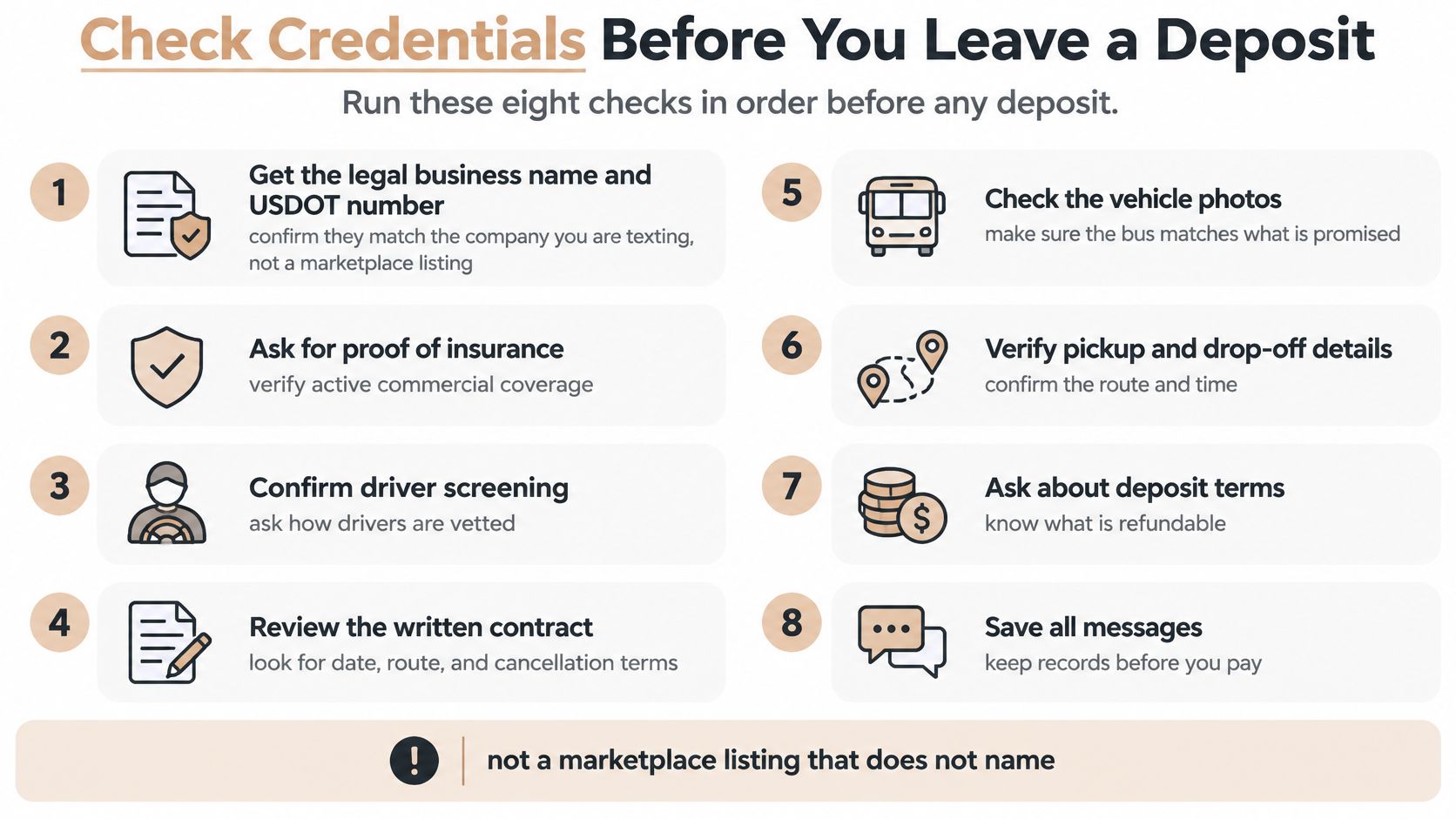
Run these checks in order. Keep the answers together with the written quote so another guardian can understand the arrangement without reconstructing a text conversation.
- Get the legal business name and USDOT number. Pass standard: the carrier's identity matches the company named in the booking documents, rather than an unnamed marketplace supplier.
- Request the commercial insurance certificate. Pass standard: coverage is active for the service date and applies to passenger transportation in the assigned vehicle class. Ask the carrier or insurance representative to clarify anything ambiguous.
- Confirm the chauffeur and credentials. Pass standard: a named professional chauffeur holds the commercial license appropriate to the assignment. A parent volunteer or teen isn't a substitute; if assignment happens closer to departure, require a written confirmation deadline.
- Match seats to the passenger list. Pass standard: the written capacity accommodates the entire group with a belt for each rider and no standing.
- Put prohibited-item rules in writing. Pass standard: zero alcohol, drugs, vaping, and other agreed prohibited items, with a clear response if someone brings them. NHTSA's teen-driving guidance notes that every state sets the minimum legal drinking age at 21.
- Name the supervising adults. Pass standard: each vehicle has a named trip lead and identified chaperones. For this planning standard, require at least one adult on a Sprinter and more than one on a mini-bus or coach, then increase supervision for the group's needs.
- Lock the operating details. Pass standard: pickup windows, curfew, approved stops, and authority to change the route are written down.
- Approve the payment terms last. Pass standard: a written quote specifies fixed pricing, no surge, deposit terms, cancellation terms, and how itinerary changes affect the booking.
Keep a booking record another adult can use
What to verify before a teen party bus deposit
| Check | Ask for | Pass standard |
|---|---|---|
| Carrier identity | Legal name and USDOT number | Name matches the company you book |
| Insurance | Commercial certificate for the date | Passengers covered on that vehicle class |
| Chauffeur | Name and license class | Commercial license, not a teen or volunteer |
| Capacity | Seats versus headcount | One belt per rider, no standing |
| Alcohol | Written policy | Zero alcohol and zero drugs on board |
| Supervision | Chaperone names | One named trip lead per vehicle |
| Money | Written quote and deposit terms | Fixed pricing, no surge |
Screening and supervision are separate questions. Parents organizing a school or youth-group trip can use VolunteerBadge's discussion of background check policies for youth leagues to frame questions about adult screening, responsibilities, and documentation. That resource doesn't verify a transport carrier or replace its insurance and licensing checks.
Ask how a substitute chauffeur or replacement vehicle will be approved. A booking can look complete until equipment changes, so require notice and recheck capacity, restraints, and credentials before accepting a substitution.
The common miss is paying a broker who can't produce the operating carrier's documents. Hold the deposit until every check passes. Text (631) 294-0747 with the date and headcount to request a quote, and ask for the USDOT number and insurance certificate for your service date.
Run Seat Belts Headcounts and a Fixed Route
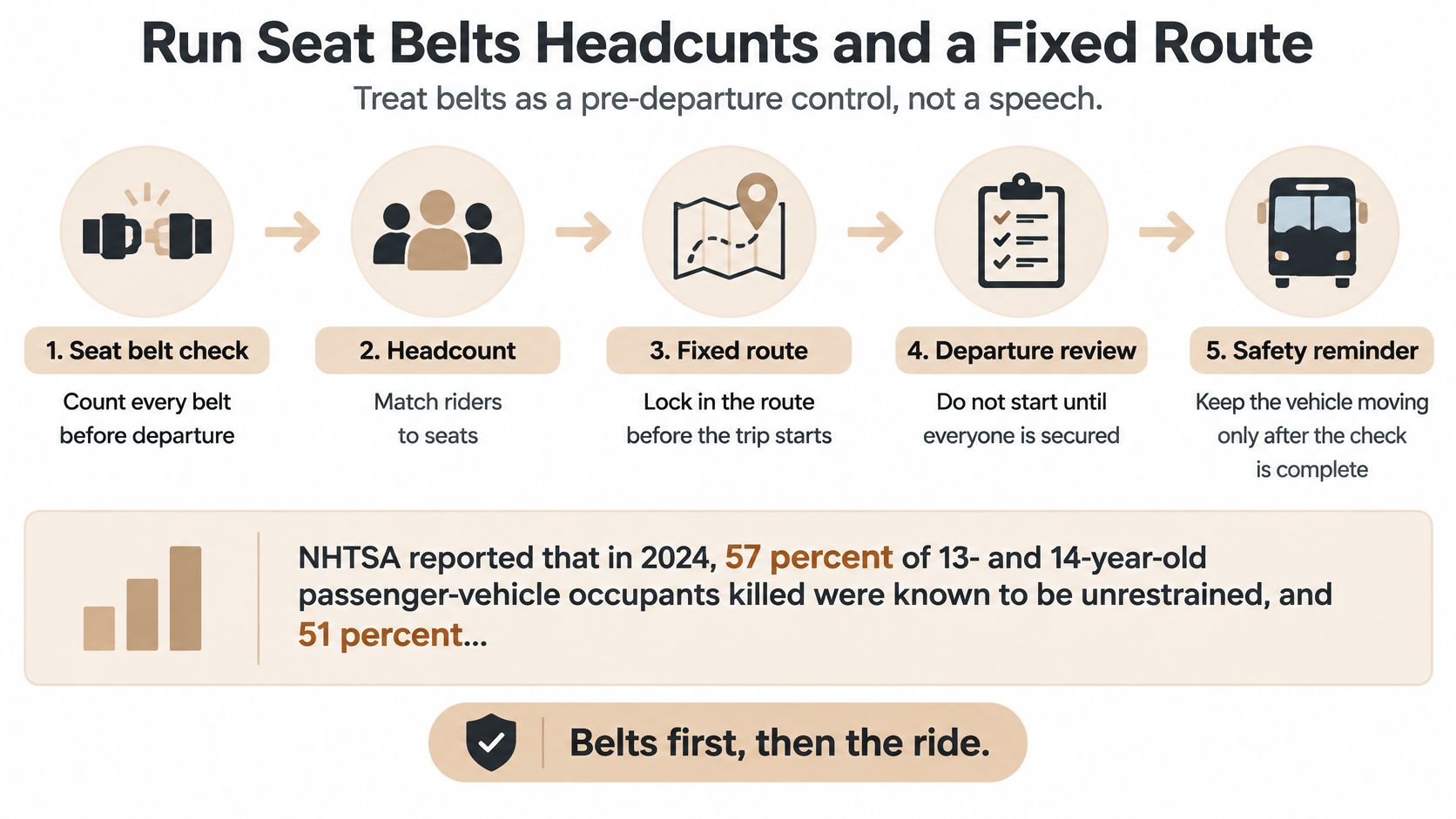
In 2024, 57% of 13- and 14-year-old passenger-vehicle occupants killed in crashes were known to be unrestrained, while 51% of teen drivers killed were unbelted, according to NHTSA's seat-belt guidance, which also reports a national front-seat belt-use average of 91.2%. For a supervised charter, set the departure standard at 100% observed belt compliance, not the national average.
Treat belts as a pre-departure control, not a speech. Telling passengers to buckle up isn't the same as confirming that every occupied seat is secured.
Make departure a repeatable procedure
- Collect the manifest before the first pickup. Obtain the signed passenger list, guardian emergency contacts, approved destinations, and relevant medical instructions. Give the trip lead a controlled copy that can be updated.
- Assign seats before boarding. Keep passengers in manufacturer-designated seats. Check younger passengers' restraint needs before the service date rather than trying to solve a child-seat issue at the curb.
- Have the chauffeur lead the belt check. The chaperone can assist with visibility toward the rear, but the vehicle stays parked until completion is confirmed. This includes a short repositioning trip between homes.
- Keep passengers seated while moving. No standing, aisle movement, or opening doors. Handle photos, seat changes, and retrieval of stored belongings while safely parked.
- Repeat after every stop. Record the passenger count, completed belt check, and any exception for each leg. New passengers and returning passengers both need verification.
Hold rule: Any unresolved exception holds the vehicle. The chaperone or guardian intervenes before departure, whether the issue is a missing passenger, a refusal to buckle, or an unusable restraint.
Separate passenger management from driving
The trip lead handles behavior. The chauffeur drives. If a disagreement requires sustained attention, resolve it while parked rather than expecting the chauffeur to monitor the road and negotiate with passengers.
If a teen feels ill, arrange a safe stop, contact the guardian, and keep the passenger accounted for. For a medical emergency, contact emergency services instead of treating it as an ordinary itinerary change. Don't depart with an uncounted rider or let a sick passenger leave without an authorized handoff.
A larger coach makes accountability harder, not easier, unless boarding, seating, and drop-offs stay on a controlled manifest.
The predictable failures are assuming teens will self-police in the back, skipping a recheck after a pickup, and accepting a lounge-style layout without a belt for every passenger. Entertainment must fit the seated arrangement. A playlist works; dancing while the vehicle moves doesn't.
For dance-specific coordination, the prom transportation planning guide can help organize the event itinerary. Families also arranging private-car travel across the border can consult G1ready.ca's passenger guidance for Ontario teen drivers, rather than assuming New York permit conditions apply there.
The ride does not replace adult supervision at the venue or after the final drop-off. Name the adult taking over at each boundary.
Plan Hamptons Pickups and Late Night Returns
Nighttime needs its own operating plan. In 2024, 56% of passenger-vehicle occupants killed between 6 p.m. and 5:59 a.m. were unrestrained, compared with 41% during daytime hours, according to NHTSA's seat-belt safety material. Don't let a late finish turn the return into a less controlled version of the outbound trip.
Work backward from the home-arrival requirement. The useful question isn't when the event ends, but when passengers must be boarded, checked, and ready to leave.
Turn addresses into usable pickup instructions
Use full street addresses for every stop, not a beach name, restaurant nickname, or dropped pin alone. For homes in East Hampton, Amagansett, Sag Harbor, Wainscott, and Quogue, include the house number, private-lane instructions, gate code, and a daytime photograph of the entrance when access isn't obvious.
Choose a legal, suitable boarding location with room for the assigned vehicle. A driveway that works for an SUV may not work for a coach. Tell dispatch about narrow approaches, restricted turning space, and gates before confirming the stop.
For a hypothetical summer itinerary, a planner might allow 45 to 70 minutes for a Montauk-to-Southampton return on Montauk Highway, then ask dispatch to revise that allowance for the date, stops, and conditions. That's a planning example, not a promised drive time. Bridgehampton or Water Mill may suit midpoint pickups when friends are spread along the route, provided parents agree to the meeting location and handoff.
Use a handoff log, not just a group chat
Build the return workflow before the event:
- Fix the stops. Record approved pickup and drop-off addresses, including access instructions.
- Identify the passenger representative. Keep a named adult trip lead available to the chauffeur and dispatcher.
- Control route changes. Don't allow unscheduled stops unless dispatch authorizes them and guardian approval is obtained where needed.
- Timestamp handoffs. Maintain a live manifest showing who boarded, who left, and when.
- Verify release. The chauffeur and trip lead confirm that each minor goes only to the authorized adult or location.
- Record exceptions. Log delays, belt refusals, medical issues, and route changes so the receiving adult understands what happened.
Set a target of zero unauthorized deviations and a documented handoff for every passenger. If the party splits across vehicles, each vehicle needs its own passenger record, with a coordinator tracking the overall move. A group chat can carry updates, but it shouldn't be the only record of who is where.
Return-trip discipline: A late arrival changes the notification plan. It doesn't cancel the handoff procedure.
For example, a family might propose wheels rolling by 11:30 p.m. for a midnight curfew. Dispatch should confirm whether that hypothetical window works for the actual route; boarding, intermediate stops, and access time all need room in the schedule.
Reserve the return vehicle with the outbound trip. Even a company operating around the clock needs confirmed capacity, and an unreserved on-demand car at 1 a.m. in Montauk is a weak hypothetical backup.
Send delay updates before guardians start wondering where the group is. The mistake to avoid at the end is skipping the final passenger count because the night ran long.
Agree an Early Exit Then Request a Quote
A teen who needs to leave shouldn't have to choose between staying in an unsafe situation and explaining everything in front of friends. Build a discreet exit into the booking, and tell the teen that asking for help won't trigger an argument during the pickup.
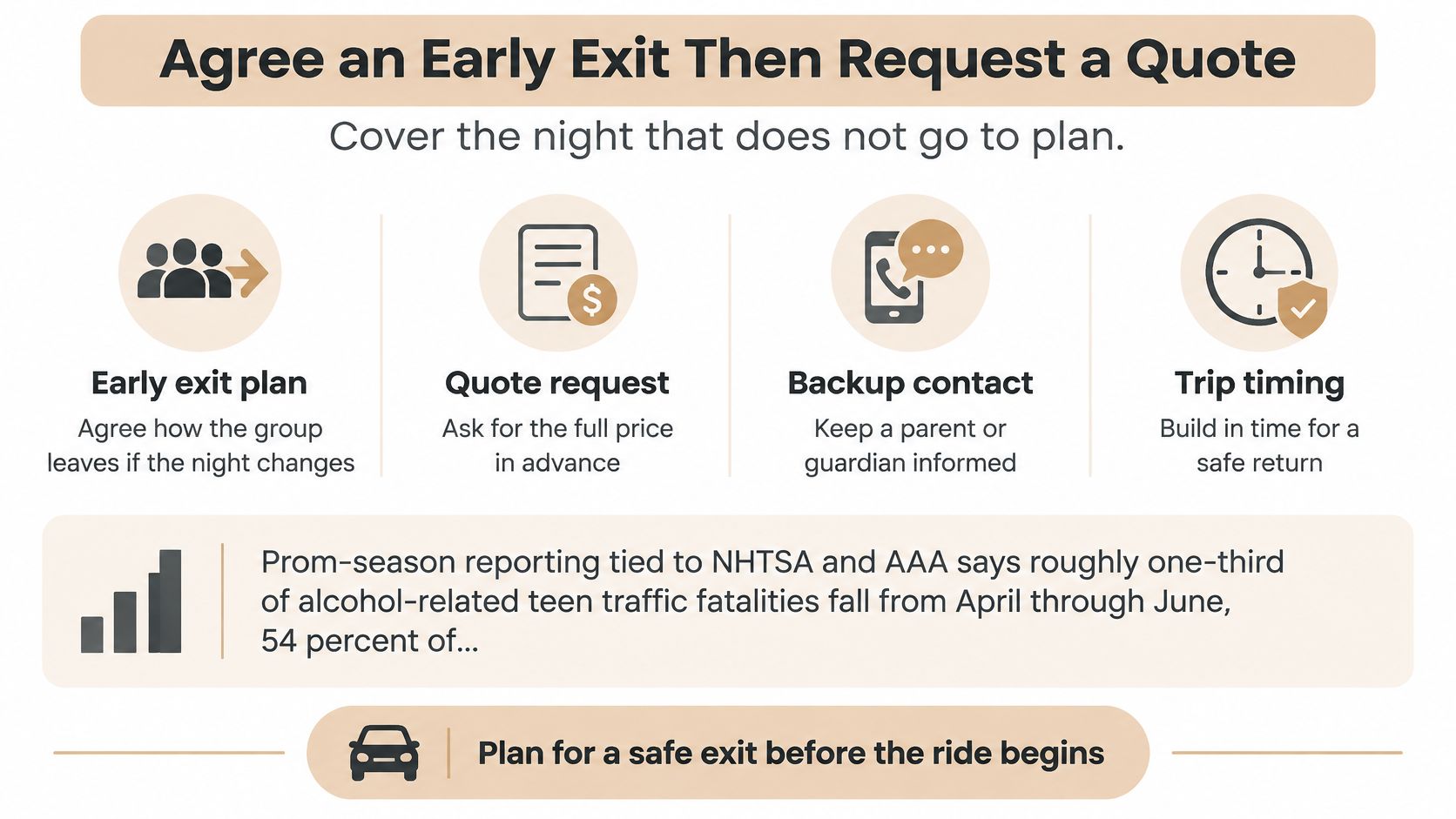
NOCO Style's prom-season reporting citing NHTSA and AAA says roughly one-third of alcohol-related teen traffic fatalities occur from April through June, 54% of students who drink on prom night consume four or more alcoholic beverages, more than 85% say they or peers may choose impaired driving rather than call parents because they fear punishment, and only 21% reportedly called parents for a pickup after impairment. The practical response is a no-judgment rescue arrangement, not an assumption that a reserved bus resolves every risk.
Agree on the exit before anyone leaves home
- Choose a code word. It means contact the guardian now. The teen shouldn't need to describe alcohol, harassment, or conflict in a public message.
- Authorize destination changes. Identify which guardian can approve an alternate drop-off and how dispatch will verify that approval.
- Arrange a separate departure. A passenger may leave while the group continues only through an approved pickup and documented handoff. Update the manifest immediately; don't send a minor outside alone to wait.
- Keep an around-the-clock guardian contact. Confirm a backup adult, send live delay updates, and establish who answers if the primary guardian misses the call.
The chauffeur drives and communicates, and does not supervise the party inside the venue. Agree who will bring the teen to the approved pickup point and who stays with the remaining group.
Ask whether early departure means a separately reserved vehicle, a guardian pickup, or an authorized change to the main itinerary. An available seat isn't the same as an available vehicle, and the main bus can't take a passenger home while simultaneously remaining with everyone else.
Put the recovery arrangements in the quote
Reserve return capacity with the outbound booking rather than assuming an on-demand ride will appear on the East End. Use the party bus rental cost guide to frame questions about the itinerary and vehicle arrangement, then request fixed pricing and no surge for the agreed service.
The booking is ready when the quote, manifest rules, and exit plan are all in writing. Text (631) 294-0747 with this message, replacing the brackets with your trip details:
Please quote teen event transportation for [date], with [total headcount including chaperones], pickups in [towns], and a home curfew of [time]. Please confirm fixed pricing, no surge, return capacity, and whether an early-exit seat and separate pickup arrangement can stay available.
Hamptons Leisure Limo offers pre-arranged car, limousine, and group transportation for Hamptons proms, birthdays, and graduation events with fixed pricing and no surge. Visit Hamptons Leisure Limo to review transportation options, then Text (631) 294-0747 with your passenger count, pickup towns, and return requirements to start a documented teen-trip booking.
Ready to Ride with Hamptons Leisure Limo?
Fixed pricing. No surge fees. 30 years of experience serving the Hamptons. Text us what you need and we will send a quote.