Can You Drive After Wine Tasting? No Safe Wait
Updated November 22, 2026
No. Don't drive after a wine tasting, and don't count on a waiting period to fix it, because no universal wait time makes every person fit to drive. Impairment begins at a blood alcohol concentration of 0.02, far below the 0.08 legal limit most U.S. states use for ordinary drivers, so a number under the line tells you almost nothing about whether you can hold a lane.
That answer holds after every reasonable caveat about body weight, food, and pacing. It holds for three samples and for ten, and it holds whether the last pour landed twenty minutes or two hours ago.
Three things get underestimated on a tasting day: how much alcohol a flight contains, how little the spit bucket changes your BAC, and how long the liver takes to clear what you swallowed. On the East End those underestimates meet two-lane roads, summer traffic, and a long ride home after the final stop.
The fix isn't metabolic. It's logistical, and it gets decided before you leave the house.
Table of Contents
- The Short Answer After a Wine Tasting
- How Tasting Pours Add Up to Real Drinks
- Why Spitting Does Not Clear You to Drive
- Why No Wait Time Works for Everyone
- Crash Risk Below the Legal Limit
- Plan and Book the Ride Before the First Pour
The Short Answer After a Wine Tasting
If you swallowed wine at a tasting, don't drive. The number people reach for, the legal limit, answers a question about penalties. It doesn't answer a question about skill.
A BAC under a legal limit is not a fitness test. The National Highway Traffic Safety Administration's sober driving campaign places the start of measurable impairment well below 0.08 and describes the damage skill by skill. At 0.02 BAC, visual functions decline and the ability to perform two tasks at once is reduced. At 0.05 BAC, coordination and the tracking of moving objects worsen, steering becomes more difficult, and responses to emergency situations slow. At 0.08 BAC, concentration, short-term memory, speed control, information processing, and perception are impaired.
What changes as blood alcohol rises
| BAC | What fails first | What this level is not |
|---|---|---|
| 0.02 | Vision declines and doing two tasks at once gets harder | Not a safe zone |
| 0.05 | Coordination, tracking, steering, and emergency response worsen | Not a small-pour free pass |
| 0.08 | Concentration, short-term memory, speed control, processing, and distance perception | Not a target to drink up to |
| Under the posted limit | A person may feel normal and still be impaired | Not proof of fitness to drive |
A limit is not a target
Nothing on that ladder is a level you can sit just beneath and call safe. The failures arrive in order, and the first ones are exactly the skills a driver needs on a crowded two-lane road: seeing clearly, judging a closing distance, handling two inputs at once. Someone at 0.05 who feels fine has already lost some steering precision.
What the ladder can't tell you is how many tastes produce each level. Pour size, body mass, sex, food, and time all move the number, and none of them is visible from the seat of your own car. Two people can share the same flight, the same lunch, and the same three hours, and walk out with different readings.
Practical rule: If wine went in, the keys stay put. Settle that before the first pour and the rest of the day stops being a judgment call.
Feeling steady doesn't move you back down the ladder, and neither does the clock on your phone. This is a physiological measurement, not a mood, and the gap between how a person feels and how a person performs is where most post-tasting decisions go wrong.
Where the rules get sharper
Penalties vary enormously from state to state, and the paperwork that follows a charge is its own maze. Readers who want to see how one state structures those consequences can work through this overview of Georgia DUI penalties and charges from Brian Hansford Law, which is useful context whether you're driving in the South or trying to understand how seriously the line is enforced.
The logistics side is easier to control. Groups traveling on one of our North Fork wine tours never reach the parking-lot moment at all, because the return trip was settled hours earlier. That's the whole trick: replace the estimate with an arrangement.
How Tasting Pours Add Up to Real Drinks
A tasting flight feels smaller than a bottle. Sometimes it is, and often it isn't, especially once lunch and a second stop join the day.
One standard drink, in plain numbers
The U.S. standard drink contains about 14 grams, or 0.6 fluid ounces, of pure alcohol. The National Institute on Alcohol Abuse and Alcoholism's standard drink guidance translates that into 5 fluid ounces of wine at roughly 12 percent alcohol by volume, and notes that a typical 750-milliliter bottle of table wine holds about five of those drinks.
Tasting pours usually land under 5 ounces, which is where the undercounting begins. A one-ounce taste is a fifth of a standard drink. A two-ounce pour is 40 percent of one. Small looks harmless in the glass and adds up quickly in the arithmetic.
How a flight stacks up
Ten one-ounce tastes of a 12 percent wine, swallowed, come to about two standard drinks. Five two-ounce pours arrive at the same place. Neither figure sounds like much until the paired lunch glass joins it, plus the top-up a host pours without being asked, plus the last taste at a second winery on the way home.
Stronger wine pushes the total above what the flight sheet suggests. A 14 or 15 percent red in a generous pour carries more alcohol than the 12 percent benchmark, and the standard drink count climbs with it.
Tasting scenarios in standard drinks
| Scenario | Approximate standard drinks | Planning note |
|---|---|---|
| 5 oz table wine at 12% ABV | 1 | The benchmark pour, larger than many tastes |
| 750 ml bottle at about 12% ABV | 5 | A shared bottle across stops adds up fast |
| Ten 1 oz tastes at 12% ABV, swallowed | about 2 | Small pours are still real drinks |
| Five 2 oz pours at 12% ABV, swallowed | about 2 | One flight can equal two drinks |
| About four drinks in two hours | near 0.08 for many women | A benchmark, not a promise |
| About five drinks in two hours | near 0.08 for many men | A benchmark, not a promise |
The NIAAA's own numbers, as summarized in its guide to how many drinks are in common containers, show that a typical adult can reach a BAC near 0.08 after approximately four drinks in about two hours for women or five drinks in about two hours for men. A flight, a lunch glass, and one final sample can approach those totals without anyone ordering a bottle.
Count every swallowed sample, including the partial ones, as part of the day's total.
That count is a tracking tool, not a timer. It tells you what you've had. It can't tell you when you're fit to drive, because the same four drinks land differently on different bodies. Use the number to book the ride, never to justify the drive.
If you'd rather have the sequencing worked out in advance, this guide to planning a wine tour covers stop order, timing, and where to build in slack.
Why Spitting Does Not Clear You to Drive
The spit bucket is a tasting skill. It isn't a license to drive.
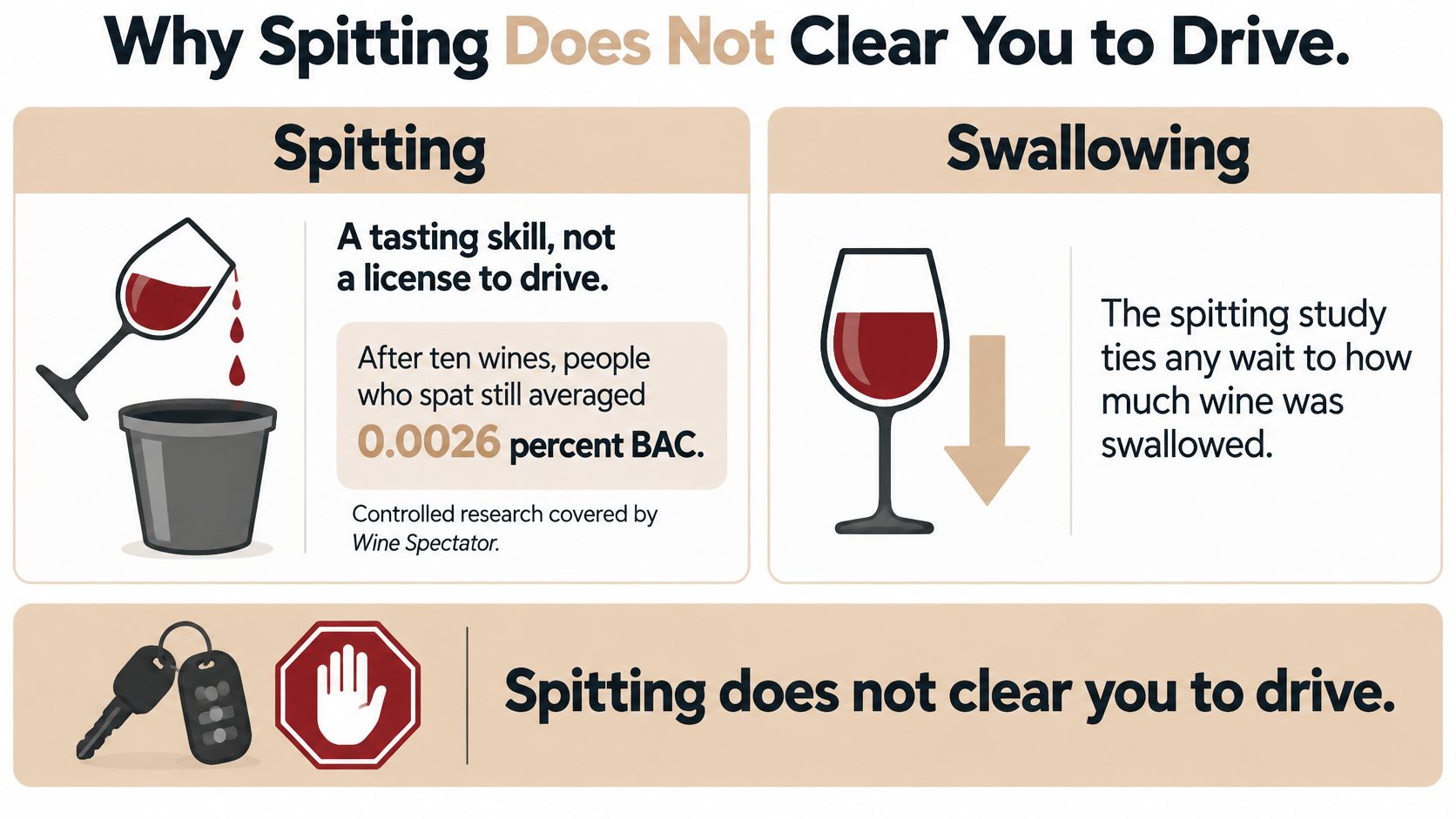
Controlled research covered by Wine Spectator's report on alcohol absorption during wine tasting found detectable BAC even among participants who spat every sample. After tasting ten wines, the spit-only group averaged 0.0026 percent BAC. Low, and not zero.
What the comparison actually showed
The same investigation had participants swallow roughly 15 milliliters of each sample, and those readings came out substantially higher. Five of seven participants in that group went past a 0.05 percent comparison limit. That's the part most spit-bucket advice skips. The difference between spitting and swallowing is real, and it doesn't make spitting the same as not drinking.
Real tastings rarely follow a lab script. Guests swish and spit, rinse and swallow, take a full sip at the last stop because the pour was a favorite, and meet hosts whose pour sizes shift from one room to the next. Alcohol left in the mouth can also lift a breath reading temporarily even when the deeper reading is low.
Spitting reduces exposure. It does not guarantee fitness to drive.
The comparison between a controlled study and a real itinerary comes down to the details of the day itself.
That distinction matters more on a multi-stop day than at a single bar. A professional panel with strict spit discipline is a different exposure from a North Fork or South Fork afternoon with food pairings, uneven spittoon use, and a car waiting in the lot. Breath testing has its own quirks too, and anyone curious about how mouth alcohol confuses meters can read about false positives from chewing gum from The Law Offices of Attorney Angel Lugo.
Treat the whole itinerary as the unit that needs a plan, not the number of samples that went into the bucket.
Why No Wait Time Works for Everyone
A fixed wait time sounds like the responsible compromise: finish the last tasting, sit in the parking lot for an hour, then drive home. The body does not run on a schedule anyone can count down from a car seat.
The one hour rule and what it leaves out
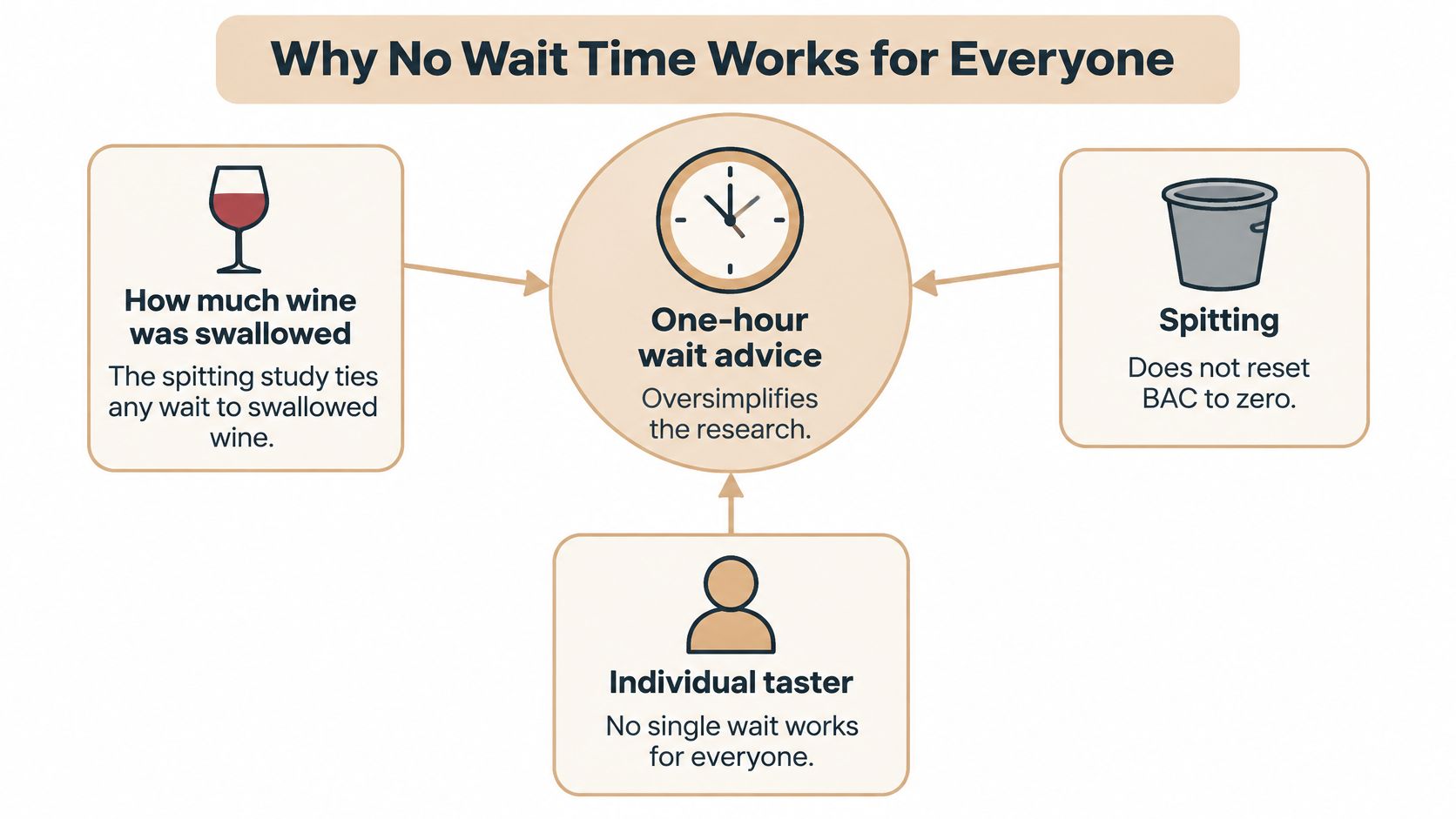
The tasting study behind much of the spitting data is explicit that any waiting period should relate to how much wine was swallowed, and it found that swallowing during a tasting could push participants above the legal limits used in more than one country, as reported in the published tasting study in Wine Studies. That is a long way from "wait an hour and go."
Timing creates the second problem. Absorption is gradual, so BAC can still be rising well after the last pour. A driver who feels clear leaving the final winery may be climbing toward a peak rather than coming down from one. Feeling sober and being sober are two different events, and on a tasting day they can arrive far apart.
The benchmark often cited, about one hour to eliminate one normal drink, tracks how the body clears alcohol once it reaches the blood. The NIAAA's overview of alcohol metabolism explains that most ethanol is processed in the liver through alcohol dehydrogenase and the acetaldehyde pathways that follow. The liver works like a single toll booth: traffic clears at its own pace, and nothing at the coffee stand speeds the line. Cold showers, fresh air, exercise, and a nap change how alert someone feels while the alcohol keeps circulating, and food slows absorption without removing what is already there.
Factors that break a universal wait time
| Factor | What it does | Safer move |
|---|---|---|
| Body size and sex | The same number of drinks produces different BAC | Do not copy another person's limit |
| Drinking speed | Faster sipping raises BAC sooner | Pacing counts drinks; it cannot erase them |
| Food | Slows the rise without removing alcohol already absorbed | Eat, then still treat the total as alcohol |
| Time after the last pour | BAC can keep rising well after the tasting ends | Do not leave just because the tasting ended |
| Metabolism | Varies widely from person to person | Do not use a single hour rule |
| Medications and fatigue | Can deepen impairment at the same BAC | Treat them as extra risk |
| Pour size and wine strength | A "taste" changes size from room to room | Track how much you actually drank |
What replaces the countdown
A personal breathalyzer gives a number. A number is still not a departure time, and one reading cannot convert a multi-stop itinerary into a safe drive home. The reading can sit under the legal limit while the person holding it is already impaired, and that gap matters on a day when Route 27 backs up at the Shinnecock Canal and the drive demands more attention than a quiet side street.
The plan that works takes metabolism out of the equation entirely. Leave the car parked for the day, name a sober companion who drinks nothing, or book a chauffeur for the full loop. A dedicated driver for the day means the group can taste, eat, and shop between stops without anyone watching a clock or doing math in a parking lot at four in the afternoon.
Crash Risk Below the Legal Limit
Crash risk rises well before a wine-tasting day feels finished. The National Highway Traffic Safety Administration's drunk driving data reports that drivers at 0.08 BAC are approximately four times more likely to crash than drivers with zero BAC. At 0.15 BAC, the risk is at least 12 times higher. Most states set the legal limit for ordinary drivers at 0.08, while Utah's limit is 0.05.
The deaths above the line
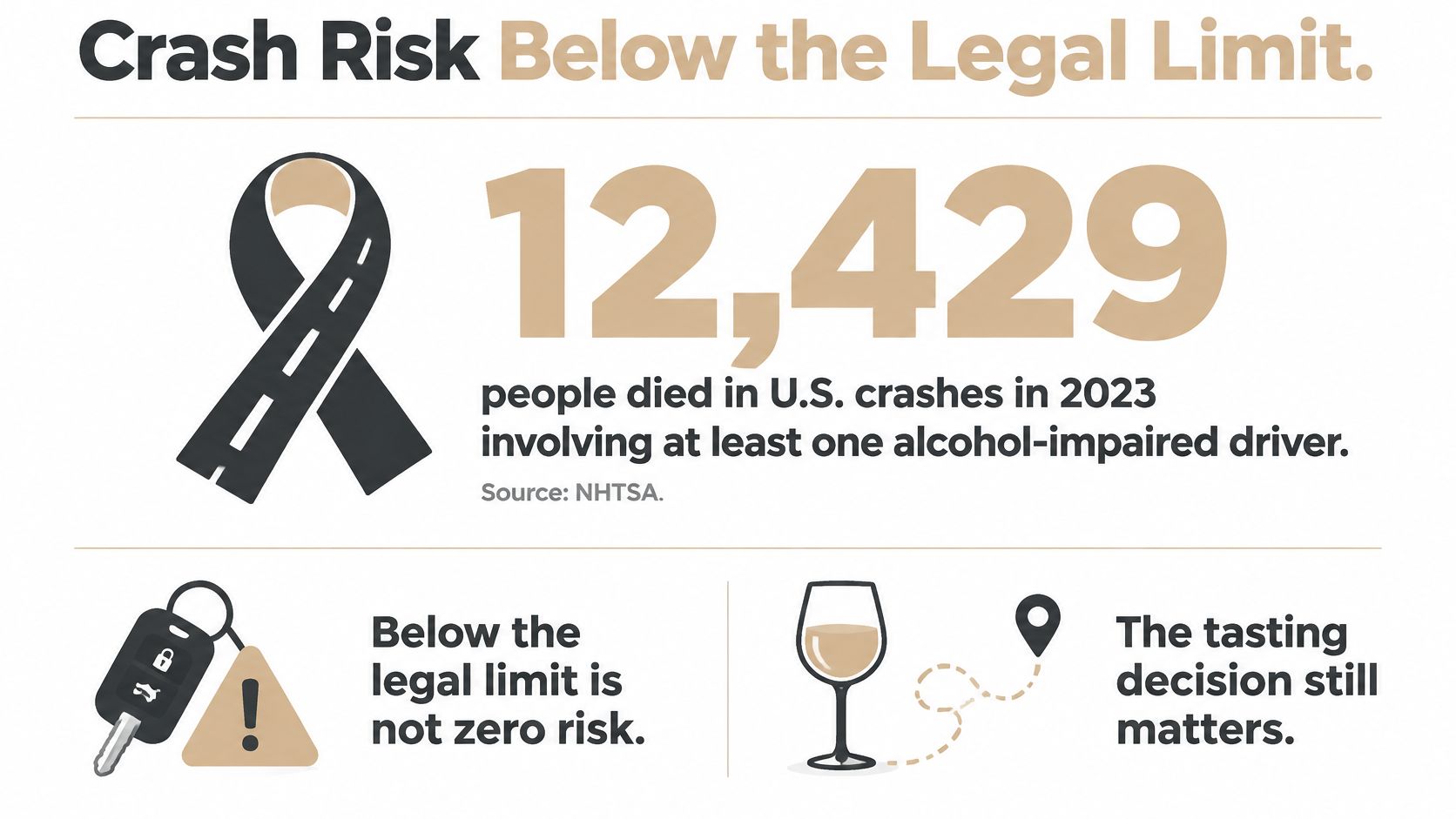
In 2023, 12,429 people died in U.S. motor vehicle crashes involving at least one alcohol-impaired driver. That accounted for 30 percent of all traffic fatalities, or an average of one such death every 42 minutes. Among 13,996 drivers involved in fatal crashes who had measurable alcohol, 84 percent, or 11,779 drivers, had BAC levels at or above 0.08.
The deaths below it
The legal limit is not a safety threshold. NHTSA recorded 2,028 deaths in 2024 in alcohol-related crashes involving drivers with BACs from 0.01 to 0.07. Those drivers were below the 0.08 limit used in most states, but some were at or above Utah's 0.05 limit.
Even at lower BAC levels, impairment can affect lane position, judgment of closing speed, and reaction time. On a summer afternoon along Route 27, traffic can stack up at Shinnecock Canal. A delayed reaction leaves less room to respond.
If alcohol was consumed, don't drive. Small pours and a clear head don't change the answer.
DUI laws and penalties vary by state. A DUI guidance from Olson & Sons overview explains how Hawaii handles penalties, license actions, and procedures.
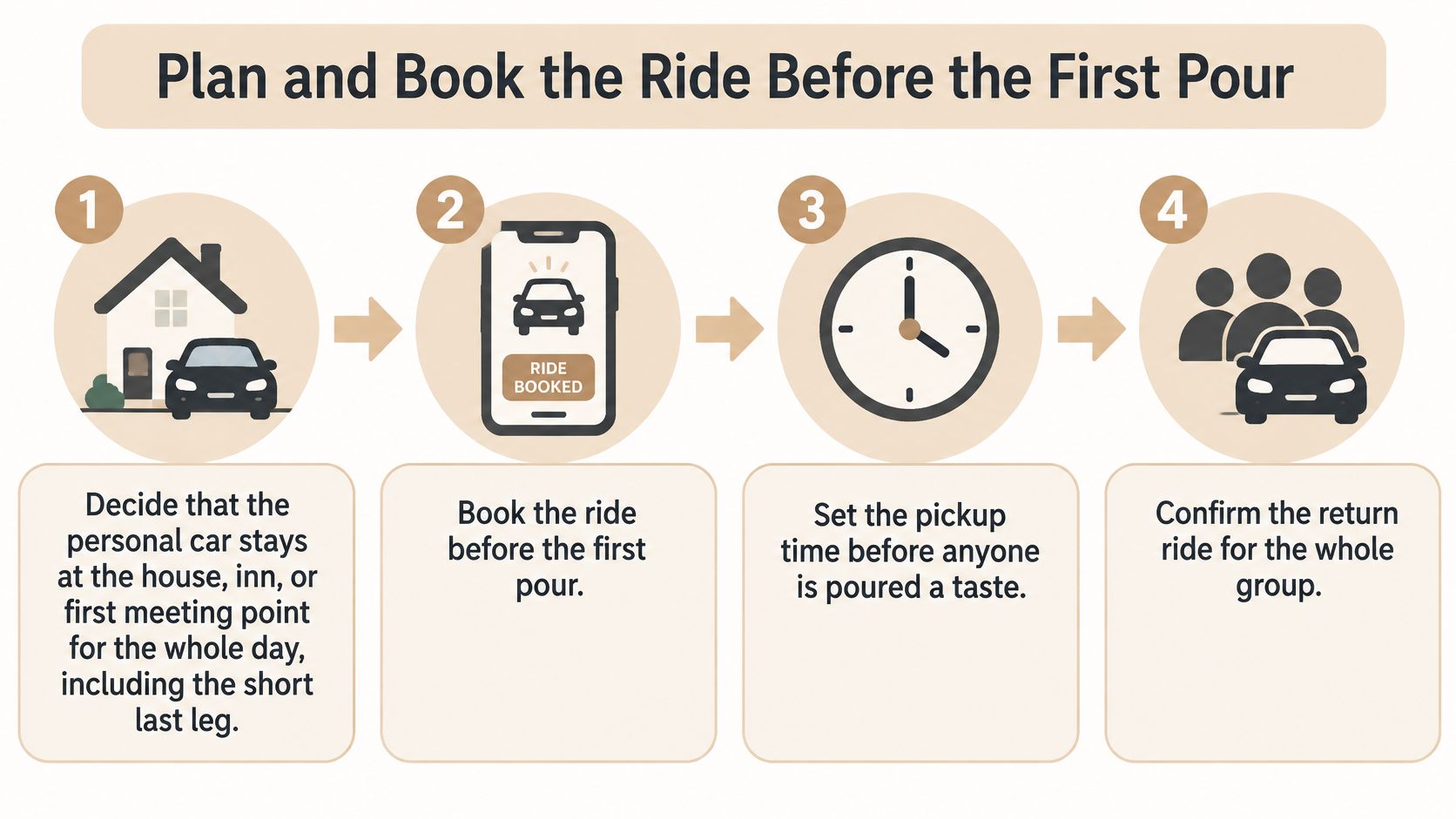
Plan and Book the Ride Before the First Pour
Everything above points one direction. The useful version of the answer to can you drive after wine tasting is a plan finished before the first glass is filled.
Five steps that settle it in advance
- Park the personal car for the entire day. Leave it at the house, the inn, or the first meeting point, and include the short last leg. The ten-minute hop from the final winery back to the rental is exactly the drive people talk themselves into.
- Name one person who drinks nothing, or book a chauffeur for every stop. A designated driver covers the whole itinerary, from the first pickup to the final drop-off. If nobody in the group wants that job, a professional removes the question entirely.
- Write the route down. Winery order, lunch, and any shop stop, with buffers built in. East End traffic in summer is predictable in the worst way. Our chauffeurs adjust departure times for the congestion that stacks up at Shinnecock Canal and Water Mill on summer weekends, and Route 27 backs up at the canal on Friday afternoons.
- Share the itinerary and a mobile number with the group. When a tasting runs long, the group texts an updated time and the driver stays nearby and ready. The schedule moves by message, so nobody stands in a parking lot weighing a bad choice.
- Strike breathalyzers, coffee, and naps from the plan. None of the three is a green light. If one of them is the basis for driving home, there's no plan.
Three group setups and what each needs
A sober member of the group. This person carries everyone else home, and sober means no tasting at all. A shared sip here and a spritzer there still count as drinking. If that person wants to taste, the arrangement fails and you're in the next scenario.
A couple who both plan to taste. Two tasters, zero drivers. Book the ride for the full loop, including the gap between the first and second winery, since that's where unplanned driving usually happens. A ride covering only the return trip leaves the middle of the day exposed.
A North Fork loop with several rooms. Three or four vineyards, a lunch stop, and five or six hours of continuous travel. The ride has to cover every leg of the day, and the vehicle has to stay with you. Hourly bookings keep the vehicle and chauffeur with the group for as long as the day runs, which matters when the last tasting runs slower than planned.
A ride that starts at the last winery is a rescue. A ride that starts at the first one is a plan.
The routes, vehicle options, and booking details for a day like this sit in our guide to North Fork wine tours and transportation. Our North Fork vineyard tours pair clients with a designated chauffeur who handles the driving while the group tastes, on custom itineraries with fixed pricing and no surge fees. Text (631) 294-0747 with the winery list, group size, and rough timing for a quote, and the schedule comes back confirmed before the day begins.
Booking early is the one part of the day that never depends on metabolism, pour size, or how alert anyone feels in a parking lot at sunset. That's why it works.
Hamptons Leisure Limo provides chauffeured North Fork and South Fork wine tours, airport transfers, and point-to-point service across the Hamptons with fixed pricing and no surge fees. If a tasting day is on the calendar, we'll build the itinerary around your winery list and keep a vehicle and chauffeur with your group from the first pour to the last stop. Visit Hamptons Leisure Limo to see the fleet and the service area, or text (631) 294-0747 for a quote.
Ready to Ride with Hamptons Leisure Limo?
Fixed pricing. No surge fees. 30 years of experience serving the Hamptons. Text us what you need and we will send a quote.