Airport Transfers JFK: Your Complete Hamptons Guide
Updated September 27, 2026
JFK handles 63,265,972 passengers in 2024 and 62,629,455 in 2025, making it the primary gateway for international travelers, and ongoing construction means passengers from Terminals 1, 2, and 3 may need a shuttle or AirTrain connection before reaching the correct pickup area. For a transfer to the Hamptons, build extra time into the plan and confirm the handoff before you land.
You've collected your bags, found the terminal exit, and expected to see a chauffeur waiting nearby. Instead, signs direct you away from the curb, construction changes the route, and the car-service pickup point may be at an off-terminal lot. That's the hidden difficulty behind airport transfers JFK. The road trip to Southampton, East Hampton, Sag Harbor, or Montauk is only one part of the journey. Getting from the aircraft to the vehicle can require just as much planning.
JFK opened in 1948 as New York International Airport, became widely known as Idlewild Airport, and was renamed John F. Kennedy International Airport in 1963. Its role has expanded from a regional airfield into a global hub serving 204 destinations in 2025. Historical and operating information about JFK helps explain why a transfer to the East End can involve international arrivals, terminal changes, customs, luggage, construction traffic, and a long drive in a single itinerary.
Table of Contents
- Navigating JFK Ground Transportation Challenges
- How to Book a Reliable Airport Transfer
- Choosing the Right Vehicle for Your Group
- Understanding Fixed Pricing Versus Surge Costs
- The Benefits of Real-Time Flight Tracking and Curbside Pickup
- Why Choose a Professional Car Service for Your JFK Transfer
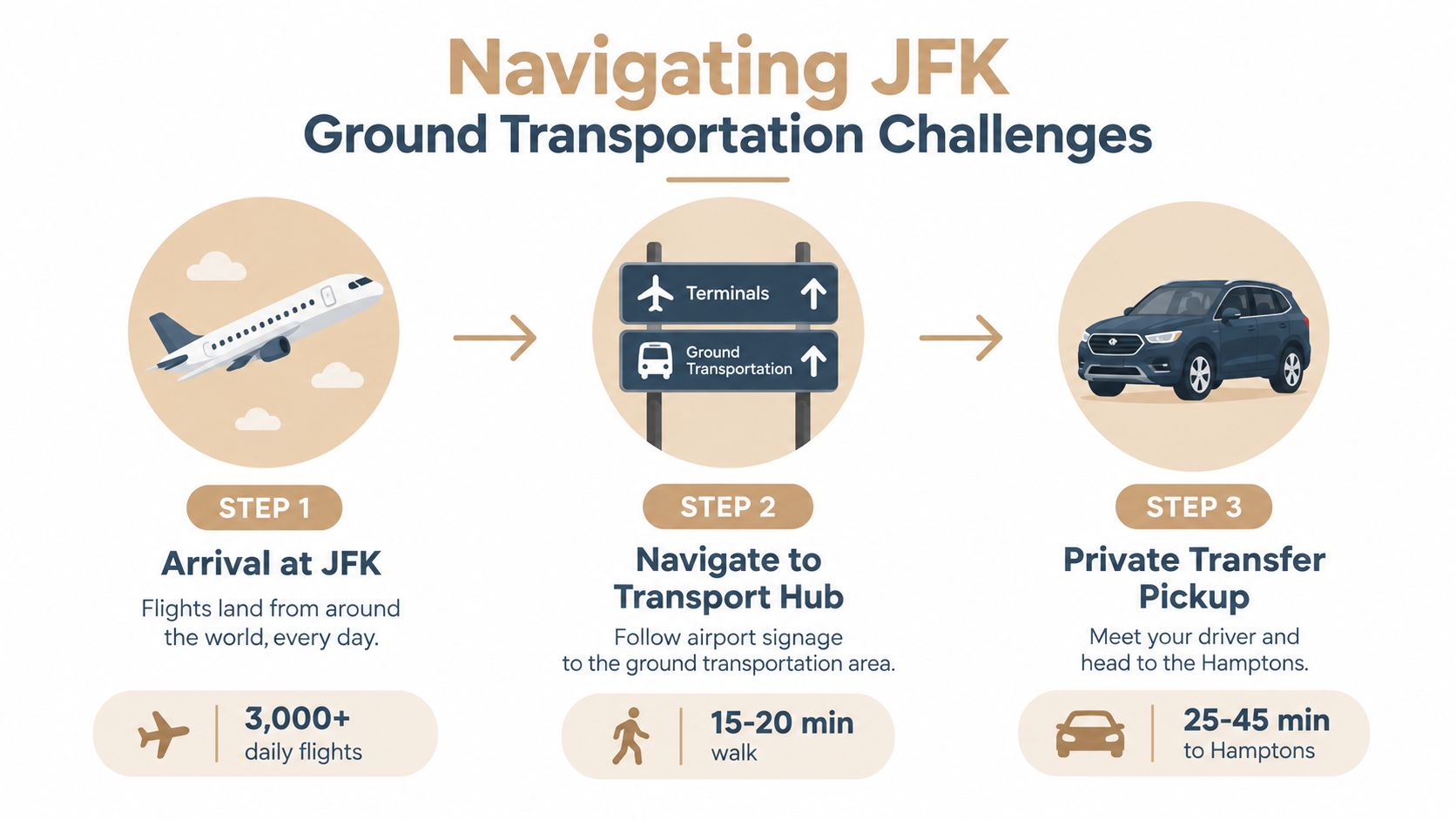
Navigating JFK Ground Transportation Challenges
A traveler arriving from Europe may clear customs, collect several bags, and assume the next step is just walking to the curb. At JFK, that assumption can create unnecessary stress. Construction has changed how some airport pickups and drop-offs work, and official guidance warns that reaching the terminal curb can take longer than usual. In some situations, passengers are directed to the Lefferts Boulevard AirTrain pickup and drop-off lot rather than being collected directly at the terminal. JFK's construction impact guidance explains why the traditional curbside handoff isn't always available.
Terminals 1, 2, and 3 can require a shuttle or AirTrain connection to reach the shared ground-transportation hub. That turns a private transfer into a multimodal handoff. A passenger with a rolling suitcase may manage it comfortably, but the experience is different with children, oversized luggage, mobility needs, or a tight connection to Long Island.
Why the pickup point matters
JFK's official rules state that terminal curbsides are for active pickups and drop-offs only. Vehicles can't park in front of or beside a terminal, unattended vehicles may be towed at the owner's expense, and passengers must remain in the vehicle while using those areas. JFK pickup and drop-off rules are important for anyone expecting a casual curbside meeting.
For-hire vehicle arrangements can be even more specific. At Terminals 5 and 7, pickups have been relocated to the Howard Beach Ride App and Car Services Lot near Howard Beach AirTrain Station, and for-hire pickups aren't permitted at those terminals until further notice. Current pickup information for for-hire vehicles shows why a booking should include the exact meeting location, not just “JFK arrivals.”
A professional chauffeur should know whether the booking requires curbside service, an approved lot, or an AirTrain-assisted handoff. Travelers comparing taxis, ride apps, shared shuttles, and private cars can also review this transportation services comparison before choosing the arrangement that fits their luggage, timing, and destination.
How to Book a Reliable Airport Transfer
A dependable JFK transfer starts with accurate information, not a last-minute request at baggage claim. Give the booking team your flight number, airline, arrival date, terminal when known, final destination, passenger count, luggage details, and any child-seat or pet requirements. The flight number lets dispatch monitor schedule changes and coordinate the pickup window around the actual arrival.
A practical booking sequence
Confirm the route. State whether you're traveling from JFK to Southampton, East Hampton, Montauk, Sag Harbor, or another East End address. A door-to-door transfer needs the complete destination, including a hotel, private residence, office, or event venue.
Share the flight details. Flight tracking is useful because landing times change. It also gives the chauffeur context when customs, baggage claim, or terminal movement takes longer than expected.
Choose the vehicle around luggage. Passenger count alone isn't enough. A group may fit in a vehicle by seating capacity but still lack room for checked bags, golf equipment, strollers, or shopping items.
Confirm the meeting method. Ask whether the service is curbside meet and greet, a designated airport lot, or an AirTrain connection. JFK's official travel guidance recommends following live traffic and construction updates and using approved pickup locations. Port Authority travel tips for airport passengers also notes that JFK can experience gate-hold and taxi delays of 15 minutes or less, which is another reason to avoid a schedule with no buffer.
Request fixed pricing. A fixed quote with no surge makes the transport budget easier to understand than a demand-based fare that changes while you wait. Ask what the quote includes, including tolls, airport procedures, waiting terms, and the final destination.
For a more detailed checklist, use this guide to request an airport transfer quote. The strongest booking confirmation leaves both sides with the same information: who is arriving, where the handoff occurs, what vehicle is assigned, and how the service responds if the flight changes.
Practical rule: Don't book “JFK to the Hamptons” as though it were a simple point-to-point taxi ride. Book the airport procedure and the East End route together.
Choosing the Right Vehicle for Your Group
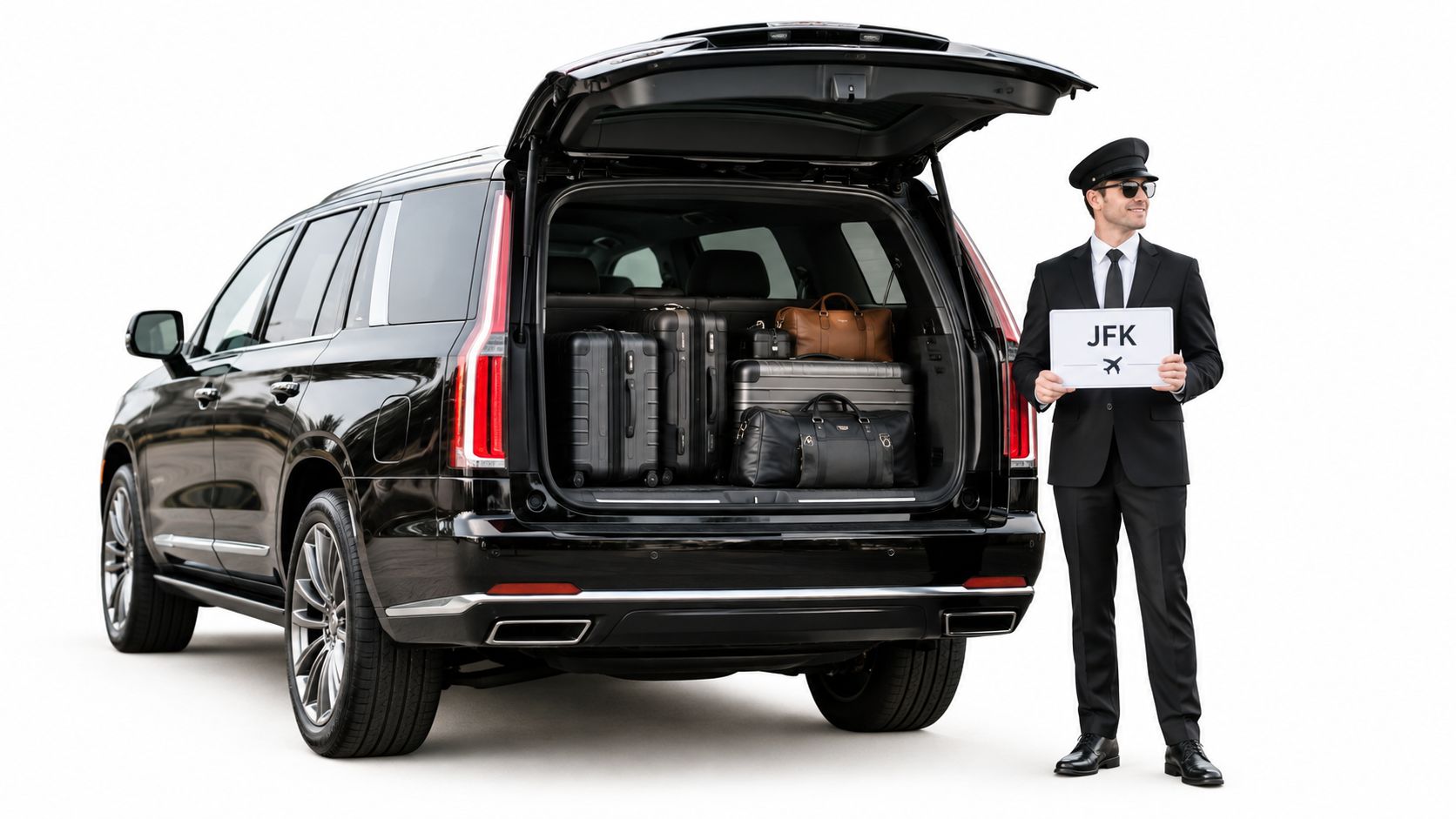
The right vehicle depends on people, bags, and purpose. An executive traveling alone with a compact suitcase may prefer a Mercedes-Benz S-Class. A family with checked luggage and a stroller may need the extra cargo space of a premium SUV. A wedding party, corporate group, or extended family may be more comfortable in a Mercedes-Benz Sprinter van or a larger coach.
Match the vehicle to the actual trip
| Travel situation | Practical choice | Why it works |
|---|---|---|
| Solo executive or couple | Mercedes-Benz S-Class, up to 3 passengers | Quiet, polished space for a small party |
| Family with luggage | Premium SUV, such as a Chevrolet Suburban or Cadillac Escalade | Comfortable seating and useful cargo capacity |
| Group transfer | Mercedes-Benz Sprinter van, up to 14 passengers | Keeps the group together instead of splitting into several cars |
| Larger event movement | Mini-bus or coach | Supports coordinated transportation for substantial groups |
The published fleet options from Hamptons Leisure Limo include premium SUVs for up to 6 passengers, Mercedes-Benz Sprinter vans for up to 14, Mercedes-Benz S-Class service for up to 3, and mini-buses ranging from 25-passenger, 36-passenger, and 55-passenger coaches. Those capacity figures are useful starting points, but they shouldn't replace a luggage conversation. A full passenger load with large suitcases may need a larger vehicle than the seating number suggests.
The details that change the decision
Ask about child seats before the day of travel, especially when an infant or young child is included. Pet-friendly arrangements should also be confirmed in advance, as should golf clubs, wheelchairs, musical instruments, or multiple oversized cases.
A sedan can be the wrong choice even when the passenger count appears acceptable. The result is a cramped cabin, bags placed where they shouldn't be, and an uncomfortable ride across Long Island. Conversely, a Sprinter may be unnecessary for a small party that values a quieter executive setting.
A short visual overview can help groups think through the vehicle selection and airport handoff:
Share the complete manifest with the reservation team. The best vehicle decision is made before the chauffeur arrives, not beside the terminal with luggage on the pavement.
Understanding Fixed Pricing Versus Surge Costs
Ride apps are convenient because they let travelers request a vehicle from a phone. Their weakness appears when demand, weather, traffic, or a sudden wave of arrivals changes the fare during the exact period when the traveler has the least flexibility. A family standing at an airport pickup point can't always wait for the price to normalize, and a business traveler may not be able to postpone the trip.
Fixed pricing solves a different problem than convenience. It creates a defined transport arrangement before the journey begins. The quote can be reviewed while the traveler is still planning, rather than accepted under pressure after landing. For Hamptons routes, that predictability matters because the trip includes airport logistics, traffic exposure, and a substantial distance to the East End.
What each model rewards
| Booking model | Main advantage | Main trade-off |
|---|---|---|
| On-demand ride app | Immediate request through a phone | Fare and vehicle availability can change |
| Taxi from the airport line | Familiar airport option | Less control over vehicle type and advance coordination |
| Shared shuttle | May suit travelers comfortable with multiple stops | Departure and arrival timing are less personal |
| Pre-arranged car service | Confirmed vehicle, route planning, and fixed pricing | Requires advance booking and accurate trip details |
A fixed quote doesn't eliminate traffic or construction. It does remove one source of uncertainty. Travelers can then focus on the operational questions that affect the journey, such as the meeting point, wait policy, luggage fit, and whether the chauffeur monitors the flight.
Read more about the difference between fixed-price airport transportation before comparing offers. The useful comparison isn't just the lowest displayed fare. It's the total value of a confirmed vehicle, predictable terms, correct pickup instructions, and a plan that doesn't change because several other passengers landed at the same time.
No service can promise that a construction delay won't affect the road journey. A transparent quote, however, helps prevent an airport disruption from becoming a pricing surprise as well.
The Benefits of Real-Time Flight Tracking and Curbside Pickup
A scheduled arrival time isn't always the same as the time a traveler reaches the pickup point. A flight may land early, wait for a gate, or arrive on time while customs and baggage claim take longer than expected. That difference is where real-time flight tracking becomes useful.
Suppose an international flight reaches JFK later than planned. The chauffeur sees the revised status, adjusts the expected arrival window, and avoids treating the original schedule as a rigid appointment. The passenger can proceed through the airport without repeatedly reopening a ride app or wondering whether the vehicle has already left.
The curbside experience has limits
Meet and greet doesn't mean a chauffeur can leave a vehicle unattended at any terminal. JFK's curbside rules require active pickup and drop-off, and construction may move the authorized meeting point away from the terminal. A well-coordinated service explains that distinction before arrival and sends the passenger to the correct location.
The difference between a private transfer and public transit is clearest here. JFK's AirTrain connects with parking areas, the Long Island Rail Road, the New York City Subway, and local buses, making it an important access link for travelers who prefer a public connection. JFK AirTrain information is useful for passengers planning an independent route, but the traveler remains responsible for moving luggage between the aircraft, train, and onward connection.
For a Hamptons itinerary, that can add decisions at the busiest part of the trip. A private transfer can instead coordinate the airport handoff with the road journey, subject to the current pickup rules and construction layout.
Waiting terms should be clear
Ask how complimentary wait time works for both domestic and international arrivals. Publicly available operator policies vary, with examples ranging from 45 minutes for domestic arrivals and 60 minutes for international arrivals to 90 minutes for domestic arrivals and 120 minutes for international arrivals. An example of published JFK transfer waiting terms illustrates why travelers should confirm the actual policy attached to their reservation.
The important questions are straightforward: Does the chauffeur track the flight? When does the wait period begin? What happens after customs, baggage claim, or a terminal transfer extends the arrival? Clear answers prevent a stressful conversation beside the carousel.
For more detail on the operational side, review this guide to tracking flights in real time. The goal isn't to pretend airports run perfectly. It's to give the chauffeur enough information to respond intelligently when the schedule changes.
Why Choose a Professional Car Service for Your JFK Transfer
The strongest JFK transfer plan treats the airport and the East End as one connected journey. It accounts for the terminal, the authorized pickup point, the passenger's luggage, the flight status, the vehicle, and the final address. That approach works better than choosing a car only after landing, especially when construction has changed familiar airport routines.
The trade-off is simple. Public transportation can connect JFK with New York City and Long Island, but it requires travelers to manage the transfers themselves. Ride apps provide flexibility, but availability and pricing can change. A pre-arranged car service requires planning, yet it gives the traveler a named booking, a selected vehicle, a defined quote, and a coordinated pickup process.
What reliability looks like in practice
Experienced chauffeurs contribute more than driving skill. They understand how airport pickup procedures affect the passenger, where a luggage handoff can become difficult, and why a route to Montauk should be planned differently from a trip to Manhattan. They also know that a flight arriving at the gate isn't necessarily a passenger ready for collection.
A suitable vehicle protects comfort over the full trip. Fixed pricing supports budget control. Flight monitoring supports schedule flexibility. Clear instructions protect the handoff. Together, these elements reduce the number of decisions the traveler must make while tired, delayed, or carrying luggage.
Hamptons Leisure Limo is one option for pre-arranged JFK transportation, offering airport transfers between JFK and Hamptons destinations, real-time flight tracking, curbside pickup where airport rules permit it, fixed pricing, premium SUVs, Mercedes-Benz Sprinter vans, and larger group vehicles. The company is based in Southampton and serves routes across the Hamptons, Long Island, and New York City.
The airport's redevelopment will continue to make pickup instructions important. Travelers should check current official guidance, confirm the exact meeting location with the service, and build a realistic buffer for construction, traffic, customs, and terminal movement. A smooth transfer doesn't depend on luck. It comes from matching the booking details to the way JFK operates that day.
For JFK to Hamptons airport transfers, Hamptons Leisure Limo coordinates flight tracking, approved pickup procedures, fixed pricing, and vehicles suited to solo travelers, families, executives, and larger groups. Text (631) 294-0747 for a quote, or visit Hamptons Leisure Limo to arrange a reliable ride from the airport to Southampton, East Hampton, Sag Harbor, Montauk, or another East End destination.
Ready to Ride with Hamptons Leisure Limo?
Fixed pricing. No surge fees. 30 years of experience serving the Hamptons. Text us what you need and we will send a quote.