40 Person Party Bus: The Ultimate Large Group Guide
Updated October 6, 2026

You've gathered the guest list, the wedding party has added a few last-minute names, and now the transportation plan says “40 person party bus.” The number sounds straightforward until you account for actual seats, luggage, coats, mobility equipment, emergency exits, and the amount of time guests will spend inside the vehicle. A bus can be legally rated for a group and still feel cramped on a long Hamptons itinerary.
The right question isn't only how many people can physically enter the vehicle. It's how many can ride legally, safely, and comfortably, with a seating layout and operating plan that match the event. That distinction matters for weddings, proms, corporate outings, winery trips, concerts, and any night when one transportation mistake can disrupt the entire schedule.
Table of Contents
- Why Capacity Is a Regulated Calculation
- Safety and Seating Rules You Must Verify
- How to Book a 40-Person Party Bus
- Choosing Between a Party Bus, Sprinter Van, and Coach
- Planning Itineraries and Managing Large Groups
- Next Steps for Your Group Reservation
Why Capacity Is a Regulated Calculation
A group once arrived for a large event believing they had solved transportation because the brochure listed enough seats for everyone. Once the coordinator counted the actual bench layout, garment bags, coolers, and guests who needed easier boarding, the math changed. The vehicle's advertised maximum wasn't the same as its usable capacity.
That situation is common because “40 passenger” can describe a certified maximum, a manufacturer's seating calculation, or a marketing category. Those descriptions don't always account for how adults occupy bench seating, whether every position has a usable restraint, or how much room must remain available around emergency exits.
The broader motorcoach market shows why large-group vehicles should be treated as commercial passenger transportation rather than oversized limousines. In 2023, the United States and Canada had 1,984 motorcoach companies operating 47,946 coaches, which collectively provided 38.0 billion passenger miles and traveled 1.6 billion miles. The average coach traveled approximately 33,976 miles that year, according to the American Bus Association motorcoach census. A 40-person party bus sits within this wider motorcoach category, which generally covers passenger vehicles at least 35 feet long and designed for 30 or more passengers.
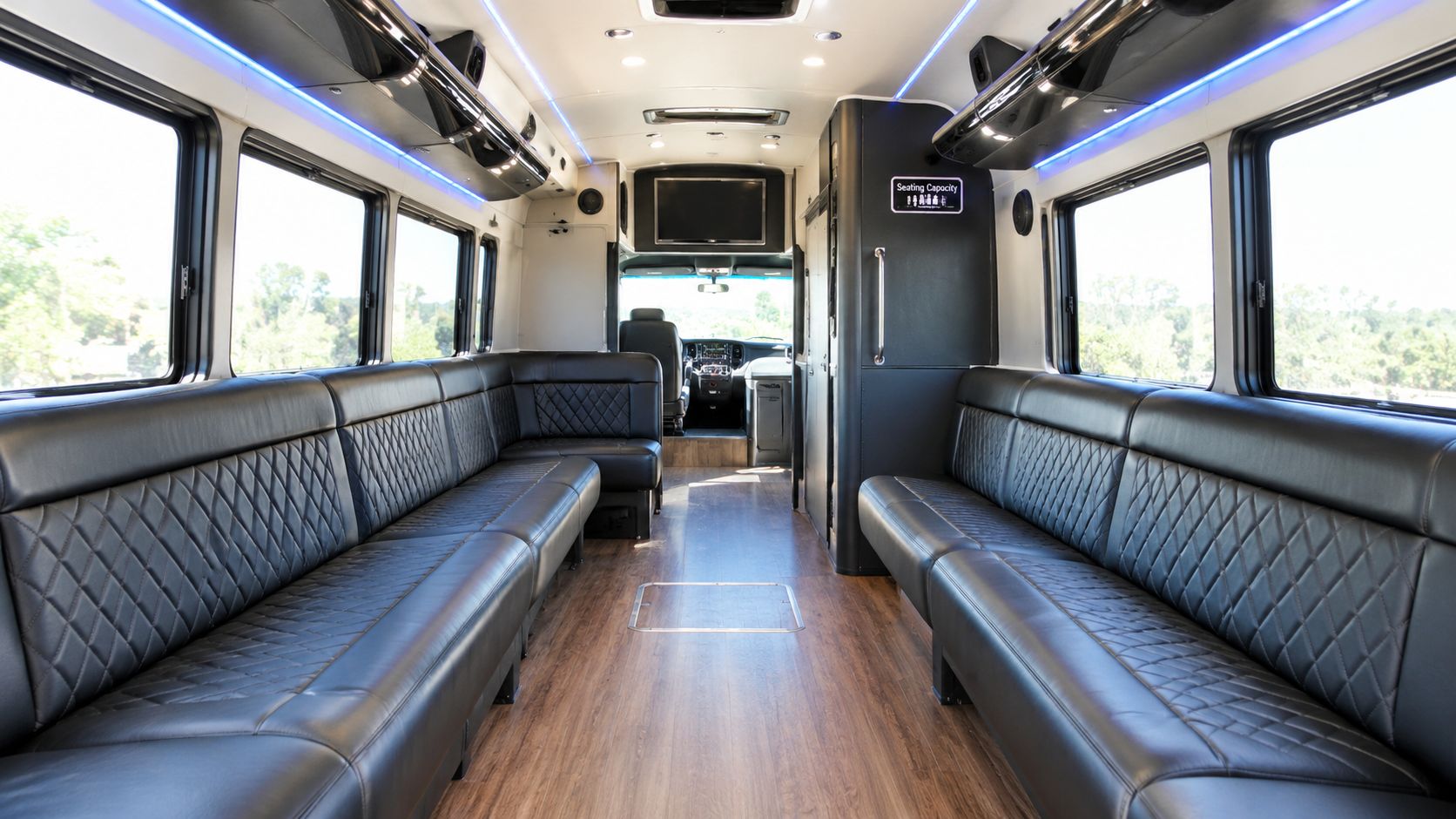
The advertised number is only the starting point
A vehicle designed for forty passengers may be comparable in capacity to a small charter coach, not a conventional limousine or van. In practical terms, that size can consolidate roughly 10 passenger cars carrying four people each, reducing the number of vehicles required for a coordinated event. The calculation is useful, but it doesn't mean every booking should place forty adults into every available position.
Start with the vehicle's certified passenger capacity, gross vehicle weight rating, seating configuration, and operating jurisdiction. Then ask how the operator counts passengers. A dense bench may look spacious in a photograph, but adult occupancy can be more restrictive than the manufacturer's pupil or bench-seat rating.
FMCSA guidance for school-bus-derived vehicles uses two adults per bench seat, or approximately two-thirds of the manufacturer's pupil seating capacity, when determining adult seating capacity. That principle is a useful reminder that passenger capacity isn't always a simple seat-by-seat count. The FMCSA guidance on calculating adult seating and emergency-exit space also reinforces the need to preserve exit access and aisle clearance.
Practical rule: Quote the vehicle around its usable seating and evacuation arrangement, not around the largest number printed in a sales listing.
A comfortable plan may involve fewer passengers than the legal maximum. Weddings bring formal clothing and bags. Winery trips bring purchases and coolers. Corporate groups may carry presentation materials. Long itineraries make tight seating more noticeable. If the final count leaves no room for those realities, a second vehicle or a larger coach may produce a better experience than filling every nominal seat.
Safety and Seating Rules You Must Verify
A professional booking starts with documents, not interior lighting. Before confirming a 40 person party bus, request the vehicle's certified passenger capacity, GVWR, commercial registration, inspection status, insurance documentation, and chauffeur qualification. The operator should also identify the exact vehicle being assigned, because safety equipment can vary between vehicles carrying the same marketing label.
The seating plan deserves close attention. Every passenger should have a designated position while the vehicle is moving unless the vehicle and applicable jurisdiction explicitly permit another arrangement. Standing-room assumptions create problems around emergency evacuation, restraint use, and insurance. A brochure that shows an open center area doesn't automatically authorize passengers to stand during travel.
Restraints and emergency preparation
Federal occupant-protection rules distinguish buses by weight and design. The FMCSA seat-belt and occupant-protection requirements identify lap and shoulder belts for designated seating positions on medium over-the-road motorcoaches weighing between 10,000 and 26,000 pounds, as well as large buses over 26,000 pounds. Vehicle category, manufacture date, and state law can affect the exact requirement, so planners should verify the assigned vehicle rather than infer compliance from the word “party bus.”
NHTSA states that new over-the-road buses and other large buses above 26,000 pounds GVWR are required under the relevant rule to provide lap and shoulder belts at each driver and passenger seating position, with the requirement applying to newly manufactured buses beginning in November 2016. NTSB also recommends a pre-departure briefing covering exits, fire extinguishers, seat-belt procedures, and emergency instructions. Its cited NHTSA finding says properly worn lap and shoulder belts can reduce fatal-injury risk in rollover crashes by 77 percent, primarily by preventing ejection. These details appear in the NHTSA motorcoach seat-belt rule announcement.
For passengers who need help with fit or belt reach, a practical resource on Seat Belt Extenders RV safety can help explain why belt length and latch access should be checked before departure. Any extender or accessory must be compatible with the specific restraint system and approved for its intended use.
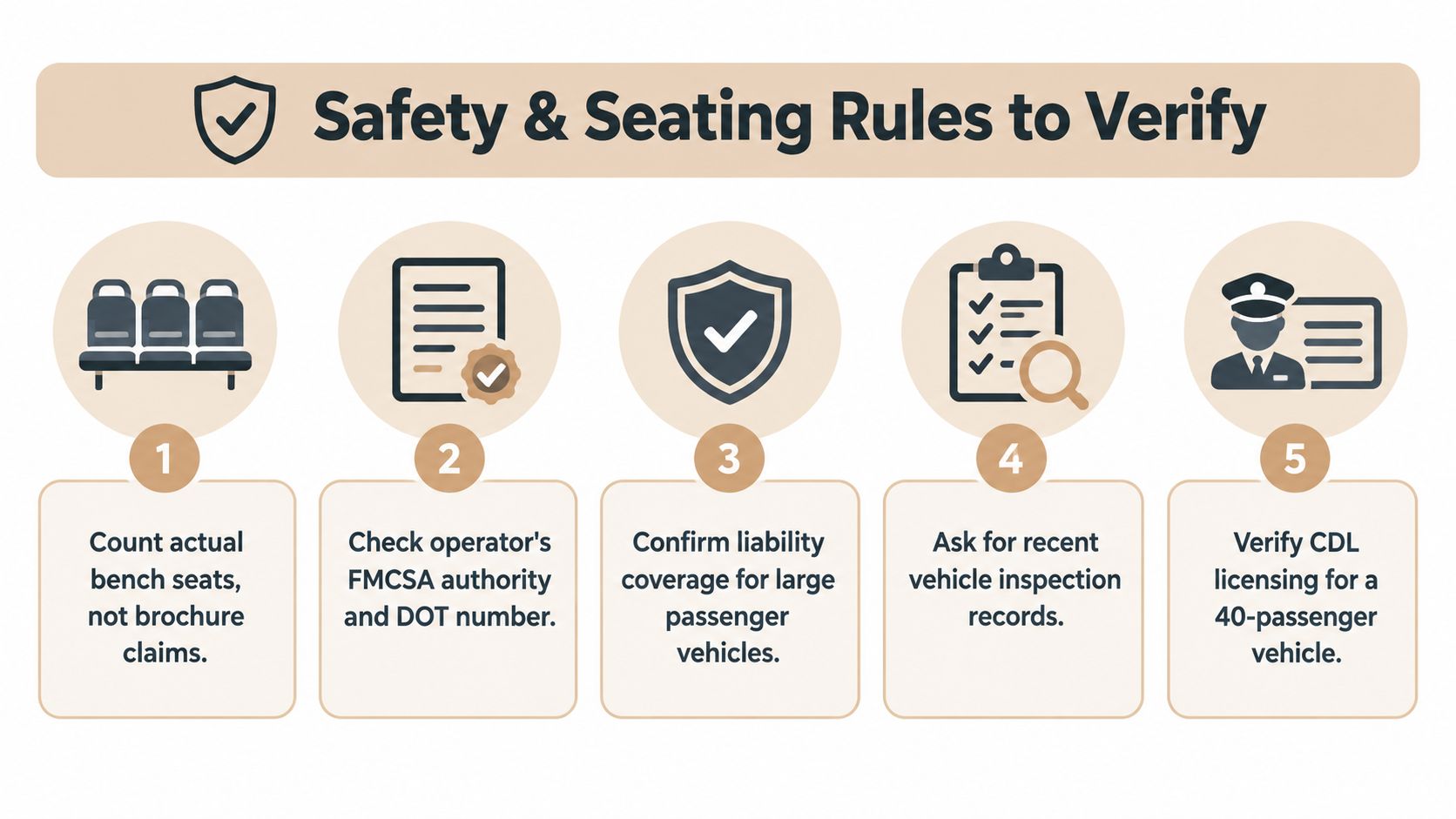
A concise verification checklist
- Count actual seating positions: Confirm bench seats, individual seats, aisle clearance, and the number of usable restraints.
- Review emergency access: Make sure luggage, coats, decorations, and coolers won't block exits or passageways.
- Inspect equipment: Ask about belts, latches, seat anchorages, tires, lights, extinguishers, communication equipment, and inspection records.
- Confirm the operator's authority: Ask for the applicable operating authority, DOT identification, commercial registration, and insurance documentation.
- Brief the group: The chauffeur should identify exits, belt procedures, emergency instructions, and the requirement to remain seated when appropriate.
For a useful comparison with smaller group vehicles, review 15-passenger party buses. The same principle applies at every size: the exact vehicle configuration matters more than the category name.
How to Book a 40-Person Party Bus
Large-group reservations work best when the planner gives the operator a complete operating picture at the start. A headcount alone isn't enough. Pickup locations, stops, luggage, boarding needs, timing, and the final destination all affect which vehicle and schedule will work.
Start with a complete movement brief
Prepare the following before requesting a quote:
- Confirmed or expected headcount: Separate adults, children, guests using mobility equipment, and anyone who needs step-free boarding.
- Pickup details: List every address, including hotels, private residences, venues, airports, and backup pickup points.
- Event timing: Include guest arrival time, ceremony or meeting start, photo locations, dinner reservations, and final drop-off.
- Equipment and luggage: Mention garment bags, golf clubs, coolers, promotional materials, or other items that may compete for interior space.
- Operating preferences: State whether you need point-to-point service, hourly coverage, multiple stops, or a coordinated fleet.
Request fixed pricing and confirm whether the reservation includes all planned movements. Hamptons and Long Island schedules can change quickly during events, so the quote should identify waiting time, additional stops, cancellation terms, and what happens if the headcount changes. If a provider uses surge pricing, ask for the conditions in writing. A clear quote is easier to compare than an attractive starting rate that changes after the itinerary is complete.
Verify the operator before paying a deposit
Ask for the assigned vehicle's insurance documentation, inspection status, and commercial registration. Confirm that the company can provide a qualified chauffeur for the vehicle class and route. For interstate for-hire passenger transportation, a 40-person vehicle falls within the federal 16-seat threshold, including the chauffeur. The applicable federal financial-responsibility rule sets $5 million in coverage for vehicles designed for 16 or more occupants, compared with $1.5 million for vehicles designed for 15 or fewer occupants. Review the FMCSA passenger-carrier insurance requirements with the trip's operating circumstances in mind.
Send the manifest and final itinerary before the event, not at the curb. A centralized dispatch plan gives the chauffeur team one current version of the schedule and gives the planner a clear contact for flight changes, late arrivals, or a revised guest count.
Choosing Between a Party Bus, Sprinter Van, and Coach
A single 40 person party bus keeps a group together, but it isn't automatically the right vehicle. A Mercedes-Benz Sprinter van can work better for a smaller subset, while a full coach may provide more practical room for a group carrying luggage or traveling between distant locations. In some cases, two coordinated vehicles create a smoother boarding process than one crowded interior.
| Fleet Type | Typical Capacity | Best Use Case | Accessibility Options |
|---|---|---|---|
| Mercedes-Benz Sprinter van | Configuration dependent | Smaller wedding parties, executive groups, winery outings, and short local movements | Confirm step height, door width, seating arrangement, and mobility needs |
| 40 person party bus | Certified capacity varies by vehicle | Shared celebrations, proms, nightlife, corporate outings, and event transfers | Verify lift or ramp availability, securement position, aisle clearance, and boarding procedure |
| Full motorcoach | Large-group configuration | Longer itineraries, airport movements, corporate events, and groups with substantial luggage | Ask about accessible equipment, boarding locations, restroom access, and securement arrangements |
| Coordinated multi-vehicle setup | Combined capacity depends on fleet | Groups with different pickup points, accessibility needs, or staggered schedules | Match each guest group to the vehicle that supports its specific requirements |
When a Sprinter van makes more sense
A Sprinter is usually easier to place at private homes, narrow driveways, smaller venues, and multiple pickup points. It can also keep a smaller leadership group, wedding party, or executive team together while the larger guest group uses separate transportation. The trade-off is limited space for a large guest list, luggage, and social movement.
A party bus provides a shared interior and can make the ride part of the celebration. It may suit a local nightlife route or wedding transfer where the group wants to remain together. It's less forgiving when the headcount reaches the stated maximum or when guests bring bulky items.
When a coach is the more practical choice
A full motorcoach generally makes more sense when comfort, luggage capacity, climate control, and longer travel time matter more than a lounge-style interior. A coach can also simplify airport transfers and corporate movements where everyone needs a predictable seat and a clear boarding process.
New York adds a separate compliance question. Most carriers transporting passengers for compensation within the state must obtain operating authority from NYSDOT. Passenger vehicles registered by carriers must pass a NYSDOT inspection before DMV registration, and vehicles subject to NYSDOT inspection generally require inspection at least every six months, according to New York passenger-carrier guidance. Ask which vehicle is authorized for the route and whether its inspection status is current.
For additional context on the distinction between a lounge-style vehicle and other group options, see what a limo bus is. The final choice should follow the itinerary, passenger needs, and usable space, not just the most exciting vehicle description.
Planning Itineraries and Managing Large Groups
Forty guests don't move through the Hamptons like four guests. Boarding takes coordination, stops take longer, and a single missing person can hold the entire schedule. The strongest itineraries build time around real group behavior instead of treating every stop as if the vehicle can unload and reload instantly.
For a wedding, identify who boards at each location and assign one point person to communicate with the chauffeur team. For a prom or nightlife itinerary, use a manifest and a clear meeting location at every stop. For a corporate outing, share the schedule with the event lead and executive assistant so no one relies on a series of separate text messages.
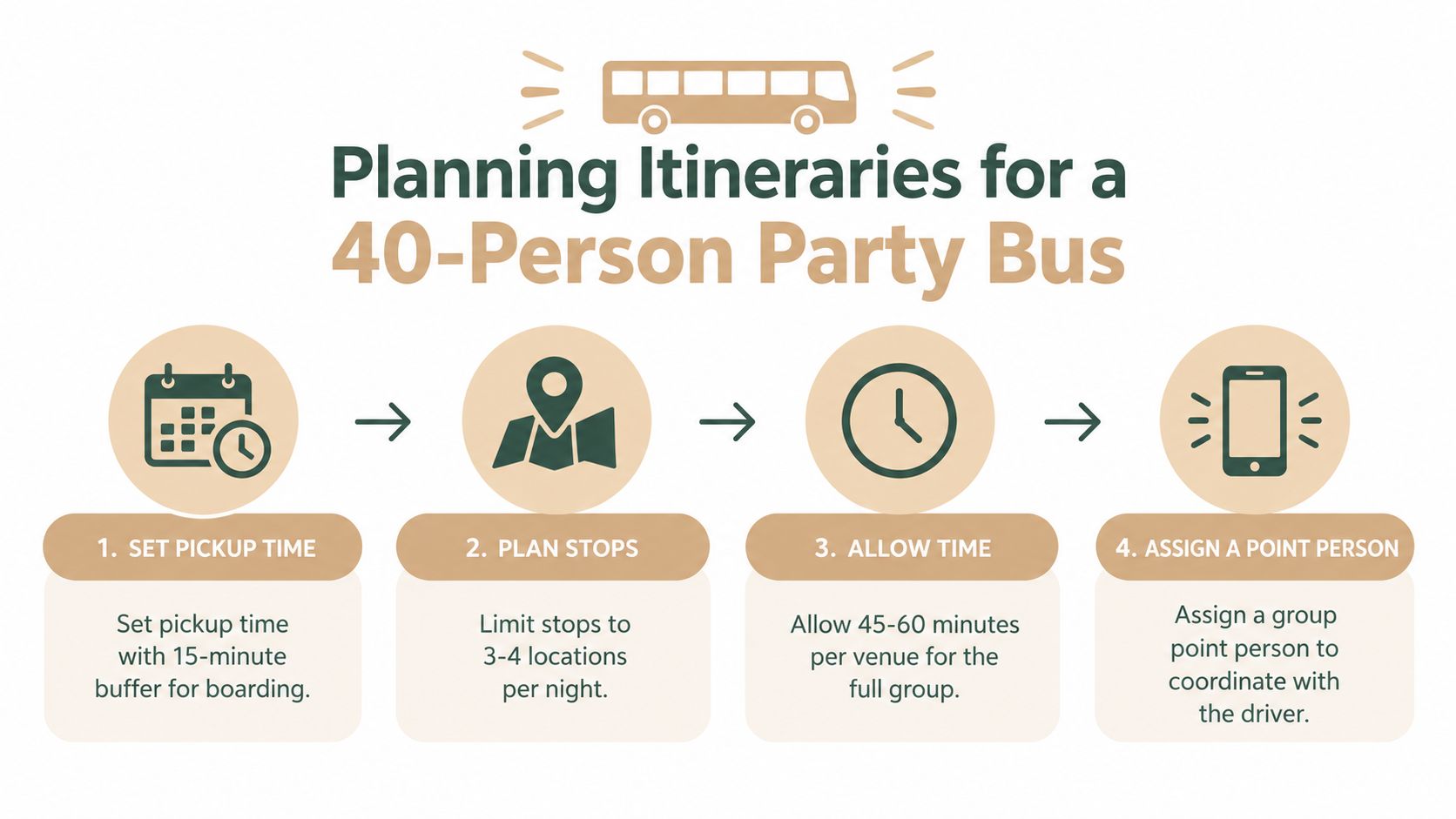
Build the itinerary around the margins
The vulnerable parts of a large-group movement are usually the margins, not the main drive. A coat that needs storage, a late RSVP, a guest using a wheelchair, or a service animal can change the boarding plan. Ask about these details before payment and obtain written confirmation of the exact vehicle and procedure.
Federal ADA regulations state that vehicles covered by applicable accessibility requirements must be readily accessible and usable by people with disabilities, including wheelchair users. A generic 40-person party bus shouldn't automatically be assumed to have a lift, ramp, securement position, suitable door dimensions, or enough aisle clearance. Review the ADA Title III transportation regulations and confirm the assigned vehicle directly with the operator.
Use a manifest that identifies:
- Passenger count: Keep one current list and establish a deadline for final changes.
- Mobility requirements: Note step-free boarding, securement needs, seating preferences, service animals, and accessible rest stops.
- Stored items: Count garment bags, luggage, coolers, golf equipment, decorations, and purchases from winery stops.
- Communication roles: Give the chauffeur one point person and give that person the current itinerary.
- Contingency planning: Decide in advance what happens if usable seating falls below the expected count or a second vehicle becomes necessary.
Long-distance group travel requires the same discipline used for Europe and MENA group trips. The route may be different, but the planning principle is consistent: define the group's movement, equipment, access needs, and communication chain before departure.
For Hamptons weddings and corporate events, a group transportation service can coordinate multiple vehicles, pickup points, and a consolidated schedule. The service should still be evaluated against the actual manifest and vehicle documentation.
Next Steps for Your Group Reservation
A strong reservation usually begins with an uncomfortable conversation about the final headcount. Planners often want to reserve exactly enough seats because the number looks efficient. That approach leaves no room for a guest who joins late, a mobility device, a row of coats, or a luggage requirement that wasn't mentioned during the first call.
Start by separating rated capacity from planned capacity. Ask the operator to identify the exact vehicle, certified passenger capacity, seat layout, restraint configuration, luggage arrangement, and accessibility equipment. If the group will spend a long time onboard, judge the plan by comfort and evacuation access rather than by whether every advertised position can be occupied.
Questions to ask before signing
- Which vehicle is assigned: Request the make, model, configuration, and passenger rating in writing.
- What documentation is current: Ask about commercial registration, inspection records, operating authority, insurance, and chauffeur qualification.
- How are belts provided: Confirm the number, location, accessibility, and working condition of passenger restraints.
- How are changes handled: Clarify procedures for a lower or higher final headcount, additional stops, flight delays, and itinerary changes.
- What happens if the vehicle changes: Require notice and approval if the assigned configuration is replaced.
- How is accessibility managed: Confirm boarding equipment, securement, service-animal policy, and the procedure at every pickup location.
- What does the quote include: Request fixed pricing, identify waiting and stop policies, and confirm whether surge charges apply.
A local wedding illustrates why these questions matter. The ceremony may end on time, but formal photographs can delay the reception departure. If the plan includes a tight restaurant reservation, the chauffeur needs the current pickup contact and a realistic departure window. If the group includes guests staying at different properties, one central meeting point may be easier than sending a large vehicle through several narrow residential streets.
A corporate outing has different priorities. Executives may need a quiet, predictable ride, while the event organizer needs one schedule and one billing contact. A coach can be more practical than a party-style interior when the itinerary includes luggage, presentation materials, or a longer regional transfer. A nightlife group may prefer a shared social space, but it still needs a manifest, clear stop instructions, and a plan for keeping everyone accounted for.
The motorcoach industry's history also supports planning for normal demand and disruption. The United States and Canada recorded approximately 535.8 million passenger trips in 2019, but that fell to about 124.6 million in 2020, a 76.7 percent decline. Passenger miles dropped from approximately 61.9 billion to 19.2 billion over the same period, while industry miles traveled declined from about 1.77 billion to 677.2 million, according to the 2023 Motorcoach Census. The lesson for planners is simple: reserve early for event-heavy periods and maintain a backup plan when the schedule or attendance remains uncertain.
Once the headcount, route, accessibility needs, vehicle documents, and price structure are confirmed, put everything into the reservation record. Text (631) 294-0747 for a quote and provide the complete itinerary rather than only asking for a vehicle that “fits forty.” That gives the transportation team enough information to recommend a compliant, comfortable arrangement.
Hamptons Leisure Limo coordinates pre-arranged transportation for weddings, corporate events, airport movements, nightlife itineraries, and large-group travel across the Hamptons and Long Island. The fleet includes coordinated group options, including a full coach for groups that need additional seating and luggage capacity. Visit Hamptons Leisure Limo and text (631) 294-0747 to request fixed pricing with no surge.
Ready to Ride with Hamptons Leisure Limo?
Fixed pricing. No surge fees. 30 years of experience serving the Hamptons. Text us what you need and we will send a quote.