30 Passengers Party Bus: A Hamptons Guide
Updated November 1, 2026
Your wedding group is ready outside a Southampton house, but the driveway is narrow, the garment bags are piling up, and someone has brought a cooler nobody mentioned. The vehicle listing says it seats the whole group. Now you need to know whether everyone and everything can travel together.
A search for 30 passengers party bus gets you plenty of lighting and leather-seat photos. The useful questions are less glamorous: where do the bags go, which positions have belts, and can the vehicle reach the pickup? Those answers determine whether a bus is a sensible fit or whether coordinated vehicles will make the day easier.
Table of Contents
- What Thirty Seats Really Hold
- Layouts and Amenities on a Party Bus
- Safety Rules Insurance and the Chauffeur
- Weddings Proms and Corporate Shuttles
- Hamptons Roads Luggage and Split Groups
- What Shapes a Group Quote
- How to Book Without a Surprise
- Text for a Fixed Group Quote
What Thirty Seats Really Hold
At a narrow wedding pickup, start with the load, not the vehicle photograph. Count the people waiting by the door, then identify everything that needs storage. A gown in a protective bag, a boxed gift, and a rigid cooler don't disappear just because the passenger roster matches the advertised capacity.
Certified seating capacity means designated seating positions. Usable capacity is a planning judgment about whether your actual group can occupy those positions while belongings remain properly secured and access stays clear. Bags don't legally turn an aisle into storage or a lounge corner into another seat.
Count people, bags, and awkward items separately
Build your list in that order. Put handbags and small personal items in one category, suitcases in another, and bulky items such as decor or mobility equipment in a separate note. Tell the dispatcher whether a wheelchair user needs accessible boarding and to remain in their wheelchair, rather than treating the chair as ordinary baggage.
A party bus should be assessed as a passenger-carrying vehicle, not a stretch limousine with extra floor space. A group with light personal belongings might fit comfortably where the same group arriving with airport luggage won't. The difference is the storage arrangement, not how tightly guests agree to sit.
The following table offers illustrative planning loads, not certified capacity reductions. The wedding-attire estimates aren't a rule for every vehicle, and luggage should never be carried in an aisle.
What a 30 Seat Party Bus Can Carry
| Load | Usable group | Better plan |
|---|---|---|
| Hands free guests only | About 28 to 30 seated adults as a planning example, subject to designated seats | One 30 passenger party bus |
| Wedding attire and gifts | Plan around the mid 20s if bulky items would otherwise consume approved seating space | Coach with bays or two vehicles |
| Airport or train arrival | Full roster only if every suitcase has approved storage outside the aisle | Split vehicles or a larger coach |
| Prom or gala with small bags | Close to the full seated count if belongings fit securely | One bus if belts and curb space work |
| Gear, coolers, or child seats | Recount approved positions after confirming storage and restraint compatibility | Recount, then split if anyone would stand |
Find the split point before pickup
The split point isn't a universal headcount. It's the moment the proposed load requires someone to stand, a bag to obstruct access, or equipment to occupy space without an approved securing arrangement. A smaller passenger roster doesn't solve a storage problem unless the operator confirms where the belongings can go.
Practical rule: If the loading plan starts with putting suitcases in the aisle, change the plan before booking.
At a Montauk inn or Southampton driveway, boarding also involves checking names, helping guests aboard, and loading belongings. Don't schedule departure at the same moment guests are told to come downstairs. Give the coordinator a manifest and a separate luggage list so the chauffeur isn't trying to solve both at the curb.
Layouts and Amenities on a Party Bus
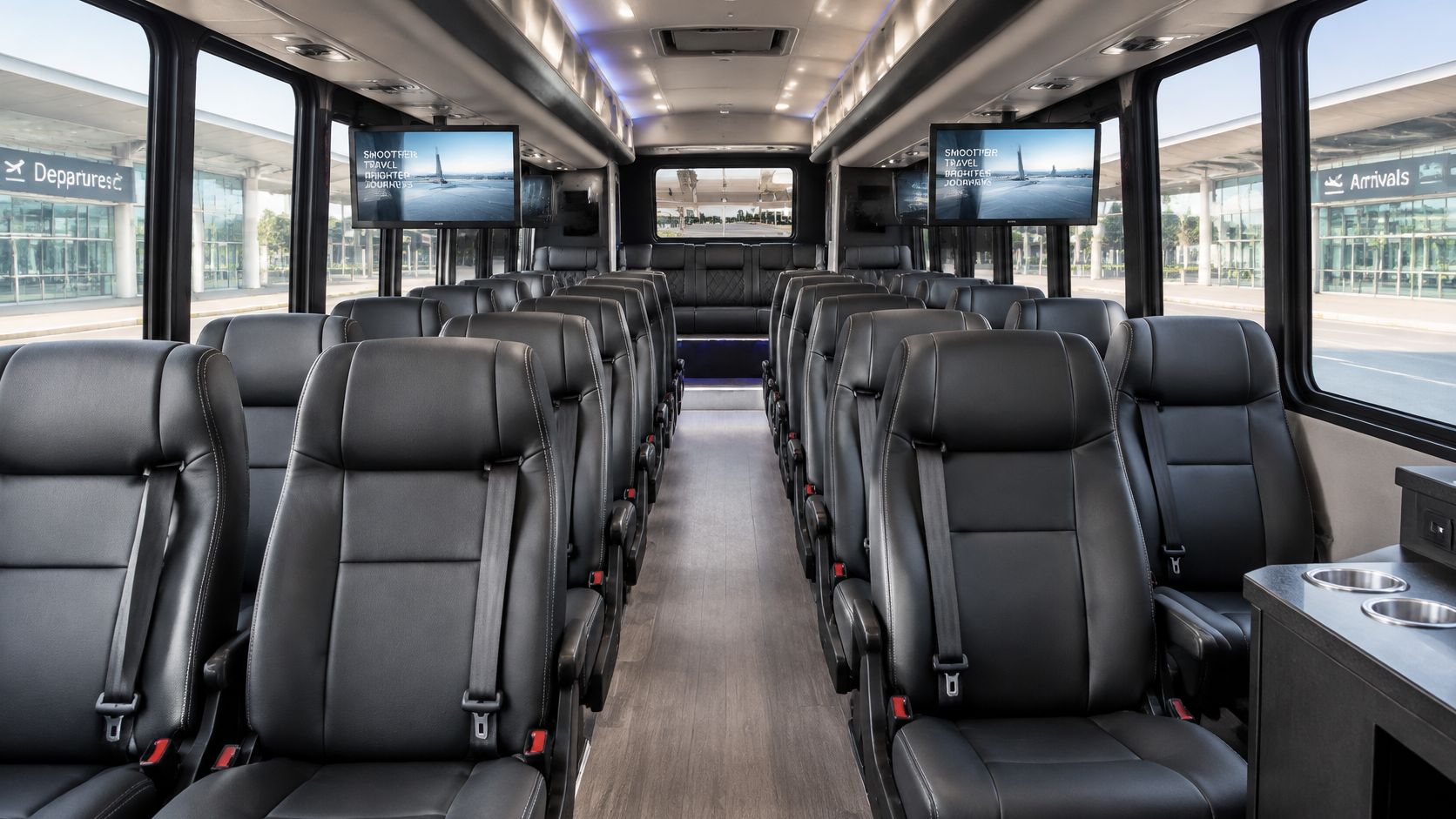
Step aboard a forward-facing shuttle layout and the purpose is clear: passengers take individual positions beside a center aisle. That arrangement is worth considering for transfers and guest shuttles because you can inspect each seating position and understand the walking route before anyone boards.
Use this interior view to assess the seating arrangement, not to assume the pictured vehicle is the one assigned.
Compare the floor plans
A perimeter lounge changes the experience. Guests face inward, which can suit conversation, but knees, gowns, and personal belongings share the space beside the seats. Inspect the actual designated positions rather than estimating capacity from the length of a bench.
A mixed layout combines forward-facing seating with a lounge area. For a wedding-party scenario, that might let hosts sit together while other guests occupy rows. It still needs a seat map that accounts for everyone, including anyone who needs easier boarding or additional personal space.
Our explanation of what a limo bus is helps separate the marketing term from the interior arrangement. Neither a lounge label nor a charter label tells you the complete equipment specification.
- Forward-facing rows: Inspect aisle clearance, seat access, and the location of storage.
- Perimeter seating: Check designated positions and whether formal clothing will crowd the walking space.
- Mixed seating: Confirm that the attractive rear lounge is included accurately in the seating plan.
Separate comfort features from transport needs
Tinted glass, colored lighting, phone-connected audio, charging ports, and a cooler compartment are features to confirm on the assigned vehicle. They're not a substitute for storage or suitable restraints. A restroom also needs explicit confirmation because its installation can affect the available interior layout.
For a New York City to Montauk itinerary, discuss restroom access and comfort breaks when setting the route. Don't infer that a bus has a restroom from its exterior size, and don't assume a bar area comes stocked. Ask about beverage permissions, sealed-container storage, and cleanup expectations before guests bring supplies.
This video provides another visual reference for evaluating the passenger environment.
Ceiling height may make standing comfortable while parked. It doesn't make standing an appropriate travel arrangement. Choose the interior for how guests will ride, not just how it looks when empty.
Safety Rules Insurance and the Chauffeur
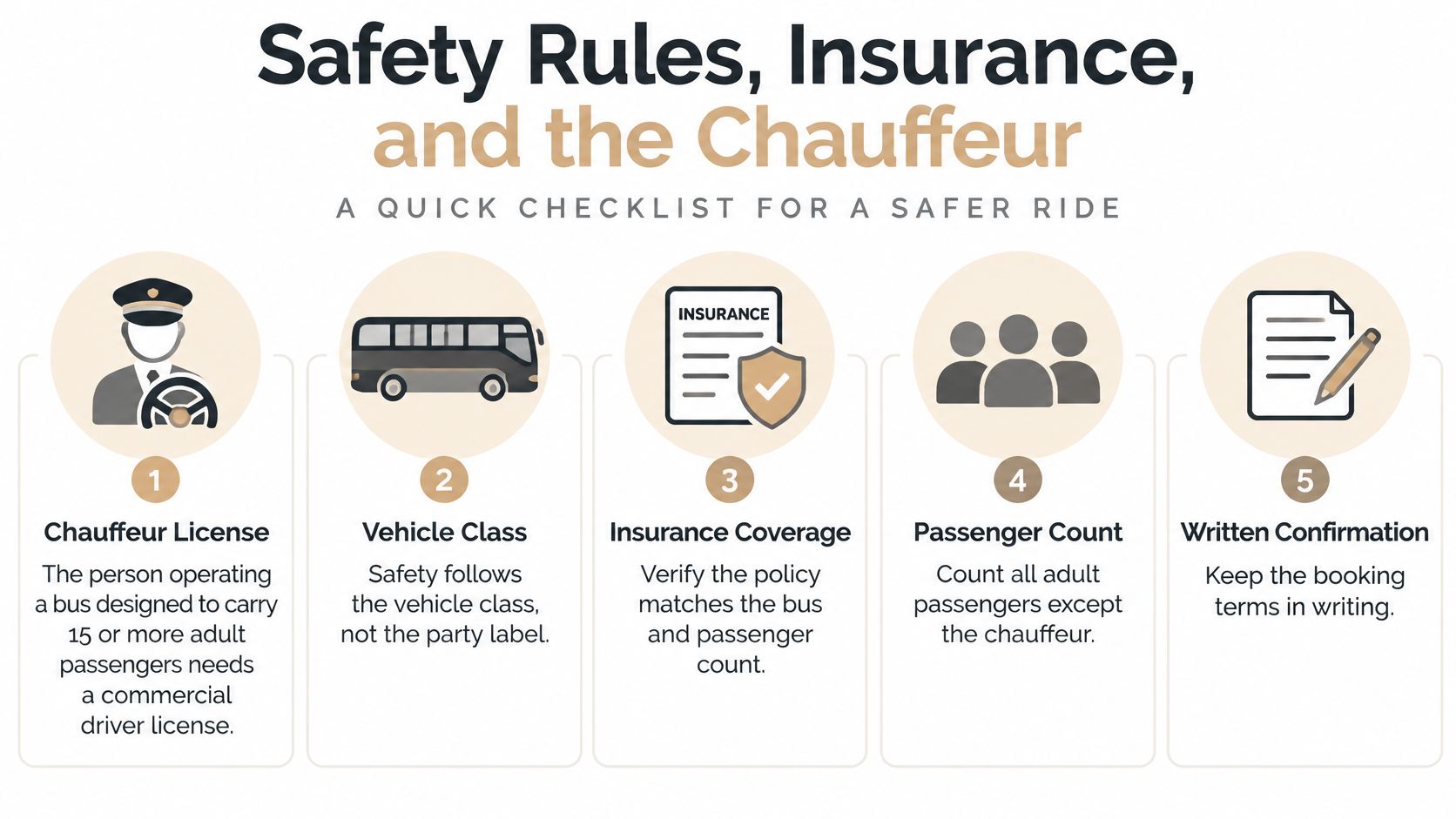
A clean bus and a stocked cooler tell you nothing about who is driving it. The credential conversation starts with the person at the wheel. The New York DMV passenger-transport guide requires a commercial license with a passenger, or P, endorsement for someone operating a bus designed to transport 15 or more adult passengers, excluding the chauffeur, along with the applicable knowledge and skills testing. That guide also directs the chauffeur to review the previous inspection report and confirm reported defects were repaired, or determined not to require repair, before signing.
Treat that as a concrete booking check. Ask for confirmation tied to the assigned chauffeur and the assigned vehicle, rather than a general statement that the drivers are experienced.
Verify the vehicle category and coverage
Under the FMCSA passenger-carrier guidance, a vehicle designed to carry 16 or more people, including the chauffeur, falls within the relevant commercial-motor-vehicle capacity threshold. Interstate, for-hire passenger operations generally also require federal operating authority and commercial safety compliance. The certified capacity that sets the license class also sets your legal headcount, so the seat map you approve is the number that matters at the curb, not the headcount you hope will show up.
Insurance should match the vehicle and the operation, and the operator should be able to show proof of coverage for the assigned bus before you pay a deposit. Ask for documentation that names the specific vehicle, not a fleetwide summary.
Use this checklist to organize the documentation conversation.
Match belts and exits to the actual bus
The FMCSA occupant-protection chart distinguishes motorcoaches from other bus categories and specifies the weight bands and belt expectations summarized below. Confirm gross vehicle weight rating, body classification, and designated seating positions together, because an advertised seat count means little if some positions lack restraints.
Belt and Class Checks Before Booking
| Vehicle class | Belt expectation | Check before booking |
|---|---|---|
| Medium motorcoach, 10,000 to 26,000 lb GVWR | Lap and shoulder belt at every designated seat | Confirm GVWR and the seat map |
| Large motorcoach, above 26,000 lb GVWR | Lap and shoulder belt at every designated seat | Confirm body class and the seat map |
| Other bus categories | Requirements may differ, including chauffeur-only belt rules | Ask for the federal classification in writing |
An aftermarket lounge conversion can change the original seating arrangement. Have the operator confirm the configuration you are booking and the restraints available at each intended position.
The federal emergency-exit rule addresses applicable FMVSS 217 compliance, including emergency-exit arrangements for buses above 10,000 pounds GVWR and distribution of required exit space. Working release mechanisms, visible markings, and accessible exits matter as much as the paperwork. A cooler or bag pile parked in front of an exit undoes the compliance on paper.
Before departure, have the group listen to the exit briefing. Count the passengers, keep access unobstructed, and have everyone remain seated and use the provided restraints while moving.
Weddings Proms and Corporate Shuttles
A wedding guest shuttle and a wedding-party ride may share a destination but need different loading plans. Guests moving from an inn to a ceremony usually travel lightly. Attendants may bring garment bags, flowers, gifts, and items needed for photographs or an outfit change.
Choose the vehicle around each departure wave, not the total attendance printed on the invitation. A bus that works for repeated hotel departures may be a poor choice for transporting the wedding party and its belongings in a single movement.
Match the event to the movement
When a 30 Passenger Party Bus Fits the Event
| Occasion | Typical pattern | Fit |
|---|---|---|
| Wedding guest shuttle | Waves between inn, ceremony, and reception | Fits when each wave stays within certified capacity with little luggage |
| Wedding party ride | Attendants plus gowns and gifts | Often tight because attire needs protected storage |
| Prom | One school group and a curfew | Strong fit with belts and agreed alcohol rules |
| Corporate offsite | Colleagues plus laptops and carry ons | Bag storage matters more than the roster alone |
| Winery or beach afternoon | One group and several reboardings | Fits if the schedule has slack |
| Late gala return | Formal dress and a long night | Fits if the aisle stays clear through the last stop |
For prom, settle the supervision and communication arrangements before pickup. A guardian should have the day-of contact, the return location should be unambiguous, and the group should understand the alcohol and conduct rules. Don't leave the chauffeur to negotiate those rules with students at departure.
A corporate offsite introduces a different challenge: arrivals may be staggered, colleagues may carry work equipment, and the final destination might be a club entrance with controlled access. Give the coordinator the venue contact and distinguish guests who are ready to leave from those still collecting luggage.
Book the departure wave you can actually load, not the guest list you hope will organize itself.
Plan the return as carefully as the arrival
For a winery or beach afternoon, identify who confirms that everyone has reboarded. Repeated stops create opportunities for someone to remain in a tasting room, return to a changing area, or join another part of the group. A named organizer should reconcile the manifest before departure.
At a late gala, decide whether guests leave together or in separate return waves. Include wraps, mobility needs, and the last departure in the plan. An early return for tired guests shouldn't leave the remaining group without confirmed transport.
Wedding planners should also assign responsibility for gifts and decor. Those items may leave at a different time from the people who brought them. A separate collection arrangement can preserve a passenger shuttle's usefulness without forcing belongings into the cabin.
The right comparison isn't party bus versus ordinary bus. It's the event's actual movement pattern versus the seating, storage, and access available.
Hamptons Roads Luggage and Split Groups
Treat Friday traffic and the pickup curb as constraints, not details to resolve after booking. A route through Southampton, Bridgehampton, and East Hampton may look straightforward on a map, but the chauffeur still needs a permitted place to stop and enough room to maneuver.
For estate gates and inn courtyards, send entrance photos and a map pin showing the intended boarding point. Include low branches, gateposts, tight corners, parked cars, and any instruction against reversing onto the road. A lawn or soft shoulder isn't a substitute for a suitable loading location.
Check the entrance and the whole route
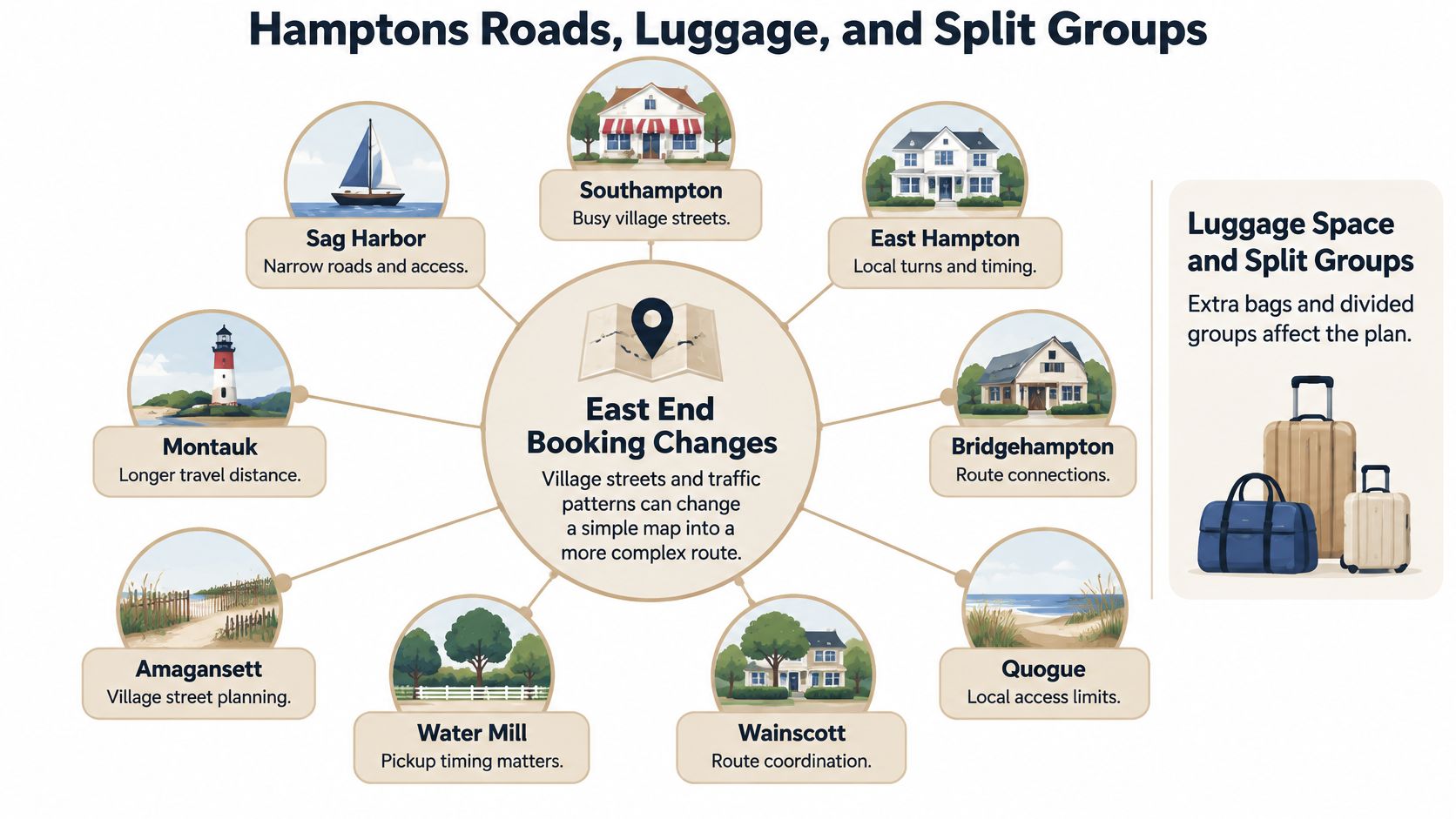
Sag Harbor calls for attention to street access, while a Montauk destination changes the distance and return planning. Amagansett, Water Mill, Wainscott, and Quogue each need an exact address rather than a town-only estimate. Ask the venue where passenger vehicles should load and identify a backup location that guests can reach safely.
Use this route-planning diagram as a reminder to assess each stop individually.
Airport collections introduce the most obvious storage test. Arrivals at JFK, LaGuardia, Newark, or MacArthur can involve suitcases, carry-ons, evening clothes, and equipment that wasn't included in the original roster. Send the baggage inventory before allocating passengers.
- Split by pickup needs: Keep travelers arriving together on the same assigned manifest where practical.
- Share one itinerary: Give each vehicle the same destination sequence and current venue instructions.
- Name a group contact: Make changes through the coordinator rather than through separate guest messages.
Distinguish local travel from interstate travel
New York City to the Hamptons doesn't become interstate travel merely because it's a long journey. Newark pickups or routes involving another state need separate consideration. The FMCSA multimodal passenger guidance explains why vehicle capacity and operating circumstances, rather than a party-bus label, determine the applicable commercial framework.
For accommodation and shared-itinerary decisions, Global Vacation Rentals' advice to plan a stress-free group vacation is a useful companion to the transport manifest. Our group transportation service guide adds context for organizing the movements between those stays.
Give dispatch the curb notes with the passenger list. Separate vehicles can follow one coordinated plan without needing to occupy the same narrow entrance simultaneously.
What Shapes a Group Quote
A useful quote starts with a vehicle match and a complete itinerary. Send the stops in travel order, the required arrival time, and the final return arrangement. Include waiting at venues rather than describing the trip only as transportation between towns.
Define the booked time
Ask which hours count toward the booking and how overtime is handled. Airport meeting times can change with flight delays, while a reception may finish later than planned. Those possibilities belong in the written terms.
For airport-specific preparation, Easy Travel Bookings' explanation of how to book airport transfers can help you organize the flight and meeting details. Our guide to party bus rental cost factors provides additional context for comparing the scope of a group booking.
- Vehicle assignment: State the passenger load, luggage, and access restrictions.
- Time boundaries: Confirm pickup, waiting, final drop-off, and overtime.
- Written terms: Request cancellation conditions and any permitted changes.
A failed curb check can require a different vehicle arrangement. Resolve that before paying a deposit so you're comparing a workable itinerary, not an attractive quote for a vehicle that can't reach the entrance.
How to Book Without a Surprise
Book the arrangement that matches your load, then make the agreement specific enough that someone who wasn't in the planning conversation could run the day. Photos help, but they don't establish storage dimensions, accessible boarding, or the exact seating configuration.
Use the booking sequence below to assemble a single written record.
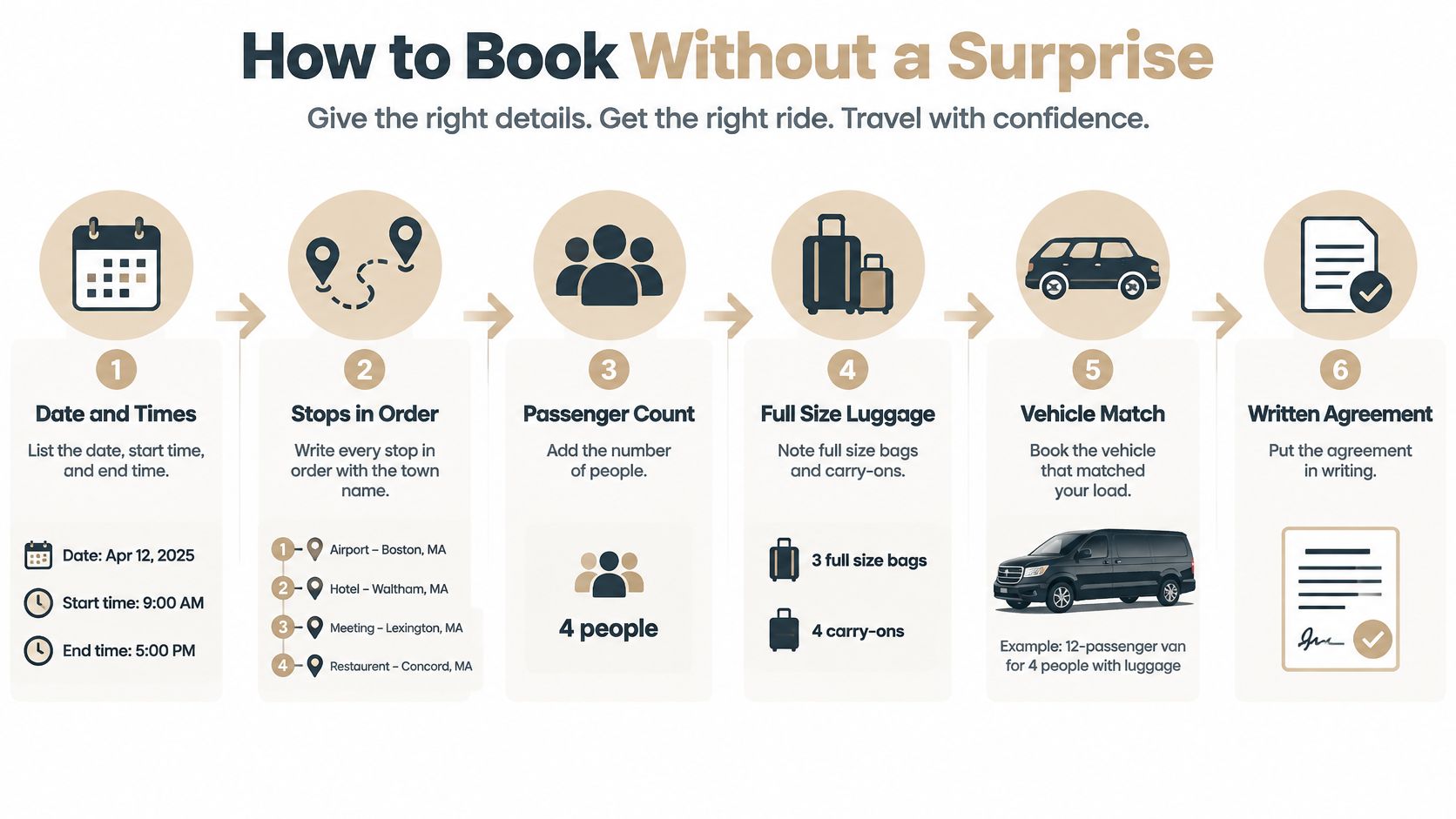
Send and confirm the booking essentials
- Date and route: List the date, start time, end time, and every stop in order with its town and exact address.
- Passenger and item manifest: Add the people, full-size bags, carry-ons, child seats, mobility equipment, and anything that needs dedicated storage.
- Assigned vehicle details: Confirm seated capacity, restraint type, luggage arrangement, boarding access, and whether a restroom affects the layout.
- Credentials: Request the appropriate New York passenger endorsement, applicable registration or operating authority, and commercial insurance documentation for the assigned arrangement.
- Written quote terms: Request fixed pricing with no surge, plus the overtime rule and cancellation conditions in the same record.
- Day-of coordination: Name the contact authorized to approve changes and provide a backup loading location for every restricted entrance.
Keep this record with the event itinerary. If a planner hands responsibility to a family member or executive assistant, that person should receive the same version rather than a collection of screenshots from different conversations.
Resolve substitutions before payment
Ask how a proposed vehicle change will be communicated. A replacement needs to meet the agreed passenger, baggage, restraint, and access needs, not merely look similar from outside. If the changed arrangement affects the number of vehicles or loading location, update the manifest and guest instructions.
Before the deposit: Confirm that the promised transport arrangement works at the venue entrance, not just on the booking form.
Don't leave an unresolved driveway question until the wedding morning. Send the entrance photographs to the venue and coordinator, and settle any alternate pickup while guests can still receive clear instructions.
Once the workable arrangement is confirmed, reserve it rather than continuing to circulate incompatible options. The most useful booking is the one your guests, venue contact, and transport coordinator can all understand and execute.
Text for a Fixed Group Quote
Go with a single bus only when the people, belongings, and access all suit that specific vehicle. If airport luggage, formalwear, mobility equipment, or a restricted driveway makes that uncertain, choose a coordinated split or discuss a coach with dedicated luggage storage. Don't force a nominal headcount into an unsuitable layout.
For bookings with Hamptons Leisure Limo, there's an important distinction: we use multiple vehicles with one coordinator for groups bigger than 14 passengers. A search for a party bus can help you understand the category, but it shouldn't create an assumption that your booking will be a single lounge-style vehicle.
Send the details that decide the arrangement
Text (631) 294-0747 with the date, towns, passenger count, bag count, and entrance restrictions. Include flight details for airport pickups and tell us whether guests travel together throughout the day or leave in separate waves. We offer fixed pricing with no surge, based on the agreed arrangement.
Hamptons Leisure Limo is fully USDOT registered and commercially insured. Request the registration and commercial insurance details in writing before paying a deposit, along with the assigned transport arrangement.
We serve Southampton, East Hampton, Sag Harbor, Montauk, Bridgehampton, Amagansett, Water Mill, Wainscott, and Quogue. Send curb photographs and venue instructions with your inquiry so the plan accounts for where guests will board, not just where the address pin appears.
Hamptons Leisure Limo offers coordinated group transportation with fixed pricing and no surge, helping you match passengers, luggage, and East End access to a workable itinerary. Visit Hamptons Leisure Limo and Text (631) 294-0747 with your date, stops, headcount, and bag count for a fixed group quote.
Ready to Ride with Hamptons Leisure Limo?
Fixed pricing. No surge fees. 30 years of experience serving the Hamptons. Text us what you need and we will send a quote.