Winery Limo Long Island: Tour Planning
Updated October 8, 2026
You've booked the tasting rooms, invited the group, and picked the North Fork wineries. Then someone asks the question that can disrupt the entire day: How will everyone get from the Hamptons, Manhattan, or an airport to each vineyard, and back home after the last pour? A winery tour isn't just a collection of addresses. It's a coordinated itinerary involving reservations, vehicle access, rural roads, mobility needs, meal breaks, and a dependable return plan.
A well-planned winery limo Long Island experience keeps those details in the background. The group can focus on conversation, food, and tastings while a professional chauffeur manages the route and the vehicle remains available throughout the itinerary.
Table of Contents
- The Reality of Long Island Wine Country Logistics
- Designing a Realistic North Fork Itinerary
- Selecting the Right Vehicle for Your Group
- Navigating Winery Reservation Thresholds and Rules
- Prioritizing Safety and Alcohol Awareness
- Securing Your Tour with Fixed Pricing and Support
The Reality of Long Island Wine Country Logistics
A group can do everything right on paper and still lose valuable time at the first stop. They arrive at a popular North Fork tasting room, discover that the hired van can't use the property's entrance, and learn that the venue requires advance coordination for parking. Another group reaches the region by train, only to find that local transportation between wineries is limited and the next return connection doesn't fit the tasting schedule.
That friction comes from treating wine country like a compact urban district. The wineries may look close together on a map, but each property has its own entrance, parking layout, reservation rules, terrain, and closing rhythm. A rideshare app might show nearby vehicles, yet availability can be unpredictable once the group leaves the station or finishes at a rural vineyard.
Long Island's commercial wine industry began in 1973, when Alex and Louisa Hargrave established Hargrave Vineyard in Cutchogue. The region now includes approximately 60 to 82 wineries, depending on the definition and date measured, spread across the East End and recognized through the Hamptons, North Fork of Long Island, and Long Island AVAs. That distributed geography is why a tour requires pre-arranged, point-to-point transportation rather than one simple transfer. The regional history and winery distribution are documented in this Long Island wine country profile.
Why the last mile matters
The North Fork rail and bus network can help travelers reach the region, but it doesn't automatically solve the movement between tasting rooms. The LIRR connection to Mattituck runs only a few times daily, and local transportation between wineries is limited, according to this North Fork wine travel guide.
A private vehicle changes the operating model. The chauffeur picks up the group at a home, hotel, airport, or Hamptons address, waits during the itinerary, and completes the final drop-off without asking guests to locate separate rides after tasting. That fixed-route approach is especially useful when the group is carrying luggage, wine purchases, event equipment, or child seats.
Practical rule: Proximity between vineyards doesn't guarantee a practical car-free tour. The last-mile connection often controls the entire day.
Designing a Realistic North Fork Itinerary
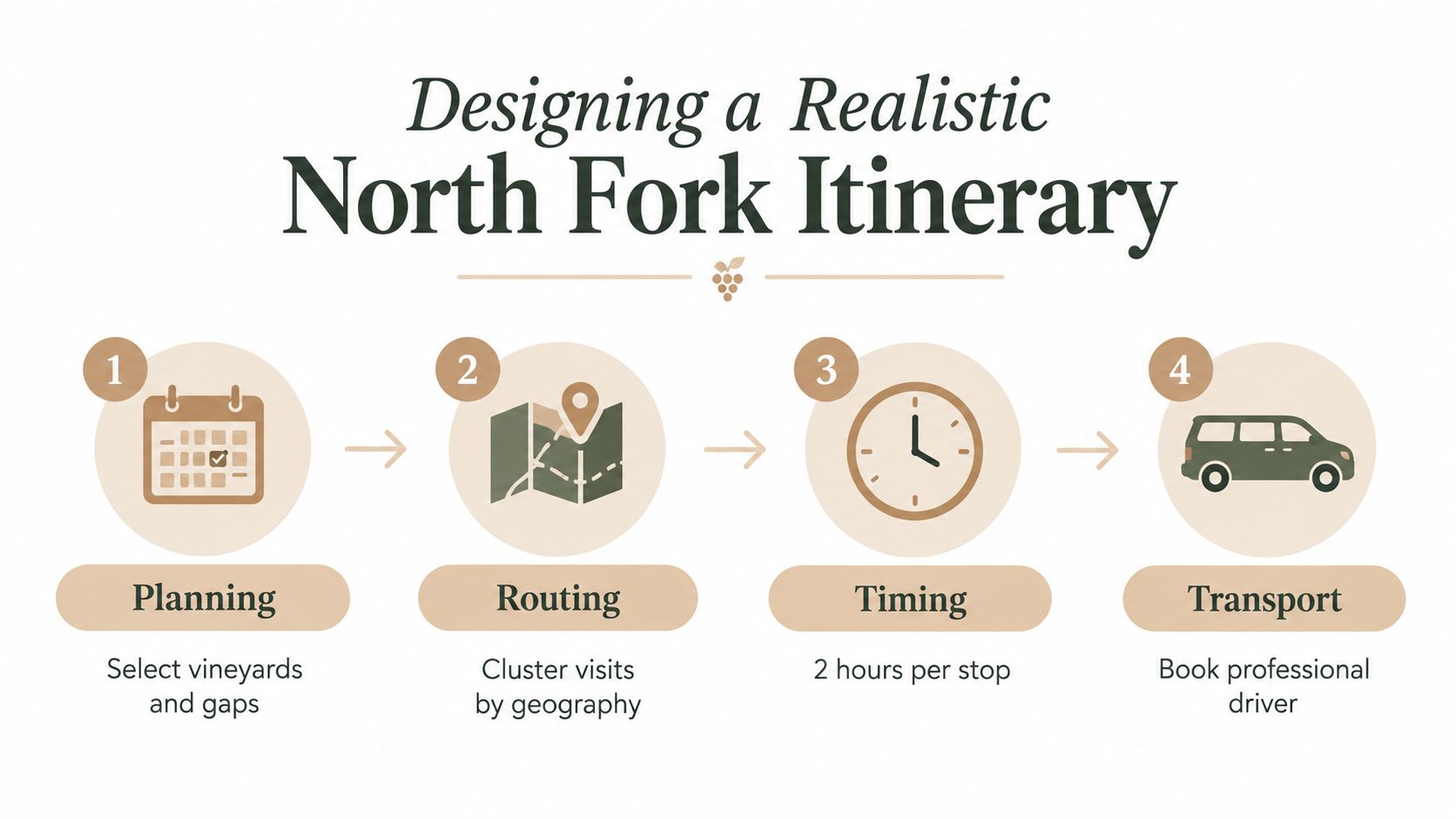
A reliable itinerary starts with confirmed reservations, not with a list of places that look appealing on a map. The route should account for arrival procedures, parking, restroom stops, loading, meal timing, traffic, photographs, and the possibility that a tasting runs longer than expected.
Build the day around real constraints
Collect the complete trip brief. Confirm the group size, pickup zone, mobility needs, luggage, child seats, preferred return time, tasting reservations, meal stop, and whether anyone needs to remain near the vehicle. A change in any one of these details can affect vehicle selection and routing.
Cluster stops geographically. Keep the first part of the day in one practical area, then move deliberately toward the next cluster. Avoid crossing the entire East End between consecutive appointments just because two venues appeared together in a search result.
Protect recovery time. A tasting isn't a fixed-duration transaction. Guests may need time to check in, use the restroom, browse the shop, take photographs, or collect purchases. Scheduling consecutive reservations with no margin turns a relaxed outing into a series of late arrivals.
Add food and water before the group needs them. A meal stop gives guests time to reset and helps prevent the itinerary from becoming a continuous sequence of tastings. It also creates a useful timing point if the first venue runs late.
Set a clear final destination. The return plan should include the exact hotel, residence, airport, or event venue. A final headcount is easier when everyone knows where the group is going and when the vehicle will leave.
A New York State agricultural profile supports this dispatch approach, reporting more than 3,000 vineyard acres, approximately 1.2 million gallons of annual wine production, and roughly 1.3 million annual winery visitors. Those figures reinforce that the region functions as a substantial destination with real routing demands, not as a single roadside attraction. The New York State Library profile also highlights the need for buffers around reservations, traffic, check-in, and vineyard overruns.
Let one coordinator own the moving parts
For a larger group, one trip coordinator should maintain the live itinerary and communicate timing changes to the chauffeur and venues. That person can confirm whether the group is ready to depart, track purchases or personal items, and make decisions if a tasting extends beyond its planned window.
A detailed guide to planning a wine tour can help organize the reservation sequence before transportation is booked. The practical test is simple: if one stop runs late, can the rest of the day absorb the delay without losing the meal, the final reservation, or the return pickup?
Selecting the Right Vehicle for Your Group
Vehicle selection should leave room for comfort, movement, purchases, and mobility equipment. Choosing a vehicle that technically fits the passenger count can still create an unpleasant day if guests have to compress bags between seats or if there isn't space for a wheelchair, walker, cooler, or child seat.
Match capacity to the actual party
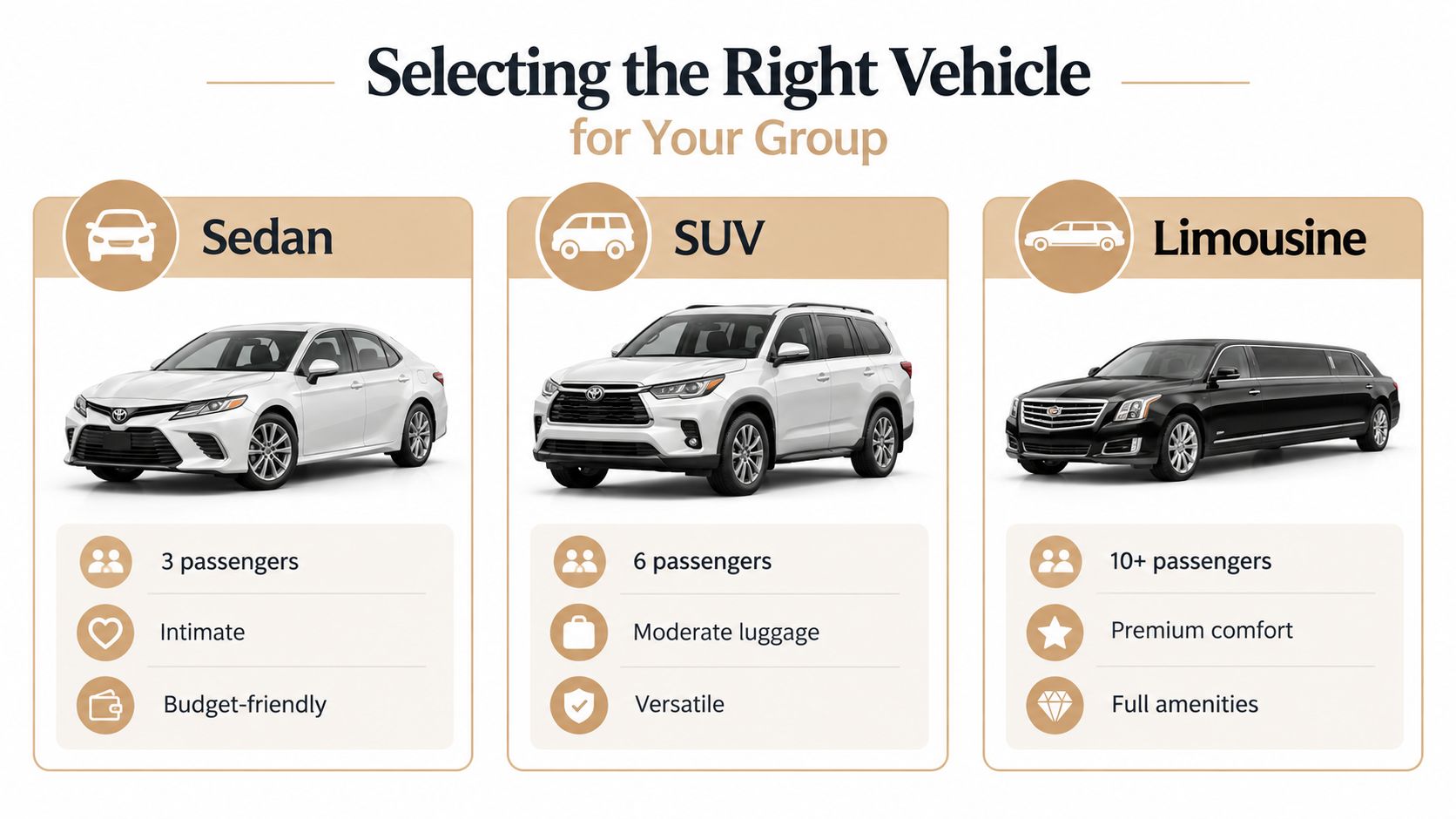
A six-passenger premium SUV suits a small group that wants privacy, storage, and a comfortable door-to-door ride. It can work well for a couple traveling with luggage or a small gathering that doesn't need a larger cabin.
A 14-passenger van gives a medium-sized group more useful separation between people and belongings. It can be a practical choice for family outings, corporate groups, or friends bringing purchases and personal items. If the group expects significant wine purchases, the vehicle plan should address storage before departure.
A larger coach becomes appropriate when the party exceeds van capacity or when several vehicles need centralized coordination. Corporate retreats, wedding parties, and large family gatherings benefit from one dispatch point, a shared manifest, and a consistent return plan rather than a collection of unrelated rides.
Capacity isn't just a seat count. It includes room for people to sit comfortably, enter and exit safely, store belongings, and remain with the group when the itinerary changes.
Accessibility requires two separate checks
Vehicle accessibility and venue accessibility aren't the same thing. New York tourism guidance notes that a Long Island winery may have an accessible entrance and tasting room while still presenting uneven gravel or grass outdoors. It also warns that travelers who can't transfer may have no accessible rideshare option in the region, as described in this accessible Long Island travel guidance.
Before confirming the itinerary, ask each venue:
- Entrance: Can the selected vehicle reach the accessible entrance?
- Surface: Does the route include gravel, grass, slopes, or uneven walkways?
- Restrooms: Are accessible facilities available near the tasting area?
- Seating: Can the guest remain seated with the group?
- Parking: Is there a designated location for the vehicle?
- Equipment: Can the vehicle accommodate a wheelchair, walker, or other mobility equipment?
Mixed groups need the same level of care. An older guest, pregnant traveler, child, service animal, and wheelchair user may all have different requirements. Child seats should be requested before service, and the final passenger manifest should include equipment that occupies cabin or storage space.
A wine tour limo option should be evaluated by vehicle configuration, chauffeur coordination, and access planning, not by the exterior appearance of the vehicle alone.
Navigating Winery Reservation Thresholds and Rules
North Fork wineries don't operate under one shared policy for group size or hired vehicles. A venue may welcome small walk-ins, require reservations at a specific threshold, restrict buses, or ask a limousine group to submit a separate request even when the party itself isn't especially large.
The thresholds matter because the reservation may determine whether the group can sit together, whether parking is available, and whether the venue can receive the selected vehicle. Several regional examples are summarized below.
| Winery | Group Size Threshold | Hired Vehicle Policy |
|---|---|---|
| Pellegrini Vineyards | Reservations at five guests | Confirm vehicle access directly |
| Several North Fork wineries | Reservations at six guests | Confirm group and parking rules |
| Lenz Winery | Seven to sixteen guests | Advance coordination required |
| Sannino Vineyard | Seven to fifteen guests | Formal request for seven to fifteen guests or any party arriving by hired vehicle |
| Raphael Vineyards | Eight guests | Confirm vehicle access directly |
| Paumanok Vineyards | Eight guests | Confirm vehicle access directly |
| RGNY | More than ten guests require an experiential reservation | Full headcount under one reservation |
| Jamesport Vineyards | Reservation required for tastings | Confirm vehicle and group rules |
| Macari Vineyards | Reservation required for tastings | Confirm vehicle and group rules |
The threshold information comes from this North Fork winery planning guide, while individual policies can change and should be confirmed before final dispatch.
Sannino and RGNY show why headcount matters
Sannino Vineyard allows walk-ins under its general policy for groups of up to six guests, but reservations are recommended for groups of seven or more and for parties arriving by hired vehicle. Its formal large-group request covers parties of seven to fifteen guests, or groups using a limousine or other hired vehicle. The reservation helps guarantee service, parking, and one table for the full group, according to Sannino Vineyard's current FAQ.
RGNY uses a different threshold. Groups of ten or fewer may walk in, although seating availability is limited, while parties of more than ten must book an experiential reservation. Guests who want to sit together should place the full headcount under one reservation. Splitting a larger party into separate bookings doesn't automatically solve the seating problem, as explained in RGNY's visit information.
A regional directory also identifies properties where groups of eight to twenty-five must prepay, tasting rooms that limit groups to eight, and venues that don't permit buses or bachelorette parties. Some properties restrict limousines, buses, or vans altogether. The North Fork winery directory is useful for initial planning, but a direct venue confirmation remains necessary.
The final passenger count should be settled before the chauffeur's timing is finalized. A group that grows after reservations are made may need a different vehicle, a revised table request, or an entirely different venue sequence.
Prioritizing Safety and Alcohol Awareness
Alcohol safety starts before the first tasting. The professional chauffeur should be designated in advance, remain with the vehicle throughout the itinerary, and stay entirely separate from the group's alcohol consumption. That arrangement removes the temptation to ask a guest to drive later because the original plan changed.
The safety plan should be operational, not merely promotional. A dispatcher or trip coordinator should know where every passenger is expected to finish, which venue is next, and who has authority to approve a change in the route.
Use controls that work in real conditions
- Professional chauffeur: Assign the transportation role before the first tasting and don't transfer it to a guest later.
- Water intervals: Keep water available and schedule breaks between tasting experiences.
- Meal timing: Place food into the itinerary rather than waiting until guests are already uncomfortable.
- Live manifest: Record the passenger list, destinations, venue contacts, and emergency numbers.
- Final headcount: Count passengers before leaving the last stop, including anyone who stepped away or stayed inside.
- Return destination: Confirm every guest's hotel, residence, airport, or event destination before the final departure.
The National Highway Traffic Safety Administration reported 11,904 U.S. fatalities in crashes involving at least one alcohol-impaired driver in 2024, representing 30% of all traffic fatalities. The same NHTSA traffic safety report reported that alcohol impairment among drivers in fatal crashes was three times higher at night than during the day.
Plan differently after dusk
A late itinerary needs more pickup margin than an afternoon return. Rural roads can be unfamiliar, visibility changes, and passengers may be tired or separated from the group after the final tasting. Direct drop-offs to the confirmed destinations are safer than asking guests to arrange separate transfers once the service ends.
The chauffeur should know what to do if a passenger becomes incapacitated, loses contact with the group, or refuses to leave the final venue. The plan might require venue staff, the trip coordinator, or dispatch to intervene. No provider can control how much a passenger consumes, but a written escalation process and documented headcount create practical safeguards.
Securing Your Tour with Fixed Pricing and Support
A wine tour quote should reflect the complete operating plan, not just the distance between pickup and the first vineyard. Ask whether the service includes the vehicle's availability during tastings, the planned return, tolls, coordination for multiple vehicles, and changes caused by a reservation running late.
Fixed pricing provides a clearer planning baseline than an app that recalculates availability as demand changes. A verified service description for fixed-price transportation states that fixed pricing models with no surge or cancellation fees are often up to 40% less than comparable ride-share options during peak periods. That claim has no linked source in the supplied data, so it should be treated as a provider-level statement rather than a universal market result. The useful point for planners is predictability, not a promised saving.
A practical booking checklist
- Confirm the pickup: Give the exact Hamptons address, hotel, airport terminal, or Manhattan location.
- Finalize the manifest: Include adults, children, service animals, luggage, mobility equipment, and child-seat needs.
- Secure each reservation: Ask every winery about group thresholds, table arrangements, parking, and hired-vehicle restrictions.
- Choose the vehicle: Leave margin for comfort and storage rather than booking to the exact seat count.
- Set the return: Identify every drop-off and establish a final headcount procedure.
- Assign one coordinator: Use one contact for venue timing, passenger updates, and dispatch decisions.
- Request fixed pricing: Confirm the quote, availability, and cancellation terms in writing.
For corporate planners and wedding coordinators, centralized coordination and consolidated billing can be more useful than managing several independent rides. A service with airport coverage, hourly availability, and local routing knowledge can also adjust the pickup plan when an itinerary changes.
Hamptons Leisure Limo provides pre-arranged North Fork wine tours, fixed pricing, and vehicle options including premium SUVs, Sprinter vans, and larger coaches. Its fixed-price transportation information explains the model, while the booking conversation should still cover the exact venues, passenger needs, and access restrictions.
Text (631) 294-0747 for a quote, and provide the pickup location, group size, preferred wineries, reservations, mobility requirements, and return destination so the route can be planned around the actual conditions of your day.
Text (631) 294-0747 to arrange a North Fork wine tour with pre-arranged transportation, a vehicle matched to your group, and a chauffeur who remains available throughout the itinerary. Visit Hamptons Leisure Limo to begin planning a fixed-price route from the Hamptons, Long Island, New York City, or a local airport.
Ready to Ride with Hamptons Leisure Limo?
Fixed pricing. No surge fees. 30 years of experience serving the Hamptons. Text us what you need and we will send a quote.