Who Pays for Transportation at Wedding
Updated October 18, 2026
There's no single rule for who pays for transportation at a wedding. Traditional etiquette assigns wedding party and immediate family cars to the bride's family and the groom's transport to the groom's family, but most couples now split the cost with both families while guests pay for their own travel to the destination and the couple pays for any shuttle they publicly offer. Forget the popular advice that one side writes one check for every ride. That blanket rule collapses on a Hamptons weekend, where an airport pickup, a rehearsal dinner move, and a late night return from an estate are three different trips with three different payers. Ask who pays for this specific trip, for this specific passenger group, and you'll get an answer you can budget.
Table of Contents
- The Short Answer on Wedding Transportation Etiquette
- How Wedding Funding Has Changed
- Who Pays by Passenger Group
- A Hamptons Wedding Weekend Trip by Trip
- Hamptons Vehicle Options and How to Charge Them
- Contract Clauses That Protect Whoever Pays
- Putting It Together for a Hamptons Wedding
The Short Answer on Wedding Transportation Etiquette
Traditional etiquette is a starting point, not a contract. Under that framework, the bride's family covers organized transportation for the wedding party and close family, including the move between ceremony and reception and related parking arrangements, while the groom's family covers transportation for the groom and best man. You can see that classic split laid out in The Knot's breakdown of who pays for what.
Guests outside that organized plan have always handled their own travel. That means fuel, rental cars, taxis, or rideshare to get themselves to town and around on their own schedule. It's a clean line, and it's still useful, as long as you don't treat it as law.
If a trip is required to execute your wedding itinerary, the hosts pay. If a trip is personal travel to reach the destination, the guest pays.
Traditional Rule Versus Modern Practice
Modern couples divide costs by budget and contribution, not by a chart. A parent who wants to fund a specific vendor may take transportation. The couple may take it instead because they're managing logistics. Neither choice breaks etiquette.
What does break down is leaving the payer vague. Decide early, put it in writing, and assign one person to sign. Our detailed overview of wedding transportation etiquette for hosts and guests walks through how to communicate those decisions without awkward guest questions later.
How to Apply the Rule Trip by Trip
Use three filters for every ride you're debating.
- Is it on the official itinerary: Ceremony to reception, hotel to venue, and wedding party moves are host responsibilities.
- Did you choose a hard to reach location: A remote estate, limited parking, or an open bar strengthens the case for hosted shuttles.
- Did you publicly offer it: Once a shuttle appears on your website, guests expect you to fund it.
Vendor selection works the same way, line by line rather than all or nothing. The Texas Old Town vendor advice on building a vendor list is a helpful reminder to assign each category deliberately, transportation included, instead of assuming one payer absorbs everything by default. That's the mindset that keeps family conversations calm. You're not arguing over a principle. You're assigning line items.
How Wedding Funding Has Changed
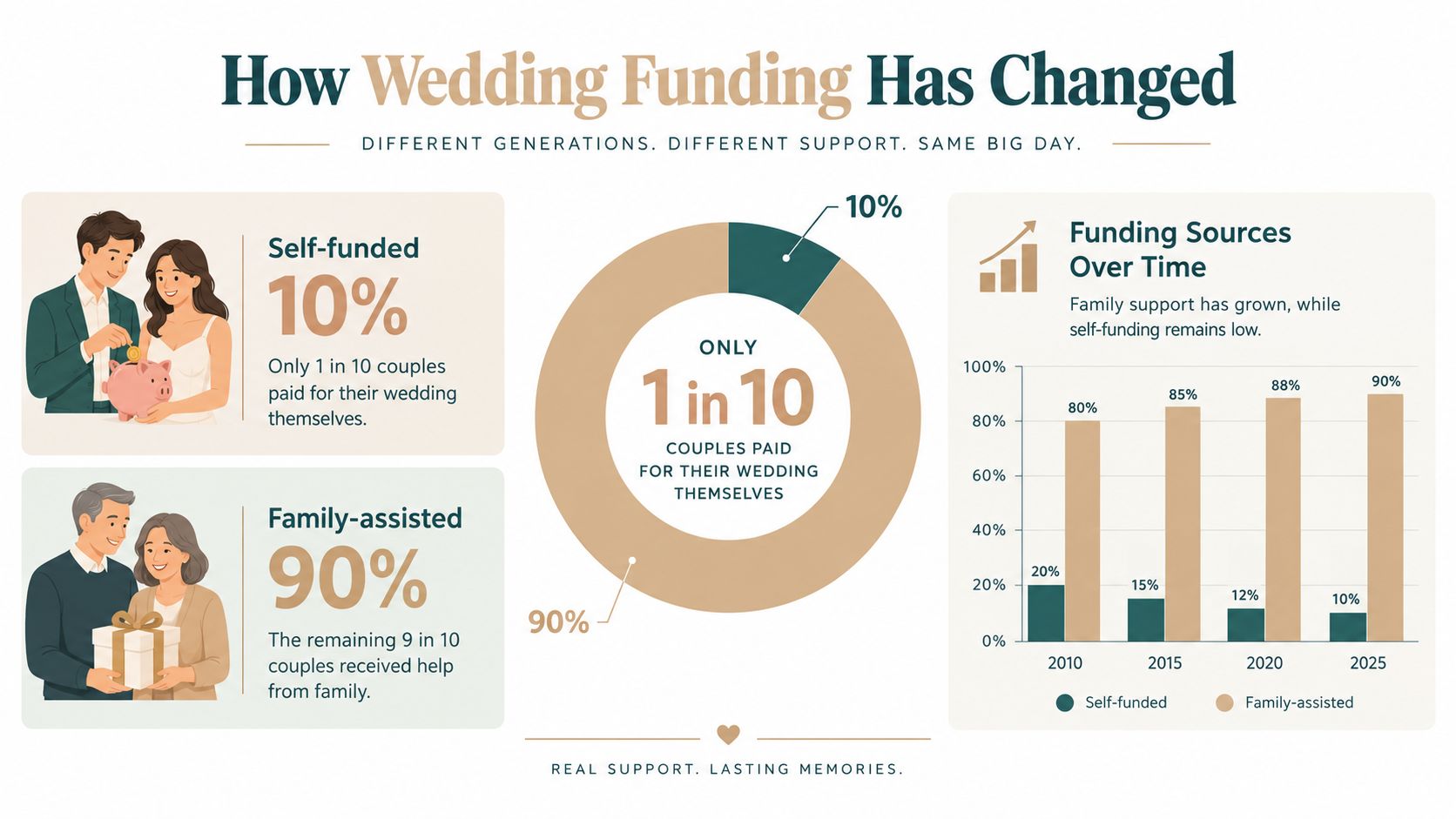
The money behind weddings no longer follows the old bride's family model, and transportation invoices reflect that shift. In a 2016 survey of nearly 13,000 couples, only 1 in 10 couples paid for the entire wedding independently, while parents collectively contributed approximately $19,000, or about two-thirds of the total wedding cost, according to WeddingWire data reported via Yahoo Finance. Within that total, the average was approximately $12,000 from the bride's parents and $7,000 from the groom's parents.
That same reporting found nearly 6 in 10 parents agreed to pay for particular wedding items or vendors rather than giving unrestricted cash. Transportation fits that pattern perfectly. A parent can sponsor the shuttle contract specifically, with a clear scope and a clear end date, instead of writing a blank check into a general fund.
What the Newer Split Looks Like
More recent data points in the same direction. The Knot's 2024 Real Weddings Study reported couples covered about 48% of wedding expenses, with parents funding the remaining 52%. That's close to an even split between the couple and both families combined.
For transportation, that means the payer is whoever has agreed to that line item in the broader budget negotiation. It might be the couple. It might be one set of parents. It might be a designated contributor who offered to handle guest logistics. All three are normal now.
destination celebrations make this negotiation even more explicit, because travel costs are impossible to ignore. If your Hamptons weekend functions like a destination wedding for most guests, the destination wedding cost etiquette guide from Passport to Adventure, LLC is useful background for separating host obligations from guest travel expenses before you send invitations.
The Practical Takeaway for Your Budget
Don't ask who traditionally pays and stop there. Ask these three questions instead.
- Who's contributing overall: Map total contributions first, then assign vendors.
- Who wants a defined item: Transportation suits a sponsor who prefers a specific, bounded cost.
- Who's managing logistics: The person coordinating pickups shouldn't automatically be the payer, but they do need authority to approve changes.
When those answers are clear, the transportation invoice stops being a family debate. It becomes one assigned line in a shared budget, paid by the party who agreed to it, with contributions settled privately among family members rather than collected from passengers.
Who Pays by Passenger Group
Splitting by passenger group is more useful than splitting by family side. Five groups show up at almost every Hamptons wedding, and each one has a different default payer. The table below gives you a working allocation you can adjust, not a rule you must obey.
| Passenger group | Traditional payer | Modern default payer | Hamptons note |
|---|---|---|---|
| Bride and groom | Bride's family, groom's family for groom | Couple or contributing family | Book a private car for photos and the getaway so you're not tied to shuttle timing |
| Bridal party and immediate family | Bride's family | Couple or hosting family | Estate venues often require coordinated arrivals, so host this move |
| Grandparents and VIPs | Bride's family | Couple or hosting family | Assign a dedicated sedan or SUV for mobility, heat, and early departures |
| Out of town guests | Guests themselves | Guests for arrival travel, hosts for offered shuttles | Host hotel to venue service when parking is limited or alcohol is served |
| Local guests | Guests themselves | Guests themselves | Provide clear parking and rideshare guidance if you aren't running a shuttle |
The Couple, Wedding Party, and Immediate Family
These rides aren't optional. If you've asked people to be in specific places, in specific attire, at specific times for photos and the ceremony, getting them there is your job. That principle holds whether the couple signs the contract or a parent funds it behind the scenes.
Immediate family belongs in the same category. Parents and grandparents shouldn't be hunting for parking on a narrow lane in Bridgehampton or waiting on a rideshare surge after the reception. Assign them to the hosted plan and tell them exactly where to be.
Guests Who Travel Independently
Guests who choose their own lodging or make personal trips outside the wedding itinerary arrange and pay for that travel themselves. That's consistent with long standing etiquette, and it's also laid out clearly in VowLaunch's guide to wedding transportation etiquette, which assigns hosts responsibility for ceremony to reception moves, bridal party transport, and the getaway vehicle while guests handle independent travel.
The line gets blurry with out of town guests staying at your room block. They've paid to reach the Hamptons. They haven't agreed to drive unfamiliar roads at midnight after an open bar. If your venue is remote, if parking is tight, or if guests don't know the area, host the hotel to venue shuttle and the return. It's a safety decision as much as an etiquette one.
Hosted or not, say so plainly: Guests can plan around either answer. They can't plan around silence.
Local guests are the easiest group. Most will drive themselves if parking is straightforward. Give them the address, parking instructions, and a realistic departure plan. If parking isn't straightforward, they belong on the shuttle too, and you should budget accordingly.
A Hamptons Wedding Weekend Trip by Trip
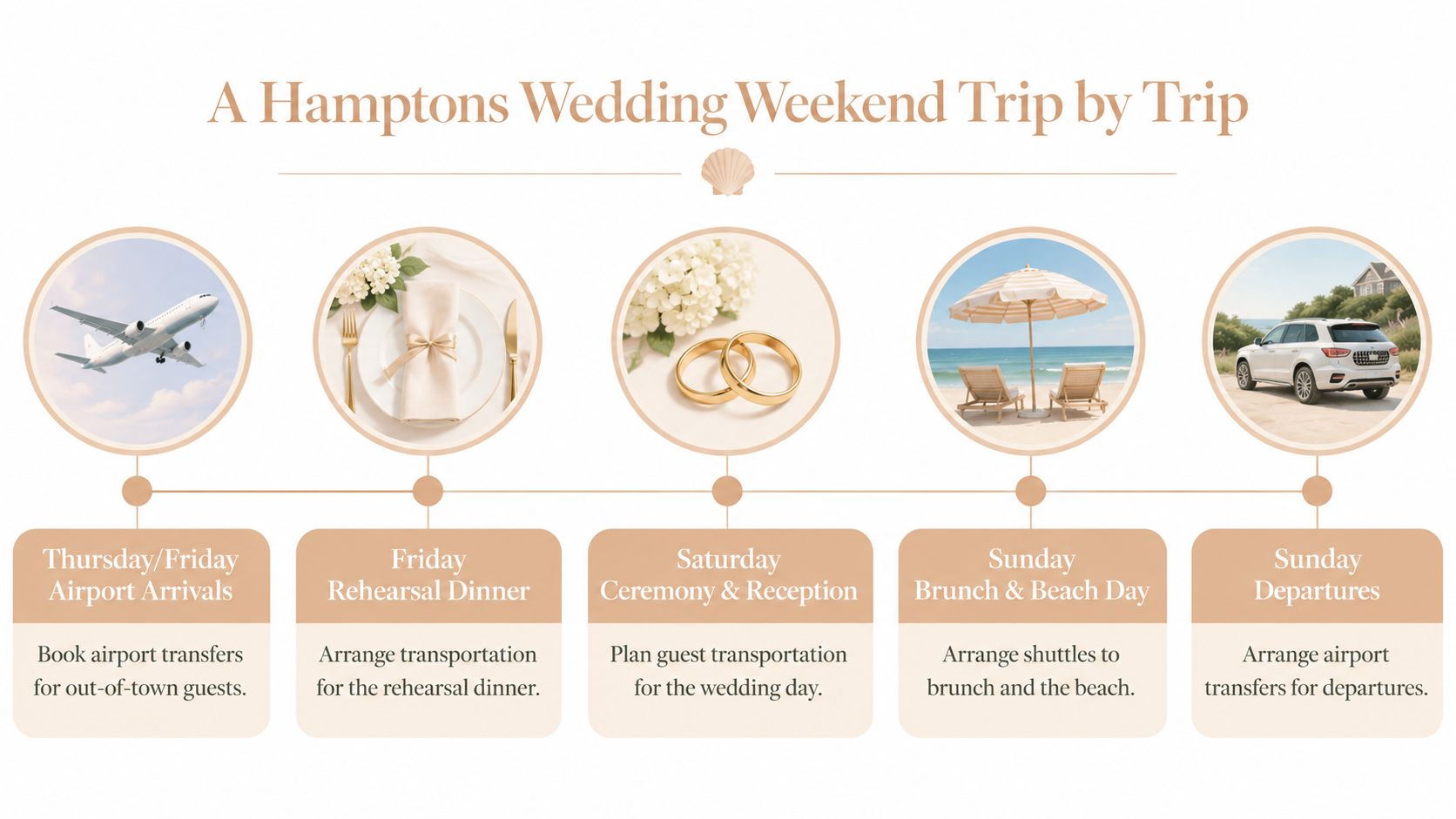
A Hamptons wedding isn't one day of rides. It's a weekend of them, spread across airports, rental houses, hotels, rehearsal venues, and estates from Southampton to Montauk. Price and assign each segment separately, and the total stops feeling mysterious.
Thursday and Friday Arrivals
Out of town guests pay for their own travel to the destination, including flights and most airport transfers. That's personal travel, not itinerary execution. The exception is a small group of VIPs, elderly relatives, or immediate family whose pickup you've offered to arrange. If you offer it, you pay for it.
Give independent travelers good information instead of a ride. Our Hamptons airport guide for arriving guests covers JFK, LaGuardia, Newark, MacArthur, and private East End airports, so guests can choose a rental, train, jitney, or pre booked car with realistic timing. Fixed pricing matters here for clients who pre book, because there's no surge surprise on a Friday afternoon in peak season.
Friday Rehearsal and Saturday Getting Ready
Whoever hosts the rehearsal dinner typically handles transportation connected to it, especially if the wedding party must move together from rehearsal to dinner. Keep it simple. One Sprinter loop beats six separate cars arriving at different times.
Saturday getting ready runs are host paid. Bridesmaids moving from a rental house to the venue, groomsmen moving from a hotel to photos, parents arriving early for portraits, these are itinerary trips. The couple or contributing family pays, and one coordinator sequences them.
Ceremony to Reception and Late Night Returns
This is the segment you should almost always host. When the ceremony and reception sit at different locations, or when guests are based at a hotel block, the shuttle connecting official venues is a host expense. Run at least one early return and one final return so older guests aren't stranded until the last song.
Once guest transportation is publicly offered through a wedding website or invitation, couples are generally expected to fund it rather than collect individual contributions from passengers, a point made directly in The Knot's wedding transportation tips. Don't list a shuttle on your website and then pass a hat. If the budget won't support a hosted shuttle, don't offer one, and give guests clear alternatives instead.
Sunday Brunch, Getaway Car, and Departures
Sunday brunch transportation follows the host of brunch. If it's an official hosted event at a separate location, provide the move or choose a walkable spot near the room block. Casual, optional gatherings can be left to guests.
The getaway car is a couple expense in practice, even if a parent gifts it. Budget it as your private vehicle, not as part of guest logistics. As you balance these weekend costs against other priorities, some couples compare tradeoffs with registry choices, and resources like best honeymoon fund ideas from EasyRegistry can help you think about where guest contributions appropriately belong, which is gifts, not shuttle seats. Sunday departures mirror arrivals. Guests handle their own, VIP pickups you've promised are yours.
Hamptons Vehicle Options and How to Charge Them
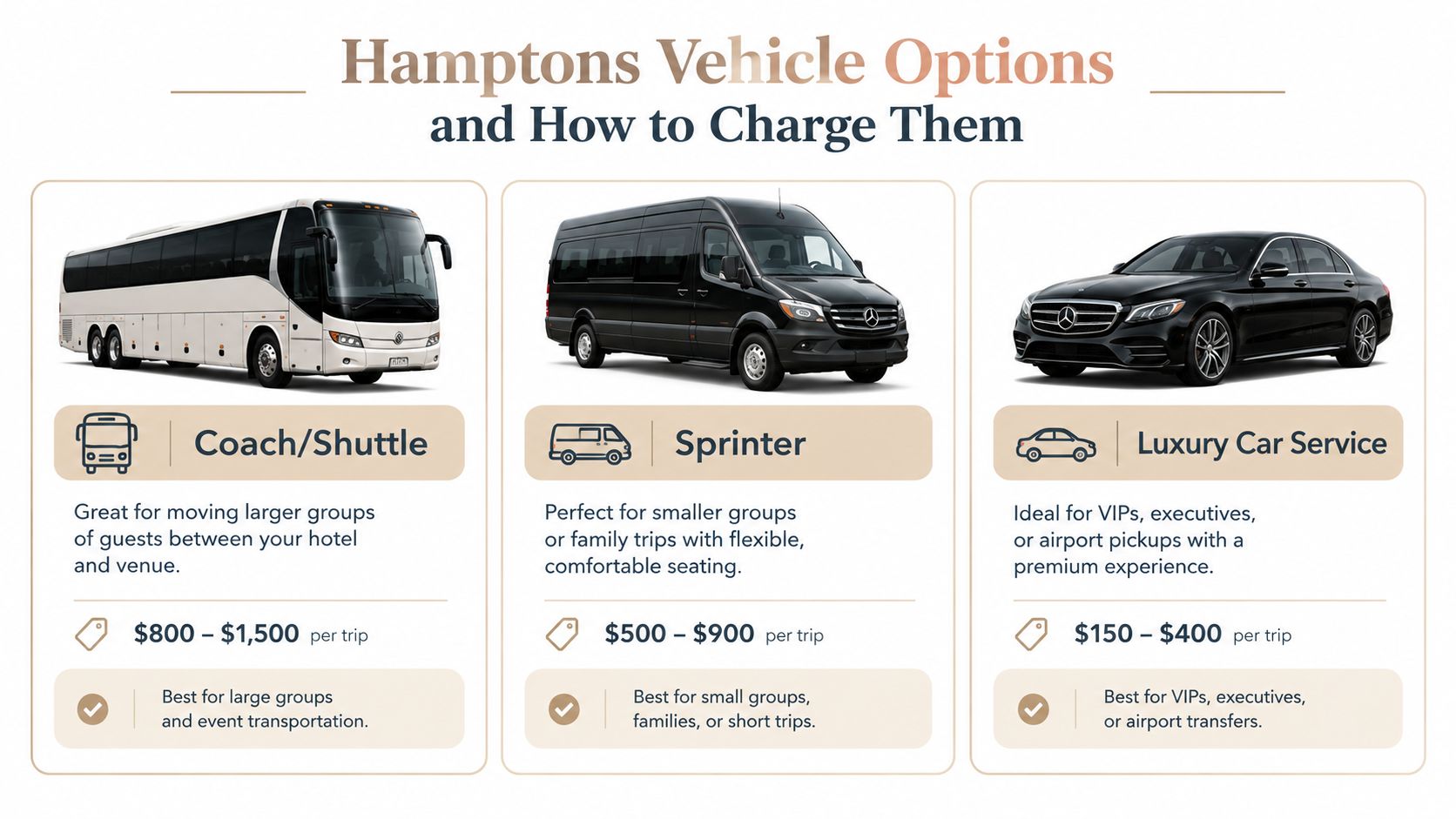
Match the vehicle to the trip and the payer becomes obvious. Three vehicle types handle nearly every Hamptons wedding weekend, and each one maps to a different passenger group from the earlier matrix.
Coach or Shuttle for Guest Moves
A coach or shuttle is built for hotel to venue guest transportation. It's the efficient way to move a room block in defined waves, with spacious seating and one loading point your coordinator can manage. The couple or hosting family signs this contract, because it's an offered, itinerary based service. Guests don't chip in per seat.
Charge it as a hosted event service with a defined route and service window. Confirm how many round trips are included, where loading happens, and what happens if the reception runs long. Those details belong in writing before anyone pays a deposit.
Mercedes-Benz Sprinter for Wedding Party and Family
A Mercedes-Benz Sprinter, up to 14 passengers, is the workhorse for bridal party and family moves. It handles getting ready runs, photo location transfers, and rehearsal dinner loops without splitting the group across multiple cars. Dresses, flowers, and a photographer fit more comfortably than they do in a standard SUV.
The payer here follows the wedding party rule. The couple or contributing family covers it, and one contract can bundle the Sprinter with the guest shuttle for consolidated billing. Hamptons Leisure Limo is one local option that offers Sprinter, premium SUV, sedan, and coach service under a single coordinated reservation, which simplifies assigning one payer and one point of contact. Compare any provider on the same basis, vehicle confirmed, route confirmed, billing consolidated.
Luxury Sedan or SUV for the Couple and VIPs
A luxury sedan, such as a Mercedes-Benz S-Class for up to 3, or a premium SUV for up to 6, suits the couple, parents, grandparents, and the getaway. These are private, flexible moves that shouldn't depend on a shuttle schedule. The couple typically pays for their own car, and the hosting family covers VIP cars they've assigned to relatives.
Guest paid vehicles belong only to guest paid trips. If a guest books their own airport car or rental, they choose and pay. Don't blur the categories by asking guests to reimburse part of a hosted vehicle. For hosted vehicles, ask for fixed pricing with no surge, so the contracting payer knows the obligation in advance. For a quote on a specific Hamptons itinerary, text (631) 294-0747 for a quote and send the trip list, not just the date.
Contract Clauses That Protect Whoever Pays
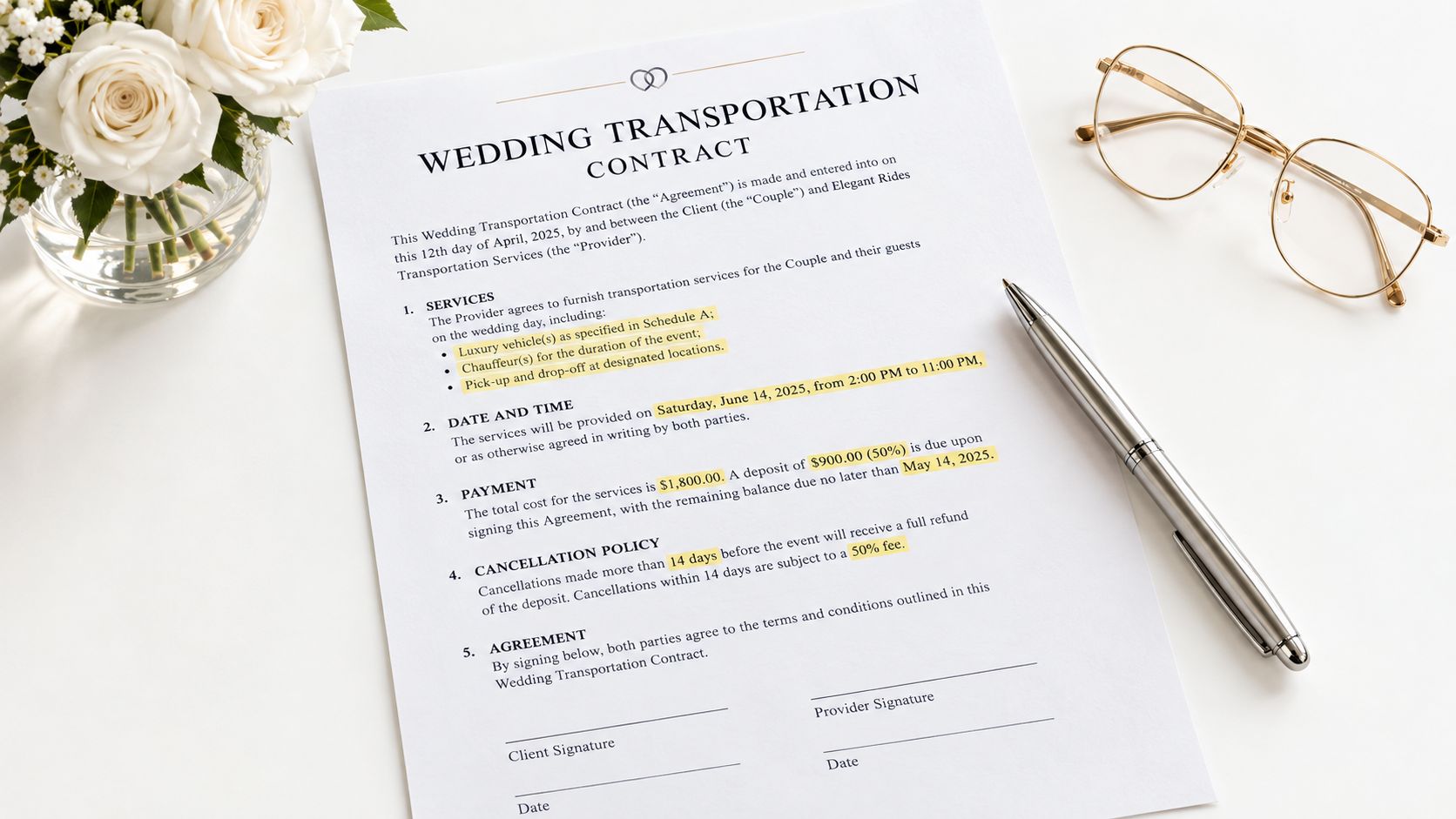
Etiquette decides who should pay. The contract decides who legally must. If those two names don't match, the signer loses. Protect the payer with specific clauses before the wedding weekend, not with a family conversation after the invoice arrives.
Wedding transportation contracts should specify the contracting payer, vehicle type and capacity, pickup schedule, grace periods, waiting-time and overtime charges, insurance, and backup-vehicle provisions, with a single named lead authorized to approve in-event changes up to a preset dollar limit, as detailed in Charter Buses USA's wedding transportation coordinator guidance. Treat that list as your minimum.
Core Terms to Put in Writing
Work through these items with any provider, and keep the signed version with your route manifest.
- Contracting payer and authorized lead: Name one financially responsible party and one transportation lead who can approve changes.
- Vehicle and capacity: Confirm exact vehicle type, seating, and a backup vehicle provision if something fails.
- Schedule and grace periods: List pickup points, times, route order, and how long chauffeurs wait before charges apply.
- Overtime and waiting charges: Define how extra time is measured when photos, toasts, or hotel loading run long.
- Insurance and registration: Confirm commercial insurance and USDOT registration across the fleet.
- Gratuity and final charges: Separate base service from gratuity and any post event charges so the payer can reconcile the bill.
Payment timing deserves its own conversation. Shuttles frequently collect the final amount after the wedding based on actual travel time, a practice noted in The Knot's guidance on when to pay wedding vendors, while general vendor practice usually requires payment before the wedding unless the contract says otherwise. Ask directly whether your reservation is a fixed route for a fixed period or a usage based invoice that can grow.
Why One Authorized Lead Matters
Wedding transportation is time dependent. A delayed ceremony consumes reserved vehicle hours whether anyone approves it or not. Without a preset approval limit, well meaning relatives can add stops, extend service, or reroute a shuttle, and the signer discovers the cost later.
Set the rule in advance. Your lead, whether that's a planner, parent, or the couple, can approve documented changes up to an agreed limit. Anything above it needs the contract signer's approval. Our breakdown of average wedding transportation costs and contract factors explains how service windows and overtime shape the final invoice, which helps you set that limit realistically. Where parents fund the wedding but the couple runs logistics, keep one contract and one consolidated invoice. Settle family contributions privately. Never collect money from passengers at the curb.
Putting It Together for a Hamptons Wedding
Take a Friday to Sunday wedding at a Bridgehampton estate as a working model. The couple signs one transportation contract and serves as the contracting payer. Both families contribute to the overall wedding budget privately, and one parent who wanted a defined vendor item reimburses the shuttle portion behind the scenes. No guest sees that split, and no one collects cash on the wedding day.
A Copyable Payment Plan
- Host paid: Sprinter for wedding party getting ready runs and photos, hotel to estate guest shuttle, ceremony to reception transfer if venues differ, two late night return waves, sedan for grandparents, getaway car for the couple.
- Guest paid: Flights and airport transfers to reach the Hamptons, rental cars or rideshare for personal sightseeing, Sunday departure travel.
- Host specific: Whoever hosts rehearsal dinner covers that evening's loop. Whoever hosts Sunday brunch covers a shuttle only if brunch is an official event at a separate venue.
Publish the hosted pickups on your wedding website with exact times and locations. State plainly which trips guests arrange themselves. Name your transportation lead for the day, confirm the approval limit for changes, and keep chauffeurs, planner, and lead on one shared manifest.
Then book the actual vehicles against that manifest. Request fixed pricing with no surge for the defined itinerary, confirm backup provisions, and lock the service windows with buffer time for Montauk Highway traffic. To price a specific weekend plan, text (631) 294-0747 for a quote with your dates, pickup towns, passenger counts, and trip segments. A trip by trip list gets you an accurate quote. A vague request gets you a vague number, and vague numbers are how payer disputes start.
Hamptons Leisure Limo provides reliable, pre arranged wedding transportation across Southampton, Bridgehampton, East Hampton, Sag Harbor, Montauk, and the wider East End, with experienced chauffeurs, Sprinters, premium SUVs, sedans, and coaches coordinated under one reservation and one consolidated bill for clients. If you're assigning payers trip by trip and want fixed pricing for your exact weekend itinerary, text (631) 294-0747 and visit Hamptons Leisure Limo to plan your shuttle, Sprinter, and getaway car with a single point of coordination.
Ready to Ride with Hamptons Leisure Limo?
Fixed pricing. No surge fees. 30 years of experience serving the Hamptons. Text us what you need and we will send a quote.