Mercedes Sprinter Van Rental: Seats, Payload and Booking
Updated November 11, 2026
Your group chat has settled the dates, the flights are booked, and someone has volunteered to arrange transportation to the Hamptons. Then the luggage messages start: checked bags, golf clubs, a stroller, and something that needs to stay hanging for the wedding.
A Mercedes Sprinter van rental can keep the group together, but the right booking starts with more than a passenger count. Usable seats, loaded weight, luggage space, and pickup access determine whether a particular Sprinter works. Treat those as separate checks, and you're much less likely to discover a problem at the airport curb.
Table of Contents
- Mercedes Sprinter Specs at a Glance
- Passenger Count, Luggage and Payload Limits
- Matching a Sprinter to Your Trip Type
- Why Filling Every Seat Raises Risk
- Self-Drive Rental or Chauffeured Sprinter
- Checking the Vehicle Records and Operator Credentials
- Confirm Your Sprinter Booking Now
Mercedes Sprinter Specs at a Glance
The Mercedes-Benz Sprinter is a common choice when a party has outgrown an SUV but doesn't need a motor coach. Its appeal is practical: a passenger cabin and a luggage compartment in the same vehicle, with different configurations available for different assignments.
The Mercedes-Benz passenger-van specifications list 12 occupants, a 3,307 lb payload, and 70 cubic feet of cargo volume, along with the length, width, wheelbase, and towing figures below. These are specifications for a cited passenger configuration, not a promise that every rental Sprinter has the same layout.
Mercedes Sprinter passenger van specifications
| Specification | Value | What It Means for Your Group |
|---|---|---|
| Seating | 12 occupants in the cited passenger configuration | Confirm usable seats in the quote, not only the model name |
| Payload | 3,307 lb | Passengers, luggage and equipment all share this limit |
| Cargo volume | 70 cubic feet | Measure luggage by bag count and size against this figure |
| Overall length | 234 inches | Check curbs, loading areas and parking structures |
| Width including mirrors | 92 inches | Narrow residential drives need a look before arrival |
| Height | 103 inches | Plan for about 8 ft 7 in of clearance |
| Wheelbase | 144 inches | Affects turning room in tight loops and porte-cochères |
| Towing rating | 5,000 lb | Relevant only if a trailer is involved, not standard transfers |
Seat count is the figure people remember. Payload and cargo volume are the figures that decide whether everyone's belongings can travel too. Neither substitutes for the other: lightweight garment bags can occupy awkward amounts of space, while compact equipment cases can add considerable weight.
The same distinction applies to luxury interiors. A Sprinter with a lounge-style conversion isn't interchangeable with a factory passenger layout. Seat placement, partitions, and rear storage arrangements affect what can be loaded, even when the exterior looks familiar.
Size matters before the group boards
At the listed overall length, the van is close to the length of a large pickup truck. That calls for a proper loading position, not just an open parking space. A chauffeur needs room to approach, open the luggage doors, let passengers board, and leave without an unsafe reversing maneuver.
Height deserves a separate check. A high-roof passenger van may not fit beneath a hotel canopy or inside a garage that accommodates an SUV. The listed height and its clearance equivalent should be treated as screening figures, not permission to squeeze beneath a sign with no margin.
Practical rule: Book the configuration, not the badge. A photograph of a Sprinter doesn't establish its seating layout, luggage capacity, or access requirements.
For a quote, translate these specifications into questions about the assigned vehicle. The final booking checklist provides a concise way to collect those answers before paying.
Passenger Count, Luggage and Payload Limits
Start with the arithmetic, then look at the bags. Using the 3,307 lb payload listed for the Mercedes-Benz Sprinter Passenger Van Select, the following hypothetical calculations assume 180 lb per passenger.
Remaining payload by passenger count
| Passengers | Passenger weight at 180 lb | Payload left before luggage |
|---|---|---|
| 8 passengers | 1,440 lb | 1,867 lb |
| 10 passengers | 1,800 lb | 1,507 lb |
| 12 passengers | 2,160 lb | 1,147 lb |
These are planning calculations, not a loading certificate. The operator must use the assigned vehicle's certified limits and account for everyone aboard, including the chauffeur where not already included in the passenger total. Don't confuse a group's headcount with total vehicle occupancy.
In the full-group example, the remaining allowance must absorb checked bags, carry-ons, child seats, coolers, and event equipment. It isn't a luggage allowance allocated independently to each traveler. A replacement vehicle or conversion may also have a different available payload.
Weight and space are separate tests
A load can pass the weight calculation and still fail the packing test. Hard-shell suitcases don't compress into gaps, golf travel covers consume long sections of storage, and a folded stroller may prevent the rear doors from closing around otherwise manageable luggage.
The cargo-volume figure is therefore a starting point, not a guarantee that a particular bag collection fits. Send a bag inventory with approximate dimensions, especially for oversized items. A photograph of the assembled luggage can help dispatch understand shapes that a simple bag count misses.
Keep the loading plan disciplined:
- Include equipment: Child seats, presentation cases, coolers, and mobility aids belong on the inventory.
- Preserve passenger space: Don't solve a rear-compartment shortage by putting loose luggage in the aisle.
- Confirm the actual vehicle: Ask dispatch to check certified payload and the installed seating arrangement, rather than applying a brochure figure automatically.
The same manufacturer listing gives a 103-inch height, approximately 8 ft 7 in, and a 92-inch width including mirrors. Those dimensions affect hotel entrances, narrow residential drives, and older garages, so provide access information before the vehicle is assigned.
The written confirmation should identify usable seats, bag count and size, child-seat requirements, and pickup clearance. That gives the operator something concrete to approve instead of a vague description of a group traveling with normal luggage.
Matching a Sprinter to Your Trip Type
A Sprinter suits a trip when both the people and their gear fit comfortably. The examples below are planning scenarios, not guaranteed capacities. They use the cited passenger layout as a baseline, with the luggage manifest deciding whether the proposed assignment is workable.
Common Hamptons group scenarios
- Airport transfers: Say you're arranging transport for 6 to 12 adults with two checked bags each plus carry-ons. Treat that as a substantial luggage assignment, not an automatic single-van booking. Ask for a loading assessment and an approved curbside meeting point before committing.
- North Fork wine tours: A hypothetical party of 8 to 12 guests may bring light bags initially, then add gifts and purchases. Allow space for those items and any coolers. Seat comfort over a longer day matters more than filling every available position.
- Wedding guest shuttles: For 10 to 12 guests, garment bags and gifts need deliberate placement. Don't add floral arrangements, signage, and reception supplies to the passenger vehicle by default. Event decor usually deserves its own transport plan.
- Corporate offsites: A scenario involving 8 to 12 travelers should include laptops, presentation cases, and any materials arriving with the team. Assign a coordinator to maintain the passenger list and release the vehicle when everyone is ready.
- Golf outings: For 4 to 12 players with a golf bag each, the clubs may become the deciding constraint before the seats do. Describe travel covers, luggage, and other equipment separately. A full group needs an explicit cargo assessment.
- School and prom trips: A proposed group of 10 to 12 students with minimal luggage needs clear guardian contacts, supervision arrangements, and approved pickup and return details. Include any accompanying adult in the headcount.
When another vehicle is the better answer
Once a group exceeds the usable seats in the quoted configuration, split the party or select a larger vehicle. Don't assume another seat can be added because a different Sprinter advertisement shows a larger interior.
For groups bigger than 14 passengers, we use multiple vehicles with one coordinator. Our group transportation service guide explains the coordination considerations behind a group move.
Airport organizers comparing shared services with a dedicated booking can also use Lodging Nearby's guide to shared airport transportation to frame questions about meeting arrangements and shared travel.
Count people, count bags, then approve the vehicle. Reversing that order leaves the luggage problem until pickup.
The best assignment isn't necessarily the vehicle with the most seats. It's the arrangement that lets everyone board, keeps belongings secured, and matches the day's route without improvised loading.
Why Filling Every Seat Raises Risk
A seat that exists isn't a seat that must be filled. Passenger capacity is an operating limit, not a target for every journey, particularly when a group also brings bulky luggage or mobility equipment.
A NHTSA crash analysis of 15-passenger vans found that vans loaded above half their designed seating capacity had a rollover rate 2.2 times that of vans loaded at or below half capacity; the same analysis reported more than five times the rollover odds at designed seating capacity compared with chauffeur-only occupancy. Those findings concern 15-passenger vans, not a Sprinter-specific risk estimate.
That scope matters. The figures don't establish a universal half-capacity rule for a Mercedes Sprinter, and they shouldn't be used to calculate the risk of an individual booking. They do challenge the assumption that passenger loading is irrelevant once everyone has a seat.
Turn the finding into loading habits
- Count people and belongings before booking. Include items that may arrive late in the planning process, such as a stroller or equipment case.
- Ask how the proposed load will be accommodated. When the vehicle approaches its practical capacity, get a clear recommendation about whether another vehicle is advisable.
- Require seat belts throughout the trip. NHTSA emphasizes their role in reducing injury risk during rollover crashes.
- Protect usable seating and exits. Don't assign a passenger to a seat occupied by luggage, and install child seats only in appropriate seating positions.
The practical objective is a controlled load with properly restrained passengers and secured belongings. Leaving a seat empty doesn't make an overloaded luggage compartment acceptable. Equally, reducing luggage doesn't excuse carrying someone without an appropriate seat and restraint.
Make mobility needs part of the assignment
A folded wheelchair, walking aid, or stroller may need space that the initial luggage estimate didn't include. If someone must remain seated in a wheelchair during travel, confirm an accessible vehicle and appropriate securement arrangements rather than assuming a standard passenger van will work.
Ask about boarding assistance and step access too. A vehicle can technically accommodate the headcount yet remain unsuitable for a passenger's actual needs. Resolve that before dispatch, when there's still time to choose the right arrangement.
Self-Drive Rental or Chauffeured Sprinter
The decision is whether to rent the van and operate it yourself or book transportation with a professional chauffeur. Those are different services, with different responsibilities for licensing, insurance, routing, and the day's schedule.
This comparison shows where those responsibilities sit.
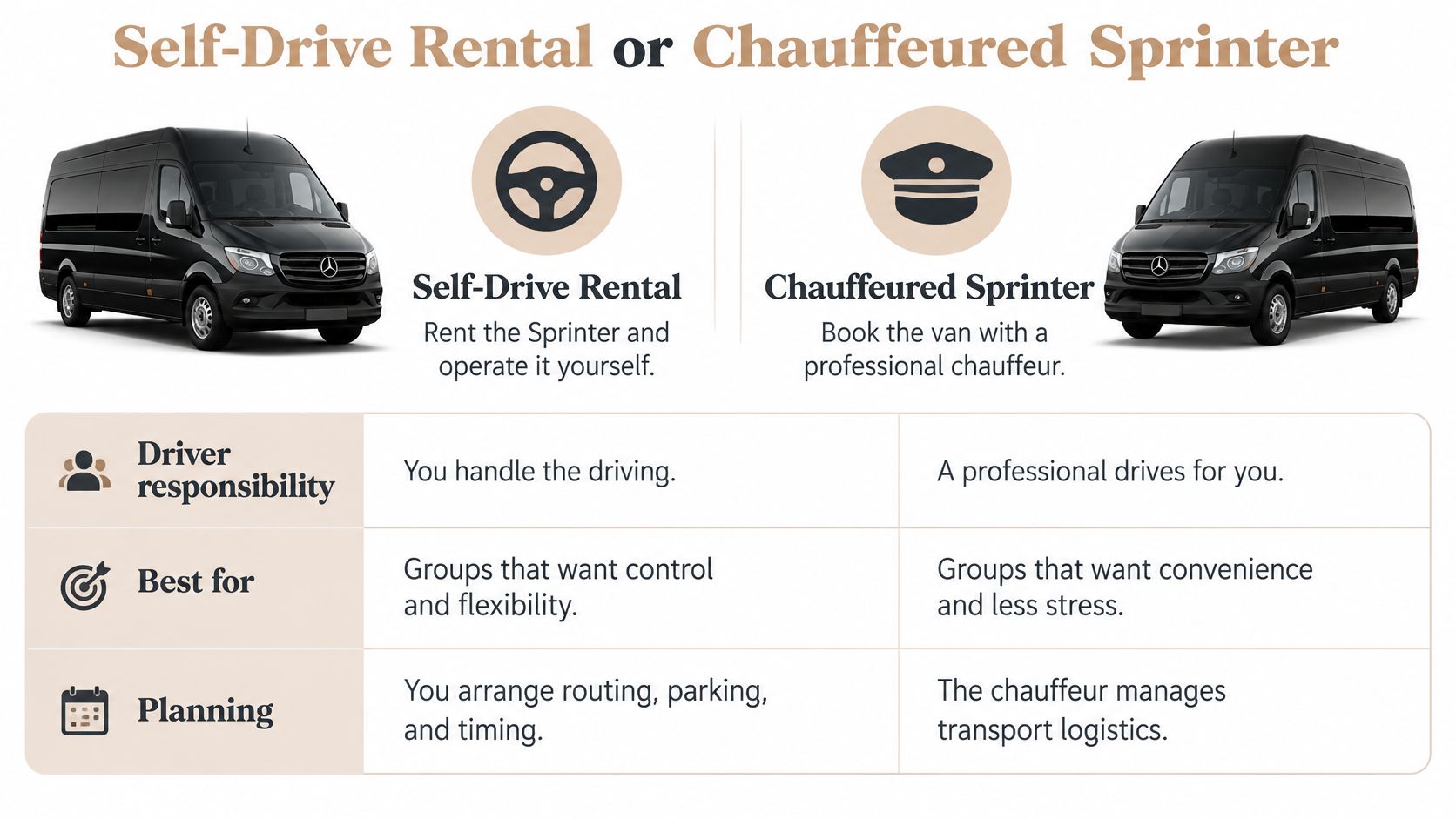
Self-drive rental compared with a chauffeured Sprinter
| Factor | Self-drive rental | Chauffeured Sprinter |
|---|---|---|
| Who operates the van | The renter | A professional chauffeur |
| Licensing | Renter must confirm the license rules for the group size | Chauffeur must hold the credentials required for the assignment |
| Liability and insurance | Renter confirms the rental agreement and personal policy | Operator provides commercial insurance and USDOT registration where required |
| Attention during the trip | Renter manages traffic, parking and timing | Chauffeur manages the route, timing and parking |
Self-drive provides direct control, but someone in the party must remain responsible for the vehicle. That includes checking entrances, finding suitable parking, and staying fit to operate it after a long day. A chauffeured booking transfers those transport tasks to a professional, though the organizer still needs to provide an accurate itinerary.
Licensing isn't settled by the model name
The Busxoxo Sprinter rental guide notes that vehicles carrying 16 or more occupants, including the person operating the vehicle, can trigger a commercial license with passenger endorsement. Don't treat a general statement that a standard license is sufficient as approval for every vehicle or use.
For compensated interstate operations, FMCSA's small passenger-carrying vehicle guidance identifies requirements for vehicles designed or used to carry 9 to 15 passengers, including registration, operator identification, chauffeur qualification, and maintenance records. Vehicle use and the itinerary matter alongside seating capacity.
Before signing a self-drive agreement, establish whether your personal policy transfers and what the rental contract excludes. For chauffeured transportation, confirm commercial coverage, applicable operating authority, and whether the quote includes the chauffeur. Our explanation of what chauffeur service includes helps distinguish the service from a vehicle-only rental.
Use this video alongside the written comparison, not as a substitute for checking the agreement.
For corporate groups, weddings, minors, and airport travel, responsibility and fatigue deserve as much attention as the headline quote. Choose a chauffeured configuration that fits the assignment, or a larger transport arrangement when it doesn't.
Checking the Vehicle Records and Operator Credentials
Verify the specific vehicle, not only the brand name. A well-presented Sprinter still needs a documented recall check and current maintenance records.
NHTSA's Sprinter vehicle records identify campaigns involving certain 2019 to 2022 Sprinters with instrument-cluster illumination issues, certain 2019 to 2021 vehicles with longitudinal-frame reinforcement fasteners, and certain 2024 Sprinters with parking-brake cable-bracket welds that could fail. The fastener issue could affect stability or third-row seat mounting, while the parking-brake issue could permit disengagement and rollaway.
Follow a VIN-based verification process
- Record the vehicle identification number. Keep it with the booking information so the check relates to an identifiable vehicle.
- Check the VIN against NHTSA's recall database. A model-year search provides context, but the VIN determines whether a particular vehicle is affected.
- Verify applicable remedies. Confirm that an authorized dealer has completed the required work and closed the relevant campaigns.
- Retain the result in the dispatch file. If dispatch substitutes a vehicle, repeat the check for that replacement.
Airport transfers and weddings leave little room for last-minute uncertainty. A substitution may solve availability while creating a different seating or luggage problem, so vehicle verification should remain attached to the assignment.
Use the following visual as a reminder to check records and credentials. The assigned vehicle's VIN record, rather than a generic checklist, determines which campaigns apply.
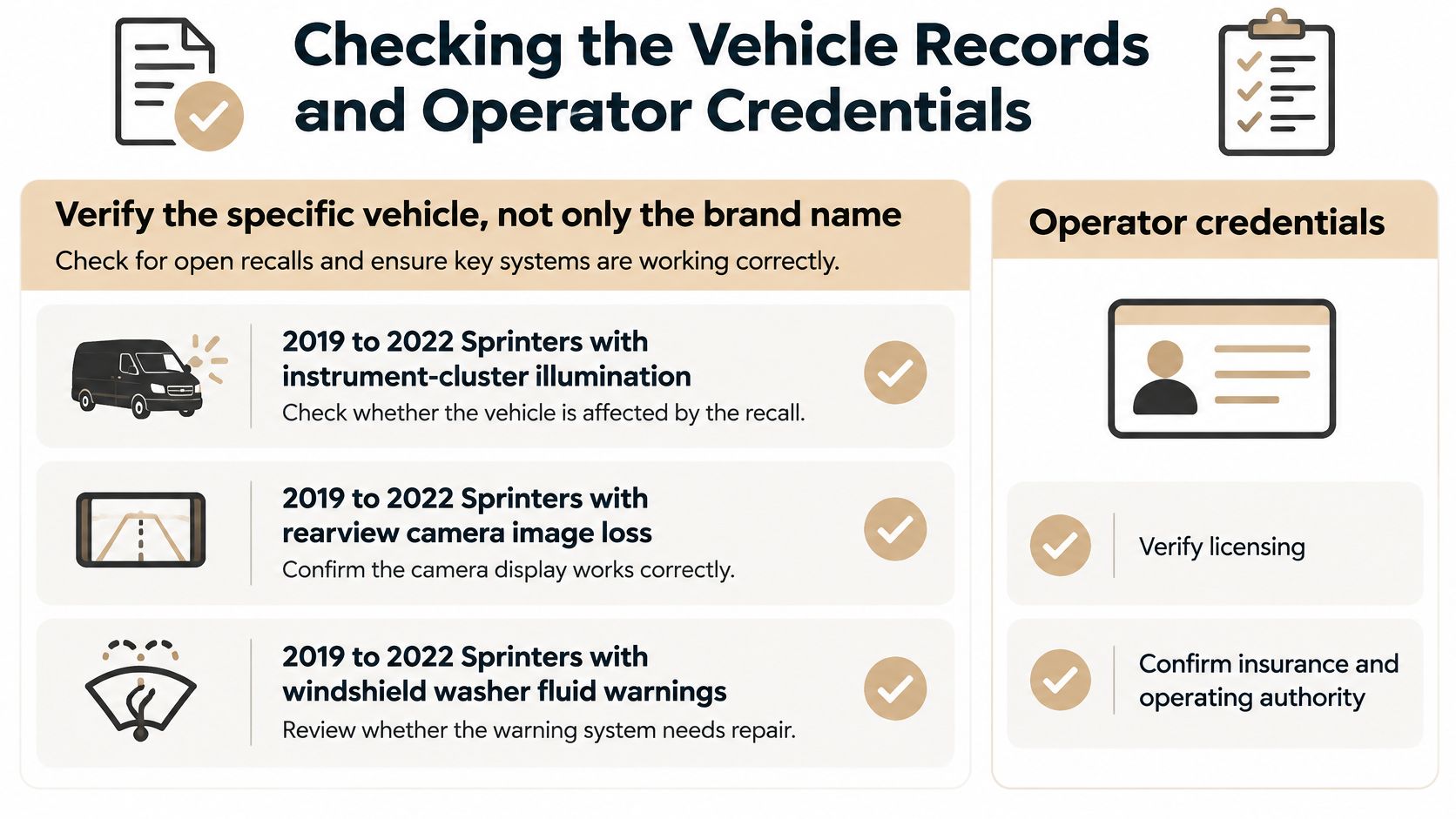
Check the operator as well as the van
Hamptons Leisure Limo is a family-owned black car and limousine service based in Southampton, NY, and we're fully USDOT registered and commercially insured. We can confirm these credentials when asked, along with the relevant vehicle and chauffeur records.
For any commercial booking, review chauffeur qualifications and maintained inspection and repair records. Our guide to commercial vehicle insurance explains why coverage belongs in the booking discussion rather than being assumed from a polished website.
Booking convenience and operational verification are separate matters. For accommodation managers coordinating guest arrivals, hostAI's resource on how to turn rental websites into booking channels offers context on the digital booking side; it doesn't replace a transport operator's credential checks.
Finally, confirm that passenger seats are factory-approved and properly latched. Don't accept an aftermarket conversion's advertised capacity as evidence that every seating position is suitable for passenger service.
Confirm Your Sprinter Booking Now
A sound booking matches the group, its belongings, and the access at the pickup point. Before paying, get those details into a written confirmation that dispatch can use.
Our Mercedes-Benz Sprinter Van carries 14 passengers. That's our fleet configuration, distinct from the manufacturer's passenger example used for the capacity calculations. The luggage assignment still needs approval for the actual trip.
Your prepayment checklist
- Seat count: Confirm usable passenger seats in the quoted configuration. Include accompanying adults and any child-seat positions in the assignment.
- Bag count: List checked bags, carry-ons, golf bags, strollers, garment bags, and event items by number and size. Flag anything that can't be stacked or laid flat.
- Height and access: Confirm the assigned vehicle can use the pickup point, garage, or porte-cochère. Send a clearance-sign photograph or venue contact when access is uncertain, and identify an alternative outdoor loading point.
- Vehicle records: Request the VIN and recall status. If the assigned vehicle changes, ask dispatch to confirm the replacement's suitability.
- Operator credentials: Confirm USDOT registration, commercial insurance, and appropriate chauffeur records. We can provide confirmation of our registration and insurance.
- Terms in writing: Review cancellation and change terms before paying, including how to submit a request and receive acknowledgment.
Know the terms before committing
We use fixed pricing with no surge. Give us the pickup location, destination, schedule, and vehicle requirements at the start so the quote reflects the actual assignment. Include intermediate stops and whether the trip is a transfer or requires the vehicle to remain available.
Cancellations made within 48 hours of scheduled pickup incur a 50% fee. Cancellations made 48 hours or more before scheduled pickup are completely free. Keep the written terms with the confirmation so the person managing the booking can act on them if plans change.
Before you pay: Make sure the confirmation describes the trip you're actually taking, not the simpler version discussed before the flights, luggage, and event schedule were finalized.
Text (631) 294-0747 for a quote, with your group size, luggage count, pickup address, and flight or event time ready. Include oversized items and access concerns in that first message so we can assess the complete assignment.
Hamptons Leisure Limo offers chauffeured Sprinter transportation for Hamptons airport transfers, weddings, corporate outings, and group trips, with fixed pricing and no surge. Visit Hamptons Leisure Limo to explore your options, then Text (631) 294-0747 with your passenger count, luggage details, and itinerary for a quote.
Ready to Ride with Hamptons Leisure Limo?
Fixed pricing. No surge fees. 30 years of experience serving the Hamptons. Text us what you need and we will send a quote.