Long Island Wine Trail: Routes, Times and Planning
Updated November 20, 2026
You've got a date in the group chat, a few winery names saved, and people asking what time they should be ready. Then the awkward questions start: Can everyone arrive in the same vehicle? Is lunch included in the timing? Does a reservation at the far end of the North Fork leave enough time to get back to Southampton?
A good Long Island Wine Trail day starts with those questions, not a longer winery list. Choose the right part of the island, protect the tasting windows, and leave enough room to enjoy the places you've booked.
Table of Contents
- Long Island Wine Regions at a Glance
- Choose the North Fork, South Fork or a Split Trip
- The Official North Fork Route
- Travel Times and Last-Mile Access
- Plan a Route That Does Not Overload the Day
- Reservation and Vehicle Rules by Venue
- Book Your Wine Trail Day With a Plan
Long Island Wine Regions at a Glance
Wine producers by region on Long Island
| Region | Wine producers | What it means for a day trip | Route anchor |
|---|---|---|---|
| North Fork | 59 | Most options and shortest hops between tasting rooms | Route 25 and County Route 48 |
| South Fork (Southampton, East Hampton) | 6 | Fewer stops, longer drives between them | The Hamptons appellation |
| Western Suffolk County | 7 | Separate area, not on either fork | Western Suffolk addresses |
| All of Long Island | 70 | About 3,000 planted acres and over 500,000 cases a year | Long Island appellation |
These figures come from Suffolk County's craft beverage industry overview, citing 2021 industry information, which lists 59 North Fork producers, six South Fork producers, seven in western Suffolk, and 70 across Long Island, alongside approximately 3,000 planted acres and more than 500,000 cases annually. The published area counts don't add up to the stated island-wide total, so treat them as the county's separate reported figures rather than a reconciled directory.
Using the county's stated total, about 84 percent of the listed producers sit on the North Fork. That concentration gives you more opportunities to choose nearby tasting rooms, although proximity alone doesn't guarantee compatible reservations.
Think in neighborhoods, not one destination
The Long Island Wine Trail isn't one road, one property, or a walk between tasting counters. The broader Long Island appellation encompasses Nassau and Suffolk counties, as described in the Long Island AVA overview, while the county separates its producer listings by area.
Think of planning a visit to several neighborhoods in a city. You wouldn't choose restaurants at opposite ends of the map just because both appeared on a favorites list. The same logic applies to vineyards.
The North Fork offers the strongest starting point when tasting-room choice matters most. South Fork properties need more deliberate sequencing because there are fewer opportunities to substitute a nearby stop if your preferred reservation isn't available.
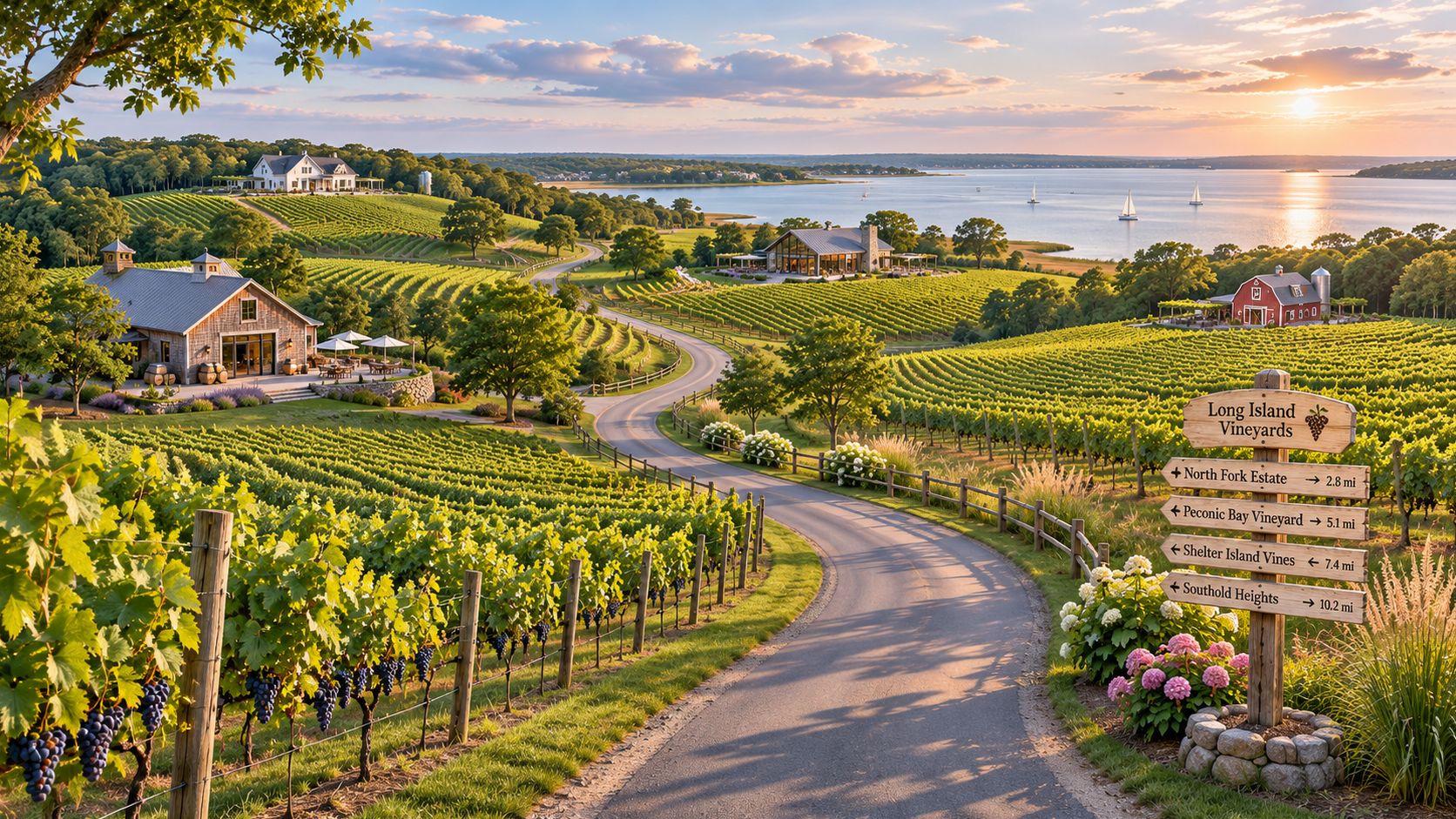
This vineyard view captures the setting, but your actual route should follow confirmed appointments rather than scenery alone.
Keep the wider trip separate
If the wine day forms part of a longer coastal vacation, the HYDAWAY East Coast travel guide is useful for considering the wider trip. Keep that broader sightseeing wish list separate from your tasting-day schedule.
Choose the region first, then choose wineries inside it. A compact cluster usually gives you a better starting point than a collection of famous names scattered across the island.
Choose the North Fork, South Fork or a Split Trip
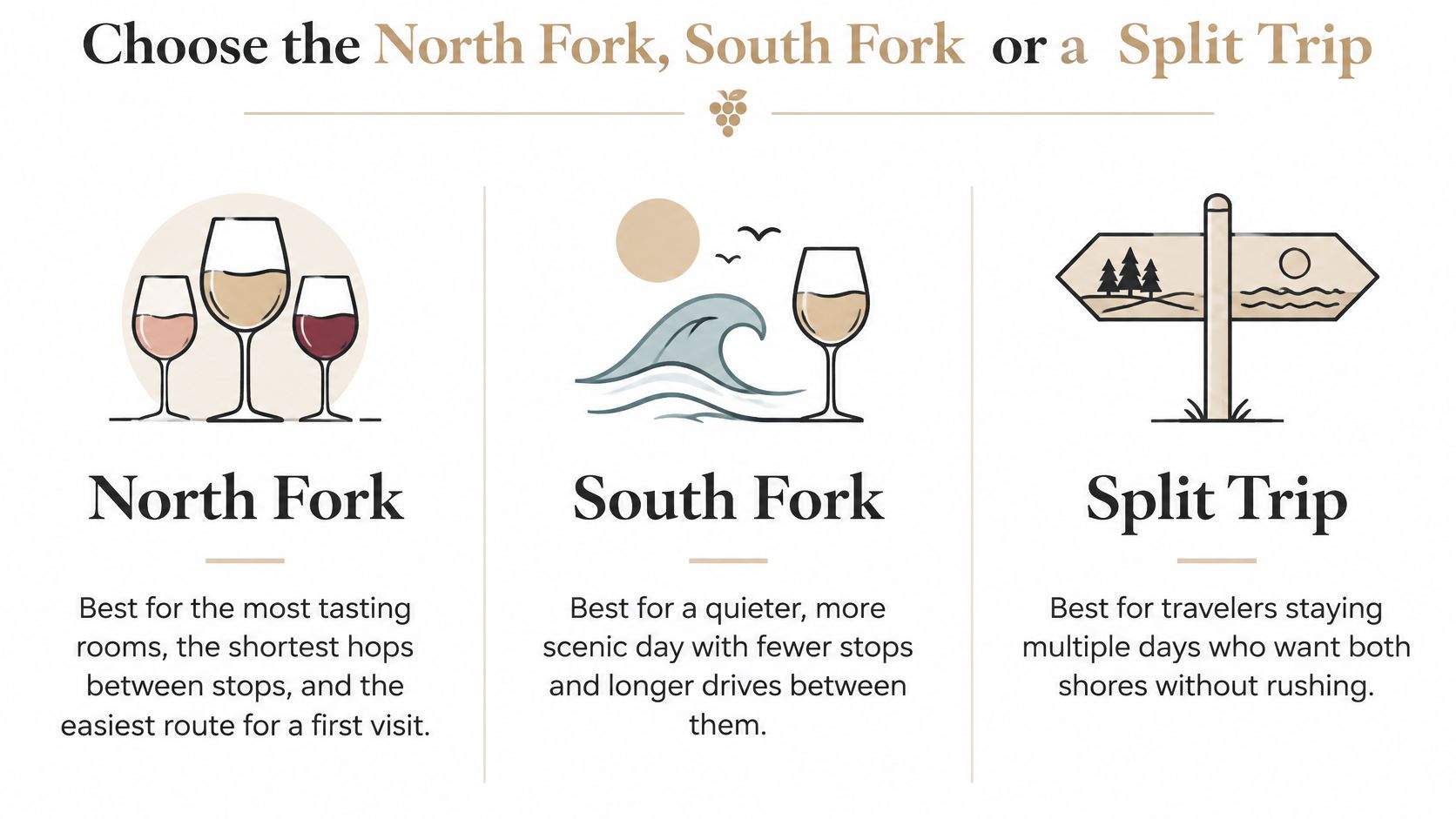
Choose the North Fork for the broadest tasting-room choice and the simplest first-visit route. You'll have more flexibility to build around a preferred wine style, a meal stop, or an available reservation without changing the character of the entire day.
Choose the South Fork when you're staying in Southampton, East Hampton, or Sag Harbor and want a lighter wine itinerary. The trade-off is fewer winery choices and more deliberate travel between them, but staying near your accommodation may matter more than maximizing tastings.
Use this comparison to settle the shape of the trip before anyone starts booking.
A split trip works better across separate days
I wouldn't combine both forks in a single tasting day. You're adding a substantial repositioning journey between appointments that already require arrival, check-in, seating, and time to taste.
If both shores matter, give each its own day. Otherwise, you can spend the afternoon protecting the next reservation rather than enjoying the current one.
Practical rule: Pick the experience you want to have, then remove the journeys that don't contribute to it.
Let the group decide the scale
Ask these questions before choosing properties:
- Starting point: Are you leaving a Hamptons house, a Manhattan hotel, or an airport?
- Available time: Is this a short outing between other commitments or the main event of the day?
- Group size: Can everyone fit the same reservation category, or will the venue need special arrangements?
- Preferred pace: Does the group want a focused tasting, a leisurely meal, or time outdoors between appointments?
Say you're organizing a group of eight for a half-day outing. I'd prioritize easy pickup, a compatible group reservation, and a straightforward return rather than a distant must-visit property.
A couple with a full day has more flexibility. They can accept a longer approach journey or choose a more specialized tasting without coordinating everyone else's departure deadline.
For a visual introduction to the destination, this video can help the group discuss what kind of outing they want.
Before looking at individual wineries, pick one region and agree on a stop count. That decision prevents the itinerary from growing every time someone shares another recommendation.
The Official North Fork Route
The North Fork Wine Trail is more than a tourism label. The New York Senate's announcement of the 2013 wine-trail legislation describes a designated road network and identifies The Hamptons, North Fork, and Long Island as the associated American Viticultural Areas.
Follow the designated road sequence
Use the legislative route as a map reference:
- Start at Long Island Expressway Exit 71.
- Follow State Route 24 to County Route 105.
- Continue to Route 25, then head east along it.
- Use Route 48, also known along its stretches as North Road, Middle Road, or Sound Avenue.
- Continue west on County Route 48 to Edwards Avenue.
- Return south to the Long Island Expressway.
This sequence identifies the principal road network connecting the vineyard area. It doesn't mean every tasting appointment should follow the complete loop, or that every winery entrance sits directly on a designated road.
Turn the map into an appointment order
Enter each winery's actual arrival address into your map application. Use the tasting-room entrance, not just the vineyard name, and check any arrival directions included in the confirmation.
Then look for unnecessary reversals. If your route takes you east, back west, and east again, rearrange the appointments before paying for them.
A useful working sheet includes the property name, entrance address, confirmed arrival time, and departure target. Share the same version with everyone coordinating the day so an old reservation screenshot doesn't become the working schedule.
Don't book a complete road loop merely to say you followed the trail. The route is a planning tool, not a sightseeing obligation.
Write down your selected stops in the order they fall along the road network. Use that geographic order to request reservation times, rather than booking whatever time appears first and trying to repair the route afterward.
Travel Times and Last-Mile Access
A recent Long Island wine-tour travel guide describes traffic-related journeys from New York to the wine regions of roughly 2.5 to 3.5 hours. Treat that as a reason to reserve most of the morning for the approach journey, not as a guaranteed arrival window.
Our Manhattan trips take about 2 hours door-to-door to Southampton and about 2.5 hours to East Hampton or Sag Harbor. Those destination estimates and the broader traffic range describe different journeys and conditions, so they shouldn't be used interchangeably.
Travel times to the wine regions
| From | To | Typical travel time | Planning note |
|---|---|---|---|
| Manhattan | Southampton | About 2 hours door-to-door | Plan extra time on summer weekends |
| Manhattan | East Hampton or Sag Harbor | About 2.5 hours door-to-door | Allow for Route 27 delays on Friday afternoons |
| Manhattan | Wine regions by road, in traffic | Roughly 2.5 to 3.5 hours | Traffic-related range, not a guaranteed arrival |
| MacArthur Airport (ISP) | South Fork towns | Approximately 45 minutes to 1 hour as an initial planning allowance | Confirm the exact town and arrival conditions |
| Shinnecock Canal (Route 27) | Through traffic on summer weekends | Allow a congestion buffer | Leave earlier or build in extra time |
Reaching the East End isn't reaching the tasting room
Rail, bus, and ferry options can get you to the East End, but you generally still need a car or chauffeur after arrival. Service on the forks is less frequent than elsewhere on Long Island, which makes missed connections harder to absorb.
A train can remove the longest road segment without solving the journeys between wineries. You still need a confirmed pickup location, a workable transfer, and a return connection that fits the final tasting.
A car-free approach journey isn't automatically a car-free wine day.
For the North Fork, use the expressway approach and vineyard road network to assess the onward transfer. For the South Fork, evaluate the exact town and property addresses because a familiar Hamptons destination name doesn't tell you how much travel remains.
Plan around people and belongings
Groups should settle these details before booking:
- Arrival point: Confirm the station, ferry terminal, hotel, or airport pickup location.
- Luggage: Include suitcases and anticipated wine purchases when discussing space.
- Mobility: Explain boarding needs, walking limitations, and any mobility equipment.
- Return connection: Check the actual departure schedule rather than assuming another service will follow shortly.
Route 27 backs up at Shinnecock Canal on Friday afternoons. Our chauffeurs adjust departures for predictable congestion at the canal and Water Mill on summer weekends.
Check rail departure times against the first reservation, and send us the exact road journey before committing to a tight arrival. When the group has luggage, mobility needs, or several stops, a private vehicle is often the practical choice. Text (631) 294-0747 for a quote based on the actual route.
Plan a Route That Does Not Overload the Day
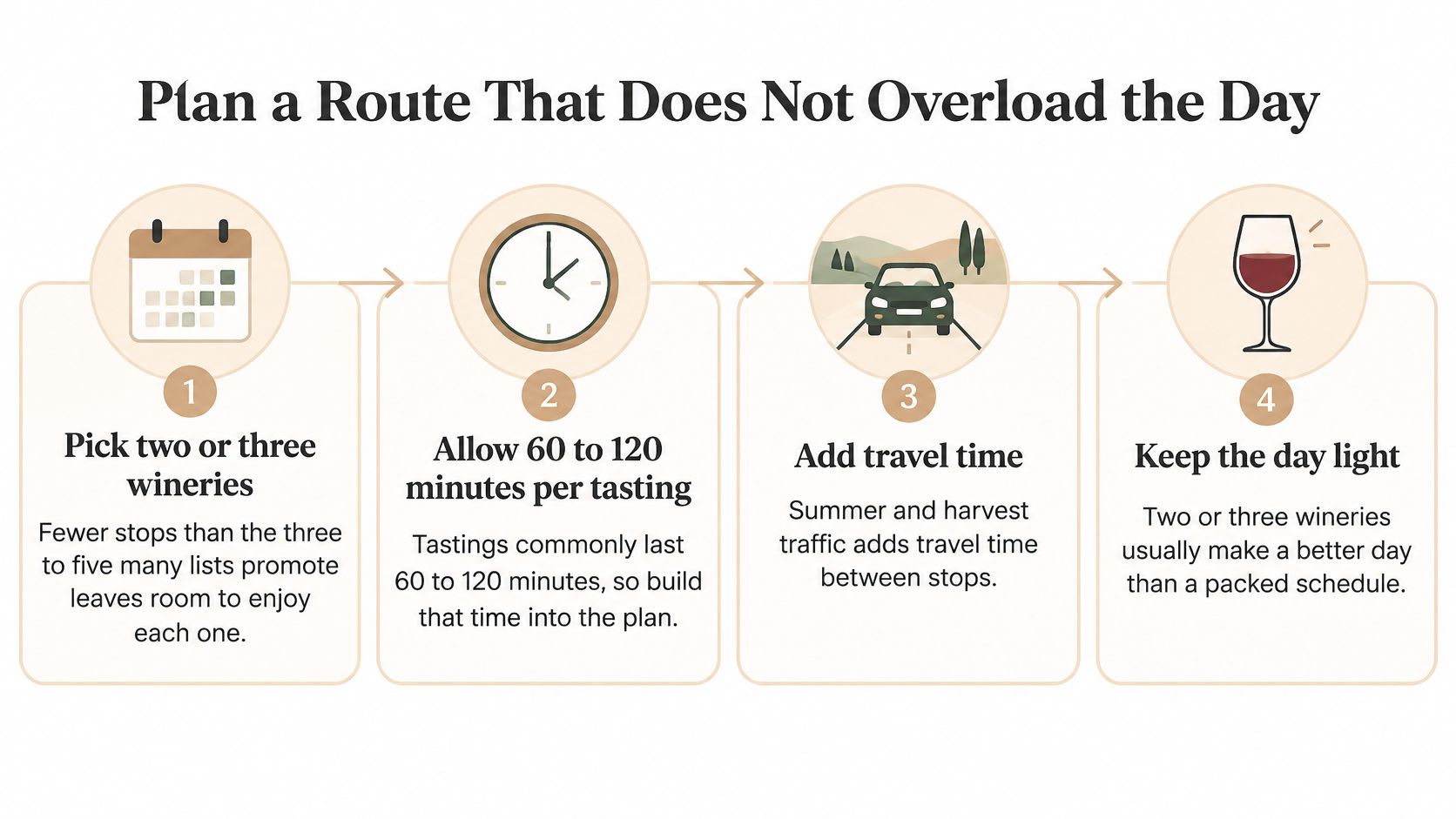
Two or three wineries usually make a better day than a crowded checklist. The Winetraveler Long Island planning guide recommends that stop count, notes that tastings commonly last 60 to 120 minutes, and cautions that summer and harvest traffic increase travel time.
That's why I wouldn't start with the three-to-five-stop model promoted in many itineraries. A reservation is time spent at a property, not a pin to reach.
Build the schedule in this order
Choose one region. Keep the main outing within a coherent area. The common slip is adding a property on the other fork because someone recognizes its name.
Pick two or three nearby stops that suit the group's interests. Avoid booking a fourth appointment because there's an empty-looking gap on the calendar.
Allow the full tasting duration stated by each venue, using the planning range above until you have confirmation. Don't treat the start of the next reservation as your departure time from the current one.
Check reservation requirements and group rules before paying. A booking platform accepting a party size doesn't necessarily answer questions about a hired vehicle.
Cluster the appointments geographically. Open the complete route in your map application rather than checking each journey separately and missing the repeated backtracking.
Add a meal break and a delay buffer. The common mistake is treating lunch as something that happens invisibly between tastings, then discovering that the final appointment no longer fits.
Book transport for the full outing window. Include pickup, approach travel, visits, the meal, and the return, not just the time printed on the first reservation.
The process below summarizes the pacing decision.
Protect the purpose of the outing
If you're weighing an organized outing against arranging separate journeys, consider whether wine tours are worth it in terms of coordination and usable time, not winery count alone.
The transferable planning principle is to secure fixed commitments before filling the gaps. Travelers organizing other appointment-based holidays can also consult Diving Escapades' guide on how to organise a diving holiday for a different travel-planning context.
Use this fill-in template before finalizing the day:
Working itinerary: Pickup location and departure → first confirmed tasting → meal location and service window → next confirmed tasting → optional final visit only if timing works → return destination and target arrival.
A slower route gives you room to ask questions, finish a conversation, and buy a bottle without making the next reservation someone else's problem.
Reservation and Vehicle Rules by Venue
Tasting reservation rules to check
| Rule | Example from the listing | Planning response |
|---|---|---|
| Reservation window | Noon to 4 p.m. | Schedule every stop inside the window |
| Reservation length | 90 minutes per booking | Allow 90 minutes per stop plus travel |
| Party size | One to eight people per reservation | Request separate bookings for larger groups, subject to approval |
| Vehicle type | Buses, limousines and vans not permitted | Ask each venue about group vehicles before booking |
| Payment | Prepaid reservations required | Book and pay ahead |
These are historical event rules, not universal winery policies: Long Island Wine Country's 2024 Harvest Tasting listing specified noon-to-4 p.m. reservations, 90-minute bookings, parties of one through eight, prepayment, and no buses, limousines, or vans, without exceptions.
Apply the restriction to the whole party
A vehicle's seating capacity doesn't guarantee admission to a tasting program. If an event excludes limousines or vans, choosing a spacious vehicle won't resolve the restriction, and dropping passengers nearby shouldn't be treated as a workaround.
For a hypothetical party of nine, ask whether the venue will permit separate bookings before purchasing them. Splitting the reservation doesn't automatically change how the winery classifies the group, and some venues may require you to choose a different program.
Admission check: Describe both the full party and the actual vehicle. Don't ask only whether a table is available.
The reservation window also needs careful reading. Ask whether the published end time means the final available start, the end of service, or the time everyone must leave.
Keep written answers with the itinerary
Before departure, confirm:
- Booking details: Date, arrival time, tasting format, and expected finish.
- Party approval: Total attendance, including anyone not tasting.
- Vehicle permission: The vehicle category you'll use.
- Payment status: Prepayment requirements and the applicable change terms.
- Arrival instructions: Entrance, parking, and where the chauffeur should wait.
Keep confirmation emails and venue replies together on a phone, with a copy available to the person coordinating the group. If someone changes the vehicle or adds a guest, recheck the permission instead of assuming the original answer still applies.
Personal preparation matters too. Share what to wear on a wine tour with the group so footwear and clothing suit the planned setting.
This policy table is a starting point for questions. The selected venue's current written rules determine what you can book.
Book Your Wine Trail Day With a Plan
Send the trip details together rather than starting with a vehicle request alone:
- Start point: The full pickup address or confirmed arrival location.
- Region: North Fork, South Fork, or separate days for each.
- Number of stops: Your intended pace, with optional visits clearly marked.
- Reservation times: Confirmed appointments and any bookings still pending.
- Group size: Everyone traveling, whether or not they're tasting.
- Luggage or mobility needs: Bags, equipment, and boarding considerations.
- Return plan: The destination and any firm arrival deadline.
That information lets us assess vehicle size and timing against the actual route. It also helps distinguish a relaxed afternoon from an itinerary that only works if every transfer and tasting finishes early.
Put responsibility in the right place
Choose the region, set the stop count, and get the venue permissions settled before confirming the transport arrangement. Then decide who will remain responsible for driving throughout the outing.
Hamptons Leisure Limo is a family-owned luxury car and limousine service based in Southampton. We offer custom North Fork vineyard tours with a designated chauffeur, with fixed pricing and no surge so clients can arrange the day around an agreed plan.
For an outing with several timed appointments, review our hourly limo service while deciding the full pickup-to-return window. Keep pending winery requests clearly labeled so a tentative tasting doesn't get mistaken for a confirmed stop.
You don't need a finished itinerary to make contact. A starting address, preferred region, group size, and honest description of the day you want are enough to begin a useful timing discussion.
Text (631) 294-0747 to plan the day, or use the same number to call. Send the details as one message so the route, party, and reservation requirements can be considered together.
Hamptons Leisure Limo offers custom North Fork vineyard transportation with a designated chauffeur, fixed pricing, and no surge. Visit Hamptons Leisure Limo to explore the service, then text (631) 294-0747 with your pickup point, group size, and preferred stops to plan a Long Island Wine Trail day that leaves time to enjoy the tastings.
Ready to Ride with Hamptons Leisure Limo?
Fixed pricing. No surge fees. 30 years of experience serving the Hamptons. Text us what you need and we will send a quote.