Hamptons Limousine Wedding Service Guide
Updated October 12, 2026

You've chosen the venue, the reception timing is taking shape, and someone has finally asked the question that can disrupt the entire day: how will everyone get there, and how will they get back? In the Hamptons, wedding transportation is rarely just a polished ride for the couple. Rural estates, dispersed hotel blocks, narrow lanes, limited staging areas, late-night departures, and changing guest needs all have to work together.
A well-planned limousine wedding service protects the timeline while giving the couple, wedding party, and guests a calmer experience. The practical work happens before the first vehicle arrives, through accurate fleet sizing, route planning, accessibility checks, safety verification, and a contract that makes schedule changes understandable.
Table of Contents
- Understanding Wedding Transportation Budgets
- Sizing Your Fleet for Peak Demand Windows
- Choosing the Right Vehicles for Hamptons Venues
- Coordinating Accessibility and Analog Guest Support
- Verifying Safety Standards and Compliance
- Navigating Contracts and Fixed Pricing Models
- Executing a Flawless Day-Of Logistics Plan
Understanding Wedding Transportation Budgets
A hotel-to-ceremony transfer for the couple is a different operation from moving guests between several hotels, a rural estate, a reception venue, and an after-party. In the Hamptons, the budget must account for vehicle class, guest count, distance, waiting time, and each separate movement. Rural access roads, limited staging space, and long repositioning drives can affect the quote even when the vehicles spend little time carrying passengers.
The Knot's 2024 Real Weddings Study surveyed 16,956 couples married between January 1 and December 31, 2024, and reported average wedding transportation spending of $1,075 nationally. The Knot's wedding transportation cost guide reports an average of $1,044 for local or hometown weddings and $1,190 for destination weddings. Domestic destination weddings averaged $1,204, while international destination weddings averaged $839.
These figures provide context, not a local quote. Long Island pricing is typically higher than the national average, and East End weddings often require more complicated routing than a single urban pickup. A useful proposal should describe the actual transportation plan, including vehicle time, standby periods, transfers between locations, and any return service.
Guest count changes the operation
Guest count remains one of the clearest cost drivers. The same study found that weddings with 50 or fewer guests averaged $583 for transportation, while weddings with more than 100 guests approached $1,200. Those amounts show why guest transportation belongs in the early planning conversation, before the couple selects vehicles based mainly on appearance.
A small wedding may need a premium SUV for the couple and a separate vehicle for family members. A larger event may need several shuttles, staggered departures, or a coach assigned to a hotel block. Capacity is only part of the decision. Guests also need to arrive within the required window and leave without waiting outside after the reception.
Vehicle type affects the budget as well. Town cars and wedding limousines commonly cost $75 to $150 per hour, while larger party buses generally cost $200 to $300 per hour, according to this wedding transportation cost guide. Treat those ranges as planning references, since a Hamptons proposal may also reflect distance, minimum booking periods, waiting time, and route complexity.
Build the budget around movements
List every required movement before comparing quotes:
- Couple transportation: Hotel, bridal suite, ceremony, reception, and final departure.
- Wedding-party transfers: Bridal-party staging, ceremony arrival, photo locations, and reception movement.
- Guest shuttles: Hotel blocks, ceremony venue, reception venue, and return trips.
- Special movements: Airport arrivals, rehearsal dinners, after-parties, or next-day departures.
Ask whether the proposal uses fixed pricing, whether surge pricing applies, and which services remain variable if the timeline changes.
Sizing Your Fleet for Peak Demand Windows
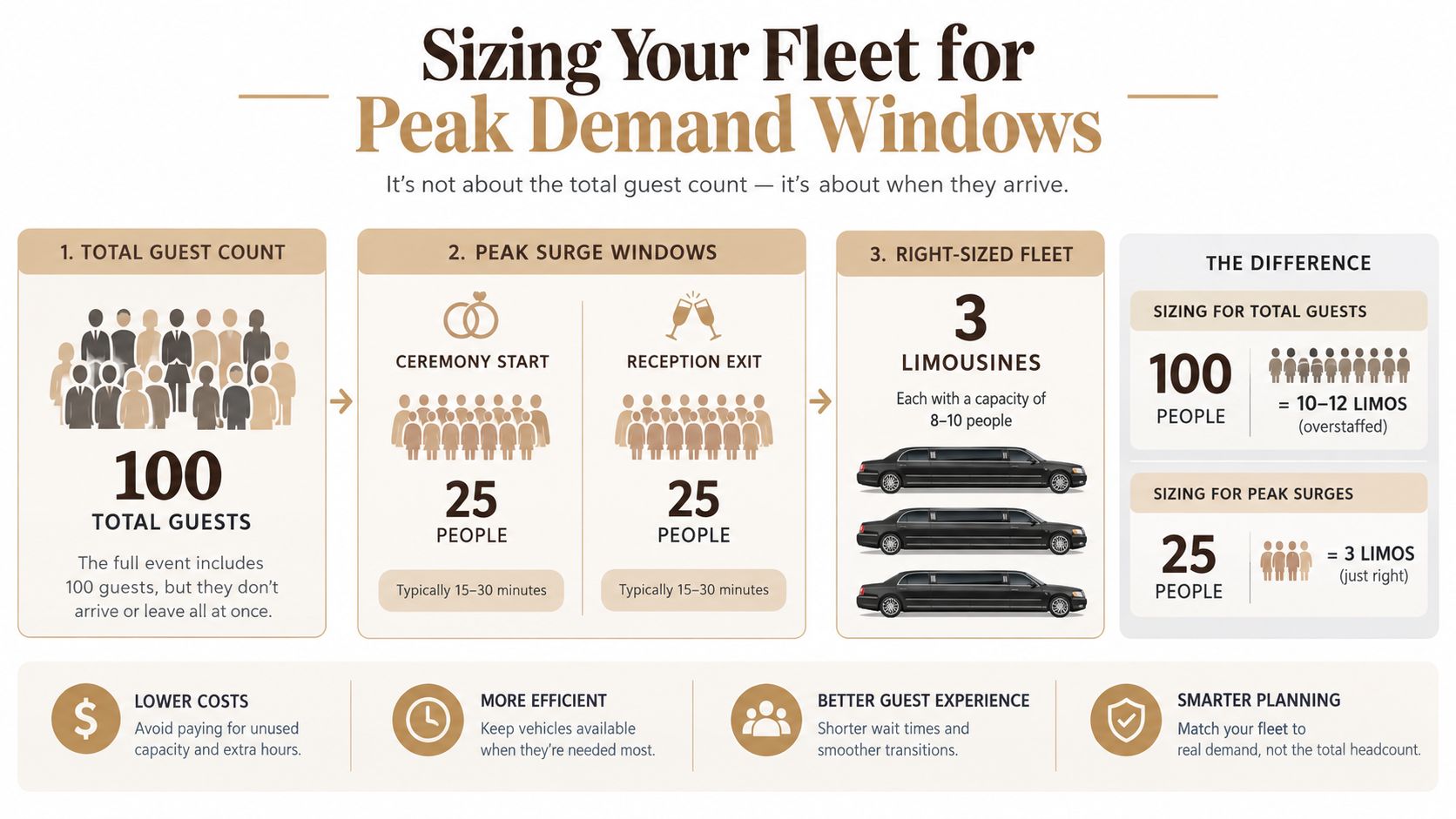
At a rural Hamptons estate, the guest list may look manageable until everyone needs a ride within the same short window. A coach can carry many passengers, yet a narrow driveway, gravel approach, or limited staging area may prevent it from serving the venue efficiently. Fleet sizing must follow the busiest movement period, not total attendance alone.
Calculate effective capacity
For group transportation, usable capacity depends on practical seats and completed round trips. The operating formula is C = S × (60/T). S represents practical seating capacity, while T is the full cycle time in minutes. Include staging, boarding, unloading, repositioning, traffic, and recovery time. Drive time between two addresses is only one part of the cycle.
A 55-seat coach with a 45-minute round-trip cycle theoretically allows 1.33 cycles per hour, as explained in this event shuttle scheduling guidance. Actual throughput drops when passengers carry luggage, use mobility equipment, need child seats, or board slowly.
Use this sequence:
- Find peak demand. Count the largest group requiring transport for ceremony arrival and post-reception departure.
- Set the arrival deadline. Work backward from the latest acceptable arrival, allowing time for boarding and the complete route.
- Measure the complete cycle. Record loading, unloading, staging, repositioning, traffic variation, and recovery time.
- Calculate effective capacity. Use practical seats rather than the vehicle's stated maximum.
- Add resilience. Keep approximately 15% to 20% spare capacity for luggage, no-shows, slower boarding, traffic, and vehicle or chauffeur contingencies. This is an operator's planning rule, not capacity that should be sold in advance.
A Hamptons route may require extra recovery time when vehicles share a single entrance or must wait for another vehicle to clear the loading area. Confirm these constraints before converting theoretical capacity into a guest schedule.
Model the exit separately
The post-reception departure surge needs its own calculation. Guests may leave gradually, but departures often cluster when the venue closes, a hotel block has arranged transportation, or an after-party begins at a fixed time.
One coach can work when guests are concentrated at a central hotel or venue. Several SUVs may perform better when pickups are spread across different properties or roads are too narrow for a coach. A 14-passenger Sprinter can fill the middle ground, provided its access, luggage space, and turning requirements fit the route.
Practical rule: Divide peak passengers by effective fleet capacity, then test the result against the latest acceptable arrival and departure times. Total guest count is only the starting point.
Before finalizing vehicles, ask the venue where they can stage, whether a coach can turn, whether guests will cross gravel or grass, and whether another event will use the same loading area. Summer traffic adds uncertainty, so a schedule without recovery time is already short on capacity.
Choosing the Right Vehicles for Hamptons Venues
Vehicle selection should follow the venue, route, group, and luggage pattern. A large vehicle isn't automatically the better choice. A coach that comfortably carries a hotel block may be unable to reach a private estate's driveway or turn safely near a reception entrance.
| Vehicle Class | Max Capacity | Ideal Use Case |
|---|---|---|
| Premium SUV | Up to 6 passengers | Couple, immediate family, or a small bridal-party transfer |
| Mercedes-Benz Sprinter van | Up to 14 passengers | Mid-sized wedding party or hotel-to-venue shuttle |
| Mini-bus | 25 or 36 passengers | Organized guest movement between nearby lodging and venues |
| Full-size coach | 55 passengers | Larger guest groups using a central hotel or venue route |
| Mercedes-Benz S-Class | Up to 3 passengers | Private couple transfer or executive-style point-to-point travel |
A premium SUV is usually the most flexible option for the couple. It can handle a private driveway more easily than a full-size coach, offers room for attire and personal items, and works well for a schedule with several short movements. The trade-off is capacity. It isn't a substitute for guest transportation.
The Mercedes-Benz Sprinter van sits between private luxury transportation and a larger shuttle operation. It can suit a bridal party that wants to travel together while avoiding the access demands of a coach. Check interior dimensions if long dresses, garment bags, luggage, walkers, or other mobility equipment are involved.
Match the coach to the road
A 25-passenger or 36-passenger mini-bus can be practical when a guest group is too large for a Sprinter but the venue has a restrictive approach. A 55-passenger coach is efficient when the route is simple, the staging area is confirmed, and guests are concentrated at one or two pickup points.
Ask the venue manager specific questions:
- Turning space: Can the assigned vehicle complete the required turn without reversing through pedestrian areas?
- Surface conditions: Are the approach and loading zones paved, compacted, or soft after rain?
- Clearance: Are there low branches, gates, narrow bridges, or restricted driveways?
- Staging: Can the vehicle wait without blocking catering, emergency access, or guest arrival lanes?
- Walking distance: How far will guests travel from the unloading point to the entrance?
Reviewing the available fleet options is useful, but the final decision should come from a route and venue assessment. A glamorous vehicle that can't reach the site on time is the wrong vehicle for the wedding.
Coordinating Accessibility and Analog Guest Support
At a rural Hamptons venue, a guest may face gravel, a long driveway, weak cellular service, and no clear place to wait for a vehicle. Digital tools help many passengers, but older attendees, guests with mobility limitations, and people unfamiliar with event apps may struggle with QR codes, GPS links, group chats, or revised pickup instructions.
An industry compilation estimates that roughly 20% to 30% of wedding guests may have low technical comfort, be older, or be unfamiliar with event apps, while also emphasizing advance planning for mobility-limited guests. This wedding transportation technology resource highlights the practical gap between digital convenience and inclusive service.
Ask accessibility questions before booking
Seat count does not confirm accessibility. A vehicle may have available seats yet lack the doorway width, ramp, lift, aisle clearance, or storage needed for a particular mobility aid.
Confirm these points in writing:
- Access equipment: Is a lift or ramp available, and can the chauffeur deploy it at the actual venue?
- Interior dimensions: Will a folded wheelchair, walker, or other device fit securely?
- Boarding time: Does the schedule allow safe, unhurried boarding without forcing the vehicle to leave on time?
- Assistance: Can the chauffeur provide appropriate help while protecting the guest's dignity and safety?
- Walking conditions: Will the passenger cross gravel, grass, uneven paving, or a long driveway?
- Pickup positioning: Can the vehicle reach the most accessible entrance instead of stopping at a distant staging point?
Give one planner, family member, or transportation liaison responsibility for these details. That person should share the information with the appropriate vendor contacts, keep it private, and prevent the guest from repeating the same explanation throughout the booking process.
Create an offline service layer
Printed pickup instructions should list the hotel name, meeting point, vehicle description, departure window, venue address, and a phone number. A staffed meeting point supports guests who do not use smartphones, especially when a hotel lobby has multiple entrances or a rural property has weak cellular coverage.
A dedicated phone contact also matters when timing or pickup locations change. Digital tracking can coordinate many passengers, while printed schedules and a human point of contact keep transportation usable for guests who need another way into the event.
Verifying Safety Standards and Compliance
Wedding transportation is a safety-critical operation. The reception may involve alcohol, late-night travel, unfamiliar roads, and guests who are tired after a long day. A polished vehicle matters, but maintenance records, operating authority, inspections, seat-belt procedures, and contingency planning matter more.
A transportation-planning source citing National Highway Traffic Safety Administration data reports that 11,904 people died in alcohol-impaired-driving crashes in the United States in 2024, and impaired drivers were involved in roughly 30% of traffic fatalities nationwide. Those figures cover all driving, not weddings specifically, but they explain why NHTSA advises arranging a sober ride home before drinking begins. The wedding shuttle safety guidance applies that principle to pre-arranged hotel pickups, fixed departure windows, and multiple return trips.
Use a vendor-vetting checklist
Under Federal Motor Carrier Safety Regulations, passenger carriers must systematically inspect, repair, and maintain vehicles under their control. Each commercial vehicle must receive a periodic inspection at least once every 12 months, covering federally specified minimum standards. FMCSA's inspection, repair, and maintenance guidance explains the maintenance responsibility.
Ask the transportation provider to confirm:
- Vehicle records: Current inspection status, defect correction, and vehicle-specific maintenance documentation.
- Pre-trip checks: Confirmation that the actual vehicle assigned to the wedding receives a pre-trip inspection.
- Replacement planning: A backup vehicle and communication process if a mechanical problem occurs.
- Commercial protection: Operating authority and appropriate commercial insurance for the service.
- Venue safety: Safe staging, turning space, loading zones, and pedestrian separation.
New York operators generally need operating authority from the New York State Department of Transportation when carrying passengers for compensation within the state. Passenger vehicles registered by carriers must pass NYSDOT inspection before DMV registration, and covered vehicles must be inspected at least every six months. Altered or stretched limousines also require a pre-trip safety briefing for passengers. These requirements are outlined in New York DMV passenger transportation information.
Cover children and nighttime travel
New York requires children under age four to ride in child safety seats, while children under age eight must use an appropriate child-restraint system, such as a federally approved harness, vest, or booster seat. A standard seat belt alone doesn't satisfy the applicable child-restraint rules. New York City's TLC passenger FAQ provides the restraint requirements.
Seat belts remain relevant in luxury vehicles. In 2023, 49% of passenger-vehicle occupants killed in traffic crashes were unrestrained among cases with known restraint use, compared with 56% at night and 42% during daylight. NHTSA's seat-belt guidance advises passengers to buckle up in taxis, limousines, and rideshares. The chauffeur should make the expectation clear before departure, especially for late-night returns.
Navigating Contracts and Fixed Pricing Models
A transportation contract should answer the uncomfortable question before the wedding does: what happens if the schedule slips? Ceremonies run late, photography takes longer than planned, venues change loading areas, and guests sometimes need an additional return trip.
A variable hourly model can make those changes expensive or difficult to authorize. Traffic delays may extend the booking, and an extra stop may trigger travel or waiting charges. Fixed pricing can offer more predictability, but only when the contract clearly identifies what the fixed amount covers and what remains variable.
Demand plain-language scope
Independent wedding-budget guidance identifies omitted categories that can affect the final transportation bill, including tax, gratuity, overtime, travel, parking, setup, staffing, cancellation terms, and weather uncertainty. This wedding budget guidance on hidden costs recommends obtaining each item in writing before payment.
Another venue-planning source reports that 42% of couples in a 2024 survey encountered unexpected outside-vendor fees, reportedly ranging from $500 to $1,500. That finding reinforces the need to ask for the maximum possible exposure, not just the initial quote.
Your contract should state:
- Minimum service: Required hours or defined routes.
- Billing increments: How additional time is measured.
- Overtime: The rate, approval process, and person authorized to extend service.
- Waiting time: When waiting begins and whether it is included.
- Travel charges: Mileage, tolls, parking, setup, or out-of-area fees.
- Gratuity: Whether it is included, excluded, or handled separately.
- Cancellation: Cancellation and rescheduling deadlines.
- Vehicle substitution: What happens if the assigned vehicle becomes unavailable.
- Weather: Procedures for severe weather, unsafe access, or venue closure.
- Damage: Responsibility for vehicle damage and cleaning.
- Contingencies: Backup vehicle, communication process, and dispatch authority.
A contract platform such as BoloSign event contract platform can help planners organize approvals, signatures, and documented changes. It doesn't replace careful reading. The couple or planner still needs to understand every variable.
No-surge pricing is useful because it removes one source of uncertainty, but it doesn't automatically make every change free. Ask whether the quote is fixed by route, by vehicle, by service window, or by the complete transportation plan. Text (631) 294-0747 for a quote that reflects the actual schedule.
Executing a Flawless Day-Of Logistics Plan
At a rural Hamptons estate, a coach may reach the property but lack room to turn near the ceremony site. A shuttle can also be delayed when guests leave different hotels or follow separate venue entrances. The day runs better when one person owns dispatch communication, the venue confirms staging space, chauffeurs receive the current timeline, and guests get both digital and printed instructions.
Work backward from the wedding date
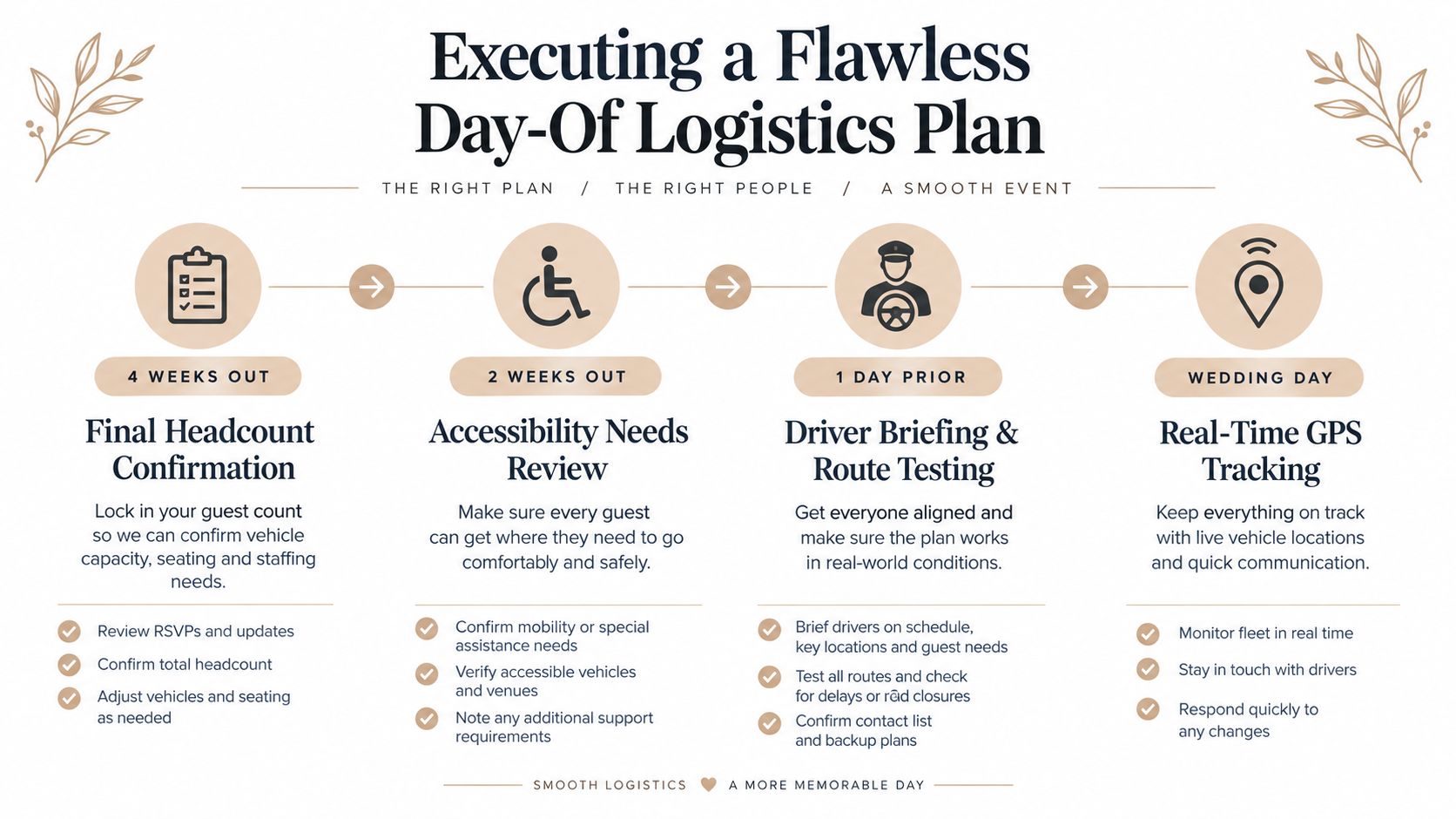
Four weeks out: Confirm the guest count, hotel blocks, ceremony and reception addresses, vehicle assignments, and every required movement. Keep couple transportation separate from guest shuttles so the primary vehicle is not diverted for an unplanned group transfer.
Two weeks out: Review accessibility needs, child-restraint requirements, luggage, garment bags, and guests who need an analog contact. Confirm printed pickup instructions and identify a staffed meeting point for guests who may not use smartphones.
One week out: Reconfirm venue access, coach turning space, loading zones, restricted roads, and staging instructions. Send the transportation team the latest master timeline, not an older proposal.
One day prior: Brief chauffeurs on routes, entrances, venue contacts, passenger movements, and escalation procedures. Test uncertain routes, especially around rural estates, narrow drives, and schedules involving multiple venues.
Wedding day: Confirm vehicle readiness, staging, passenger counts, and the first departure. Keep the planner or designated point person in direct contact with the lead chauffeur and dispatch contact. GPS tracking can improve visibility, but it should support, not replace, phone communication and a printed schedule.
Every movement needs an owner, a time, a pickup point, and a fallback decision. Assign those details before guests arrive, then give the venue and transportation team the same version of the schedule.
For guest behavior and polished arrivals, review wedding transportation etiquette. Clear meeting points, boarding times, and contact instructions reduce missed departures and prevent chauffeurs from waiting without direction.
A reliable operation does not require the couple to monitor every vehicle. It requires a documented chain of command, confirmed access, trained chauffeurs, and clear procedures for changes. That preparation keeps the wedding party focused on the ceremony and reception instead of resolving transportation problems in formalwear.
Hamptons Leisure Limo coordinates East End wedding transportation with premium SUVs, Mercedes-Benz Sprinter vans, mini-buses, and a 55-passenger coach. The service offers fixed pricing and no surge fees for pre-arranged transportation. Visit Hamptons Leisure Limo to arrange couple transfers, guest shuttles, hotel routes, and late-night returns, or text (631) 294-0747 for a quote.
Ready to Ride with Hamptons Leisure Limo?
Fixed pricing. No surge fees. 30 years of experience serving the Hamptons. Text us what you need and we will send a quote.