JFK Limo Services: What to Know Before You Book
Updated September 25, 2026

You've just landed at JFK after a long trip, your phone is full of delayed-flight notifications, and the last thing you want is to negotiate a pickup while your luggage is still on the carousel. Or you're leaving East Hampton on a summer Friday, staring at the clock and wondering whether the car service you booked has allowed enough time for the airport, the terminal, and the road back to the East End.
That's the essential question behind JFK limo services. You're not only booking a black car. You're arranging a long, delay-sensitive transfer with airport rules, luggage, terminal access, traffic, vehicle capacity, and pricing terms all working together. After years of running Hamptons routes, I tell returning clients to judge the entire operating plan, not just the vehicle photograph or the first quote that appears on an app.
Table of Contents
- What JFK Limo Services Actually Cover for Hamptons Travelers
- Inside a Typical JFK Limo Booking
- Fixed Pricing Versus Surge on the JFK to Hamptons Run
- How Flight Tracking and Curbside Pickup Work in Practice
- Choosing the Right Vehicle for Your Trip
- Why a Dedicated Hamptons Provider Beats a Generic City Service
- Booking Your JFK Limo With Confidence
What JFK Limo Services Actually Cover for Hamptons Travelers
A returning East Hampton client once called after landing at JFK at 9 p.m. on a Friday in July. He expected the chauffeur to be waiting directly outside the terminal doors, but the practical part of the booking was different. The chauffeur had the flight details, knew the assigned terminal, was waiting in the permitted staging area, and moved toward the pickup point only when the passenger was ready.
That distinction matters on the Hamptons corridor. A properly arranged transfer usually begins with a private black car dispatched to a home, hotel, office, or rental property in East Hampton, Southampton, Bridgehampton, Sag Harbor, Water Mill, or Westhampton. The service then covers the planned airport transfer, luggage assistance, terminal drop-off for departures, or a meet-and-greet or curbside pickup for arrivals.
For a trip between the East End and JFK, clients are paying for coordination as much as transportation. The route can cover roughly 100 to 120 miles, depending on the Hamptons address and the terminal destination. The right quote identifies the vehicle class, pickup address, passenger count, luggage requirements, airport terminal, and whether the trip is one-way or part of a return itinerary.
What the quoted transfer should identify
Before you confirm, ask for the full scope in writing:
- Vehicle and capacity: The quote should state the vehicle class, not just “luxury car.”
- Pickup and destination: Give the complete Hamptons address and the JFK terminal or airline.
- Airport procedure: Confirm curbside pickup or inside-terminal meet-and-greet, where offered.
- Waiting terms: Ask how flight delays, baggage collection, customs, and additional waiting are handled.
- Extra charges: Bridge and tunnel tolls, gratuity, added stops, and waiting beyond the included grace period should be clear.
Airport curbs are for active loading only. The Port Authority travel guidance states that vehicles can't park or wait on airport roadways, while designated cell phone lots provide free waiting areas. A professional chauffeur won't circle the terminal indefinitely. The vehicle waits where airport procedures allow, then approaches when the passenger is ready.
For a route-specific overview, see Hamptons airport limo service to JFK. The useful question isn't whether a limo sounds luxurious. It's whether the booking accounts for every handoff from your front door to the correct terminal, and from the arrivals process back to your destination.
Inside a Typical JFK Limo Booking
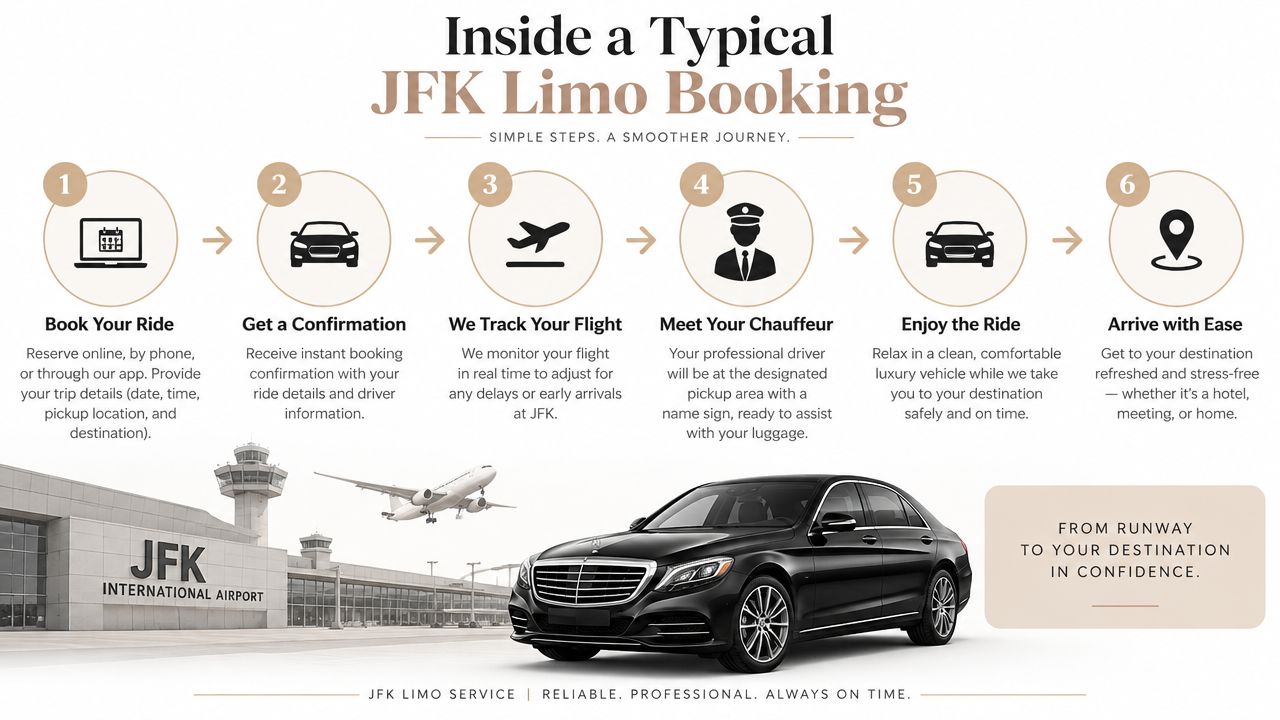
A good reservation doesn't start with “What car do you have?” It starts with the itinerary. The dispatcher needs enough information to assign the right vehicle and give the chauffeur a workable plan.
Start with the information that changes the operation
Send the pickup address, travel date, requested pickup time, destination terminal, airline, flight number when applicable, passenger count, and luggage count. Mention child seats, pets, oversized cases, golf bags, surfboards, or a stop that can't be avoided. A sedan that works for two people with carry-ons may be the wrong assignment for three passengers with checked luggage.
The first quote should also identify the vehicle class and pricing structure. Hamptons-to-JFK bookings are generally easier to manage with fixed pricing and no surge, but you still need to ask what the quote includes. Toll treatment, gratuity policy, wait time, cancellation terms, deposits, and any credit-card hold should be written down rather than assumed.
Once the reservation is accepted, the dispatcher should send a confirmation by email or text. Look for the chauffeur's name, vehicle description, plate information, contact number, pickup address, destination, and flight details. If one of those items is missing, ask before travel day.
The day before and the airport handoff
About 24 hours before pickup, the company should remind you of the reservation and confirm the meet time. The dispatcher or chauffeur can then check the planned route, including the Long Island Expressway or Southern State Parkway, according to current conditions and the direction of travel.
For a departure, the chauffeur targets your Hamptons address with enough time for the road, terminal access, airline check-in, and the uncertainty of a seasonal route. For an arrival, the terminal and airline determine where the chauffeur can legally meet you. The official JFK van and shuttle information confirms that pre-booked private transportation is part of the airport's authorized ground-transportation system.
Practical rule: Don't accept “we'll find you at JFK” as a complete meeting plan. You should know the terminal, level, pickup instructions, and contact method before the flight lands.
If your flight is delayed, the chauffeur shouldn't abandon the reservation or tell you to book again. The flight number gives dispatch a reference point, while the airport procedure determines where the vehicle waits. That combination is what turns a reservation into an actual airport transfer.
Fixed Pricing Versus Surge on the JFK to Hamptons Run
For this corridor, fixed pricing is usually the sensible choice when the trip matters. A Friday evening ride from East Hampton to JFK Terminal 4 can face heavy seasonal traffic, changing airport conditions, and a long distance that makes a last-minute app estimate difficult to judge.
Surge-based services can raise rates during Friday evening rushes, summer share-house weekends, holiday travel periods such as Memorial Day and July 4th, and storms that delay arrivals. An app may show an attractive estimate when demand is quiet, then recalculate after you request the vehicle. That uncertainty is the cost problem, even before you compare the final totals.
A fixed Hamptons quote should identify the vehicle class, route, toll treatment, gratuity policy, included waiting, and any deposit or card authorization. Some operators use a flat transfer amount, while others add clearly stated extras. The point isn't that every fixed quote is automatically cheaper. The point is that you can compare the complete itinerary before the vehicle is dispatched.
| Cost Component | Fixed-Rate Hamptons Operator | Surge App-Based Service |
|---|---|---|
| Base trip | Written fixed pricing by route and vehicle class | Estimate can change with demand |
| Peak conditions | No surge under the quoted terms | Friday, holiday, summer, and storm demand can raise the fare |
| Tolls | Confirmed in the written quote | Check whether tolls are included or added |
| Gratuity | Confirm the policy before booking | Review the app's treatment and suggested gratuity |
| Waiting | Stated grace period and additional terms | Check when airport or delay charges begin |
| Vehicle | Assigned class should be identified | Vehicle availability can change at dispatch |
| Payment | Deposit or card hold may apply | App authorization and final adjustment may differ |
The fixed-price Hamptons airport service explanation is useful because it focuses on the part clients often skip, namely the written definition of the fare. For an off-peak trip, a surge-based option can sometimes beat a fixed quote. If the app shows a confirmed vehicle, the capacity fits your luggage, and the final price is clear before dispatch, it may be reasonable.
Watch the trade-off, though. A lower estimate doesn't guarantee a better airport plan. You may still need to account for the pickup level, waiting rules, luggage, and whether the assigned vehicle is suitable for the long ride.
How Flight Tracking and Curbside Pickup Work in Practice
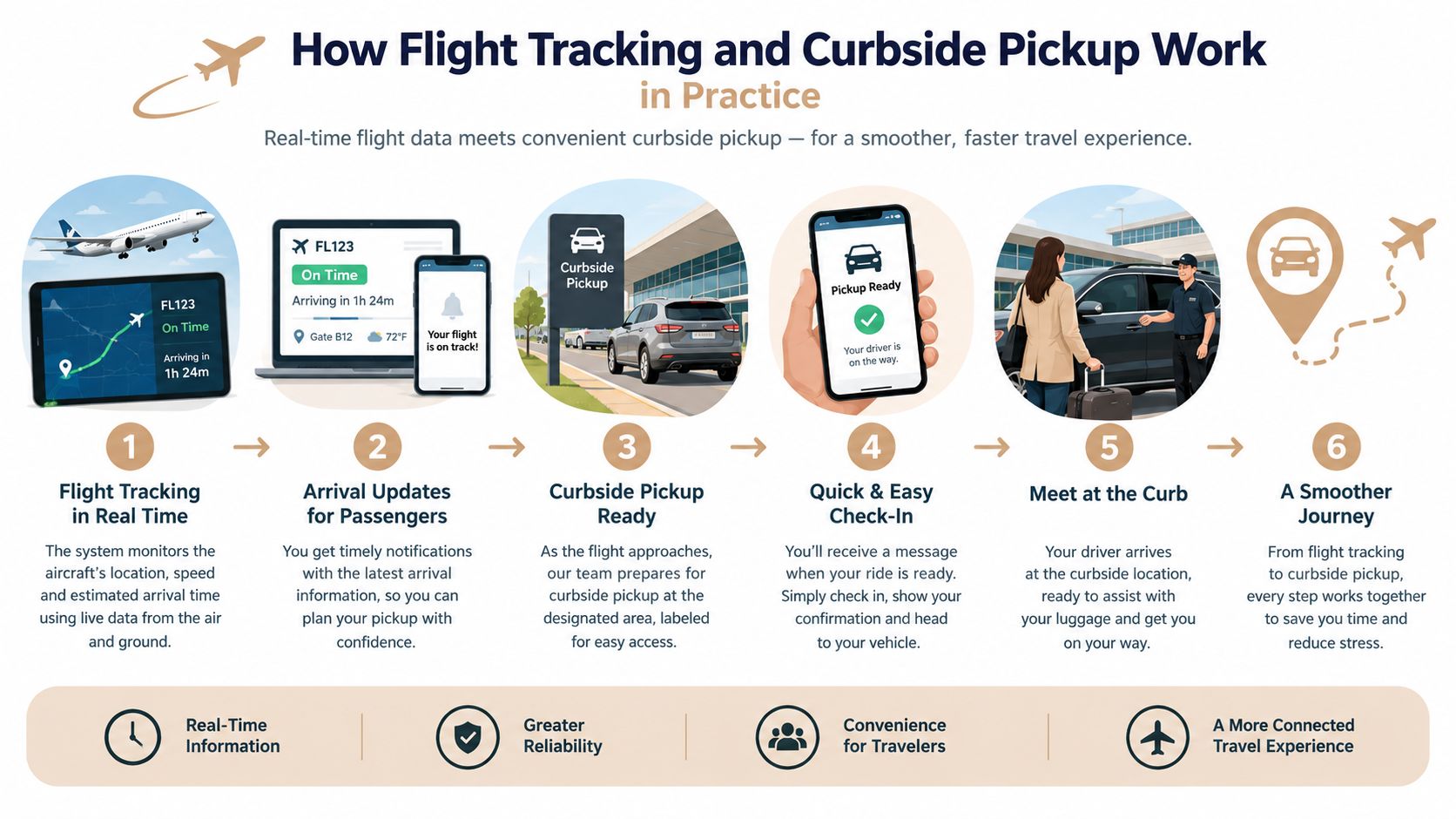
Flight tracking begins before the chauffeur leaves the Hamptons. Dispatch records the flight number, carrier, origin, scheduled arrival, and terminal. The team then watches for early arrival, delay, gate changes, ground holds, or a diversion, using live airline or FAA-based information where available.
That information changes the departure plan. A delayed flight may allow the chauffeur to leave later, while an early arrival can require an earlier departure. The dispatcher also builds in time for baggage collection and, on an international arrival, customs processing. Flight monitoring isn't a decorative feature. It helps the company decide when to stage the vehicle and when to move toward the pickup point.
Curbside is a controlled handoff
JFK's for-hire-vehicle system requires chauffeurs to use designated holding and pickup areas. The airport transportation guidance describes authorized pickup arrangements, while the operating process can involve a Cell Phone Lot, Limo Lot, and virtual first-in, first-out dispatch queue.
Terminal rules matter. Terminal-side FHV pickups are directed to the arrivals level for Terminals 1, 4, and 8. Terminals 5 and 7 require routing through the Howard Beach Ride App and Car Services Lot because of construction. The chauffeur can't improvise a terminal pickup without risking delay, a missed meeting point, or a queue violation.
Some clients want a text and curbside meeting. Others prefer a chauffeur inside the terminal when the provider offers that service. Confirm the preference before travel, and make sure the chauffeur has the passenger's mobile number. If you're delayed at baggage claim, send a message rather than walking to a different level without notice.
Airport pickup works best when the chauffeur waits off-curb and the client confirms readiness. Circling the terminal creates confusion, not reliability.
When the flight changes completely
If a flight diverts to another airport overnight, the original JFK plan no longer applies automatically. Call dispatch before collecting bags or arranging a substitute ride. The company may need the new airport, passenger location, luggage status, and revised destination before it can quote or dispatch a vehicle.
The real-time flight tracking approach for airport transfers gives clients the right expectation: monitoring helps the chauffeur adapt, but it doesn't eliminate airport rules or create a legal curbside waiting space.
Choosing the Right Vehicle for Your Trip
Vehicle choice should follow the luggage, not the occasion. A polished sedan can be ideal for one passenger or a couple with light bags, but genuine luxury sedans often have less trunk space than clients expect. On a long JFK-to-Hamptons trip, the wrong vehicle becomes uncomfortable as soon as the cases are stacked around the cabin.
A premium SUV is the safer choice for three or four passengers with checked luggage. It gives the group more room to settle in, and it leaves space for bags without forcing someone to hold a case between their legs. For larger parties, a Sprinter or mini-coach avoids splitting the group across several cars.
| Vehicle Type | Passengers | Luggage | Best For |
|---|---|---|---|
| Mercedes-Benz S-Class or comparable sedan | Up to 3 | Carry-ons and limited checked luggage | Solo executive travel or a couple traveling light |
| Premium SUV, such as a Chevrolet Suburban or Cadillac Escalade | Up to 6 | Multiple checked bags and carry-ons | Families, executives with luggage, and longer stays |
| Mercedes-Benz Sprinter | Up to 14 | Group luggage, event equipment, or bulky items | Families, wedding groups, surfboards, and shared transfers |
| Mini-bus or motor coach | Group-specific | Large group luggage and event equipment | Corporate movements, weddings, and coordinated events |
Use a simple capacity test
Ask three questions before choosing:
- How many people are traveling? Count adults, children, and anyone who needs extra personal space.
- What must fit inside? Include checked bags, carry-ons, golf clubs, surfboards, strollers, and garment bags.
- How long will you sit in the vehicle? A larger cabin has more value when traffic stretches the journey.
The drive can take two to four hours depending on season and conditions, so comfort isn't a minor consideration. That time range is an operational planning estimate rather than a promise. Friday summer traffic, weather, roadwork, and airport delays can all change the experience.
For a couple with two carry-ons, a sedan is a clean fit. For four adults returning from an international trip, I recommend an SUV even if the bags look manageable at home. For a group bringing surfboards, event cases, or several weeks of luggage, book the Sprinter early and describe the oversized items precisely.
Why a Dedicated Hamptons Provider Beats a Generic City Service
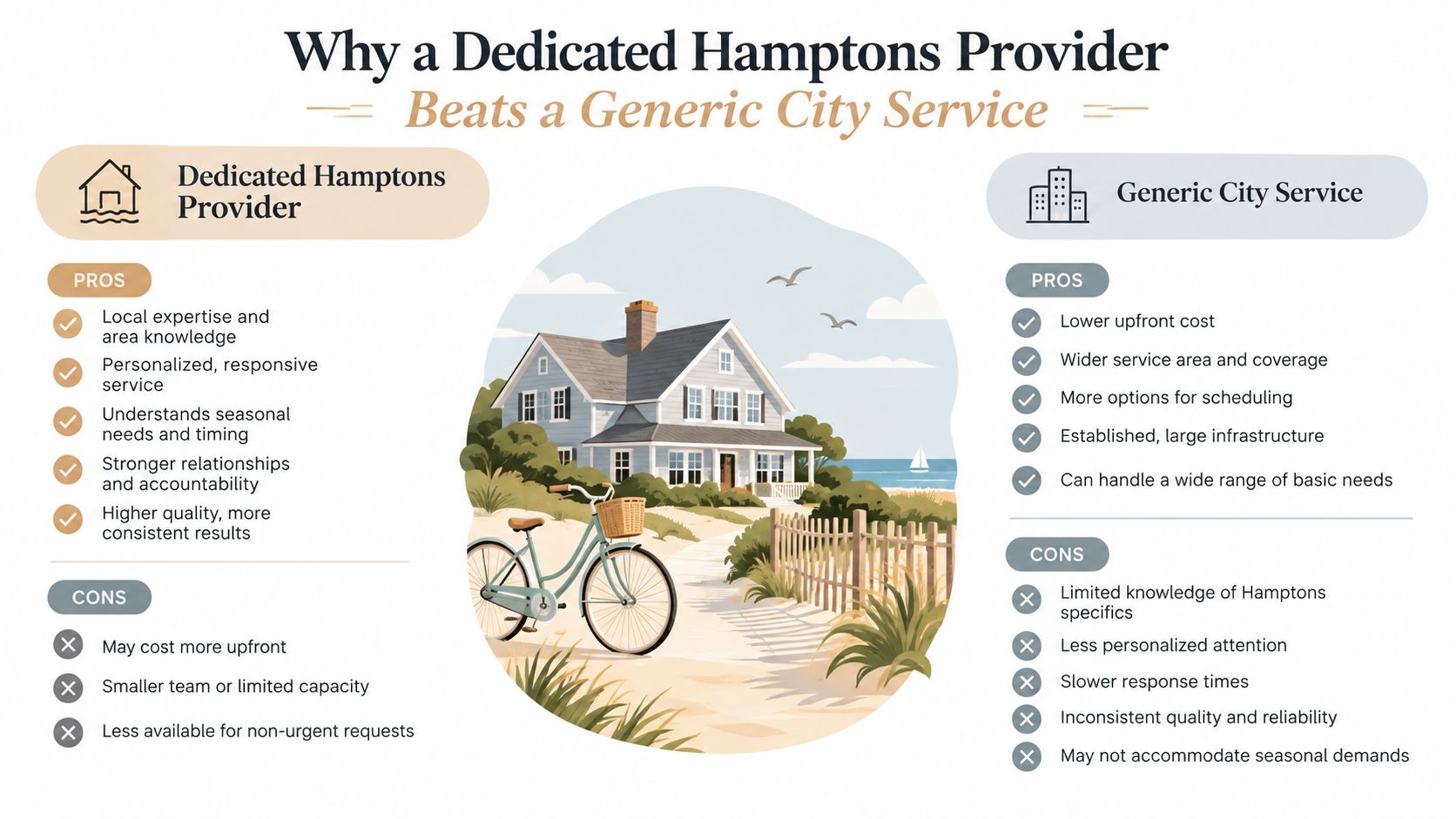
A city-based black-car company can dispatch a polished vehicle to JFK. That doesn't mean it understands the entire Hamptons run. The outbound leg starts in a place where seasonal traffic windows, bridge backups, ferry schedules, toll routes, and limited stopping options matter as much as the vehicle itself.
A Hamptons-based operation sees patterns that a generic city dispatch may miss. Friday afternoon traffic can build before the trip appears difficult in an app. The Long Island Expressway may slow sharply, and a route that looks straightforward from Manhattan can become a very different assignment once the chauffeur has to reach East Hampton, Sag Harbor, Water Mill, or Montauk.
The hidden cost of unfamiliar mileage
A generic service may assign whichever chauffeur is closest to the airport or city pickup. That chauffeur may be experienced, but may never have driven beyond Westhampton or may not know the practical stopping points for fuel, rest, or a family traveling with children. The company may also factor deadhead time from Manhattan into the assignment, even when the client only sees a single airport transfer.
A dedicated provider can plan tolls and route choices with more familiarity. It can also understand ferry timing when a client is connecting to an island destination, and it may assign one chauffeur to both legs of a round trip. That continuity reduces the number of handoffs and gives the chauffeur a clearer understanding of the client's preferences.
Operator's view: On a long airport route, familiarity is a practical feature. It affects departure planning, stops, toll handling, luggage expectations, and what happens when the road doesn't behave as planned.
The Port Authority airport traffic dashboard guide places taxis, limos, for-hire vehicles, AirTrain, and other access modes in the same broader airport transportation picture. That reinforces the right comparison. You're choosing a door-to-door operating plan, not merely a car category.
A dedicated Hamptons provider won't remove traffic from the route. It can make the route more predictable by starting with the correct local assumptions. For returning clients, that reliability is more valuable than the convenience of booking the first city service with availability.
Booking Your JFK Limo With Confidence
The departure window is where many otherwise careful travelers make their first mistake. For a domestic flight, plan to leave the Hamptons around 3.5 to 4 hours before departure as a working guideline, then allow more time for an international flight or a peak summer Friday. Your chauffeur can refine that window after reviewing the address, terminal, airline, and travel date.
The second common mistake is failing to confirm the person meeting you. The night before travel, make sure you have the chauffeur's name, vehicle description, plate, mobile number, pickup location, and the dispatch contact. A reservation number alone doesn't help much when you're standing at a busy airport arrivals level.
Keep one complete booking record
Your confirmation should include:
- Flight details: Airline, flight number, origin, scheduled arrival, and terminal.
- Property access: Full address, gate code, building instructions, and a useful landmark.
- Passenger information: Total passengers, children, car-seat requirements, and luggage.
- Communication: Primary mobile number and a backup contact who can reach you.
- Price terms: Fixed pricing, toll treatment, gratuity policy, waiting allowance, and added-stop terms.
For an outbound booking, reconfirm the pickup time and route plan on the morning of travel. For an inbound booking, verify that the flight is still assigned to the expected terminal and tell dispatch if your phone number or luggage situation has changed.
Make the last decision before you make the first payment
Share the full trip details with your chosen Hamptons provider 24 to 48 hours ahead when possible. Lock the price and inclusions in writing, confirm the vehicle class, and ask exactly where the chauffeur will wait if you arrive early, late, or need extra time at baggage claim.
JFK handled 62.63 million passengers in 2025, including 34.53 million international passengers, and processed 464,281 aircraft movements that year, according to JFK passenger and operations statistics. Those figures help explain why airport transfers require more planning than a normal point-to-point ride. JFK is a large, active gateway, and the Hamptons leg adds a long road journey after the terminal handoff.
If you're comparing airport modes, the official AirTrain page notes that additional riders cost $4.50 each and that the system allows up to 5 riders. See the JFK AirTrain passenger guidance when comparing rail access with a private vehicle, especially if you have luggage or a larger party.
Reconfirm the reservation the morning of travel, keep your phone charged, and don't change the meeting level without telling dispatch. A clear plan won't stop a storm or a road closure, but it gives the chauffeur enough information to make the right adjustment.
Hamptons Leisure Limo arranges fixed-price, no-surge JFK transfers from East Hampton, Southampton, Bridgehampton, Sag Harbor, Water Mill, Westhampton, and surrounding communities, with vehicle options matched to your passengers and luggage. Share your flight, terminal, pickup address, and preferred vehicle, then visit Hamptons Leisure Limo or text (631) 294-0747 for a quote.
Ready to Ride with Hamptons Leisure Limo?
Fixed pricing. No surge fees. 30 years of experience serving the Hamptons. Text us what you need and we will send a quote.