How Many Does a Limo Seat? Vehicle Sizes Explained
Updated November 19, 2026

How many clients does a limo seat? A sedan-style limousine carries up to 7 clients; a stretch limousine, 8 to 14; a 144-inch-wheelbase Sprinter, 11; a 170-inch-wheelbase Sprinter, 14; and a 55-passenger coach, 54. Each advertised seat total is one higher because it includes the chauffeur.
The headcount is only the first calculation. A certified seat count tells you how many people can ride, but not whether the group's luggage, child seats, or mobility equipment will fit comfortably.
For example, a group of seven may fit the client-seat count of a sedan-style limousine. Add luggage or child seats, and the same vehicle may no longer suit the trip. Check the seats first, then account for what everyone is bringing.
Table of Contents
- Limo Seating Capacity by Vehicle Type
- Why the Chauffeur Changes the Count
- Luggage, Children and Wheelchairs Cut Usable Seats
- Matching Group Size to Vehicle Type
- New York Rules for Stretch and Large Limos
- Confirm Your Group Size and Book the Right Vehicle
Limo Seating Capacity by Vehicle Type
How many people can a limo carry? The answer depends on the vehicle and whether the published capacity includes the chauffeur. For Hamptons Leisure Limo, passenger counts vary by vehicle: the Mercedes-Benz S-Class carries 3 passengers, the Chevrolet Suburban carries 6, the Sprinter carries 14, and the coach carries 55.
The table separates the vehicle's total seating capacity, including the driver, from the number of passenger seats. For the fleet's passenger counts and vehicle details, see the Hamptons Leisure Limo fleet.
| Vehicle type | Total seats (chauffeur included) | Usable client seats | Regulatory class |
|---|---|---|---|
| Sedan-style luxury limousine | 1 to 8 | Up to 7 | FMCSA Limousine 1 to 8 |
| Stretch limousine (New York) | 9 to 15 | 8 to 14 | FMCSA Limousine 9 to 15 |
| Sprinter passenger van, 144-inch wheelbase | 12 | 11 | FMCSA Limousine 9 to 15 |
| Sprinter passenger van, 170-inch wheelbase | 15 | 14 | FMCSA Limousine 9 to 15 |
| Motor coach, 55 passengers | 55 | 54 | Bus, 16 or more |
Sedan-style luxury limousines. In the table's general seating classes, a vehicle with eight total seats has room for up to seven clients and one chauffeur. The sedan is easy to board, but its smaller passenger count leaves less flexibility for a larger group.
Stretch limousines. Stretch models vary in seating layout. A vehicle with 9 to 15 total seats has room for 8 to 14 clients once the chauffeur's seat is counted. Bars and lounge layouts can affect how many designated seats the vehicle has. New York has rules for altered limousines, which are covered below.
Sprinter passenger vans. The Mercedes-Benz Sprinter passenger van specifications list seating for 12 in the 144-inch wheelbase and 15 in the 170-inch version. Subtract the chauffeur to get 11 or 14 client seats. The longer version adds a row, while a full passenger load can leave less room for baggage.
Motor coaches. The 55-passenger coach in the table has 55 passenger seats, plus luggage bays. Coach seating differs from the limousine counts above: its listed capacity is the passenger count, not a total that includes the driver. Coaches are used for wedding shuttles, corporate outings, and school trips.
Why the Chauffeur Changes the Count
How many guests fit when a limo's advertised capacity includes its chauffeur? Usually, subtract one from the total. An eight-person capacity, for example, means seven guest seats and one chauffeur's seat.
The Federal Motor Carrier Safety Administration's equipment classification groups limousines by total seating capacity, including the chauffeur: 1–8, 9–15, and 16 or more. It defines a limousine as a passenger vehicle built on a standard or lengthened automobile chassis. The category describes the vehicle's total capacity, not the number of guests it can carry.
Count designated, certified seating positions rather than floor space or how many people can squeeze onto a bench. Federal motor vehicle safety standards address designated seating positions and vehicle capacity (49 CFR Part 571). An improvised cushion does not create another certified seat.
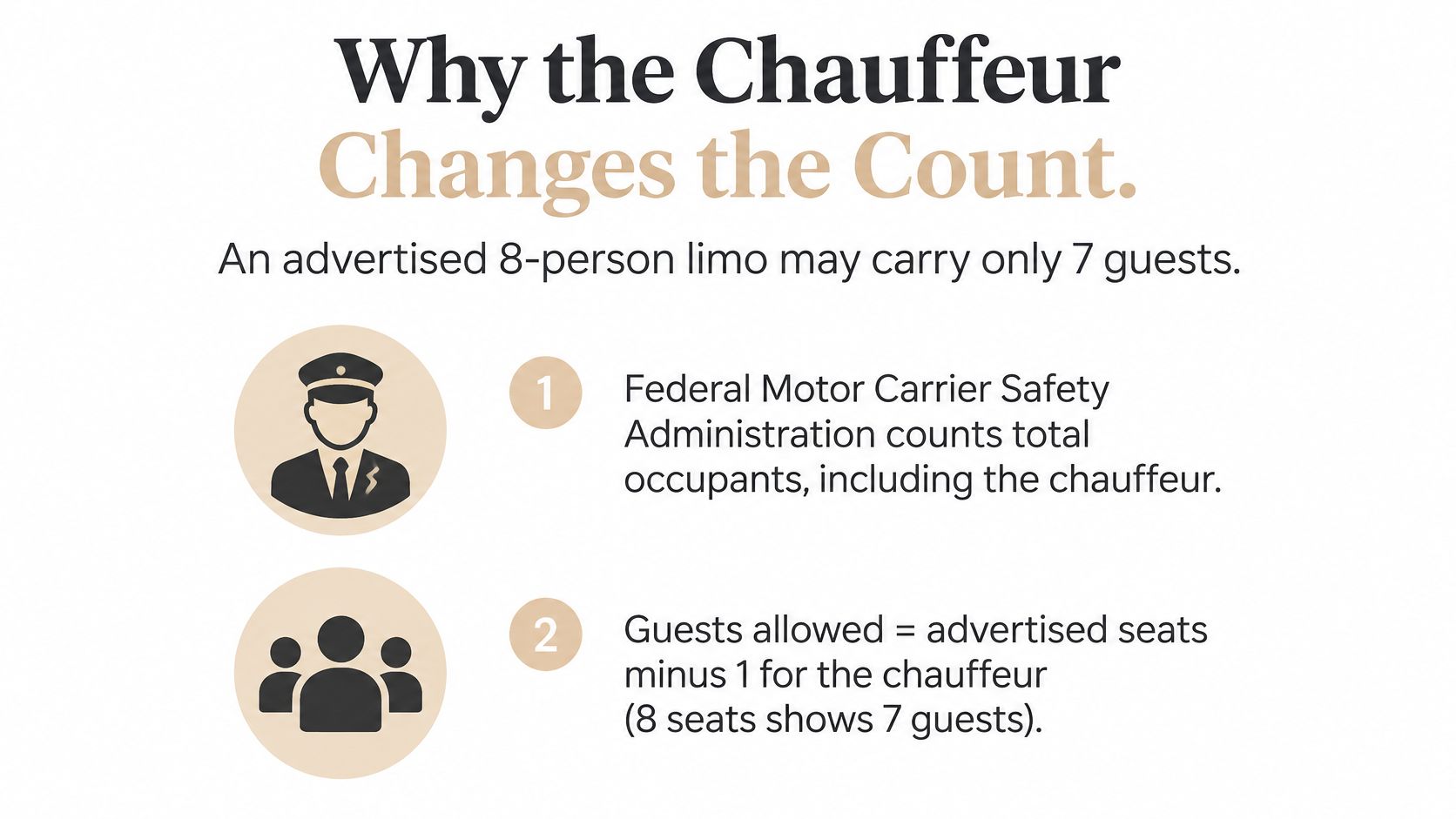
For example, a vehicle classified for 15 people has room for 14 passengers plus the chauffeur. The same arithmetic applies to a nine-person stretch: eight passengers and one chauffeur. This count answers how many people have designated seats, not whether everyone's luggage will fit.
Three questions to send before you book
- Does the advertised capacity include the chauffeur? Confirm whether the number is total occupants or guest seats.
- How many passengers can travel with the group's luggage? The seating maximum may not fit the bags as well.
- Are all the counted places designated seating positions? A bench's apparent width does not establish its certified capacity.
The chauffeur is part of the total because the vehicle has a seat for the person driving it. For a closer look at the role, see this guide to what chauffeur service includes.
Luggage, Children and Wheelchairs Cut Usable Seats
How many seats remain once luggage, child restraints and mobility equipment are accounted for? A group's headcount is only the starting point. For example, eight adults arriving at JFK with six large suitcases, two garment bags and a stroller may need more room than their passenger count suggests.
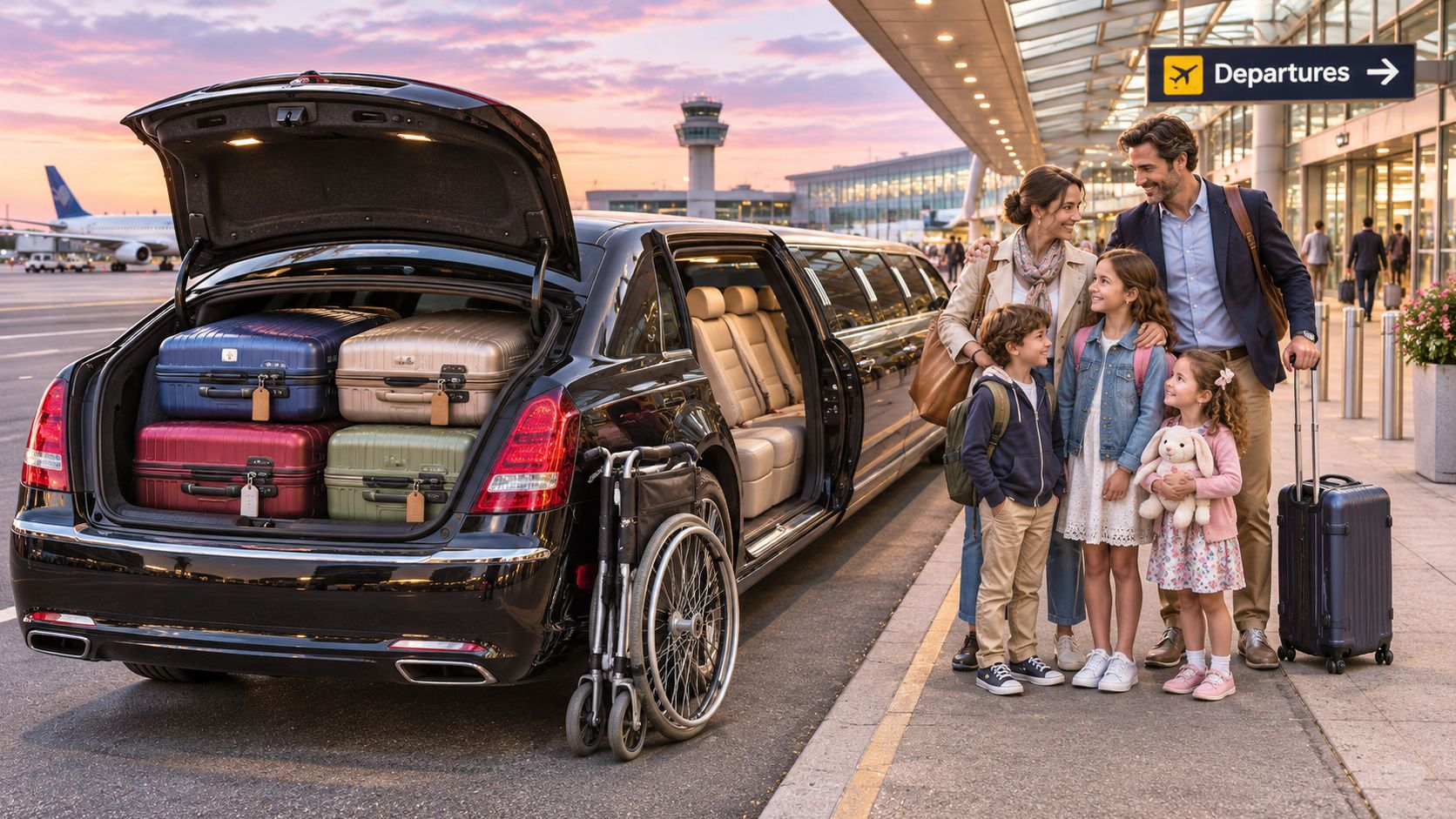
In a sedan-style vehicle, a heavy luggage load can take up space needed for passengers. Count large suitcases, golf bags, coolers and garment bags separately. A larger vehicle may preserve more room for people and bags, but comfort still depends on how everything fits.
Children and mobility equipment change the math
A child seat or booster occupies a seating position. Children should ride in the back seat and use a restraint suited to their size, weight and age. Two boosters and a rear-facing seat may leave fewer places for other passengers, so include each restraint when planning.
Wheelchairs need clear floor space as well as a path to the door. Federal accessibility guidance for non-rail vehicles specifies a wheelchair space of at least 30 by 48 inches, along with an accessible route between that space and an accessible doorway. The available room for seated passengers depends on the vehicle and its configuration.
The number on a capacity label does not, by itself, confirm that a particular group's equipment will fit. Ask how the vehicle accommodates the wheelchair and luggage together. Child seats are available on request and provided free of charge by Hamptons Leisure Limo. For airport trips with children, see the guide to airport car service with car seats.
A four-part planning method
- Count people. Include every rider, including infants and the photographer.
- List the bags. Count suitcases, then add awkward items such as golf clubs, coolers and garment bags.
- Include restraints and mobility equipment. Note each car seat or booster, and describe any wheelchair or other equipment that needs space.
- Check the fit. Ask whether the vehicle can accommodate the passengers, luggage and equipment together.
Before booking, confirm what happens if the group arrives with more luggage than expected. A vehicle's capacity cannot be changed at the curb.
Matching Group Size to Vehicle Type
Once the arithmetic is settled, the choice usually comes down to one row of a lookup table. The starting point below assumes each client travels with a normal amount of luggage, not a full wedding party's worth of hanging bags.
| Group size | Vehicle to consider | Why it fits |
|---|---|---|
| 1 to 3 travelers | Sedan-style limo | Room for bags and easy boarding |
| 4 to 7 travelers | Sedan-style limo or SUV-style luxury vehicle | Covers guests with luggage without a longer vehicle |
| 8 travelers | Stretch limousine (9 total seats) | Seats 8 clients with the chauffeur counted |
| 9 to 11 travelers | 144-inch Sprinter van (11 client seats) | Fits a larger party with bags |
| 12 to 14 travelers | 170-inch Sprinter van (14 client seats) | Largest van class for a single vehicle |
| 15 or more travelers | Motor coach or several vehicles with one coordinator | Keeps loading and luggage manageable |
Small parties. One to three clients in a sedan-style limousine travel with genuine space, and boarding takes seconds. At four to seven, the same class still works if the bags are modest. Add a seventh suitcase and the SUV-style vehicle earns its place.
Eight clients. This is the first real threshold, because a group of eight needs a stretch with 9 total seats. Trying to compress eight adults into a vehicle rated for eight leaves the chauffeur standing.
Nine to eleven clients. Our Mercedes-Benz Sprinter van carries 14 passengers, and its shorter configuration seats 11 clients, which is the sweet spot for a group that wants one vehicle without a bus.
Twelve to fourteen clients. Move to the 170-inch configuration with 14 client seats. It's the largest single van and the last stop before a coach.
Fifteen and up. For groups bigger than 14 passengers, we run multiple vehicles with one coordinator, and a 55-passenger coach comes with one chauffeur and one bill for the largest parties. Splitting a mid-size group across two SUVs with a single point of contact often works better than one long vehicle that takes twenty minutes to load.
Why the spare seat pays for itself
One empty place absorbs the bag nobody mentioned, the plus-one who turns up at pickup and the coat pile that grows on a cool night in Montauk. A vehicle that is exactly full at departure has nowhere to put any of it.
Match your headcount plus your bags to the row above, then move up a row whenever the total lands between two lines.
New York Rules for Stretch and Large Limos
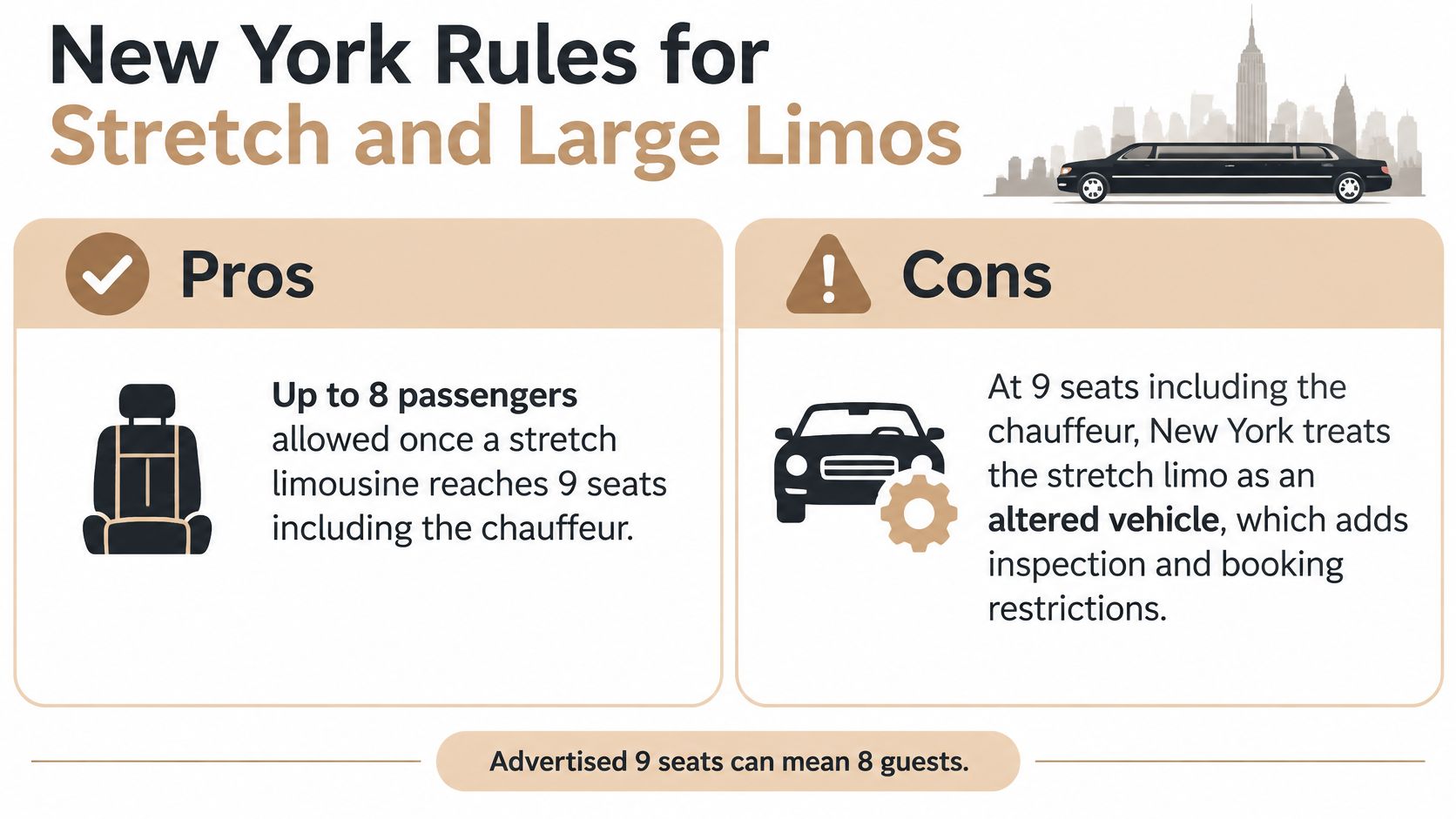
In New York, a vehicle's passenger count can affect the operating authority required for for-hire service. The New York State passenger-carrier guide identifies altered limousines carrying 11 or more people, including the chauffeur, as requiring NYSDOT operating authority (NYSDOT passenger carrier guide). That leaves room for 10 clients in a vehicle with 11 total seats.
New York also requires operators of altered or stretched limousines to give passengers a pre-trip safety briefing before the ride begins (New York DMV passenger transport guidance). Allow a little extra time at pickup for the briefing, especially if the schedule is tight.
The trade-off, side by side
Sedan-style and SUV vehicles. These are not altered limousines, so the altered-limo rules described above do not apply. For four to six clients heading to dinner in Sag Harbor, choose a vehicle with enough passenger seats and room for the group's belongings.
Stretch and larger vehicles. A stretch offers a different seating layout and may suit a group attending an event. Its operator must meet the applicable requirements, including the pre-trip briefing for altered or stretched limousines. Comparing capacity means looking at both the number of passenger seats and the vehicle's regulatory category. A capacity planning guide for Central Texas weddings offers a separate example of how certified capacity and practical comfort can differ.
Hamptons Leisure Limo is fully USDOT registered and commercially insured. Ask which regulatory category applies to the vehicle and whether its operating authority covers your group size.
Confirm Your Group Size and Book the Right Vehicle
Start with the passenger count, then check what needs to fit alongside everyone. A vehicle's listed capacity is not the same as the number of seats available to your group if the driver is included in the total.
For Hamptons Leisure Limo, the Mercedes-Benz S-Class carries 3 passengers, the Chevrolet Suburban carries 6, and the Mercedes-Benz Sprinter carries 14. The 55-passenger coach carries 55 passengers and has luggage bays. Groups larger than 14 are served by multiple vehicles with one coordinator.
Before choosing, count passengers and note the bags, child seats, strollers, and any mobility equipment. For example, a family with children should mention how many child seats are needed; child seats are available on request and provided free of charge. That information helps match the group to a suitable vehicle or coordinated set of vehicles.
Hamptons Leisure Limo is available 24 hours a day, 7 days a week, 365 days a year, and serves Southampton, East Hampton, Sag Harbor, Montauk, Bridgehampton, Amagansett, Water Mill, Wainscott, and Quogue. To request a fixed quote with no surge fees, visit Hamptons Leisure Limo and provide your passenger count, bags, child-seat or mobility needs, and pickup and drop-off locations.
A clear headcount and a list of what comes with the group make it easier to select the right vehicle before travel day.
Ready to Ride with Hamptons Leisure Limo?
Fixed pricing. No surge fees. 30 years of experience serving the Hamptons. Text us what you need and we will send a quote.