Google Reviews Rating Explained for Local Businesses
Updated September 20, 2026

On the East End, this decision usually happens in silence. A traveler steps off the Hampton Jitney in Southampton, opens Google, compares two black-car services for a Saturday night in East Hampton, and makes a choice in less than a minute.
The prices look close enough. The vehicle types look similar. Then the eye goes to the Google reviews rating. One profile shows 4.2 stars and a recent complaint about a missed pickup. The other shows 4.8 stars and comments about a chauffeur who knew how to avoid a Route 27 backup and still arrive on time. That single visible number often decides who gets the booking.
Table of Contents
- The Moment a Booking Tips Toward Five Stars
- What a Google Reviews Rating Means
- How Google Calculates and Updates the Score
- Why the Rating Matters for Bookings and Local Search
- Earning New Reviews the Right Way After the 2026 Policy Shift
- Monitoring Ratings and Responding Like a Pro Operator
- Putting It All Together for a Stronger Hamptons Reputation
The Moment a Booking Tips Toward Five Stars
I've watched this pattern for years in Hamptons transportation. Most travelers don't say, “I'm making this choice because of review math.” They just scan, compare, and move toward the option that feels safer.
Saturday nights make it even sharper. Someone is trying to get from Southampton to dinner in East Hampton, then on to a party in Amagansett or Montauk. They aren't buying a commodity. They're buying confidence that the car shows up, the chauffeur knows the roads, and the ride won't become the weak link in the evening.
What the traveler actually sees
On Google, two listings can look almost identical at first glance:
- Same service type: black car, SUV, airport runs, event transportation
- Similar pricing posture: fixed pricing, no obvious gap, no reason to assume one is dramatically cheaper
- Same map area: both serving Southampton, East Hampton, Sag Harbor, and nearby towns
Then the review layer changes the picture.
One business has a rating that signals friction. A recent complaint about lateness or a missed pickup creates doubt. The other has a stronger visible score and comments that sound local, practical, and believable. In transportation, those details matter more than polished wording.
A high rating doesn't just suggest a pleasant ride. It suggests fewer surprises.
That's what many operators miss. The Google reviews rating isn't a decorative badge. It compresses dozens of ride experiences into one public signal that people use to judge risk.
Why this matters more in the Hamptons
Hamptons travel has little tolerance for mistakes. Summer weekends are tight. Restaurant reservations don't move. Wedding timelines don't wait. Airport pickups from JFK, LaGuardia, Newark, MacArthur, or Westhampton have to connect cleanly with real schedules and changing traffic.
When a traveler compares two services before booking, they're often using the rating as a shortcut for one question: which company is less likely to create a problem for me tonight?
That's why it helps to understand what this number really is, how Google calculates it, and what moves it in a transportation business.
What a Google Reviews Rating Means
A Google reviews rating is the public score tied to a Google Business Profile. For a transportation company in the Hamptons, it functions as a compressed service record. Every clean airport pickup, clear confirmation text, late driver, billing mix-up, or missed turn adds up inside one number that a customer sees before they ever call.
Google describes that score as the average of the ratings published for the business on Google, displayed on a 1 to 5 star scale rounded to one decimal place, as described in Google's review score documentation.
The mechanics are simple. The business receives whole-star ratings from 1 through 5. Google averages them, then shows the rounded result publicly.
A simple transportation example
Say a car service receives these eight ratings after a run of airport transfers, dinner reservations, and weekend event trips:
| Review # | Stars | Running Total |
|---|---|---|
| 1 | 5 | 5 |
| 2 | 5 | 10 |
| 3 | 5 | 15 |
| 4 | 4 | 19 |
| 5 | 5 | 24 |
| 6 | 4 | 28 |
| 7 | 5 | 33 |
| 8 | 2 | 35 |
That leaves 35 total stars across 8 reviews.
35 divided by 8 equals 4.375. The displayed score becomes 4.4 after rounding.
What matters in practice is how that average behaves under pressure. In a seasonal market like the Hamptons, a small operator can go from a good July stretch to one rough August weekend fast. A single bad wedding pickup or a delayed JFK run can pull the score down in a way that takes many successful trips to repair.
That is why review volume matters, but consistency matters more. A company with fewer reviews feels every low rating more sharply. A company with a larger review base has more cushion, but repeated service mistakes will still show up in the average.
For an owner or dispatcher, the rating is not abstract reputation talk. It is a visible record of whether the operation delivers on the basics customers care about: arriving on time, sending the right vehicle, confirming details clearly, and getting people where they need to go without added stress.
How Google Calculates and Updates the Score
On the operating side, the process is straightforward. Google takes the valid star ratings published on the profile, adds them together, divides by the total number of ratings, and displays the result as an average. Google's Business Profile help page states that the review score is the average of all ratings published on Google for that business, as shown in Google Business Profile Help.
The part that causes confusion is the display. The public number is rounded, while the underlying average has more precision.
Why rounding changes what people see
A profile can improve internally before the visible number changes. If the average moves upward but doesn't cross the next rounding threshold, the public rating may look stuck.
For operators, that matters because travelers don't see the hidden progress. They only see the displayed score. Two companies can both show 4.8 while one is much closer to tipping into 4.9 and the other is barely holding the line.
This also explains why small service gains can feel invisible at first. The work is real. The display just hasn't caught up yet.
Why updates don't always happen right away
Google says a new review can take up to two weeks to update the displayed score, which is an important lag for businesses trying to monitor reputation closely, according to this review update summary citing Google behavior. That delay catches many operators off guard during busy windows.
If you're managing weekend demand in the Hamptons, you can't assume a fresh review will instantly change the public score seen by someone searching that afternoon. A positive review may not help right away. A negative one may also take time to affect the visible average.
There's a second layer too. Google screens for spam and suspicious activity, so some submissions may be delayed, filtered, or removed before they fully influence the profile.
What this means in practice
For a transportation company, the Google reviews rating should be treated like a lagging operational metric.
- Service happens first: pickup timing, vehicle condition, and communication create the review outcome
- Reviews post second: some clients leave feedback quickly, others don't
- The score updates third: public visibility may trail the actual ride experience by days
That's why the booking decision at the Jitney stop can hinge on work done weeks earlier. The traveler sees a single rounded number, but that number reflects a long trail of dispatch decisions, chauffeur performance, and follow-up discipline.
Why the Rating Matters for Bookings and Local Search
Google reviews aren't one more channel. For local businesses, they sit near the center of how people decide. One industry summary reports that 81% of consumers use Google to evaluate local businesses, 88% read Google reviews before choosing one, and 63.6% check Google reviews before visiting in person, with Google holding roughly 73% to 78% of all online reviews, according to Review42's online review statistics summary.
For a Hamptons transportation business, that means the Google reviews rating isn't a side issue. It's often part of the first screen a traveler sees before making contact.
The booking impact is larger than it looks
The strongest practical number here is the per-star relationship to conversions. A benchmark report found that a 1.0-star increase in average rating is associated with about a 44% lift in Google Business Profile conversions, and each 0.1-star gain corresponds to roughly a 4.4% conversion increase, based on the Google reviews benchmark report.
That matters in limo and black-car service because people compare narrow differences. A move from 4.2 to 4.6 doesn't look dramatic on paper. In actual booking behavior, it can change how often people call, click, or request directions.
In local transportation, a tenth of a star can be the difference between “looks fine” and “I trust this enough to book.”
Search visibility follows review strength too
Review signals also affect local search placement. Independent local SEO research has attributed about 16% of Local Pack ranking weight to review signals, and listings with 50 or more Google reviews were reported as 266% more likely to appear in the Local Pack than listings with fewer than 10, according to the local SEO review signals analysis.
For East Hampton, Southampton, Montauk, and Sag Harbor searches, that means rating and review depth work together. A profile with broader review history often presents as more credible than a profile with a slightly higher star average but very little volume. That matters for service categories like corporate limo service, where reliability and repeatability matter as much as appearance.
| Rating Range | Typical Conversion Lift | Local Pack Impact | Hamptons Booking Effect |
|---|---|---|---|
| Lower visible range | Lower relative conversion performance | Harder to stand out if review depth is thin | More price shopping, more hesitation |
| Mid-to-strong visible range | Each 0.1 gain can improve conversion by about 4.4% | Better support from review signals in competitive local results | More direct inquiries and fewer trust objections |
| Strong rating plus steady volume | Stronger combined reputation signal | Greater likelihood of showing well when review depth is established | More confident bookings for airport runs, nights out, and event moves |
Why this changes pricing pressure
A stronger Google reviews rating doesn't just help ranking. It changes the tone of the inquiry. When trust is already established, the conversation shifts from “why are you priced this way?” to “are you available at this time?”
That's especially useful during peak Hamptons weekends, when clients are comparing multiple options and want the operator least likely to create friction.
Earning New Reviews the Right Way After the 2026 Policy Shift
The old playbook was simple. Ask often, ask hard, and push the happiest riders first. That approach is now riskier.
Google's 2026 policy updates explicitly prohibit tactics such as review quotas, directing staff to solicit reviews that name a specific employee, and other manipulative practices, with stronger screening and retroactive enforcement described in Birdeye's summary of the 2026 Google review policy changes. Google can also place Business Profile restrictions for fake engagement violations, including blocking new reviews for a period, removing reviews for a period, or displaying a warning that fake reviews were removed, according to Google's fake engagement policy details.
What a safe review routine looks like
For a transportation operator, the cleanest method is boring by design. That's good.
- Send one neutral follow-up: use SMS or email after the ride, ideally once the trip is fully complete
- Include a direct review link: make the next step easy, not persuasive
- Keep the wording plain: ask for feedback, not praise
- Ask broadly: don't filter only for the people you think will leave a glowing review
- Skip incentives: no discounts, upgrades, credits, raffles, or priority treatment in exchange for reviews
A simple note works well: “If you have a moment, we'd appreciate your feedback on Google.”
That tone matters. It invites. It doesn't pressure.
What to stop doing
Some common habits now create unnecessary risk:
- Named solicitation: telling clients to mention a specific chauffeur by name
- Scripted repetition: sending every rider the same stiff, keyword-heavy request
- Review gating: only asking clients who seem happy
- On-the-spot pressure: pushing for a review while the rider is still in the vehicle
- Bulk bursts: triggering an unnatural cluster of near-identical asks
For a company coordinating reservations through forms, text, and dispatch software, it's better to build one neutral post-trip workflow than to improvise each time. If you want a simple contact path for follow-up logistics, a page like message us can support clean communication outside the review itself.
The safest review strategy is the one that still looks natural when you zoom out and examine a full month of requests.
What works better than chasing praise
The best review acquisition system starts before the ask. Confirm the pickup clearly. Send accurate vehicle details. Handle traffic updates early. Close the ride professionally. Then the review request feels earned, not extracted.
That's why seasoned operators spend less time trying to “get reviews” and more time tightening the handoffs that create them.
Monitoring Ratings and Responding Like a Pro Operator
Most review management doesn't need a full afternoon. It needs a repeatable routine. If you run transportation in the Hamptons, the goal is to catch issues early, answer calmly, and keep the public record from drifting away from the actual service you provide.
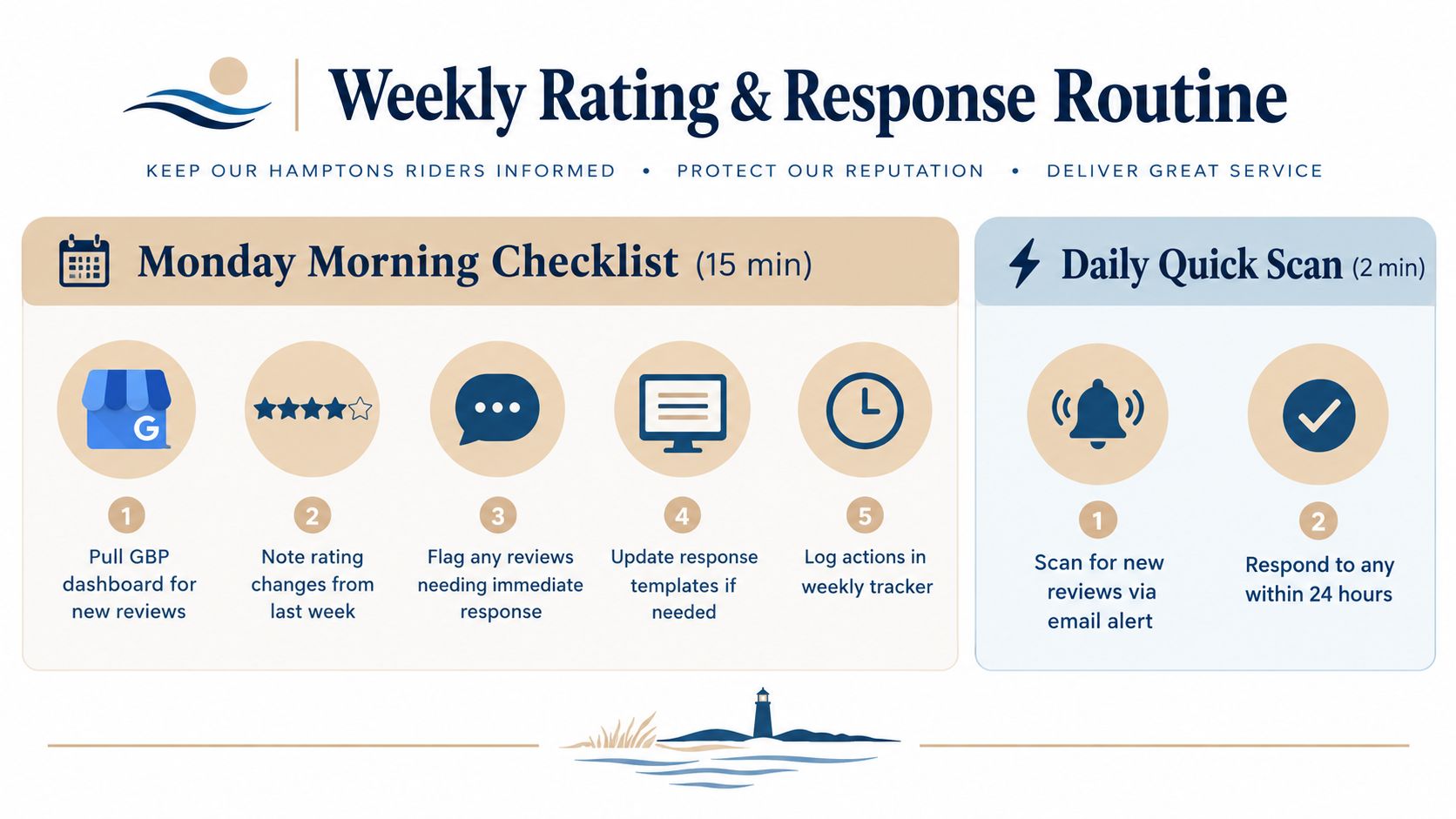
Monday morning review check
Block a short window each Monday and log four things:
- Current rating: note the visible score, even if it hasn't changed
- Review count: watch whether volume is growing steadily or stalling
- Last review date: long gaps can weaken trust, even with a solid average
- Open problems: identify any unresolved 1-star, 2-star, or 3-star feedback
That's enough for a weekly operator view. You don't need a giant dashboard. You need consistency.
If you want to compare public sentiment against your own profile presentation, your live client reviews page can help you keep messaging aligned with what Google users are seeing.
Response rules that keep things clean
Public replies should stay short, factual, and composed.
- Answer promptly: respond while the issue is still fresh internally
- Use first names only: thank the reviewer without repeating private trip details
- Keep it concise: a compact response reads better than a defensive essay
- Move sensitive issues private: safety, billing, damage, or identity details belong off the public thread
A strong reply shows that the operator is paying attention. It shouldn't read like legal copy or canned marketing.
Three response templates
“Thank you, Sarah. We appreciate you taking the time to share your experience. We're glad the trip went smoothly and that everything ran on schedule. We hope to assist with your next Hamptons ride.”
For a lateness complaint:
“Hi Michael, thank you for the feedback. We're sorry the pickup timing didn't meet expectations. We've reviewed the trip record internally and would like to follow up directly to understand what happened and address it properly.”
For a no-show allegation:
“Hi Jessica, we take this seriously and are reviewing the dispatch and communication record for the reservation now. Please contact our office directly so we can confirm the details and resolve this with you as quickly as possible.”
When to escalate internally
Not every bad review needs the same response path.
- Check the ride record. Confirm reservation time, dispatch notes, text history, and chauffeur status.
- Separate perception from failure. A delayed arrival in severe traffic isn't the same as a missed dispatch.
- Offer service recovery when appropriate. If the company clearly dropped the ball, fix the relationship directly.
- Escalate serious claims. Safety issues, accident allegations, or damage reports should move to management and, if needed, counsel or insurance review.
The operators who manage reviews well don't win by writing clever responses. They win by matching public professionalism with private follow-through.
Putting It All Together for a Stronger Hamptons Reputation
A strong Google reviews rating comes from operations, not slogans. That's the lesson.
The visible score is simple math. The booking effect is measurable. The public impression is immediate. Put those together and the rating becomes something you can manage with the same seriousness as dispatch timing, airport coordination, or vehicle readiness.
A practical 30-day plan
If you want to tighten your position over the next month, keep it focused:
- Audit the profile: check category accuracy, contact details, service areas, and review freshness
- Compare local competitors: look at three nearby transportation operators and note rating strength, review depth, and recent sentiment
- Set one rating goal: focus on a realistic improvement in visible trust, not perfection talk
- Create a weekly response block: one scheduled window beats random checking
- Define one recovery trigger: decide in advance what kind of failure gets immediate management follow-up
That framework works because it stays tied to rides, not theory.
The operator mindset that helps most
Every confirmed reservation creates a possible review outcome. Every late text, unclear pickup point, missed airport update, or polished handoff nudges the average one way or the other.
That's especially true from Memorial Day through Labor Day, when volume rises, timing gets tighter, and small process issues show up faster in public feedback. In that stretch, the operators who hold their rating usually aren't chasing applause. They're protecting the ride experience trip by trip.
Hamptons Leisure Limo is one example of that operating model. It provides pre-arranged black-car, SUV, Sprinter, and group transportation across the Hamptons, Long Island, and New York City with fixed pricing and no surge, which is exactly the kind of service environment where ratings reflect execution more than marketing language.
In the end, the Google reviews rating is a scoreboard. But the game isn't played on Google. It's played in confirmations, arrivals, route choices, chauffeur professionalism, and how cleanly a company recovers when something doesn't go to plan.
If you're booking black-car or limo service on the East End, the rating only matters if the operation behind it is steady. Hamptons Leisure Limo provides pre-arranged transportation across the Hamptons, Long Island, and New York City with fixed pricing, no surge, and the kind of local coordination that shows up in reviews for the right reasons. Text (631) 294-0747 for a quote or to line up your next airport transfer, event ride, or night-out itinerary.
Ready to Ride with Hamptons Leisure Limo?
Fixed pricing. No surge fees. 30 years of experience serving the Hamptons. Text us what you need and we will send a quote.