Golf Tour Transport: Hamptons Trip Planning
Updated October 9, 2026

Your foursome lands at a regional airport with four full-size golf bags, checked luggage, and a tee time that won't wait for baggage claim. The sedan that looked comfortable during booking suddenly has no practical room for equipment, while the club's access rules leave little tolerance for a late arrival. On the East End, golf tour transport works best when clubs, loading space, traffic, and the first tee are planned as one movement.
For Hamptons trips involving Shinnecock Hills, Maidstone, National Golf Links, or another access-constrained club, passenger count is only the beginning. The right vehicle must protect shafts, leave room for luggage, and reach the correct staging point early enough for clients to check in, warm up, and play without rushing.
Table of Contents
- Solving the Golf Equipment Logistics Challenge
- Selecting the Right Vehicle for Your Foursome
- Timing Your Airport Transfer and Course Arrival
- Navigating Drop-Off Rules at Premier Hamptons Clubs
- Coordinating Group Logistics and Fixed Pricing
Solving the Golf Equipment Logistics Challenge
A golf transfer can fail before the vehicle leaves the airport. Four golfers may occupy only four seats, but four full-size bags, shoes, carry-ons, and personal luggage create a much larger loading problem. A standard sedan can carry people comfortably and still be the wrong choice for the trip.
The equipment decision should start before the flight. A 2025 U.S. survey of 1,019 adults found that 65% of traveling golfers use their own clubs. Among those golfers, 27% prefer shipping clubs, 33% bring them on the plane, and 34% rent at the destination. These figures are reported in the 2025 golf-club travel survey from Luggage Forward. For a transport coordinator, that means the itinerary must account for club bags arriving with passengers, arriving separately by shipment, or being collected at the course or hotel.
Count volume, not just seats
Ask each group for four details:
- Passenger count: Include anyone joining the airport or hotel transfer, even if they aren't playing.
- Club-bag count: Confirm whether each player is bringing a full-size bag, sharing equipment, or renting.
- Luggage volume: Add checked cases, carry-ons, garment bags, and any event materials.
- Handoff location: Decide whether shipped clubs go to the hotel, the club, or a separate receiving point.
Golf bags shouldn't be crushed beneath hard luggage or wedged across a passenger's legs. Shafts and clubheads need stable placement, and the chauffeur should be able to load and unload without delaying the group at a narrow curbside area.
Airline rules can also affect the transfer. American Airlines' sports-equipment policy permits one golf bag containing clubs, balls, tees, and one pair of golf shoes. The bag follows standard checked-bag rules up to 50 pounds, or 23 kilograms, and 126 linear inches, or 320 centimeters. A bag above 50 pounds and up to 70 pounds may incur an overweight fee, while combined equipment above the stated allowance can be treated as separate items.
Practical rule: Tell the transport team the number of golf bags and approximate luggage volume before selecting a vehicle. “Four passengers” isn't a sufficient equipment description.
The complete trip cost isn't the same as the passenger-transfer cost. A small vehicle may require a second airport run, a club rental, excess-baggage handling, or a last-minute upgrade. Groups that ship clubs should also confirm who receives them and what happens if the flight and equipment arrive at different times.
Walking golfers may also use push carts or electric-assist equipment during their stay. For background on the practical benefits of electric assist for walking golfers, consider how that equipment will be stored during airport and hotel transfers. It still adds volume, and it shouldn't be treated as an incidental carry-on.
Selecting the Right Vehicle for Your Foursome
A vehicle's seat count tells only part of the story. For a Hamptons golf outing, the useful question is whether the vehicle can carry passengers, full-size bags, and luggage without forcing equipment into unsafe or uncomfortable positions.
A premium SUV can work well for a smaller party with modest luggage. A Chevrolet Suburban or Cadillac Escalade can seat up to 6 passengers, according to the Hamptons Leisure Limo fleet information, but the practical golf capacity depends on how many seats are occupied and how much luggage arrives with the group. Two or three golfers with clubs and light bags may have a comfortable ride. A full foursome with four club bags and airport luggage needs a careful capacity check.
A Mercedes-Benz Sprinter van is usually the more sensible option for a full foursome carrying extensive equipment. The available fleet lists Sprinters for up to 14 passengers, but the exact usable space depends on the interior configuration and passenger load. The benefit isn't just extra seating. It's easier loading, better separation between people and equipment, and a more relaxed transfer after a flight.
For corporate tournaments, charity outings, weddings connected to golf, or multi-group events, a mini-bus or coach may be more appropriate. Fleet options include 25-passenger, 36-passenger, and 55-passenger coaches. Larger vehicles reduce the number of separate arrivals at a club, but they also require advance confirmation of turning areas, staging locations, parking permissions, and road access.
Vehicle Capacity Guide for Golf Groups
| Vehicle Class | Max Passengers | Golf Bag Capacity | Best Use Case |
|---|---|---|---|
| Premium SUV | Up to 6 | Best for a small club-bag load, subject to passenger luggage | Small group, light luggage, airport or point-to-point transfer |
| Mercedes-Benz Sprinter van | Up to 14 | Better suited to multiple full-size bags and group luggage, subject to configuration | Full foursome, multi-day golf itinerary, airport-to-club transfer |
| Mini-bus | 25 or 36 | Requires advance equipment and loading plan | Corporate outing, tournament wave, several small groups |
| Full-size coach | 55 | Requires designated loading and staging arrangements | Large event, tournament circulation, coordinated group movement |
These are planning categories, not a substitute for a bag count. A full SUV can be more comfortable than a partially filled van for a small group, while a packed SUV can become awkward as soon as four golf bags and checked luggage enter the picture.
For groups considering a Sprinter, the Sprinter van rental with driver option can be evaluated around passenger count, equipment volume, pickup points, and the club's access instructions. The chauffeur also needs a clear loading plan, not just an address.
What works in practice
- Choose by equipment footprint: Count bags and luggage before confirming seats.
- Protect the passenger cabin: Keep clubs from blocking exits or occupying legroom.
- Match vehicle height and access: Confirm that the chosen vehicle can use the club's designated approach and loading area.
- Plan the return transfer: Equipment may be dirtier, wetter, or rearranged after the round, so the return vehicle needs the same capacity discipline.
The cheapest-looking vehicle often becomes the most expensive operational choice when it forces a split transfer. A properly sized vehicle protects comfort, equipment, and the timetable at the same time.
Timing Your Airport Transfer and Course Arrival
A flight landing time is not a pickup time. Golfers still need to leave the aircraft, collect oversized equipment, regroup, load bags, and travel along roads where summer traffic can change the transfer considerably. The schedule should be built backward from the first tee, not forward from the runway.
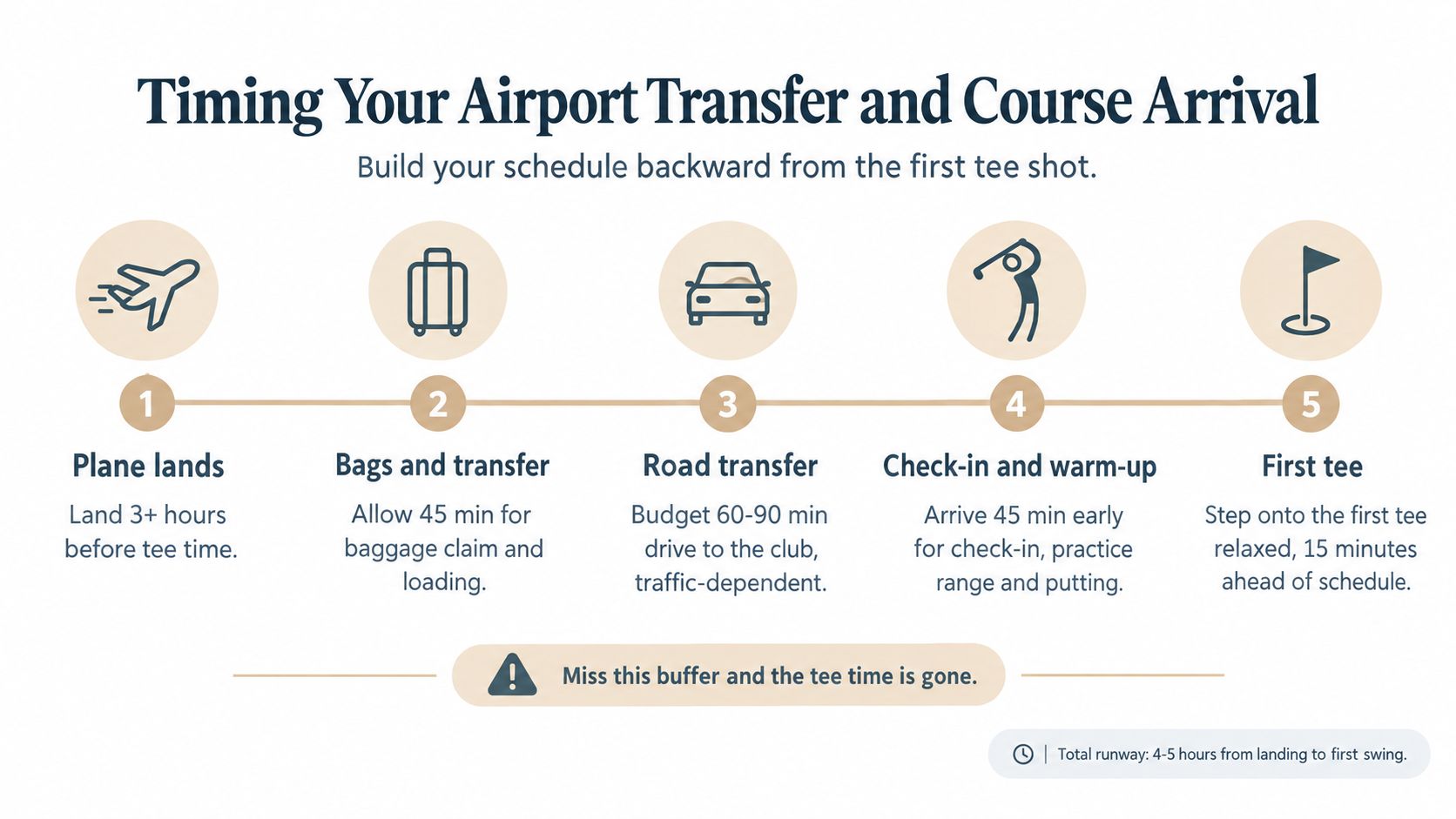
The infographic's five-step model uses a substantial runway from landing to the first swing. It identifies 3+ hours before tee time for landing, 45 minutes for baggage claim and loading, 60 to 90 minutes for the drive to the club, traffic-dependent, and 45 minutes for check-in, practice range, and putting. Its final operational target is to reach the first tee 15 minutes ahead of schedule, with a stated total runway of 4 to 5 hours from landing to first swing.
Those figures are planning guidance, not a promise about any individual airport or route. The essential principle is to protect the hard deadline. The Federal Highway Administration's planned-event guidance recommends continuous shuttle operations during ingress and egress, with service organized around arrival and departure waves rather than a rigid clock timetable. That same wave-based thinking helps private golf groups avoid concentrating every movement at the last possible moment.
Build the schedule backward
- Start with the required arrival: Confirm when the club expects the group, not merely the tee time. Some facilities need time for check-in, bag drop, parking, or a transfer from a remote lot.
- Add warm-up time: Reserve room for the practice range, putting green, restroom stop, and a calm walk to the first tee.
- Allow for loading: Golf bags take longer to load than ordinary luggage, especially when several passengers arrive together.
- Budget the road movement: Use the route, day, weather, and seasonal traffic pattern to set a realistic drive window.
- Confirm airport readiness: If a flight is delayed or equipment arrives separately, the pickup plan must be updated rather than left to the original landing time.
Arrival standard: Measure reliability at the place clients must be, not at the moment the vehicle leaves the hotel or airport.
For airport arrivals, active flight monitoring can help the chauffeur adjust readiness when the schedule changes. The service approach described in tracking flights in real time is useful because a flight's published arrival doesn't tell you when a group will have its clubs at the curb.
A live manifest should include each passenger, golf-bag count, luggage notes, flight details, club contact, and the agreed pickup point. For a multi-vehicle itinerary, separate player or VIP movement from general circulation. Record pickup punctuality, passenger wait time, and missed or delayed movements so the coordinator can identify where the plan needs adjustment.
A recovery plan matters most for the first tee. Keep an alternate route in mind, identify a secondary vehicle for critical passengers when appropriate, and confirm whether the club permits a different arrival point. The objective isn't to drive aggressively. It's to create enough margin that a normal disruption doesn't turn into a missed tee time.
Navigating Drop-Off Rules at Premier Hamptons Clubs
A Hamptons club arrival often has less flexibility than an airport curb. At Shinnecock Hills, Maidstone, and National Golf Links, the correct approach, loading area, parking arrangement, and staging permission should be confirmed before the day of play. A chauffeur who knows the road but lacks the club's current instructions can still arrive at the wrong gate or create an avoidable delay.
Consider a Shinnecock Hills arrival. The group may need a designated drop-off point, a parking pass, or instructions that keep the vehicle from waiting near a constrained entrance. The transport plan should identify where clients unload, where golf bags go next, and where the chauffeur can stage legally while the group is inside. Direct clubhouse routing isn't automatically the right answer.
Maidstone presents a different coordination question. The vehicle may need to approach through a specific access route and use a club-approved loading area rather than stopping wherever the passengers request. If the group is staying for a round and a meal, the return movement also needs a defined pickup point, because “outside the clubhouse” may not be precise enough for a busy property.
National Golf Links requires the same discipline. A good itinerary records the club contact, access instructions, parking requirement, and pickup procedure in the manifest. It also tells the chauffeur whether the group is arriving for a tee time, a hosted event, or a longer visit with a fixed departure window.
Use named zones and staging instructions
USGA host-site logistics guidance recommends specific pickup locations and continuous clubhouse shuttles. It also identifies electric multi-passenger carts as an efficient option for on-course circulation, while separate dispatch can follow matches that finish away from the clubhouse. The USGA four-ball logistics guidance explains why a mapped pickup point is more reliable than informal passenger movement.
For a larger event, the planning model becomes more formal:
- Assign service groups: Separate players, VIPs, staff, and spectators.
- Name each pickup node: Use the clubhouse, parking lot, hotel entrance, or approved gate as a specific location.
- Issue access documents: Confirm parking passes, lot designations, and vehicle permissions.
- Set a return procedure: Decide how clients request pickup and where the chauffeur waits.
- Prepare a contingency route: Account for weather, match delays, and a restricted entrance.
For tournament-scale movement, the 2018 Ryder Cup at Le Golf National near Paris illustrates the scale of the problem. Organizers planned for approximately 55,000 spectators, staff, and officials to travel to and from the venue each day, with a goal of 60% of fans arriving by train at Saint-Quentin-en-Yvelines or Massy before buses carried them to the course. Transfers from stations and park-and-ride locations generally took 10 to 15 minutes, as reported by Golf Business News' Ryder Cup transport coverage.
A private foursome doesn't need a tournament fleet, but it does need the same basic discipline. Assign the zone, respect the club's rules, and keep equipment movement separate from passenger movement whenever possible. That approach protects the gate experience and avoids asking the chauffeur to improvise at the last minute.
For major-event access questions, the US Open parking and transportation guide provides useful context on why lots, shuttles, and entrance procedures should be confirmed before departure.
Coordinating Group Logistics and Fixed Pricing
A multi-day golf trip becomes easier to manage when one coordinator holds the complete itinerary. That person should have the flights, hotels, tee times, club contacts, passenger list, golf-bag count, vehicle assignments, and return plans in one working document.
Central coordination prevents a common failure: four clients book separate rides, then discover that each chauffeur has a different pickup location or that the vehicles cannot stage together. One point of contact can align airport collection, hotel departures, course transfers, dinners, and the final return movement. It also makes changes easier when a flight is delayed or a tee time shifts.
Use one operating record
The booking process should be direct:
- Send the itinerary: Provide dates, airports, hotels, clubs, tee times, passenger names, and equipment volume.
- Confirm vehicle fit: Match each movement to an SUV, Sprinter, mini-bus, or coach based on bags and luggage, not seats alone.
- Document access rules: Add parking passes, loading zones, club contacts, and staging instructions.
- Set communication: Use text updates for flight changes, pickup readiness, and last-minute adjustments.
- Review the return plan: Confirm where the group will meet after the round and whether equipment needs special handling.
A fixed-pricing model with no surge gives the group a predictable quote for the agreed service. It doesn't remove the need to plan accurately, but it avoids making the transport budget depend on peak-period app availability. Text (631) 294-0747 for a quote.
For on-course circulation or event operations, a purpose-built street legal 12 seater cart may be relevant where the property permits that type of vehicle. It isn't a replacement for an airport-capable road vehicle, and club approval, road legality, passenger capacity, and equipment security still need confirmation.
Equipment handling deserves one final check. Push or pull carts must not be dragged beside or behind a shuttle cart while their wheels are rolling or touching the ground. The Florida State Golf Association push and pull cart policy explains that when one golf cart is used, a push or pull cart with the bag attached may be secured to the back of the shuttle cart without dismantling it, provided the wheels don't touch the ground.
Accessibility belongs in the same operating record. The U.S. Access Board states that accessible routes serving golf facilities generally require a minimum width of 48 inches, or 60 inches where handrails are provided. Where barriers keep golf cars from entering a fairway, openings of at least 60 inches should be provided at intervals no greater than 75 yards, according to the 2010 ADA Standards from the U.S. Access Board. Drop-off points and shuttle plans should connect clients with these routes rather than ending at an obstructed edge.
Hamptons Leisure Limo arranges pre-arranged airport, hotel, and club transportation with SUVs, Sprinter vans, and larger vehicles for golf groups carrying real equipment. Text (631) 294-0747 for a fixed-price quote with no surge, or visit Hamptons Leisure Limo to organize a reliable East End itinerary around your flights, club access rules, and tee times.
Ready to Ride with Hamptons Leisure Limo?
Fixed pricing. No surge fees. 30 years of experience serving the Hamptons. Text us what you need and we will send a quote.