Compare Airport Transfers for Hamptons Trips in 2026
Updated November 25, 2026

The arrivals board at JFK reads 10:40 pm. It's a Friday in July, the baggage carousel is three deep, and you're standing there with four suitcases, two children who have stopped negotiating, and a two-hour ride east. The car you booked three weeks ago is either the easiest part of the night or the part that unravels it.
That night is the reason to compare airport transfers properly. A lower quote means little if the car isn't there at 11:30, if the price moves while you're in the taxi line, or if the vehicle can't take four bags and two child seats. The useful comparison isn't a beauty contest between vehicles. It's five questions, asked in the right order, across six different ways of getting from an airport to the East End.
Table of Contents
- What to Compare Before You Book a Transfer
- How the Arrival Airport Changes the Comparison
- The Transfer Options Compared Side by Side
- Price Predictability During Peak Season
- Flight Monitoring and the Pickup at the Curb
- Accessibility Across the Whole Transfer
- Matching the Transfer to Your Group and Arrival Time
- Book the Option That Holds Its Price and Waits
What to Compare Before You Book a Transfer
Start with the clock, not the car. At 10:40 pm, the first question is whether anyone will be waiting when you clear the terminal. By 11:30, with the bags loaded, the question becomes whether the number on the booking screen is the number you pay. The five tests that decide the night run in this order.
- Price predictability. Is the figure a quote agreed before the trip, or an estimate recalculated after it?
- Availability. Is there a vehicle at the hour you land, in the season you land, not just on the date?
- Flight monitoring. Does anyone move the pickup when the plane is 90 minutes late, without you making a call from baggage claim?
- Pickup experience. Who is at the curb, how quickly are the bags loaded, and what happens at 1 am when the terminal has emptied out?
- Hamptons suitability. Two hours of highway, a group's worth of luggage, and narrow village roads at the end.
Those questions apply to every option on the market: rideshare, a taxi from the terminal stand, a shared shuttle, the Long Island Rail Road plus a local car, a rental car, and a pre-arranged black car. On East End runs, the pre-arranged car usually wins on predictability rather than headline fare. The cheap options aren't automatically bad. They fail in specific places, at specific hours, with specific loads.
A transfer quote is a promise about one number. The other four questions decide whether that promise survives the night.
How the Arrival Airport Changes the Comparison
The airport sets the rules for everything after it. Drive times below are approximate and should be confirmed against your village and the time of day, but the passenger volumes are firm. The FAA's 2024 commercial service enplanements report counted 72,725,989 boardings across JFK, Newark and LaGuardia combined, with JFK taking the largest share. Year over year, JFK enplanements rose 2.15%, LaGuardia rose 3.35%, and Newark slipped 0.13%. Volume is a proxy for curbside friction: more passengers mean longer immigration queues, busier pickup zones and more competition for cars at the same hour.
Airport by airport transfer picture for Hamptons travelers
| Airport | Drive time to Hamptons | 2024 enplanements | What it means for your transfer |
|---|---|---|---|
| JFK | About 2 hours | 31,466,102 (43.3% of the three-airport total) | Heaviest international arrival banks, 45 minutes from gate to curb is a realistic buffer, so set the pickup by terminal not by drive time |
| Newark (EWR) | 2.5 to 3 hours | 24,544,320 (33.8%) | Two-state routing and tolls, allow the extra hour and ask for tolls in the quote |
| LaGuardia (LGA) | 2 to 2.5 hours | 16,715,567 (23.0%) | Domestic and compact, but city traffic sets your departure time |
| MacArthur (ISP) | 45 minutes to 1 hour | Not in the 72,725,989 three-airport total | Shortest drive and smallest crowds, with a thinner flight schedule |
| Teterboro (TEB) | 2 to 2.5 hours | Private aviation | Arrange plane-side pickup and skip the terminal walk |
| East Hampton (JPX), Montauk (MTP), Gabreski (FOK) | 10 to 25 minutes to the village | Private aviation | Shortest final leg, with the car timed to the tail number |
The chart below puts the airport choice in a single frame.
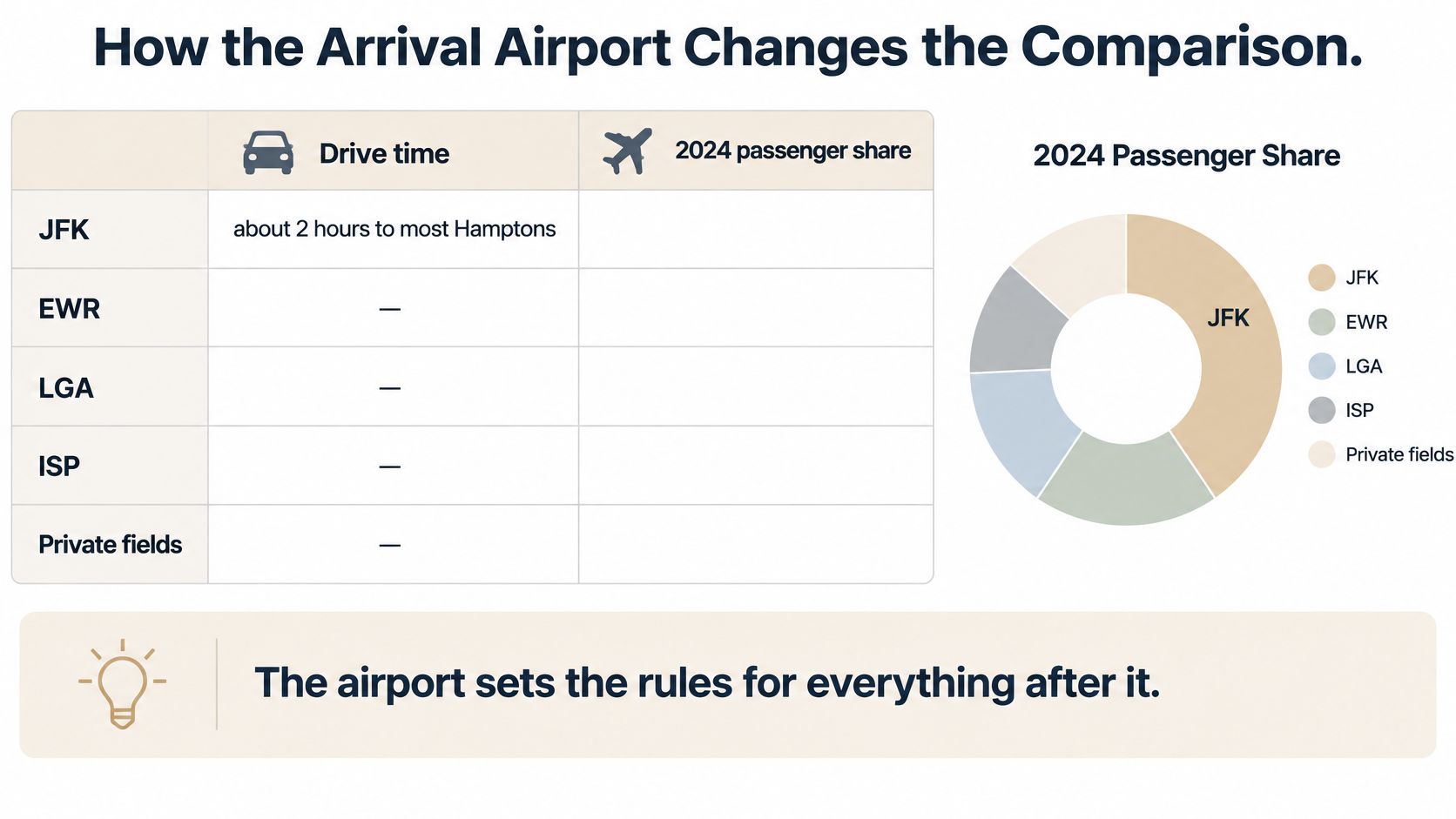
What passenger volume tells you at the curb
JFK is the big international gateway, and that changes the pickup. A heavy arrival bank can put an hour between the aircraft door and the curb once immigration and bags are counted. The transfer buffer has to match the terminal, not the drive. Newark adds a second state, bridge and tunnel crossings, and tolls that belong in the price up front. LaGuardia is compact, but the city traffic around it decides when your car can reach you. MacArthur is the shortest total journey when a flight exists, and the private fields at Westhampton, East Hampton and Montauk put you 10 to 25 minutes from the village.
The order of decisions matters. Choose the airport first, then the transfer. If you're mapping where to meet a car, explore airport terminal mapping options from Mappedin before you settle on a meeting point, because terminal layouts differ enough to change the walk with luggage.
Airport trips to the Hamptons take about 2 hours from JFK, about 2.5 hours from LaGuardia, and about 45 minutes from MacArthur (ISP), which is why the airport choice and the pickup plan belong in the same conversation.
The Transfer Options Compared Side by Side
The table below holds every option to the same five tests before any sales pitch. Read it as a decision grid, not a ranking. The same reasoning applies in other markets, where private airport cars for families get chosen on identical criteria.
Airport transfer options compared on five criteria
| Option | Price predictability | Peak-season availability | Flight monitoring | Pickup experience | Best Hamptons fit |
|---|---|---|---|---|---|
| Pre-arranged black car or limo | Fixed quote at booking, no surge | Confirmed in advance for the exact hour, 24/7 | Provider tracks the flight and adjusts the pickup | Chauffeur waits curbside and loads the bags | Groups, families, late arrivals, corporate clients |
| Rideshare (Uber, Lyft) | Moves with demand, highest in July and August | Uncertain at peak, long waits at JFK and EWR pickup zones | Limited, the app may not see a delay | Walk to a designated app pickup zone with your bags | Solo travelers with light luggage, off-peak |
| Taxi (terminal stand or pre-booked) | Metered, traffic and tolls land on the fare | Good at JFK and LGA stands, thin at ISP | None | Curbside at the taxi line, first car available | Short-notice single riders with no advance plan |
| Shared shuttle | Per-seat and low, but adds stops | Limited schedules, sells out in summer | Sometimes, by schedule rather than by flight | Shared curb wait and multiple pickups | Budget solo travelers with flexible time |
| Rail (LIRR) plus local car | Published fare plus a local car at the station | Fixed timetable, no extra cars added at peak | None | Self-managed with luggage through terminals and platforms | Light packers arriving in daylight |
| Rental car | Rate plus tolls, fuel and parking | Vehicles scarce in July and August | None | Counter line, then a lot shuttle | Multi-day stays that need a car anyway |
What each option really adds
Pre-arranged black car. The vehicle belongs to your party, the price is agreed before you leave, and the chauffeur watches the flight. The local example is Hamptons Leisure Limo, whose fleet runs from a sedan and premium SUV to a 14-passenger Sprinter and a 55-passenger coach. For ten people, that means one pickup, one coordination point and one bill.
Rideshare. The app price is an estimate until the trip closes. At JFK you walk to a designated pickup zone with your bags, and in July the number can climb between the terminal and the curb. It's workable for a solo arrival at 11 am and poor for four bags and two tired children at 11 pm.
Taxi. A metered fare is honest and unpredictable at the same time. Traffic on the Van Wyck or the LIE, a bridge toll and a reroute all land on the meter. The stand works at JFK and LaGuardia, but service at MacArthur is thin enough that you shouldn't build a night around it.
Shared shuttle. Per-seat pricing looks cheap until you count the stops. A route that collects passengers through Queens and Nassau before heading east can add an hour before the highway even starts.
Rail plus a local car. The LIRR gets you to Southampton or East Hampton on a fixed timetable, then you need a local car for the last miles. It rewards light packers arriving in daylight and punishes anyone with four suitcases and a 10 pm landing.
Rental car. The counter line in July is its own queue, followed by a lot shuttle and a drive. It makes sense for a multi-day stay that needs a car anyway, not for a single transfer to a village where parking is scarce.
Rideshare and taxi are both fine for a solo off-peak arrival. The clear failure is a 2 am February pickup in Montauk, where app supply can disappear entirely and the taxi stand is a memory.
The fare is the smallest part of the decision. A two-hour run east is decided by whether the car is there, whether it waits, and whether the number you agreed is the number you pay.
Price Predictability During Peak Season
A quote is agreed before the trip. An estimate is recalculated after it. That difference is the whole game when you compare airport transfers in July and August, because demand is the part of the price that moves.
Every transfer total has three parts: a base for the vehicle and the miles, a time component for waiting and stops, and a demand component that rises with the season. On the East End, the demand component is structural. The FAA's 2016 commercial service enplanements data puts combined enplanements at JFK, Newark and LaGuardia at 63,924,753 that year, and the agency's later figures show boardings still climbing through 2024, with Newark growing fastest of the three airports. More arrivals in the same months put more travelers at the same curbs, all bidding on the same cars.
What changes a transfer total and how to hold it steady
| What changes the total | Where it bites | How to keep it predictable |
|---|---|---|
| Seasonal demand in July and August | Rideshare and on-demand quotes | Fixed pricing confirmed at booking |
| Waiting time after landing | Metered and hourly services | Flight monitoring plus a stated grace period |
| Tolls and bridge crossings | Any option that drives | Ask for an all-in quote with tolls included |
| Extra stops along the East End | Point-to-point quotes priced per trip | Give the full itinerary at booking |
| Luggage and child seats | Rideshare and shared shuttles | Request vehicle size and seats in advance |
| Late-night or early-morning timing | Thin driver supply | Confirm the exact hour, not just the day |
| Cancellation and change terms | Prepaid bookings | Get the policy in writing |
Quote or estimate, and why the difference matters
A metered fare from JFK to East Hampton can't be known at booking because traffic and routing vary. That's not a knock on taxis. It's a reason a metered option can't be compared apples to apples with a fixed quote. The mechanics of a fixed price booked before the trip are what make two providers comparable at all.
Groups expose the math quickly. One per-vehicle price for ten people usually beats several separate rideshare quotes, because the total is counted once and the stops are counted once. The same logic applies to a family of five with car seats: one vehicle with the right seats is cheaper and calmer than two app rides.
Price swings hit hardest where substitution is hardest. A solo passenger can absorb a surge quote by switching apps. A traveler who needs an accessible vehicle, or a car fitted with child seats, has no substitute to switch to. For them, a predictable number isn't a preference. It's the plan.
Three questions for any provider. Is the number all-in, does it change if the flight is late, and what does a cancellation cost?
Flight Monitoring and the Pickup at the Curb
A pickup isn't one moment. It's a chain that starts when the flight number is recorded and ends when the bags are in the car and the vehicle is heading east. A chauffeur with a tablet can see the whole chain. A traveler outside Terminal 4 at midnight usually can't.
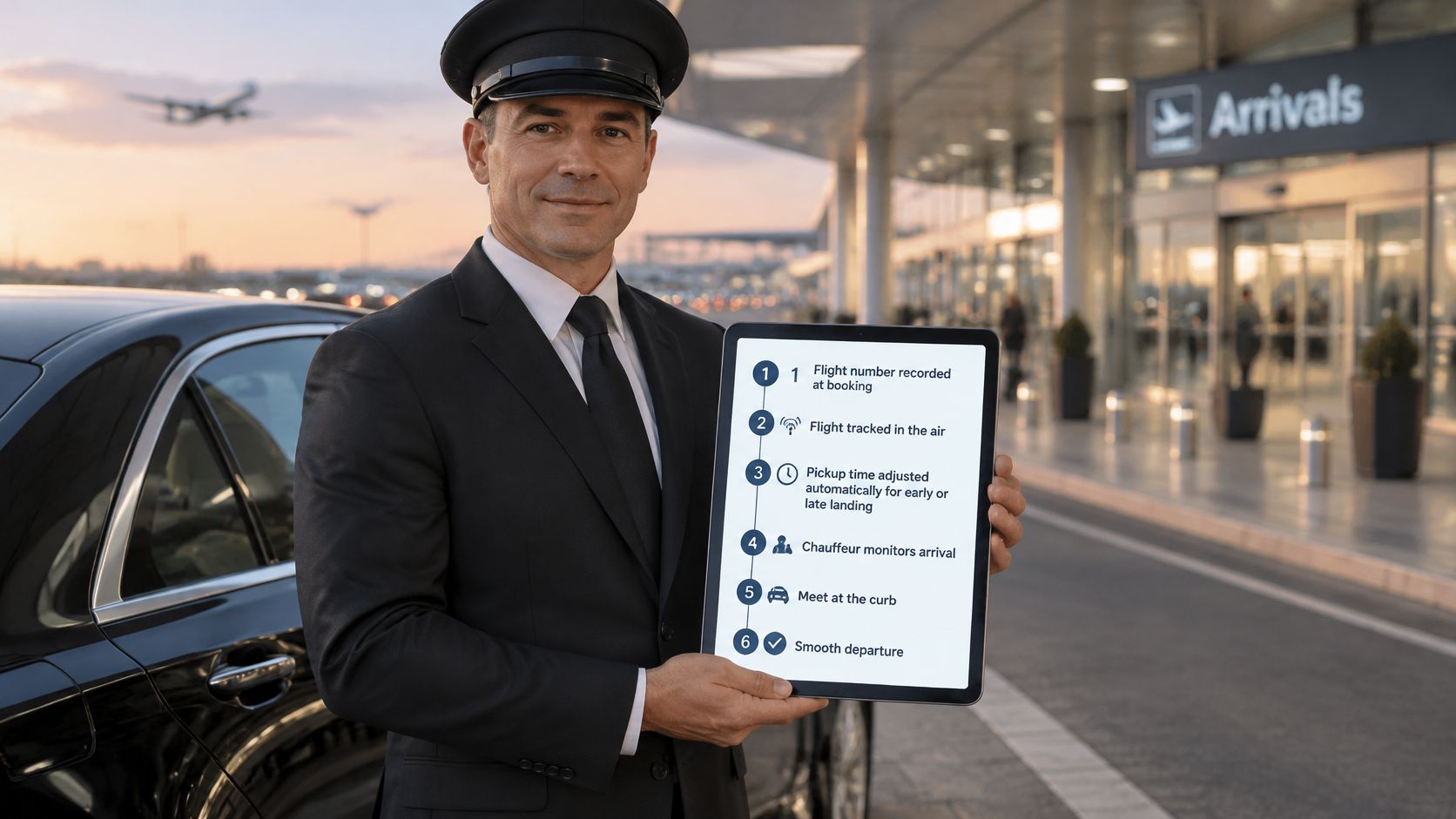
Six steps from gate to curb
- Flight number recorded at booking. The airline, flight number and arrival date go into the reservation, not just the airport and the hour.
- Flight tracked in the air. Someone watches the actual arrival time, not the schedule printed on the itinerary.
- Pickup time adjusted automatically. Our flights are monitored in real time, and pickup times adjust for delays or early landings without the client needing to call.
- Chauffeur curbside as the aircraft arrives. Chauffeurs wait curbside for clients who land late at night, when the terminal has fewer people and fewer options.
- Bags loaded and vehicle identified before the walk out. You should know the car, the color and the meeting point before you push the trolley through the doors.
- Drive east. The two-hour run is the easy part once the first five steps are handled properly.
The access chain matters more than most travelers expect. A Virginia Transportation Research Council review of six airports found average ground trips to the terminal ranged from 28 minutes to 1 hour 32 minutes, and flight time represented only 52% of total destination-airport travel time, according to the review. Airports with off-site facilities averaged 74 minutes of ground travel versus 38 minutes at airports without them.
Watching a pickup handled end to end makes the sequence clearer, especially the gap between landing and curbside.
The two details nobody asks about until they are outside
The details that decide the experience are practical: whether the meet is curbside or inside the terminal, how the car is identified, who handles the luggage, and what happens when immigration takes an hour. At MacArthur the walk from curb to car is short. At JFK international arrivals it can take the better part of an hour. The person standing there at 1 am matters more than the vehicle class.
Put two things in writing before you pay. First, the grace period after landing. Second, whether waiting beyond that grace period is billed, and at what interval. Real-time flight tracking and a stated pickup buffer are the two operational promises worth checking, because they decide who absorbs a two-hour delay.
Put two numbers in writing before you pay. The grace period after landing, and whether waiting beyond it is billed by the hour or not at all.
Accessibility Across the Whole Transfer
A transfer can clear every check on paper and still fail the passenger who needed it most. The sedan is on time, the price holds, the driver waits at the curb, and the trip still breaks because the folded walker does not fit the trunk. An airport's accessibility rating describes the building alone. It says nothing about the vehicle, the curb, or the last two hours east.
The gap shows up in the data. The UK Civil Aviation Authority's accessibility publication reports that 58% of disabled consumers in its 2025 survey had difficulty accessing or using airports and flying, with walking, standing and carrying luggage among the most common needs. The same publication cites Canadian accessibility data recording passenger complaints rising from 67 in 2019 to 2020 to 433 in 2024 to 2025, with mobility aids and assistance among the issue categories.
Four questions to ask before you book
- Does assistance run from curb to door? Ask whether the driver helps with bags and the walk, or whether help stops at the terminal entrance.
- Will the vehicle take a folding mobility aid? Give dimensions and weight at booking, because a sedan trunk and a Sprinter hold different things.
- What happens if airport assistance is late? The plan needs a fallback for the days the airport runs behind.
- How does the driver communicate about a non-visible need? Agree on a text, a phone call, a named meeting point or a companion's number in advance.
When one booking covers a child seat and a passenger travelling with a mobility aid, both needs go in the reservation so the provider can confirm a suitable vehicle. The seat is the easy part: an airport car service with car seats supplies one on request. The harder check is whether the same vehicle still fits the folded aid, the luggage and the child.
My rule for this comparison is one sentence long: judge the transfer leg on its own. A terminal that handles wheelchairs well says nothing about the car at the curb, or whether anyone helps with the bags on a midnight arrival.
Matching the Transfer to Your Group and Arrival Time
A workable transfer matches the people, luggage and landing time, not just the airport. The same JFK arrival can call for a sedan, an SUV, a Sprinter or a coach depending on who is waiting at baggage claim and how much needs to fit in the vehicle.
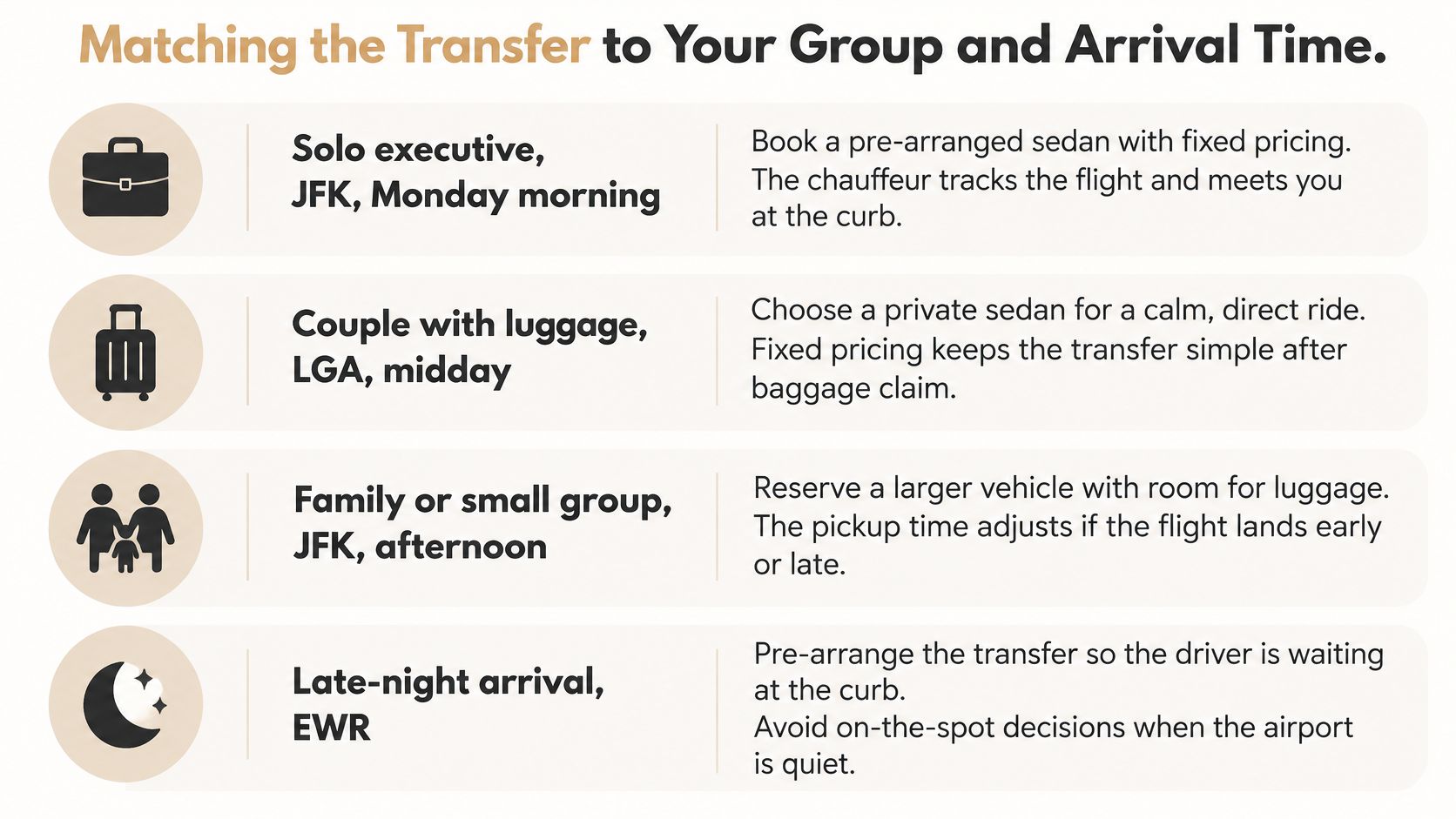
Match the trip you are actually taking
- Solo executive, JFK, Monday morning. Book a pre-arranged sedan with fixed pricing. The flight is tracked, the car is at the curb, and the roughly two-hour ride east becomes work time or sleep.
- Family of five, MacArthur, afternoon. Choose a premium SUV or a Sprinter and request car seats at booking. Four bags and two children require a different plan from one traveler with a carry-on.
- Group of ten to fourteen for a wedding weekend. Use one Sprinter or coach, one coordination point and one bill. Multiple rideshares split the group and can produce separate arrival times at the venue.
- Late-night arrival with delay risk. Choose the option with flight monitoring and a stated grace period. Pickup times should adjust automatically for delays or early landings without the passenger needing to call.
- Multi-day stay that needs a car anyway. An airport rental can beat a round trip, provided you count the counter line and village parking rather than just the daily rate.
- Traveler with a mobility aid or non-visible need. Size the vehicle for the full load, including folded equipment, companions and bags. A solo passenger count can still point to an SUV rather than a sedan.
Count the whole journey
Replace fare shopping with a count. Start with passengers and bags, then check vehicle occupancy, tolls, waiting exposure, cancellation terms and carbon per passenger. A group of ten in one vehicle produces a different total and a different emissions profile from three separate app rides.
Airport ground access is a material emissions source. Heathrow reported 533,742 tonnes of surface-access carbon emissions in 2025, a 29% reduction from its 2019 baseline, according to Heathrow's travel report. A shared pre-arranged vehicle can improve coordination and reduce the number of airport runs, but emissions should be weighed alongside luggage capacity, assistance and arrival time.
Run the comparison under your actual arrival time, group size and luggage load. A universal ranking of transfer types is a thought experiment, not a booking decision.
Book the Option That Holds Its Price and Waits
Text (631) 294-0747 for a quote, and send the flight number and destination address in the same message. That one text is the difference between a price you can plan around and a number that gets recalculated at the curb.
For the most common arrival, a peak-season landing at JFK, Newark or LaGuardia with luggage, children or a group, the verdict is a pre-arranged black car with fixed pricing, no surge and flight monitoring. Airport transfers provide door-to-door service to JFK, LaGuardia, MacArthur and Newark with real-time flight tracking. Airport service from anywhere on Long Island to or from JFK is charged at fixed rates, and clients can save up to 40% compared to rideshare services during peak Hamptons season.
The verdict by arrival type
A solo daytime arrival at MacArthur with a carry-on is close to a toss-up between a pre-booked car and a rideshare, decided by how likely the flight is to run late. Eight or more passengers point to one Sprinter or coach. A private flight into FOK, East Hampton or Montauk points to a car timed to the tail number, not to a terminal clock. Late-night arrivals at any airport point to the option that waits.
Have three details ready before you text: the flight number, the passenger and bag count, and the exact street address. "Southampton" is a town, not a pickup point, and a villa down a narrow lane changes the last ten minutes of the drive.
Hamptons Leisure Limo runs pre-arranged airport transfers across JFK, LaGuardia, Newark, MacArthur and the private East End fields, with fixed pricing, no surge and flight monitoring from landing to drop-off. If you're planning a Hamptons run in 2026, text (631) 294-0747 with your flight number and address for a quote, then visit Hamptons Leisure Limo to see the fleet and plan the rest of the trip.
Ready to Ride with Hamptons Leisure Limo?
Fixed pricing. No surge fees. 30 years of experience serving the Hamptons. Text us what you need and we will send a quote.