Are Car Service Plans Worth It for Hamptons Travel
Updated September 23, 2026

You're heading to the city, or back out east, and the same question keeps coming up at the curb, in the office, and at the kitchen table. Do you pay each time you need a ride, or do you lock in a plan and stop thinking about it?
For Hamptons travel, that question is sharper than it looks. Peak-season demand, airport timing, corporate billing, and the cost of waiting for a ride all change the answer. The right move depends on how often you travel, how predictable your routes are, and whether you value fixed pricing, no surge, and a single point of coordination more than flexibility.
| Option | Best for | Main advantage | Main drawback |
|---|---|---|---|
| Service plan or package | Frequent commuters, corporate accounts, repeat airport travel | Budget certainty and easier coordination | Can include terms you won't fully use |
| Pay per ride black car | Irregular travelers and mixed schedules | You only pay when you book | No built-in commitment or bundled structure |
| Ride share | Last-minute local trips | Easy to open an app and go | Availability and pricing can vary at the worst times |
If you're trying to answer are car service plans worth it, stop thinking in slogans. Think in routes, frequency, and control.
Table of Contents
- Introduction Are Car Service Plans Worth It Right Now
- What Car Service Plans Actually Cover
- Detailed Comparison of Plans Versus Pay Per Ride and Ride Share
- Break Even Scenarios and When the Math Works
- Real World Use Cases for Hamptons Commuters and Corporate Travel
- Hidden Risks Exclusions and Cancellation Terms to Check
- Recommendation and Decision Checklist for Enrolling
Introduction Are Car Service Plans Worth It Right Now
A week in the Hamptons answers the question fast. One client leaves Southampton for Manhattan twice before Friday, then needs a late JFK pickup after a delay. Another books one airport transfer a month and wants a clean car, a fair quote, and no surprises. Those clients need different transportation setups.
Prepaid maintenance plans follow the same logic on the auto side. Routine service still carries real cost pressure, with ConsumerAffairs reporting in 2024 that the average expected annual maintenance cost for cars on the road was about $900 ConsumerAffairs. A plan only works if the plan price comes in below what you would spend out of pocket, and if the coverage matches your mileage, vehicle type, and actual usage.
Practical rule: If you will not use it often, do not prepay for it just to feel organized.
The same break-even test applies to black car service in the Hamptons and New York City. Frequent commuters, corporate teams, and families with repeat airport runs usually get more value from a pre-arranged model than from booking each ride one by one. They get fixed pricing, no surge, and centralized billing, which matters when the same trips keep repeating.
Occasional travelers usually should pay per ride. They do not need a package sitting unused.
Some plans earn their keep because they remove friction and make recurring travel easier to control. Others are dead weight with a nicer label.
What Car Service Plans Actually Cover
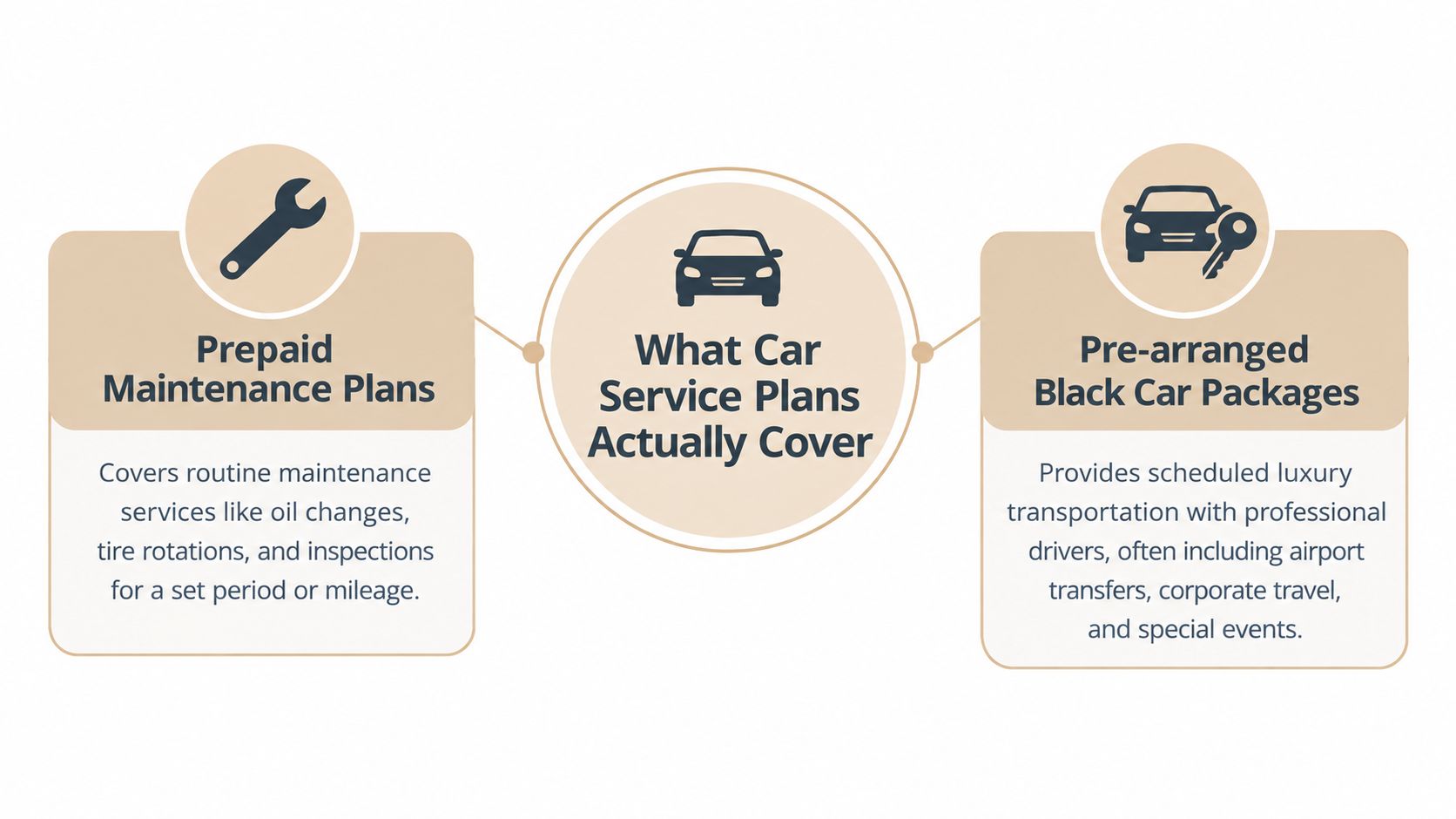
A car service plan can mean two different things, and people mix them up all the time. One version is prepaid maintenance for a vehicle, where scheduled service is bundled ahead of time. The other is a pre-arranged black car package or membership, where repeated rides are bundled with fixed pricing, priority access, and centralized billing.
The maintenance version is about keeping a car serviced on a schedule. The transportation version is about making repeat trips easier to manage. Both promise predictability, but they solve different problems.
Prepaid maintenance plans
These are tied to a specific vehicle and usually cover routine service that would otherwise be paid for one visit at a time. They can help owners budget for expected maintenance, but they're only worthwhile if the bundle is cheaper than paying as you go. They also can't be treated like unlimited protection, because coverage is usually limited by time, mileage, and contract terms.
Pre-arranged black car packages
These are the Hamptons-side equivalent of a bundled travel plan. They usually center on fixed pricing, fewer surprises, priority coordination, and easier billing for repeat routes. They're built for clients who want a steady process, not a fresh negotiation every time they book.
A ride-share app sits outside both categories. It's flexible, but it's also the least controlled option when demand spikes or timing matters. For that reason, it's the wrong benchmark if your real need is dependable service for commuting, flights, events, or corporate coordination.
The fine print matters in both models. Maintenance plans can end by time or mileage, and service packages can be tied to a vehicle, a route pattern, or a specific usage window. If you assume “plan” means unlimited, you'll misread the value immediately.
Detailed Comparison of Plans Versus Pay Per Ride and Ride Share
The cleanest way to judge the options is to compare what you're buying. A plan is about structure. Pay-per-ride is about flexibility. Ride-share is about convenience, but not necessarily consistency.
| Criteria | Service Plan or Package | Pay Per Ride Black Car | Ride Share |
|---|---|---|---|
| Pricing model | Fixed, bundled, or pre-arranged | Quote per trip | App-based and variable |
| Availability | Often built for repeat or priority use | Depends on booking time | Depends on supply |
| Billing | Centralized and easier to track | Separate invoice or card charge per ride | Individual app charges |
| Vehicle consistency | Usually more controlled | Usually consistent when booked | Can vary by tier and market |
| Chauffeur experience | More deliberate and professional | Typically professional black-car service | Mixed |
| Flight tracking and wait handling | Common in pre-arranged service | Often available in premium service | Not always dependable |
| Peak-period predictability | Stronger | Moderate | Weakest |
The big difference is not luxury. It's control. A packaged service gives you a repeatable process, and that matters when your calendar is packed and your pickup points keep changing. If you're moving executives, coordinating an event, or managing airport timing, that predictability is worth more than a vague promise of savings.
Bottom line: If your travel is repetitive, the right comparison is not “cheap app ride versus premium car.” It's “uncertain friction versus fixed process.”
Pay-per-ride black car service sits in the middle. It's a good fit when you want professional transportation without committing to a bundle, and it works well for clients who only travel that way a few times a month. If you want to see a fixed-price framework in plain terms, the logic is explained well in this fixed-price overview.
Ride-share is the loosest option. It can work for short, casual trips, but it's the least comfortable choice when you need a clean chain of responsibility, especially after a flight, before a meeting, or during peak Hamptons demand. The minute reliability matters, ride-share stops being the benchmark.
Break Even Scenarios and When the Math Works
The math works when your rides are predictable. It fails when your schedule is scattered, occasional, or hard to forecast.
High frequency beats flexibility
If you run the same Hamptons-to-NYC commute, airport transfer, or client pickup week after week, a plan or package starts to make sense because it turns transportation into a repeatable cost. Fixed pricing also matters here. It keeps you away from surge swings and last-minute pricing spikes that make one-off bookings harder to manage. What you are buying is the removal of guesswork, and that only pays off if the guesswork was costing you real time or money.
Consumer Reports has warned that some prepaid plans cost more than paying out of pocket, so savings are never automatic. The same rule applies to black car travel. A package only wins when the price matches your actual riding pattern better than single bookings do.
Low frequency usually loses
If you only travel now and then, prepaid value gets thin fast. You end up paying for unused coverage, whether that is service visits or ride credits. Occasional travelers often buy convenience, but the seller gets the margin unless the plan fits their usage closely.
If your schedule changes every week, do not force a package to do a flexible job.
Break-even comes down to consistency. Repeated routes, routine airport transfers, and steady commuting make the arithmetic work. One-off errands, short stays, and variable schedules do not.
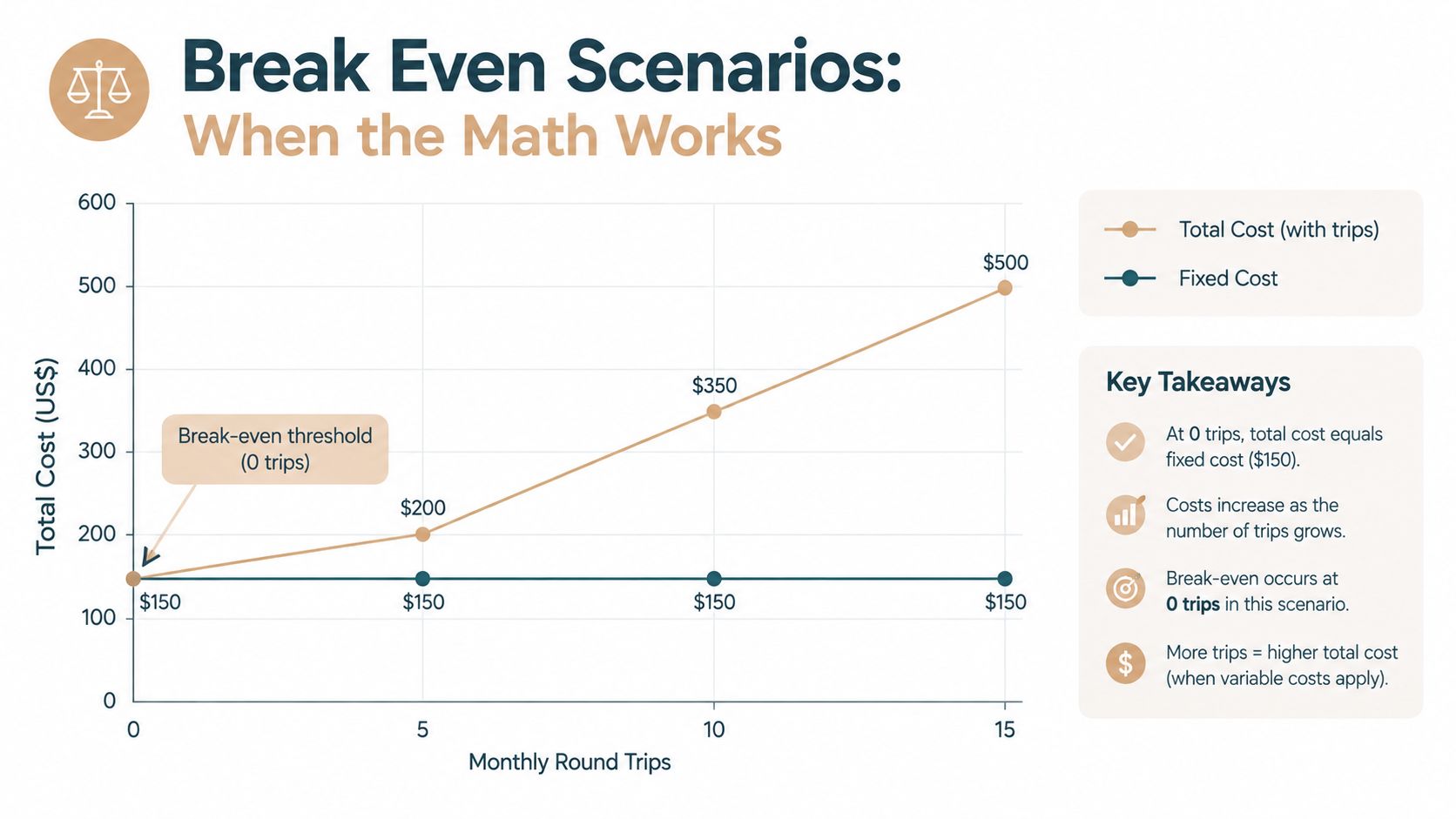
When you compare transportation instead of maintenance, read the pattern the same way you would read an estimate. If you are booking the same route often enough that billing and scheduling become a burden, a package starts earning its keep. If you are not, keep the flexibility and pay per ride.
For a practical view of how usage changes the math, the car service cost guide gives a clear framework without forcing a one-size-fits-all answer.
Real World Use Cases for Hamptons Commuters and Corporate Travel
Frequent Hamptons commuters are the easiest clients to evaluate. They want consistency, clean handoff, and no drama. When the same person is moving between the East End and New York City week after week, a pre-arranged model beats reinventing the booking process every time.
Corporate travel changes the question
Corporate teams care about billing as much as ride quality. Centralized coordination matters when there are multiple pickups, multiple passengers, or a schedule that changes midday. A package or managed service lets the office keep the process in one place instead of chasing separate confirmations.
That matters even more for group movement. If one person is landing at JFK while another is leaving Sag Harbor for a meeting, the value is in the coordination, not the vehicle alone. The right setup keeps the handoff clean and the record easier to manage.
Airport transfers and events need tighter control
Flight tracking is where pre-arranged service separates itself from casual booking. Delays happen. Gate changes happen. A good black car arrangement reduces the stress because the pickup is tied to the flight, not just the clock.
Special events are similar. Weddings, golf outings, and gala nights all work better when the transport is planned as part of the day, not improvised. For those use cases, Hamptons Leisure Limo is one option for clients who want fixed-price black-car coordination, airport transfers, corporate moves, and event transportation in one place.

The point isn't status. It's the discipline of having one contact point, one billing flow, and one standard of service. That's what makes a plan or package worth considering for repeat Hamptons and NYC travel.
Corporate limo service details are most useful when the office needs that coordination without extra back-and-forth.
Hidden Risks Exclusions and Cancellation Terms to Check
People get burned when they buy the headline and ignore the contract. That happens in maintenance plans, vehicle service contracts, and transport packages alike. The promise sounds broad, then the exclusions show up.
Consumer sources warn that these agreements often come with exclusions, difficult cancellation, and claims friction, and the FTC advises consumers to contact the dealer or contract company first, then escalate if needed FTC. That's the right order. Don't start by arguing with a salesperson after the fact. Read the cancellation language before you sign.
The clauses that matter most
A few contract terms decide whether the plan is useful or annoying:
- Exclusions and limits: Check what's covered and what isn't.
- Cancellation terms: Look for the free-look window and refund rules.
- Transfer rules: Verify whether unused coverage follows the vehicle or the owner.
- Claims process: Ask how long approval takes and what paperwork they require.
Most contracts use a short free-look period, commonly 30 to 60 days, and refunds after that are usually prorated rather than full. One manufacturer-backed prepaid maintenance plan states a 30-day full-refund period, extended to 60 days in California, if no benefits have been used Legal Clarity.
Read the cancellation language before you fall in love with the pitch.
Transferability matters too. Prepaid maintenance plans are often tied to the vehicle, and unused coverage may not automatically follow a sale or trade-in. That's a real issue if you expect to change cars soon. If you want the value to stay with you, you need to confirm it in writing.
The safest move is simple. Verify the seller, verify the contract, and verify whether the plan can be canceled cleanly. If they hesitate, walk.
Recommendation and Decision Checklist for Enrolling
Here's the direct answer. Car service plans are worth it when you use them often enough that predictability saves you time, stress, or both. They're not worth it when you'll barely touch the coverage or when the fine print makes the promised value hard to collect.
Use this checklist:
- Choose a plan or package if your trips are frequent, your routes repeat, and you want one billing stream.
- Choose pay per ride if you travel sometimes, prefer flexibility, and don't want to pay for unused coverage.
- Choose ride-share only if you're fine trading consistency for convenience.
- Ask about exclusions first if the contract sounds too broad to be true.
- Demand clarity on cancellation if you're not sure you'll keep the service through the full term.
- Prioritize fixed pricing and no surge if your travel overlaps with peak periods, late flights, or weekend demand.
My take is simple. For Hamptons commuters, corporate clients, and anyone who lives on a repeating airport or city schedule, a structured plan can be smart. For casual travelers, it's usually unnecessary. For anyone who hates surprises, the value is in the process as much as the ride.
Text (631) 294-0747 if you want a fixed-price quote and a straight answer on whether a pre-arranged transportation plan fits your travel pattern.
Hamptons Leisure Limo provides pre-arranged black-car transportation across the Hamptons, Long Island, and New York City with fixed pricing and no surge fees. If you want to compare a repeat-use transportation plan against booking each trip separately, visit Hamptons Leisure Limo and ask for a quote that matches your route, schedule, and billing needs.
Ready to Ride with Hamptons Leisure Limo?
Fixed pricing. No surge fees. 30 years of experience serving the Hamptons. Text us what you need and we will send a quote.